Premises and facilities management
Waste transfer note: what must be on it, who signs it, and how long to keep it
A waste transfer note is the written record, signed by the business handing over a load of non-hazardous waste and by the person taking it, that describes the waste and must be kept by each of them for at least two years under regulation 35 of the Waste (England and Wales) Regulations 2011.
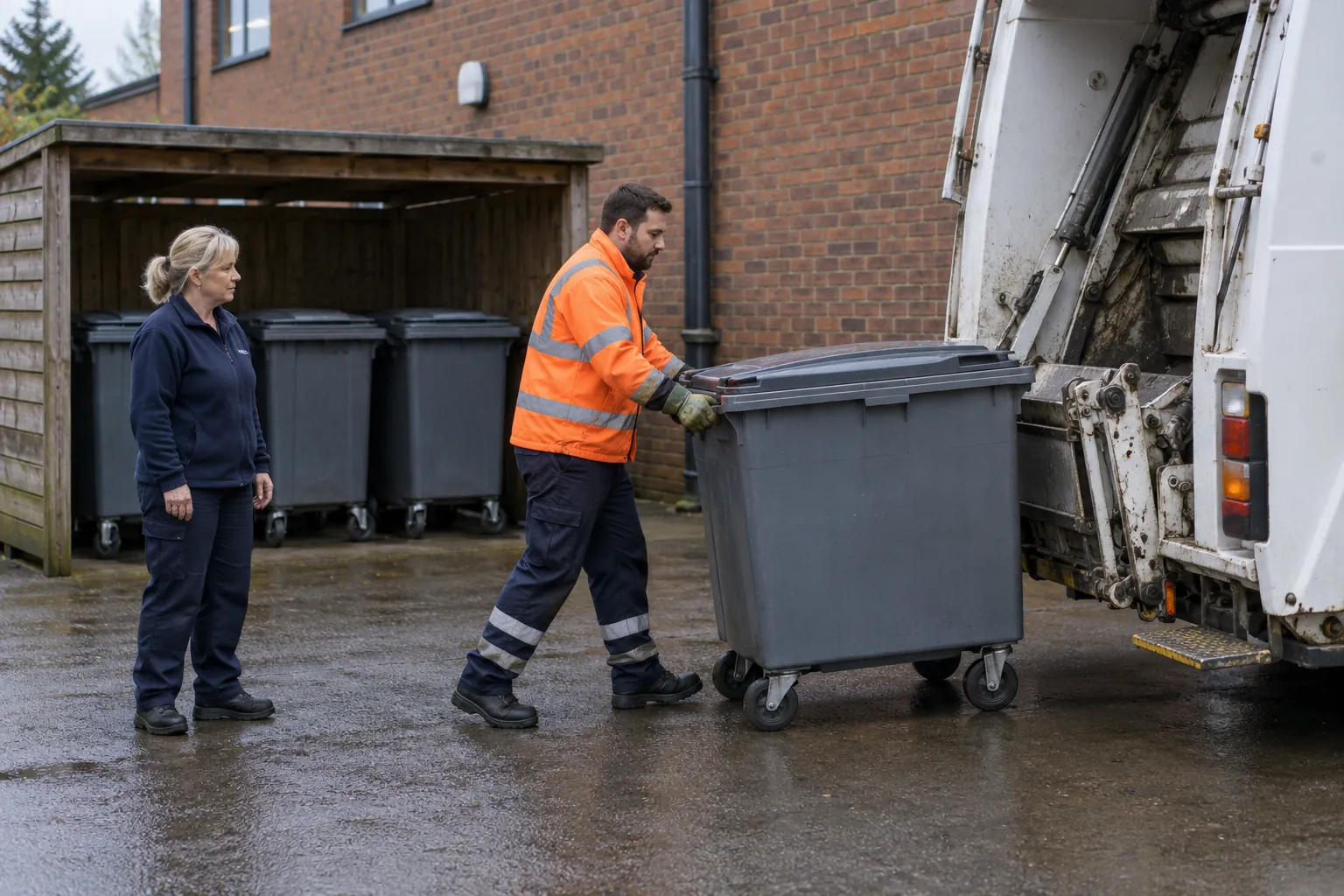
It is how a business shows it has met the waste duty of care in section 34 of the Environmental Protection Act 1990, and Scotland and Northern Ireland ask for the same note under their own rules. This guide covers what must be on a waste transfer note, who signs it, when one season ticket will do for a year of collections, how to check the carrier, how long to keep the notes, and what digital waste tracking changes.
01
The waste duty of care, and where the transfer note comes from
The duty is section 34 of the Environmental Protection Act 1990. Anyone who "imports, produces, carries, keeps, treats or disposes of controlled waste" must take all reasonable measures to prevent the waste being handled illegally or escaping from control, and, when it is transferred, to make sure it goes only to an authorised person together with "such a written description of the waste" as will let others handle it lawfully. A householder has only a narrower duty for household waste, to pass it only to an authorised person; an office, shop, school, hospital or charity has the full duty, and its business waste, often called trade waste, must be disposed of legally.
The contents of that description are set by regulation 35 of the Waste (England and Wales) Regulations 2011. It allows the information to be electronic, and says the transferor and the transferee must each keep it, or a copy, "for at least 2 years" and produce it to an officer of the regulator or the waste collection authority on demand within 7 days. The regulation never says "waste transfer note": that is GOV.UK's and the trade's name for the document. GOV.UK's guidance on waste transfer notes puts the rule plainly: "For each load of non-hazardous waste you move off your premises, you need a waste transfer note or a document with the same information, such as an invoice."
The practical detail is in the Waste duty of care code of practice (November 2018), issued under section 34(7) for England and Wales, which a court must take into account where relevant. It warns that failing to comply with the duty of care "is an offence with no upper limit on the courts' power to fine". Failing to produce the documents when asked can also bring a fixed penalty notice under section 34A of the Environmental Protection Act 1990, set at £300 unless an order substitutes another amount.
In Scotland, regulation 3 of the Environmental Protection (Duty of Care) (Scotland) Regulations 2014 requires a transfer note signed by the transferor and the transferee, with names and addresses including postcodes, the date and place of transfer, a description and quantity of the waste, its six-digit European Waste Catalogue code and the transferor's SIC code. In Northern Ireland, regulations 2 and 3 of the Controlled Waste (Duty of Care) Regulations (Northern Ireland) 2002 require a transfer note completed and signed for both the transferor and the transferee, each of whom keeps it for two years from the transfer; NetRegs lists them in its duty of care for waste legislation. NetRegs' What is the duty of care for waste? says that in both you must complete waste transfer notes for all waste you transfer and keep them for at least two years.
02
What must be on a waste transfer note
Regulation 35(2) and section 3.5 of the code set the requirements. A waste transfer note, or any document used in its place, must give:
- a description of the waste, with its List of Wastes code, also called the European Waste Catalogue (EWC) code;
- the quantity, and whether it is loose or in a container, and what type;
- the time and place of the transfer;
- the transferor's SIC code, from the UK Standard Industrial Classification 2007;
- the name and address of the transferor and the transferee, and both signatures;
- the capacity in which each is acting, such as waste producer or registered waste carrier, with their authorisation to act in it, such as a registration or permit number;
- a waste hierarchy declaration: that the transferor has applied the hierarchy in regulation 12 of the Waste (England and Wales) Regulations 2011, which puts prevention first, then preparing for re-use, recycling, other recovery, and disposal last.
The code adds that the description should mention anything a later holder needs to know: whether the waste needs a special container or particular handling, as batteries and waste electrical and electronic equipment (WEEE) do, whether it can be mixed with other wastes, and whether it is dusty, smelly or at risk of leaking. A note that says only "general waste" is weaker evidence than one that says what the waste is and where it came from.
There is no compulsory form. GOV.UK publishes a free Duty of care: waste transfer note template, fillable on screen or printable, with a Welsh-language version, and says you can instead "use alternative documentation with the required information". In practice the note is often the waste contractor's own form or an invoice, acceptable only if every item above is on it. Whoever prints it, the business handing over the waste still fills in its part, signs and keeps a copy.
03
Who fills it in, and when a season ticket will do
The code says "each holder in the waste chain shares the duty of care obligations", and a waste producer is "any person whose activities produce waste": shops, offices, factories, tradespersons such as electricians and builders, and public services such as schools and hospitals. In a non-domestic building that usually means:
- The occupier produces the everyday waste from offices, classrooms, kitchens and washrooms, and signs as transferor when the contractor collects it.
- A landlord or managing agent arranging one collection for a multi-let building should agree in writing who signs the notes and who keeps the copies; paying the invoice does not move anyone's duty.
- A contractor whose work produces waste, such as rubble from a refit, is that waste's producer under the code, so removing and documenting it is normally the contractor's job. If the building's own waste goes into the contractor's skip, it has been transferred and needs a note.
- Cleaning and security teams move bags to the bin store, not off site, but see whether the store is secure.
For regular collections of the same waste by the same carrier, one note can cover up to a year. GOV.UK says a season ticket can cover multiple transfers over up to one year when the current holder, the carrier and the type of waste stay the same, with a schedule listing each transfer's date, time, quantity and site. The code allows several sites served by the same carrier to share one season ticket's schedule, and says to keep a record of collection times and quantities. When the year is up, or the carrier or the waste changes, a new one is needed.
Each stream needs its own description: dry mixed recycling, food, glass and general waste collected separately are separate transfers. NetRegs, the guidance for Scotland and Northern Ireland, classes hygiene waste and sanitary protection as offensive waste, which is non-hazardous; like any non-hazardous waste anywhere in the UK, it needs transfer notes when it leaves the site, so check the washroom services collection is covered too. One-off loads need their own note: a skip for a strip-out, a furniture clearance, confidential paper sent for shredding.
No note is needed for non-hazardous waste when the holder does not change, such as waste moved to other premises of the same business, though the code calls a record of internal transfers best practice. Hazardous waste needs a consignment note even then.
04
Checking the carrier, and keeping waste under control until it goes
A note signed by an unauthorised carrier does not meet the duty. The code says an authorised person is "someone who has a valid registration as a carrier, broker or dealer of waste" or a waste operator with an environmental permit or registered exemption to accept that waste. Ask for evidence, then check it: in England on the Environment Agency's register of waste carriers, brokers and dealers, searchable by name, registration number or postcode; in Wales on Natural Resources Wales' waste carrier register; in Scotland and Northern Ireland through the SEPA and NIEA registers NetRegs links to. An upper tier registration allows a carrier to transport other people's waste; lower tier is mainly for organisations carrying their own. In England an upper tier registration number starts CBDU and a lower tier one starts CBDL.
The duty follows the waste "throughout its complete journey to disposal or recovery". The code says to ask the next holder where the waste is going, check that destination is authorised, and, if you suspect the waste is not being handled properly, ask for evidence that it arrived and was accurately described, and adds: "Record any checks you make as you can use this as evidence that you have met your duty of care." GOV.UK's guide to disposing of business or commercial waste says to report a carrier who disposes of waste illegally to Crimestoppers.
Until it is collected, the waste is the building's to control. Section 3.3 of the code asks for containers that are clearly labelled, suitable and designed to prevent leakage, and access limited to those authorised to handle the waste, which "will help prevent accidents, pests, incidents of vandalism and theft" and stops others adding to it. In practice that is the bin store: lids closed, bins not overflowing, no bags left beside them, the store locked where it can be.
Separation is a legal requirement too. Under Simpler recycling: workplace recycling in England, from 31 March 2025 businesses, charities and public sector organisations must separate dry recyclables (plastic, metal, glass, paper and card) and food waste from non-recyclable waste; micro-firms with fewer than 10 full-time equivalent employees have until 31 March 2027. Wales has its own workplace recycling rules. Each stream that leaves on its own collection is a transfer of its own.

05
How long to keep waste transfer notes, and whether they can be digital
Section 3.6 of the code sets the period for which waste documents must be retained, whether you transferred or received the waste:
- two years for non-hazardous waste transfer notes;
- two years for season tickets and their schedules, which GOV.UK counts from the last transfer;
- three years for hazardous waste consignment notes.
An officer can ask to see them and, under regulation 35(6), they must be produced within 7 days. GOV.UK tells each party to keep a paper or electronic copy and "show it to an enforcement officer from your local council or the Environment Agency if asked". Both businesses keep copies, so the one handing over the waste cannot rely on the waste company's files.
The notes can be digital. Regulation 35(4) allows electronic information that can be produced in "visible and legible documentary form", and regulation 35(5) accepts an electronic signature. Many contractors issue notes through a customer portal; that works if someone at the building can download each one and the copies are stored with the building's own records, where they outlast the contract.
Mandatory digital waste tracking has started for receiving sites. The Environment Agency and Defra's policy paper Developing the digital waste tracking service makes it mandatory for receiving site operators in England and Wales from October 2026 and in Northern Ireland and Scotland from January 2027, and for waste collectors from October 2027. Those phases fall on the sites that receive waste and the firms that collect it, and the paper sets no date for a business that only produces waste, which goes on completing and keeping transfer notes under regulation 35.
06
Where the record fails, and what SiteClara does about it
The notes usually exist somewhere; the trouble is around them. The season ticket ran out last spring and nobody asked for a new one. The refurbishment skip came and went with no note on file. The carrier's registration was checked once, when the contract started. And the duty to stop waste escaping is met, or not, in the bin store: lids left open, bags piled beside the bins after a missed collection, someone else's rubbish tipped in overnight, and nobody can say when the store was last looked at.
SiteClara records the routine checks where they happen. A printed QR poster, with an NFC tag behind it if staff should tap, goes at the bin store, the recycling point or the loading bay. Cleaners, caretakers or security officers scan or tap with their own phone, with no app to install, see the checks due there, such as lids closed, bins not overflowing and the store locked, and mark each one done or explain what stopped them. A photo can be asked for, and the time and the named person are recorded as it happens.
A missed collection, an overflowing bin or dumped waste is reported at that location and goes onto the team's list of jobs until someone closes it, and a supervisor can escalate it to the building manager. The supervisor sees which checks are due, done and missed, records why one was missed, and approves a daily report that goes to nominated management or client contacts the next morning: a dated, named record of how the waste was kept between collections.
07
Questions people ask
Are waste transfer notes a legal requirement?
Yes: when a business passes non-hazardous waste to someone else, regulation 35 of the Waste (England and Wales) Regulations 2011 requires a written description, signed by both parties and kept for at least two years. No particular form is required, and GOV.UK's guidance on waste transfer notes says an invoice with the same information will do. Scotland and Northern Ireland have the same requirement under their own duty of care regulations.
Do waste transfer notes have to be digital?
No: regulation 35 of the Waste (England and Wales) Regulations 2011 allows paper or electronic notes, and accepts an electronic signature. Mandatory digital waste tracking applies first to receiving sites, from October 2026 in England and Wales and January 2027 in Scotland and Northern Ireland, and to waste collectors from October 2027, under Defra and the Environment Agency's policy paper on developing the digital waste tracking service.
Where can I buy waste transfer notes?
You do not need to: GOV.UK publishes a free Duty of care: waste transfer note template, and most waste contractors supply their own notes or a season ticket. Any document with all the required information is acceptable.
How long does a waste transfer note last?
A single waste transfer note covers one transfer, while GOV.UK's guidance on waste transfer notes says a season ticket can cover multiple transfers of non-hazardous waste over a period of up to a year, as long as the holder, the carrier and the type of waste stay the same. Either must then be kept for 2 years, a season ticket and its schedule counted from the last transfer.
08
Further reading, and a list to take away
In England, GOV.UK's guide to disposing of business or commercial waste covers responsibilities, storage and transfer notes, and the Waste duty of care code of practice applies in England and Wales. NetRegs covers Scotland and Northern Ireland.
To check a building's waste compliance, make sure that:
- every collection, for every stream, is covered by a note or a current season ticket and schedule;
- each note has the description and code, quantity, time and place, SIC code, both parties' details, capacities and signatures, and the waste hierarchy declaration;
- season tickets are renewed on time, and one-off loads and hygiene collections have notes of their own;
- hazardous waste moves on consignment notes, kept for three years;
- each carrier's registration is checked on the public register, and the check recorded;
- the bin store is secure and checked between collections;
- notes are kept for two years and can be produced within 7 days.
Sources
Every document this guide quotes or links to, in the order it first cites them.
- Section 34 of the Environmental Protection Act 1990 legislation.gov.uk
- Regulation 35 of the Waste (England and Wales) Regulations 2011 legislation.gov.uk
- Waste transfer notes gov.uk
- Waste duty of care code of practice gov.uk
- Section 34A of the Environmental Protection Act 1990 legislation.gov.uk
- Regulation 3 of the Environmental Protection (Duty of Care) (Scotland) Regulations 2014 legislation.gov.uk
- Controlled Waste (Duty of Care) Regulations (Northern Ireland) 2002 legislation.gov.uk
- Duty of care for waste legislation netregs.org.uk
- What is the duty of care for waste? netregs.org.uk
- Regulation 12 of the Waste (England and Wales) Regulations 2011 legislation.gov.uk
- Duty of care: waste transfer note template gov.uk
- Hazardous waste consignment note gov.uk
- Disposing of hazardous waste gov.uk
- Offensive waste netregs.org.uk
- Register of waste carriers, brokers and dealers environment.data.gov.uk
- Waste carrier register naturalresources.wales
- Disposing of business or commercial waste gov.uk
- Simpler recycling: workplace recycling in England gov.uk
- Workplace recycling gov.wales
- Developing the digital waste tracking service gov.uk
Related guides
 Premises and facilities managementBuilding compliance checklist: the statutory picture for a UK buildingBuilding compliance checklist for UK non-domestic buildings: fire, electrical, gas, water, asbestos, lifts, access and energy, who is responsible, how often.
 Premises and facilities managementPremises manager: what the job involves, and how to run it wellWhat a premises manager does in a college, charity, housing provider or trust: the compliance calendar, contractors, security, budgets and reporting.
 CleaningCOSHH assessment: the five steps, and the checks that keep it trueWhat a COSHH assessment is, the five steps, what to record for cleaning products, how to keep a COSHH register, and the checks that keep the controls working.
 Premises and facilities managementFacilities management contract: what to put in it, and how to make it workWhat goes into a facilities management contract: scope, specifications, payment, KPIs and deductions, TUPE, mobilisation and exit, and the NEC4 standard form.