Security patrols
Elevator entrapment: a procedure for the people who answer the call
An elevator entrapment is when an elevator car stops, through a power failure, a mechanical fault or a safety device, with passengers inside who cannot get out by the normal means.
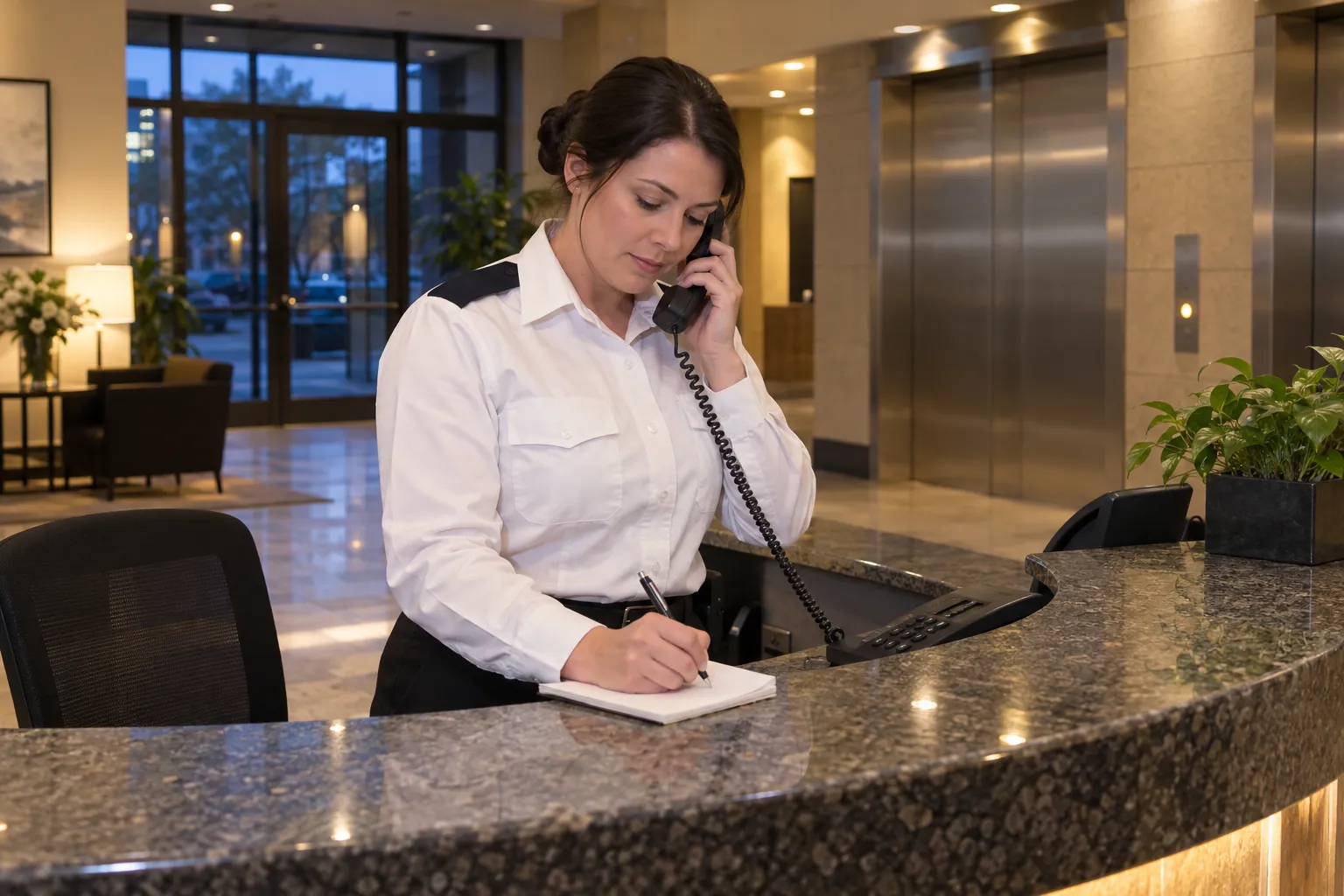
It is usually more frightening than dangerous, and it is usually a security officer, a front desk or a building engineer who hears about it first. This guide sets out a procedure for those people: how the call reaches you, the first minutes, who frees the passengers and who does not, when to call 911, and what to write down afterward.
01
What an elevator entrapment is, and whose procedure it is
An entrapment is a stalled elevator with passengers inside who cannot leave the car by the normal means. The car may have stopped between floors, stopped at a landing with the doors shut, or lost power. Most entrapments end with a mechanic or the fire department releasing the passengers unharmed. The procedure exists so that the wait is as short and calm as it can be, the right people are called in the right order, and nobody makes it worse by trying a rescue they are not trained for.
There is no single federal rule that tells a building's staff what to do when someone is stuck. The duty sits with the owner. Elevators are regulated by the states and some cities, which license the equipment, inspect it and adopt a safety code. In Washington, for example, RCW 70.87.060 makes the owner or the owner's appointed agent responsible for the safe operation and proper maintenance of a conveyance once it has an operating permit, and for the periodic tests the state requires. In Texas, the Texas Department of Licensing and Regulation's elevator FAQ for building owners says the owner must obtain an inspection every 12 months to get a Certificate of Compliance, and must maintain the equipment in compliance with the standards and codes the state has adopted.
The code most jurisdictions adopt is ASME A17.1/CSA B44, Safety Code for Elevators and Escalators, which ASME describes as "the accepted guide throughout North America for the design, construction, installation, operation, inspection, testing, maintenance, alteration, and repair of elevators, escalators and related conveyances." The current edition is 2025, but a building is held to the edition its state or city adopted, with any local amendments, and the authority having jurisdiction decides.
Where the building's workforce is covered by an OSHA standard that requires an emergency action plan, 29 CFR 1910.38, Emergency action plans, says the plan must include "[p]rocedures for reporting a fire or other emergency" and "[p]rocedures to be followed by employees performing rescue or medical duties." An entrapment procedure fits naturally there, and in the security team's post orders, even where no rule demands it.
02
What an entrapment procedure covers
A good procedure fits on one page at the security desk and in the post orders, and it answers these questions for this building:
- Where the call arrives. The emergency phone in each car rings somewhere: the security desk, the front desk, the elevator contractor's monitoring center or a third-party answering service. Staff need to know which, and what that service does next.
- How to identify the car. Which bank, which car number, and how to tell where it has stopped. Label the cars the same way on the procedure as on the equipment and the contractor's records.
- Who to call, in order. The elevator contractor's 24-hour emergency line and the account or unit number they will ask for; the building engineer or chief engineer; the property manager; and 911 for the cases set out below.
- What staff do while waiting. Keep talking to the passengers, keep others away from the car, and meet the mechanic or firefighters at the door.
- What staff never do. Force the doors, open the roof hatch, move the car, or help anyone climb out.
- How the car comes back into service. Only when the mechanic says it is safe, and never on staff's own judgment.
- What gets recorded, by whom. The times, the people, the calls and the cause, as described in the section on the record below.
- After hours. Who answers when the desk is not staffed, and whether the building has anyone on site at night who can reach a trapped passenger.
Keep the numbers on the page itself, not only in someone's cell phone, and check them whenever the maintenance contract changes hands.
03
The first minutes: a step-by-step procedure
When an entrapment is reported, by the in-car phone, by a passenger's cell phone or by someone who hears shouting in the lobby, the person who takes the call works through these steps:
- Talk to the passengers. Tell them who you are, that you know where they are and that help is being called. Ask how many people are in the car, whether anyone is hurt, unwell, pregnant, elderly or has a medical condition, and whether the lights and ventilation are working.
- Identify the car. Confirm the bank, the car number and, if you can, the floor where it has stopped.
- Call the elevator contractor's emergency line. Say it is an entrapment, not just a car out of service, give the unit number and the number of passengers, and write down the reference number and the time they expect to arrive.
- Call 911 if anyone is in danger. See the list below. If in doubt, call.
- Tell the building engineer and the property manager. The engineer may be able to check the power supply or the machine room alarms, but not to release the car.
- Stay in contact. Speak to the passengers every few minutes, tell them what is happening and when help is expected, and ask again how they are.
- Keep the area clear. Stop people using the rest of the bank if the contractor or the fire department asks you to, and keep onlookers away from the landing doors.
- Meet the responders. Have someone at the entrance to take the mechanic or firefighters straight to the car and the machine room, with keys to both.
- Record the release. Note when the passengers were out, how each one was, and whether anyone needed medical help.
The passengers should be told the same thing the city of New York tells elevator riders. The NYC Department of Buildings' elevator safety advice tells people who are stuck to "Ring the alarm," "Relax because help is on the way" and "Wait without prying open the doors," and warns: "Never attempt to exit a stalled elevator without the help of the building management or emergency responder." It also says not to exit the elevator if it stops more than 9 inches from the landing, and to use the stairs in a fire.
04
Who frees the passengers, and who does not
The people who release trapped passengers are the elevator mechanic and, where they are called, firefighters. Opening a hoistway door or moving a car by hand is dangerous: a car that moves unexpectedly, or a passenger who climbs out of a car that is well above or below the landing, can fall into the hoistway. Building staff should never do it unless the building has a written, trained and authorized arrangement with its contractor and the state or city allows it. In Washington, RCW 70.87.230 says that, except as provided in RCW 70.87.270, a person may not perform conveyance work in the state unless they are an elevator mechanic working in one of the arrangements it lists. Other states license the trade in their own ways, so check the rule where the building is.
The other roles are these:
- Security officer or front desk. Takes the call, talks to the passengers, calls the contractor and 911, keeps the area clear, meets the responders and writes the incident report.
- Building engineer or chief engineer. Checks the power supply, the machine room and any alarms the building side can see, keeps the machine room key available, and follows up with the contractor on the cause.
- Property manager. Owns the procedure and the maintenance contract, reviews each entrapment, and talks to tenants and the owner.
- Elevator contractor. Attends, releases the passengers, finds the cause, and decides when the car can go back into service.
- Fire department. Releases passengers when called, and controls the elevators in a fire.
Tall buildings have extra duties around firefighters' use of the elevators. In New York City, Chapter 6 of the 2022 New York City Fire Code, Building Services and Systems, section FC 607, requires elevators in every building 75 feet or more in height to be "kept ready for immediate use by the department during all hours of the night and day including holidays and weekends," with a competent building attendant available to operate them, except in buildings between 75 and 150 feet whose elevators have Phase I emergency recall and Phase II emergency in-car operation. It also requires a Phase I recall test at least monthly on every elevator that has it, and at least a one-floor Phase II test each month. Other cities set their own rules through their adopted fire code; know where the fire service keys are kept and who holds them.
05
The emergency phone, the rounds, and the record
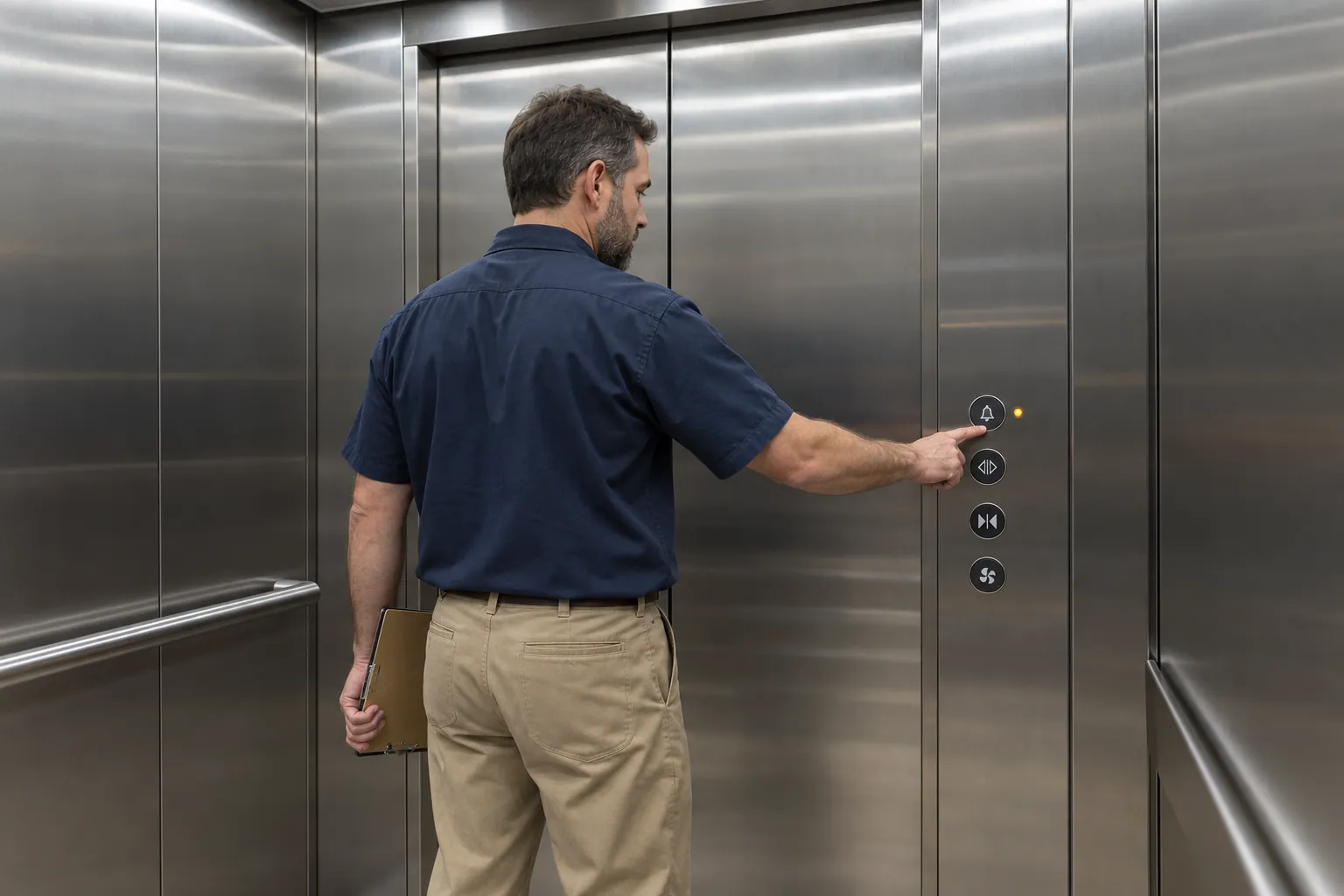
Most of an entrapment procedure depends on one thing working: the emergency phone in the car. The U.S. Access Board's guide to the ADA Standards, Chapter 4: Elevators and Platform Lifts, explains that "The ASME A17.1 code requires a two-way means of emergency communication in elevator cars," activated by a push button marked with a tactile phone symbol and the word "HELP," with a visual signal on the same panel to show that the call has been received. That light matters: a passenger who cannot hear or speak needs to know someone has answered. A regular building-side test that the call is answered, and that the light comes on, catches the line that was cut when the telecom contract changed.
Officers on patrol can add a short elevator check to their rounds without doing anything technical: ride each car, note whether it stops level with each landing, whether the doors reopen when obstructed, whether the car lights and the emergency light work, and whether the certificate or permit is posted where the building shows it. Report what is wrong; leave the fixing to the contractor.
After each entrapment, the record should show:
- the date, the time the alarm was raised and who took the call;
- the car, the bank and where it stopped;
- the number of passengers and whether anyone was hurt or unwell;
- the time the contractor was called, their reference number and their promised arrival;
- the time 911 was called, if it was, and why;
- the times the mechanic or firefighters arrived and the passengers were released;
- the cause as the mechanic gave it, and whether the car was taken out of service;
- when, and on whose word, the car went back into service;
- any follow-up: a complaint, a repair, a repeat on the same car.
Review entrapments together, not one at a time: several on one car is a question for the contractor, and long waits are a question about the contract's response terms.
Some entrapments are also accidents the state must hear about. In Washington, RCW 70.87.190 requires the owner or the owner's authorized agent to promptly notify the department of an accident that needs a physician's services or causes a disability of more than one day. Where a part of the conveyance has failed, the conveyance may not be used again until it has been made safe, reinspected and a permit issued, and damaged parts may not be removed from the premises without the department's permission. Other states have their own reporting rules; the state elevator program will tell you what applies.
06
Where the record fails, and where SiteClara fits
The entrapment itself usually gets written down. The trouble is everything around it. The daily activity report says "Car 2 stuck, mechanic called" with no release time. The emergency phone test that was meant to happen every week is assumed rather than recorded. A porter notices on Tuesday that a car is stopping an inch above the third-floor landing, mentions it to whoever is passing, and nobody tells the engineer before the car stalls on Thursday.
SiteClara is a way to record the routine part. A printed QR poster, with an optional NFC tag behind it, goes where a check is due: an elevator lobby, the machine room door, the security desk. The officer or engineer scans the code or taps the tag on their own phone, with no app to install, sees the checks due there, such as the emergency phone call-out or the ride check, and marks each one done or says what stopped them. The time and the named person are recorded as it happens, with a photo when one helps. A problem found on the round, such as a car not leveling or a dead acknowledgment light, is reported there and goes onto the team's list of jobs until someone closes it.
The supervisor sees what was due, done and missed, with the reason where one was given, and a job that needs the building manager can be escalated to them to answer. Each day the supervisor reviews the totals and photos, adds a note and approves a report that goes to designated management or client contacts at 8 a.m. the next morning, showing what was reported, what is still open and how the scheduled checks went.
07
Questions people ask
What to do if you are trapped in an elevator?
Ring the alarm or use the emergency phone, then stay in the car and wait. The NYC Department of Buildings' elevator safety advice sums it up as "Ring the alarm. Relax because help is on the way. Wait without prying open the doors," and tells passengers to "Move to the rear center of the elevator and face the doors while waiting for help." It adds: "Never attempt to exit a stalled elevator without the help of the building management or emergency responder." Its 2016 release DOB Launches 'Stay Safe. Stay Put.' Campaign for Elevator Safety puts it plainly: "if you're stuck in an elevator, the safest place to be is inside the car."
What is the 3/4 rule for elevators?
It usually refers to a clearance limit for elevators in private homes, not to entrapment in a commercial building. Florida's Section 399.031, Florida Statutes, Clearance requirements between elevator doors for elevators inside a private residence, says "The distance between the hoistway face of the hoistway doors and the hoistway edge of the landing sill may not exceed 3/4 inch for swinging doors," with a larger limit for sliding doors. The reason is a child caught between the doors: the Consumer Product Safety Commission's 2022 release on the child entrapment hazard in residential elevators warns that "Young children can become entrapped in the space between the exterior landing (hoistway) door and the interior elevator car door or gate if there is a hazardous gap," and tells owners to "Make sure that the gap between doors is no more than four inches deep."
08
Where to read more, and a list to take away
ASME publishes A17.1/CSA B44, Safety Code for Elevators and Escalators; ask your contractor or state elevator program which edition your building is held to. OSHA's 29 CFR 1910.38 sets the minimum contents of an emergency action plan where one is required. The Access Board's guide to elevators and platform lifts explains the emergency communication requirements. Your state or city elevator program sets the owner's inspection and reporting duties.
Before the next entrapment, check that:
- everyone who staffs the desk knows where the in-car emergency phone rings, day and night;
- the contractor's 24-hour number and the unit numbers are on the procedure, and still correct;
- the procedure says when to call 911, and says it plainly;
- staff know never to force doors, move a car or help anyone climb out;
- someone can meet the mechanic or firefighters with the machine room key;
- the emergency phones are tested from the building side and the tests are recorded;
- patrol rounds include a simple ride check, with faults reported to the engineer;
- every entrapment is recorded with times, the cause and the return to service;
- repeat entrapments on one car are raised with the contractor and the owner;
- you know your state's rule for reporting an elevator accident.
Sources
Every document this guide quotes or links to, in the order it first cites them.
- RCW 70.87.060 app.leg.wa.gov
- Texas Department of Licensing and Regulation's elevator FAQ for building owners tdlr.texas.gov
- ASME A17.1/CSA B44, Safety Code for Elevators and Escalators asme.org
- 29 CFR 1910.38, Emergency action plans osha.gov
- NYC Department of Buildings' elevator safety advice nyc.gov
- RCW 70.87.230 app.leg.wa.gov
- Chapter 6 of the 2022 New York City Fire Code, Building Services and Systems up.codes
- U.S. Access Board's guide to the ADA Standards, Chapter 4: Elevators and Platform Lifts access-board.gov
- RCW 70.87.190 app.leg.wa.gov
- DOB Launches 'Stay Safe. Stay Put.' Campaign for Elevator Safety nyc.gov
- Section 399.031, Florida Statutes, Clearance requirements between elevator doors for elevators inside a private residence leg.state.fl.us
- Release on the child entrapment hazard in residential elevators cpsc.gov
Related guides
 Security patrolsSecurity post orders: what they should say, and how to know they are followedSecurity post orders in the US: what they are, what state rules say, what to include, how to write, sign and review them, and how to check they are followed.
 Security patrolsSecurity incident report: what to write, and how to make it hold upHow a US security officer writes an incident report: what to include, state rules on report writing and reporting to regulators, and how to make it hold up later.
 Fire and water checksEmergency action plan: what OSHA requires, and how to keep the plan workingWhat an emergency action plan must contain under OSHA 1910.38, who needs one, how alarms, wardens, drills and reviews fit in, and what the record should show.
 Security patrolsSecurity daily activity report: what to include, and how to write one that holds upThe security daily activity report (DAR): what to record, how to write entries that hold up, how it differs from an incident report, and how to review and keep it.