Security patrols
Parking patrol: enforcing a private lot, and keeping a record that holds up
A parking patrol is the regular monitoring and enforcement of parking rules, and on a private lot or garage it is a security officer walking or driving the property to keep fire lanes and accessible spaces clear, deal with vehicles that should not be there, and spot the dark light, the open gate and the car with a smashed window.
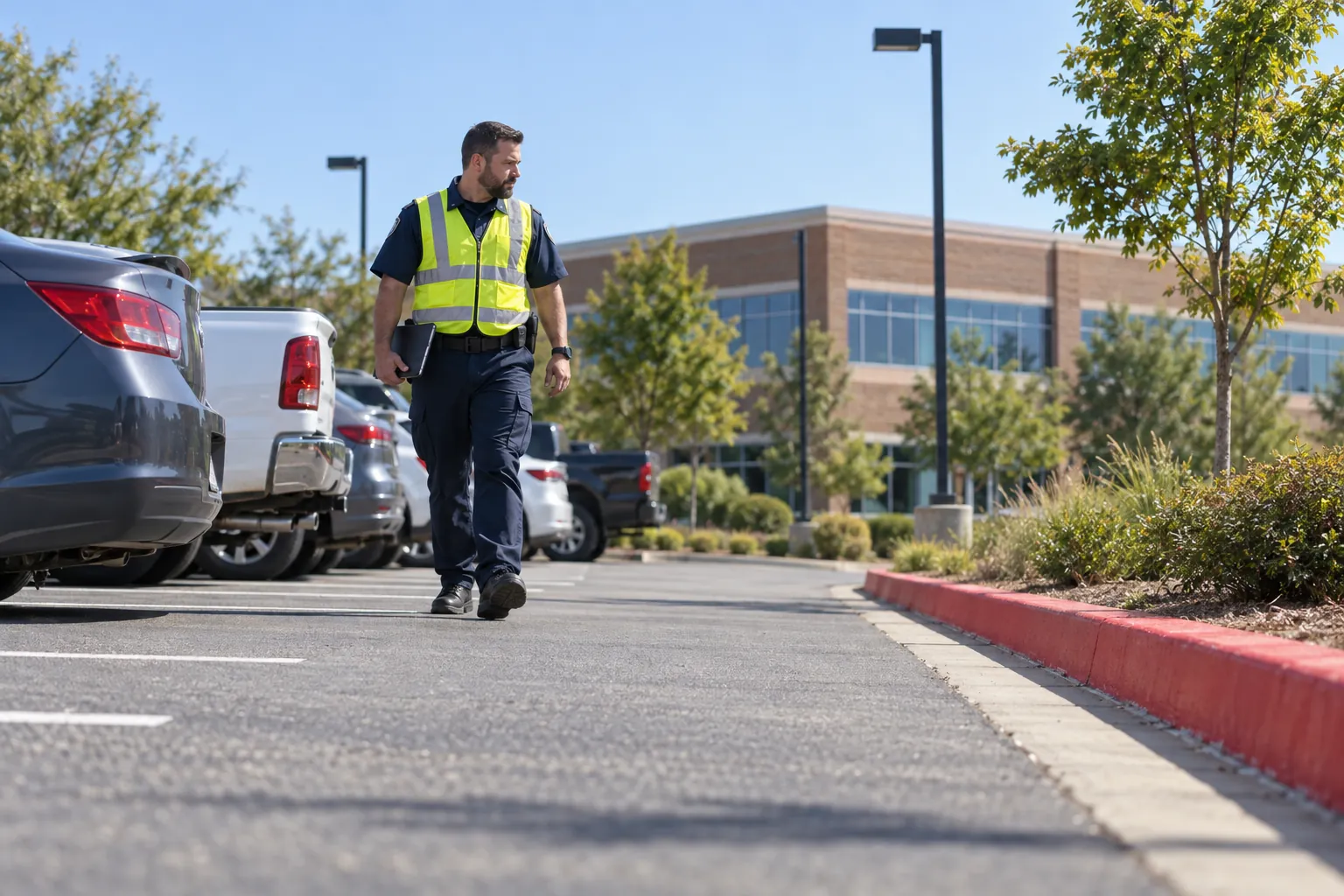
In the United States it is state law, and often city law, that decides when an unauthorized vehicle may be towed and who must authorize it. This guide covers what those laws ask of an owner, what a patrol checks, how the tow decision is made, and what a good record looks like.
01
What a parking patrol is, and the state towing laws behind it
On public streets, city parking enforcement officers enforce meters, time limits and permit zones under local parking regulations, and the citations they issue are paid or contested with the city. On private property, parking enforcement is the owner's job, not the city's. An office park, apartment complex, shopping center, hospital or campus sets its own parking rules for residents, tenants, staff and visitors, and a security officer on parking patrol enforces them for the owner: warning, recording and, where the rules and the law allow, having a vehicle towed. A warning or violation notice a security officer leaves on a windshield is the owner's notice, not a city parking citation.
There is no federal law on towing from a private lot. Each state sets the conditions, usually in its vehicle, transportation or occupations code, and many cities add their own ordinances on signs, permits and fees. Three large states show how much the rules differ.
In Texas, the Texas Towing and Booting Act, Occupations Code Chapter 2308 lets a parking facility owner have an unauthorized vehicle removed at the vehicle owner's expense if compliant signs "are located on the parking facility at the time of towing and for the preceding 24 hours," or if the driver received actual notice, or if the owner gave written notice on the windshield followed by certified mail. Section 2308.251 separately forbids leaving a vehicle in a traffic aisle, entry or exit, in a marked fire lane, in an accessible space without the plates or placard, or leaking a hazardous fluid. A parking facility owner who violates the chapter is liable for the damages and the fees under Section 2308.404, and a violation is also a criminal offense under Section 2308.405.
In California, Vehicle Code Section 22658 lets the owner or person in lawful possession of private property, including a common interest development's association, cause a vehicle's removal where, among other circumstances, a sign "not less than 17 inches by 22 inches in size, with lettering not less than one inch in height" is displayed "in plain view at all entrances to the property." The owner must tell the local traffic law enforcement agency "within one hour after authorizing the tow."
In Florida, Florida Statutes, Section 715.07 lets the owner or lessee, "or any person authorized by the owner or lessee," have a vehicle parked without permission removed by a towing business, subject to "substantial compliance" with a list of conditions: where the vehicle is stored, how quickly the towing company must tell police, and, for most property, a posted tow-away notice at every driveway.
02
What a parking patrol covers in practice
A typical round covers:
- Fire lanes and hydrants: kept clear at all times. Texas requires fire lane curbs, where no government regulation applies, to be painted red and marked "FIRE LANE--TOW AWAY ZONE" in white letters at least three inches tall at intervals of no more than 50 feet (Section 2308.251(c)). Elsewhere the locally adopted fire code and the fire marshal set the marking.
- Accessible parking: spaces and access aisles free of vehicles without a plate or placard, signs in place and readable, and aisle markings visible. The 2010 ADA Standards for Accessible Design require access aisles to be "marked so as to discourage parking in them" (502.3.3) and identification signs to be mounted at least 60 inches above the ground to the bottom of the sign (502.6).
- Aisles, entrances and exits: nothing blocking them.
- Reserved, permit and time-limited spaces: visitor, customer, resident, tenant and staff spaces used as the rules say.
- Abandoned and inoperable vehicles: flat tires, missing parts, expired registration. States set their own waiting periods: California, for example, allows removal 96 hours after a notice of parking violation, or 24 hours after telling the police about a vehicle missing a major part (Vehicle Code 22658(a)(2) and (a)(3)).
- Signs: every tow-away sign present, upright, readable and matching the statute, because a missing sign can make a tow unlawful.
- Lighting: fixtures out or flickering, dark stairwells, elevator lobbies and pedestrian routes.
- Garage equipment: barrier arms, roll-down gates, emergency call stations, stairwell doors and exit signs.
- Hazards: oil and fluid leaks, potholes, ice, debris, damaged wheel stops and trip hazards on walkways.
- Crime and suspicious activity: broken vehicle windows, people trying door handles, loitering in stairwells.
Keeping accessible features working is itself a duty. Under the Department of Justice's ADA Title III regulation, 28 CFR 36.211 (maintenance of accessible features), a public accommodation "shall maintain in operable working condition" the features required to be accessible, allowing only "isolated or temporary interruptions in service or access due to maintenance or repairs."
03
Who authorizes a tow, and what the statutes ask for
The single most important line in the post orders is who may authorize a tow. The statutes put the decision with the owner, or someone acting for the owner, and several are strict about how that is done.
- California: under Vehicle Code 22658(l), a towing company "shall not remove or commence the removal of a vehicle from private property without first obtaining the written authorization from the property owner or lessee," including an association, "or an employee or agent thereof, who shall be present at the time of removal and verify the alleged violation." The authorization must include the vehicle's make, model, VIN and plate; the name, signature, job title, address and phone number of the person authorizing; the grounds for removal; "the time when the vehicle was first observed parked"; and the time authorization was given. General authorization at the towing company's discretion may not be delegated except for a vehicle within 15 feet of a fire hydrant, in a fire lane, or interfering with an entrance or exit, and then only under a written agreement.
- Texas: under Occupations Code 2308.255, a towing company may tow from a parking facility only if the owner "requests that the towing company tow and store the specific vehicle" or "has a standing written agreement with the towing company to enforce parking restrictions in the parking facility," and, in most cases, only after written verification from the owner that the required signs are posted or notice was given. The exceptions include a vehicle left in violation of Section 2308.251 or blocking a paved driveway, where the owner must instead, on request, tell the vehicle owner which towing company and storage facility are used. Section 2308.402 bars a towing company from giving anything of value to a parking facility owner in connection with a removal.
- Florida: Section 715.07 requires the tow-away notice to be "prominently placed at each driveway access or curb cut" within 10 feet of the road, in letters at least 2 inches high, light-reflective and on a contrasting background, with "tow-away zone" in letters at least 4 inches high, mounted 3 to 6 feet above ground and "continuously maintained on the property for not fewer than 24 hours" before any tow. It also provides that "a person may not pay or accept money or other valuable consideration for the privilege of towing or removing vehicles" from a particular location.
Signs are specified closely too. Texas, for example, requires each sign to be at least 18 inches wide and 24 inches tall, mounted with its bottom edge between five and eight feet above ground, facing drivers at each entrance, and to carry the international towing symbol, who may park, the days and hours of enforcement, and a number answered 24 hours a day (Sections 2308.301 and 2308.302).
For a contract security company, the practical rules follow from this:
- Get the owner's decision on who authorizes a tow in writing: in the security services contract and in the post orders for the site. If an officer may authorize, say so, and say for which violations.
- Where the owner keeps that decision, the officer's job is to document the violation and call the named person, not to call the tow truck.
- Never let the towing company decide on its own which vehicles go, beyond what the state allows.
- Keep the security company and the owner out of any payment from the towing company. Texas bars a towing company from giving anything of value to a parking facility owner in connection with a removal, and Florida bars anyone from paying or accepting money for the privilege of towing from a particular location.
04
Running the patrol: routes, timing and post orders
Patrol frequency follows the site's risk and the client's contract: a retail lot while the stores are open, an apartment complex after dark, a hospital garage around the clock.
Vary the timing. The ASU Center for Problem-Oriented Policing guide Thefts of and From Cars in Parking Facilities notes that "very little research has been done on the value of dedicated patrols," but reports two studies that support them, including a coordinated effort in Portland, Oregon, where a bike unit "was trained to patrol in unpredictable patterns, and to make social contact with people using the parking facilities." The same guide points to poor lighting, blind spots and "ill-tended shrubbery" as conditions that make lots easier to steal from, which is why the lot's condition belongs on the round.
The post orders for a parking post should cover at least:
- The rules being enforced: who may park where, when, and with what permit or pass.
- The route and the checkpoints, including each garage level, stairwell and entrance sign.
- What the officer does for each kind of violation: warn, record, call the authorized person, or call for a tow where the officer is authorized.
- The towing company, the agreement in place, and who at the client authorizes a tow.
- When police are called, including the local notification the state requires after a tow.
- How to deal with a driver who returns while the vehicle is being hooked up. California and Florida both have rules on releasing a vehicle that has not yet left the property.
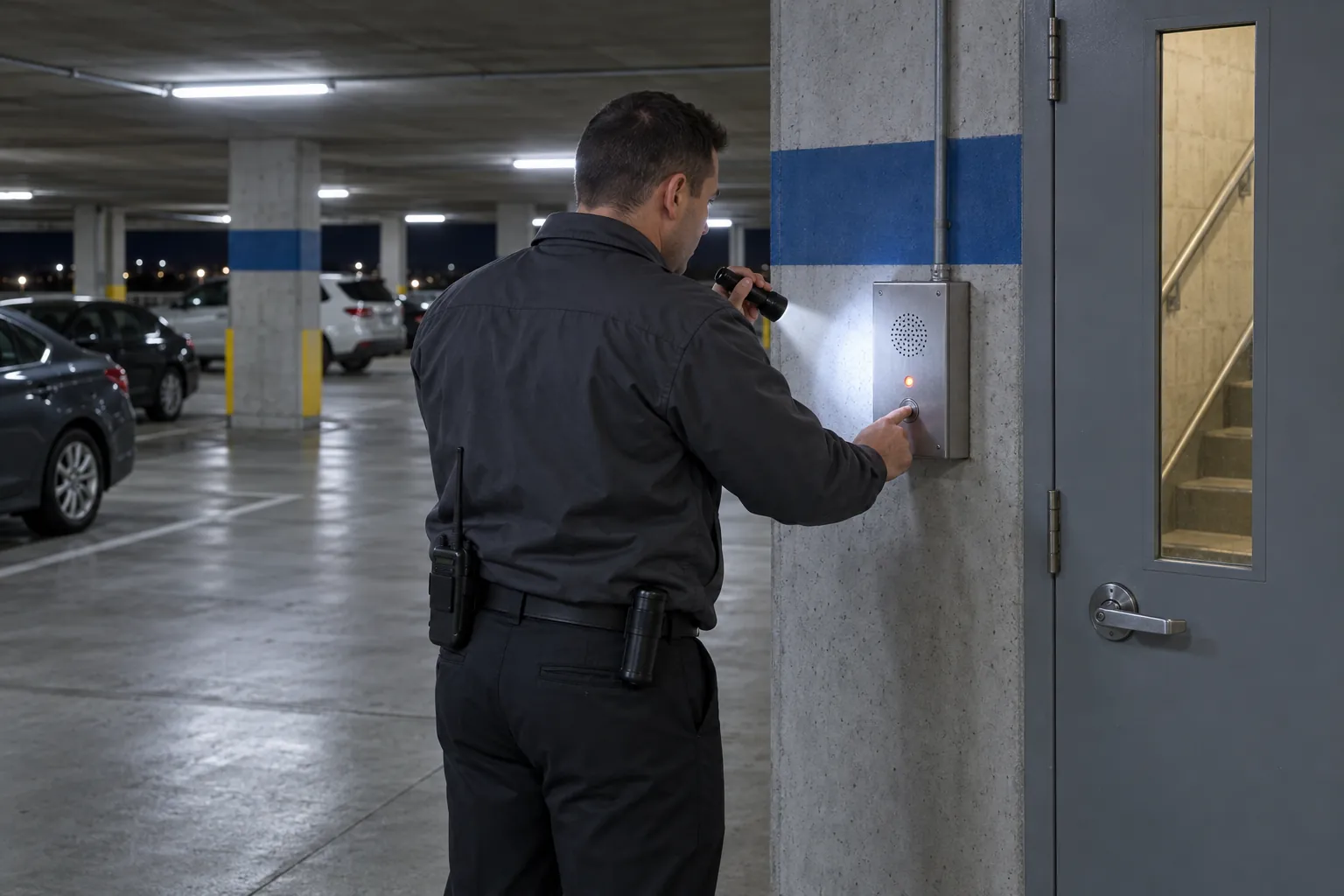
- Personal safety: a high-visibility vest, a flashlight after dark, and no confrontation over a car.
Apply the rules consistently, whoever is on shift, and record every warning so the next shift knows the history.
05
What a good parking patrol record looks like
When a tow is challenged, the questions are always the same: was the vehicle really in violation, were the signs up, who authorized it, and when. California spells out much of the answer in the authorization itself, and the towing company must keep the original authorization for three years under Section 22658(l)(3). The owner and the security company should keep their own record to the same standard. For each violation, record:
- Where: the lot or level, the space or zone, and the rule broken.
- The vehicle: make, model, color and plate.
- When it was first observed, and each later observation. California's authorization asks for the first observation time.
- Photographs showing the vehicle, its position and the nearest sign or marking.
- Any notice given: a windshield notice, with the time it was placed and a copy of its wording, and any certified mail the state requires.
- The authorization: who authorized a tow, their role, and the time.
- The tow and the police notification: the towing company, the time the vehicle left, and when and to whom police were notified.
The routine checks matter as much as the violations. Texas requires compliant signs to have been in place for the preceding 24 hours, and Florida requires them continuously for not fewer than 24 hours before a tow, so a dated record that each entrance sign was checked and found in place is part of the evidence for every tow. The same goes for fire lane markings, accessible parking signs and lighting.
Note each warning, tow and hazard in the daily activity report, and pass open issues on at shift change. Treat plate numbers and photographs as personal information, seen only by those who need them and kept only as long as the owner's policy says.
06
Where the record fails, and where SiteClara fits
The tow paperwork is usually done. The weak records are the routine ones. A patrol log that reads "lot checked, all OK" every hour cannot show that anyone looked at the sign at the side entrance that was knocked down on Tuesday, and a light out on level three, mentioned to whoever was passing, stays out for a month. When a tow is disputed, nobody can prove the signs were in place the day before.
SiteClara is a way to record the routine part of a patrol. A printed QR poster, with an optional NFC tag behind it, goes at each checkpoint that matters: an entrance sign, a fire lane, a garage level, a stairwell, an emergency call station. The officer scans the code or taps the tag on their own phone, with no app to install, sees the checks due at that point, such as "entrance sign present and readable" or "fire lane clear," and marks them done or says what stopped them. The time and the named officer are recorded as it happens, with a photo when one is asked for. A problem found on the round, such as a sign down, a light out or an oil spill, is reported there and goes onto the team's list of jobs until someone closes it.
The security supervisor sees what was due, done and missed, with the reason where one was given, and a job that needs the property or building manager can be escalated to them to answer. Each day the supervisor reviews the totals and photos, adds a note and approves a report that goes to nominated client contacts at 8 a.m. the next morning, showing what was reported, what is still open and how the scheduled checks went.
07
Where to read the law, and a short list to take away
The official texts cited in this guide:
- Texas: Occupations Code Chapter 2308, especially Sections 2308.251 to 2308.255 and 2308.301 to 2308.305.
- California: Vehicle Code Section 22658.
- Florida: Statutes Section 715.07.
- Accessible parking: the 2010 ADA Standards for Accessible Design (sections 208 and 502) and 28 CFR 36.211.
- Patrol and prevention: the POP Center guide on thefts of and from cars in parking facilities.
Then ask the fire marshal how fire lanes must be marked where you are, and the local police how they want to be told about a private tow. To take away:
- Know your state's towing statute and your city's ordinance before enforcing anything.
- Write down who may authorize a tow, for which violations, in the contract and the post orders.
- Check every entrance sign on a schedule, and record that you did.
- Record the time a vehicle was first seen, with photographs, before anything else happens.
- Report lights, signs and hazards to whoever fixes them, and follow them until they are fixed.
- Keep plate numbers and photographs private.
Sources
Every document this guide quotes or links to, in the order it first cites them.
- Texas Towing and Booting Act, Occupations Code Chapter 2308 statutes.capitol.texas.gov
- Vehicle Code Section 22658 leginfo.legislature.ca.gov
- Florida Statutes, Section 715.07 flsenate.gov
- 2010 ADA Standards for Accessible Design ada.gov
- 28 CFR 36.211 (maintenance of accessible features) ecfr.gov
- ASU Center for Problem-Oriented Policing guide Thefts of and From Cars in Parking Facilities popcenter.asu.edu
Related guides
 Premises and facilities managementParking lot inspection checklist: what to check, how often, and what to recordA parking lot inspection checklist for commercial property: pavement, striping, ADA spaces, lighting and drainage, how often to check, and a record that holds up.
 Security patrolsTrespass notice: giving one properly, and keeping a record that holds upWhat a trespass notice is under US state law, who can give one, what a written notice should say, and how security officers record it so it holds up later.
 Security patrolsSecurity daily activity report: what to include, and how to write one that holds upThe security daily activity report (DAR): what to record, how to write entries that hold up, how it differs from an incident report, and how to review and keep it.
 Security patrolsSecurity post orders: what they should say, and how to know they are followedSecurity post orders in the US: what they are, what state rules say, what to include, how to write, sign and review them, and how to check they are followed.