Premises and facilities management
Parking lot inspection checklist: what to check, how often, and what to record
A parking lot inspection checklist covers the pavement, striping and signage, accessible parking, lighting, drainage, curbs and pedestrian walkways, fire lanes and seasonal hazards such as snow and ice, and records each fault until it is fixed.
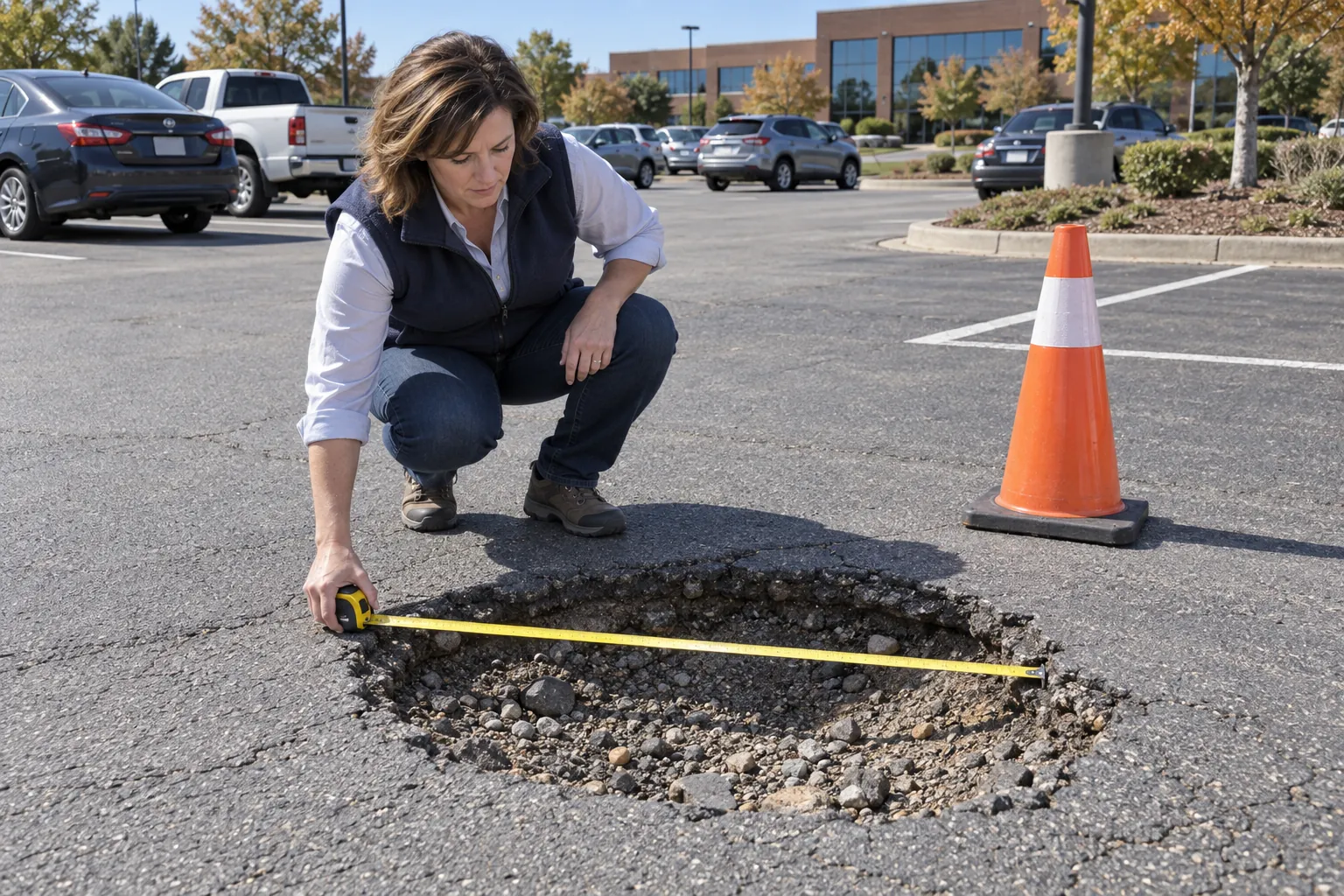
A parking lot is the first part of a building most customers and staff use and the last part anyone inspects properly. Potholes, faded striping, a blocked access aisle, a dead light pole or a catch basin that ponds and freezes are all found sooner or later: by an inspection, or by a visitor who trips. This guide covers the rules behind a parking lot inspection in the United States, what a checklist should cover, how often to walk it, the ADA items worth measuring, and how to keep a record that shows the lot was actually looked at.
01
What the rules require of a parking lot
No single federal rule says a commercial parking lot must be inspected on a checklist. The duty comes from several places, and the checklist is how a property manager shows it is being managed.
Workplace safety. Where employees walk or work in the lot, OSHA's walking-working surfaces rule applies. The definition in 29 CFR 1910.21 is broad: a walking-working surface is "any horizontal or vertical surface on or through which an employee walks, works, or gains access to a work area or workplace location." 29 CFR 1910.22 then requires that walking-working surfaces are "maintained free of hazards such as sharp or protruding objects, loose boards, corrosion, leaks, spills, snow, and ice," that they are "inspected, regularly and as necessary, and maintained in a safe condition," and that hazardous conditions "are corrected or repaired before an employee uses the walking-working surface again." Where a repair involves structural integrity, "a qualified person performs or supervises the correction or repair."
Check the state first. According to OSHA's page on State Plans, 22 State Plans cover both private sector and state and local government workers, and seven cover state and local government employees only. State Plans "must be at least as effective as OSHA," so the substance is usually the same, but the rule you cite may be your state's own.
Accessibility. A business open to the public is a public accommodation under Title III of the Americans with Disabilities Act. The Department of Justice regulation, 28 CFR 36.211, Maintenance of accessible features, says a public accommodation "shall maintain in operable working condition those features of facilities and equipment that are required to be readily accessible to and usable by persons with disabilities." It allows "isolated or temporary interruptions in service or access due to maintenance or repairs," not a van aisle that has been used for snow storage all winter. The accessible parking spaces, access aisles, signs and the accessible route to the entrance are features of exactly that kind, and their dimensions are set by the 2010 ADA Standards for Accessible Design, sections 208 and 502 for parking.
Local property maintenance. Cities and counties set their own maintenance rules for exterior property, and many do it by adopting the International Property Maintenance Code (IPMC), 2024 edition, Chapter 3, General Requirements, or an earlier edition, usually with local amendments. The code official enforces whatever your jurisdiction adopted, so read that version rather than a summary. Fire lanes, hydrants and fire department access are the fire code's business and the fire marshal's decision; the fire lane requirements guide covers them.
A dated record of inspections and repairs is also what an owner, an insurer or a lawyer will ask to see after someone falls.
02
What a parking lot inspection checklist covers
Walk the lot in the same order every time, in zones or rows that match a simple site map, so a fault can be found again by whoever is sent to fix it. A good commercial parking lot inspection checklist covers:
- Pavement surface: potholes, alligator and block cracking, raveling, loose aggregate, heaved or settled concrete, and trip edges where asphalt meets a curb, a slab or a utility cover.
- Striping and pavement markings: stall lines, directional arrows, pedestrian crosswalks, stop bars and no-parking areas that have faded or been paved over.
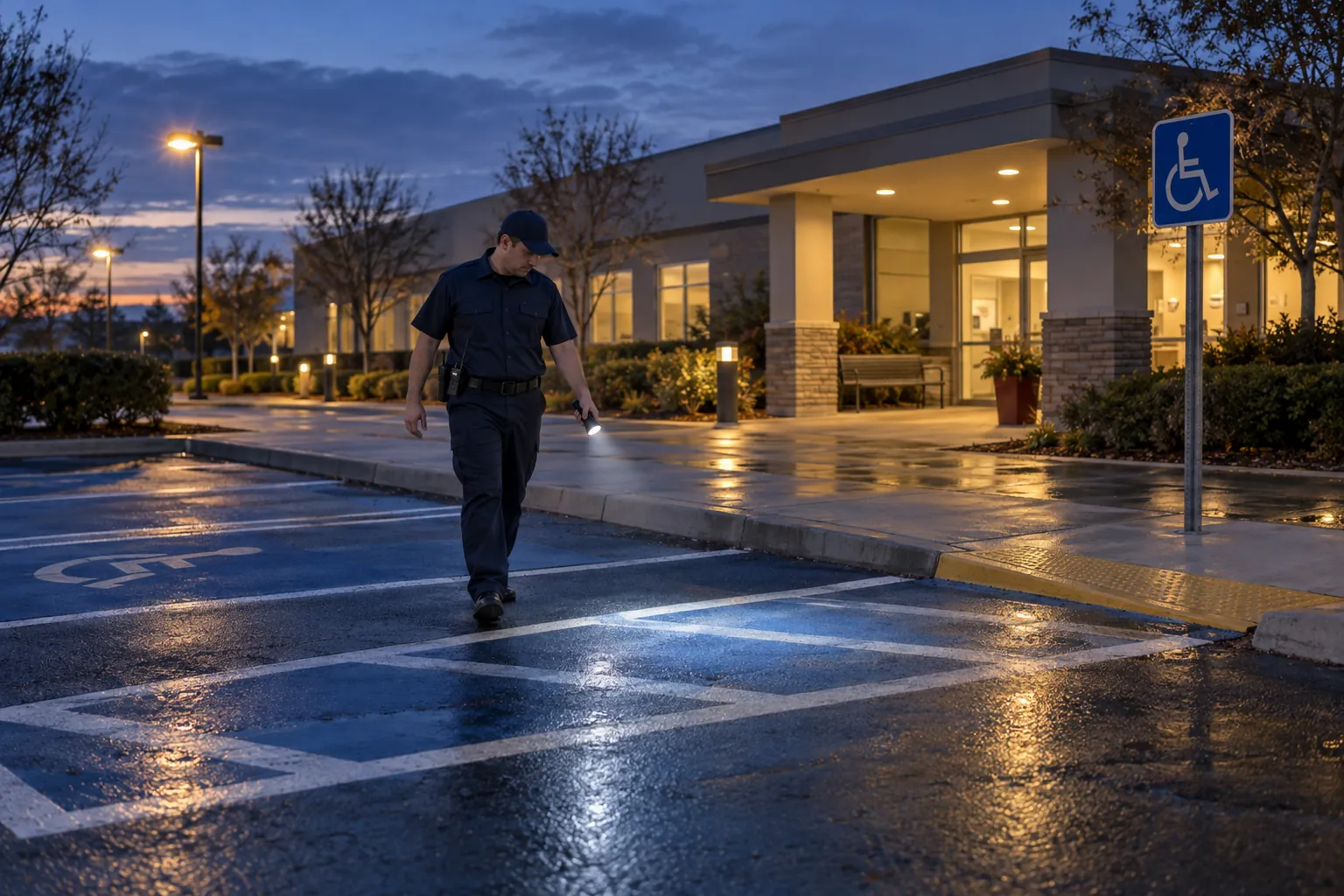
- Accessible parking: the number of accessible and van-accessible spaces, access aisle markings, signs, and a clear accessible route to the entrance (see the next sections).
- Curbs, curb ramps, sidewalks and walkways: broken curbs, cracked ramps, gaps and changes in level on the pedestrian route from the lot to the door.
- Lighting: pole and wall-pack lights out, flickering or blocked by trees, dark spots between poles, and timers or photocells that switch on too late.
- Drainage: catch basins and grates clear and seated flush, standing water after rain, ponding that will freeze, and oil staining around drains.
- Signage, fire lanes and hydrants: stop, speed, one-way and fire lane signs upright and readable, and fire lanes clear of cars, dumpsters and snow piles.
- Wheel stops and bollards: displaced wheel stops that have become trip hazards, and damaged bollards.
- Landscaping, vegetation and litter: shrubs blocking sightlines at exits, overgrown vegetation around light poles and signs, roots lifting pavement, trash, broken glass and needles.
- Security features: cameras unobstructed, emergency call boxes and gates working, and abandoned vehicles noted for the property manager.
- Seasonal items: snow and ice, salt bins stocked, plow damage, and leaves blocking drains.
A parking garage adds structural items, such as spalling concrete and leaking joints, that the walk-around can spot and report but only an engineer can assess.
03
How often to inspect, and who does each check
OSHA says "regularly and as necessary" and leaves the frequency to the employer. In practice the lot needs checks at several speeds, each done by the person who is already there:
- Daily: a quick walk at opening by the day porter, the custodian or the security officer on patrol, looking for new hazards: debris, spills, a light out overnight, a blocked accessible space, a displaced wheel stop, ice.
- After weather: after heavy rain for ponding and blocked drains, and during and after every snow or ice event for plowing, treatment and snow piles in the wrong place. The snow removal log guide covers the winter record.
- Weekly: a check after dark of every light, since a lighting fault is invisible at 10 a.m.
- Monthly: the full checklist by the building engineer, facility manager or property manager, with photos of anything new and a check that last month's faults were fixed.
- Seasonally: in spring for freeze-thaw potholes and plow damage; in the fall for crack sealing, drains, and snow storage areas that block nothing.
- Annually or before capital planning: a pavement condition assessment by a paving contractor or engineer to plan sealcoating, crack filling, overlay or reconstruction, and to budget the deferred maintenance honestly.
Security officers on a parking patrol often see the lot most, and their post orders can include a short list of conditions to report. Decide in advance who owns each kind of fault: a dead light to the lighting vendor, a pothole to the paving contractor, a blocked drain to the grounds team. The inspector's job is to find, record and make safe, not to hold the repair.
04
The accessible parking items worth measuring
Accessible parking is where a routine inspection most often finds a real problem, because the lot changes after it is built: spaces are restriped, signs are hit by cars, aisles become loading areas. The U.S. Access Board's Guide to the ADA Accessibility Standards, Chapter 5: Parking Spaces explains the 2010 Standards in plain words. The points a checklist can verify with a tape measure and a digital level are these:
- How many. The minimum number of accessible spaces follows the table in section 208.2: one for 1 to 25 spaces, two for 26 to 50, three for 51 to 75, four for 76 to 100, rising from there. "At least one of every 6 accessible spaces, or fraction of 6, in each parking facility must be sized to accommodate vans."
- Access aisles. "An access aisle at least 60 inches wide and at least as long as the parking space" is required beside each accessible space. A van space is either 132 inches wide with a 60-inch aisle, or 96 inches wide with a 96-inch aisle. "Two spaces can share one aisle," but access aisles "cannot overlap vehicular ways," and they "must be marked to discourage parking in" them.
- Slope and surface. Parking spaces and access aisles "cannot have changes in level other than slopes not exceeding 1:48," and they must meet the requirements for floor and ground surfaces.
- Signs. Signs show the International Symbol of Accessibility and "must be at least 60″ high measured to the bottom edge." Van spaces are signed "van accessible." A site with four or fewer spaces in total does not need the sign.
- Location. Accessible spaces "must be located on the shortest accessible route to an accessible entrance." Curb ramps "cannot protrude into access aisles."
- Height. In a garage, a 98-inch minimum vertical clearance applies to van spaces, their aisles and the vehicle route to and from them.
The route from the space to the door matters as much as the space. The Access Board's Chapter 4: Accessible Routes guide says that "all surfaces of accessible routes must be firm, stable, and slip resistant," that the running slope of walking surfaces cannot exceed 1:20 and cross slopes must be 1:48 maximum, and that "changes in level up to ½ inch must be beveled (but can have a vertical edge if ¼ inch maximum)." A heaved sidewalk slab with a 1-inch lip on that route is a finding, not a matter of opinion.
A routine inspection catches what drifts: a faded aisle, a missing sign, plowed snow on the van space. It does not replace an accessibility survey by a qualified professional.
05
Recording a fault, making it safe and closing it
A checklist that ends in ticks is only half a record. What matters is what happened to the things that were not fine. For each fault, record:
- Where, precisely: the zone, row or stall number from the site map, or the nearest light pole number, so the contractor goes to the right pothole.
- What, in plain words, with a photo. A photo with a shoe or a tape measure beside a crack or a trip edge shows its size better than a description.
- How serious: a simple risk rating such as make safe now, fix this week, or plan for the next paving project.
- What was done at once: a cone over the pothole, a barricade, a light reported to the vendor, the accessible space cleared of the cart corral.
- Who it went to, and the work order number if one was raised.
- When it was fixed, and who checked the repair. A job closed without a re-check is a job that may come back.
On a route employees use, OSHA's rule sets the priority: correct the hazard before an employee uses that surface again, and guard it or close the route until then.
A monthly summary for the owner or client, showing faults found, fixed and still open, oldest first, turns a stack of checklists into something that drives repairs and the pavement budget. Keep past records for as long as your insurer or legal counsel advises. And make the checks honest: a checklist signed for every day of the month in one pen, with no fault ever recorded, tells a reader that nobody looked.
06
Where the record fails, and what SiteClara does about it
Parking lot records fail in familiar ways. The daily walk is on the porter's list but nothing shows it happened. The monthly checklist is filled in at the desk from memory. The security officer tells the day shift about the dead light by the side entrance, and it stays dead for three weeks because nobody raised a work order. A pothole is reported to whoever was passing, and there is no record of when it was found.
SiteClara works on those gaps. A printed QR poster at a location, with an optional NFC tag behind it, lets staff scan or tap with their own phone, with no app to install. For a lot, that might be a poster at the security booth, the entrance by the accessible spaces and the door to the garage. Staff see the checks due there, such as the opening walk or the after-dark lighting check, and mark each one done or say what stopped them, with a photo when one is asked for. A fault found on the walk, such as a light out or a blocked access aisle, is reported with a photo and stays on the team's list of jobs until someone closes it.
The supervisor sees what was due, done and missed, and records the reason a check was missed. A job the team cannot fix itself, such as a repaving project that needs the owner's money, can be escalated to the building manager to answer. Each day the supervisor reviews and approves a report that goes to nominated management or client contacts at 8 a.m. the next morning, showing what was reported, what was completed and what is still open.
07
Where to read more, and a checklist to take away
OSHA publishes 29 CFR 1910.22, Walking-working surfaces, and its State Plans page shows which states run their own program. The Department of Justice publishes the 2010 ADA Standards for Accessible Design, and the U.S. Access Board's guides to parking spaces and accessible routes explain them with diagrams. The International Code Council publishes the International Property Maintenance Code to read free online; your city or county's website will say which edition it has adopted and what it changed.
Before you rely on your parking lot inspections, check that:
- the lot is divided into zones or rows on a simple map, and every fault is recorded against one;
- there is a daily walk at opening, a weekly check after dark, and a monthly full inspection;
- weather triggers a check: heavy rain, snow and ice;
- accessible spaces, van spaces, aisles, signs and the route to the entrance are measured, not just glanced at;
- snow storage areas are chosen before winter and do not block accessible spaces, aisles, drains or fire lanes;
- every fault has a photo, a rating, an owner and a date it was fixed;
- hazards on routes people use are made safe at once, and structural repairs go to a qualified person;
- restriping after a sealcoat is checked against the 2010 Standards first;
- the pavement is assessed by a professional at least yearly for the capital plan;
- open faults are reported to the owner or client, oldest first, every month.
Sources
Every document this guide quotes or links to, in the order it first cites them.
- 29 CFR 1910.21 osha.gov
- 29 CFR 1910.22 osha.gov
- State Plans osha.gov
- 28 CFR 36.211, Maintenance of accessible features govinfo.gov
- 2010 ADA Standards for Accessible Design ada.gov
- International Property Maintenance Code (IPMC), 2024 edition, Chapter 3, General Requirements codes.iccsafe.org
- Guide to the ADA Accessibility Standards, Chapter 5: Parking Spaces access-board.gov
- Chapter 4: Accessible Routes access-board.gov
Related guides
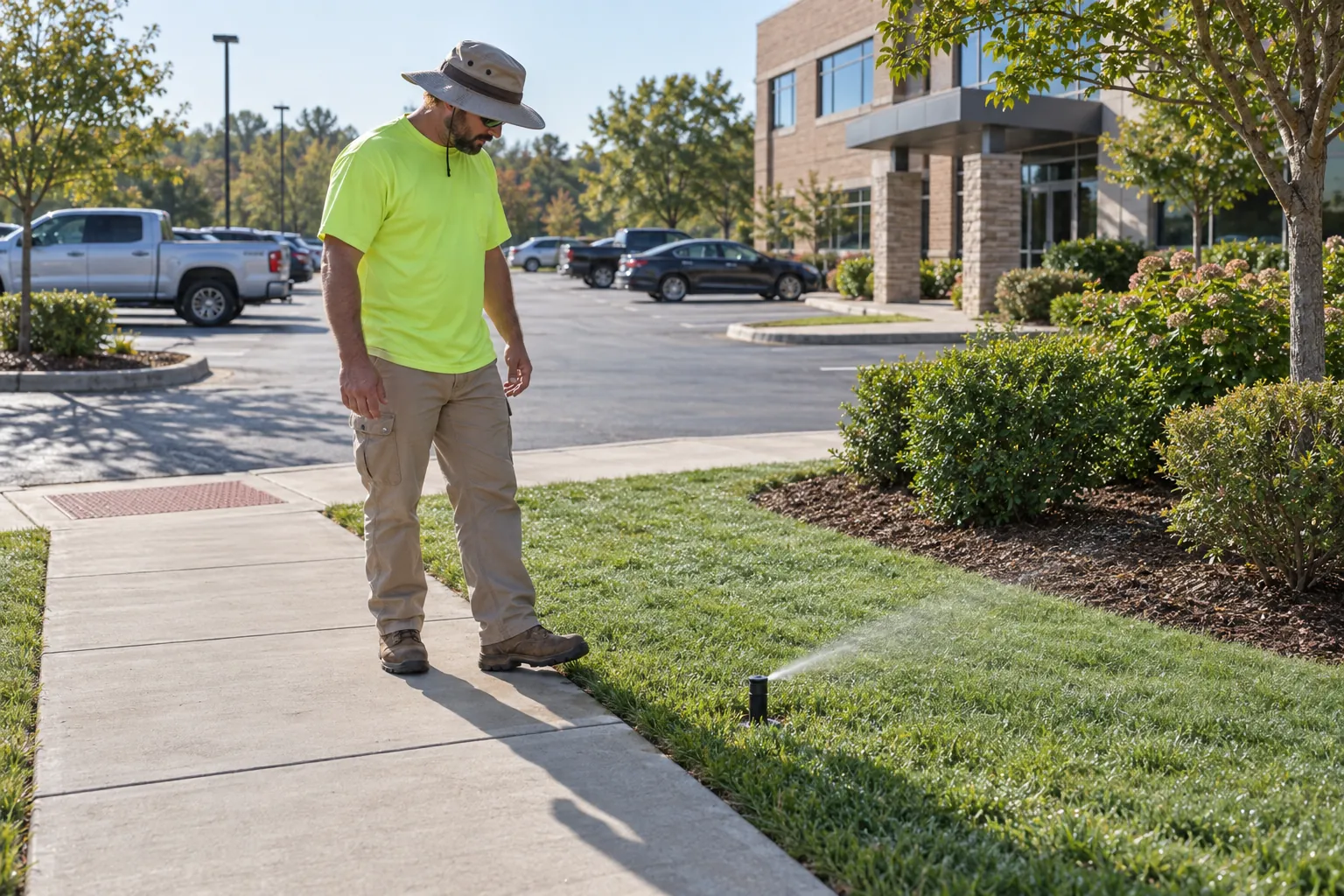 Premises and facilities managementGrounds maintenance checklist: what to check outside the building, how often, and what to recordA grounds and landscape maintenance checklist for US commercial properties: walkways, turf, trees, irrigation and play areas, by season, with OSHA and ADA duties.
 Premises and facilities managementSnow removal log: what to record, and how to make it stand upWhat a snow removal log for a commercial property should record, the OSHA and local rules behind it, how often to check, and what makes the log worth having.
 Premises and facilities managementSlip, trip, and fall prevention: keeping floors, stairs, and walkways safe every daySlip, trip, and fall prevention in a commercial building: what OSHA 1910.22 requires, where people fall, the controls that work, and how to check and record them.
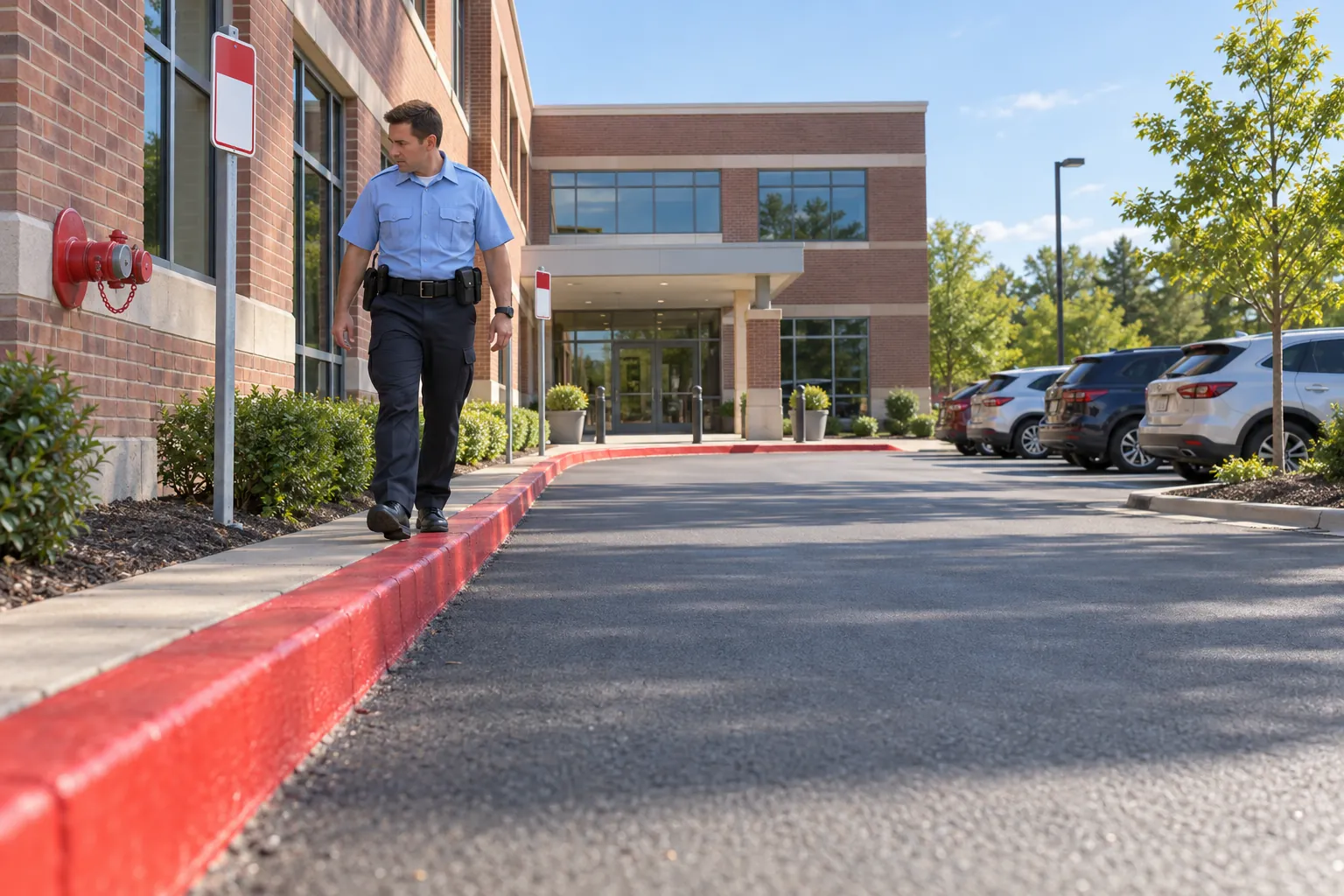 Fire and water checksFire lane requirements: what the fire code asks, and how to keep the lane clearFire lane requirements under the International Fire Code: width, clearance, signs and red curbs, keeping the lane clear, and what a routine check should record.