Cleaning
The Cleaning Accountability Framework: certification, prequalification and the records behind them
The Cleaning Accountability Framework (CAF) is an independent, not-for-profit Australian organisation that sets a standard for how commercial cleaners are paid, treated and kept safe, and checks buildings and contractors against it.

It is not a law, but it sits on top of several: the Cleaning Services Award, the Fair Work Act, the work health and safety laws and the Modern Slavery Act. This guide explains what CAF certifies, how CAF certification of a building and contractor prequalification work, and what building owners, building managers and cleaning contractors need to have in order before they start.
01
What the Cleaning Accountability Framework is
The Cleaning Accountability Framework describes itself as an independent, not-for-profit organisation set up to address the exploitation of cleaners, a workforce it says is at high risk of exploitation and modern slavery. Its Cleaners' guide to CAF (2021) puts it plainly: CAF "is an independent organisation. We work together with business, government and the union to promote labour rights and standards in the cleaning industry." The guide acknowledges support from the Fair Work Ombudsman's Community Engagement Grants Program.
CAF's starting point is that cleaners "have the right to work that is fairly paid, safe, secure, freely chosen, and undertaken with dignity". It works through three ideas it calls decent work, ethical procurement and best practice: bringing transparency to cleaning supply chains, setting a national standard (the CAF Standard) and recognising buildings that meet it through certification.
None of this is compulsory. No Australian law requires a building to be CAF certified or a contractor to be prequalified. What makes CAF matter is the law underneath it, which bites on employers and, increasingly, on the businesses that buy their services:
- the Cleaning Services Award 2020 (MA000022), which by clause 4.1 covers "to the exclusion of any other modern award" employers in the contract cleaning services industry throughout Australia, and sets the minimum rates, penalties and allowances that move each year;
- the Fair Work Act 2009, under which an employer "must make, and keep for 7 years, employee records" (section 535), and a person "involved in a contravention of a civil remedy provision is taken to have contravened that provision" (section 550);
- the work health and safety laws: the Commonwealth Work Health and Safety Act 2011, which follows the model WHS Act, and the WHS Act of each state and territory other than Victoria, which follow the same model; in Victoria, the Occupational Health and Safety Act 2004;
- the Modern Slavery Act 2018, which requires an entity that is Australian or carries on business in Australia, with consolidated revenue of at least $100 million for the reporting period, to give the Minister a modern slavery statement on the risks in its operations and supply chains, for the government's public register.
Section 550 is why building owners pay attention. A person who has been "in any way, by act or omission, directly or indirectly, knowingly concerned in or party to" an underpayment can be treated as having contravened the Act themselves. CAF offers procurers a structured way to manage that risk, and to show that the price, the contract and the conditions on site have been checked against labour standards.
02
What CAF covers: its programs and its standard
The programs a building owner, building manager or cleaning contractor is most likely to meet are these:
- Building certification: an independent assessment of one building's cleaning supply chain against the CAF Standard. It is open to commercial office buildings and shopping centres, and to precincts of two to four buildings under the same contract.
- Portfolio certification for large property portfolios, and a portfolio rating that CAF says benchmarks an owner's portfolio against the CAF Standard, as a first step towards a certified portfolio.
- Contractor prequalification: an assessment of a cleaning contractor's systems, policies and processes, with a public directory of prequalified contractors.
- CAF membership: for procurers of cleaning services, funds and investors, universities, government bodies, tenants and corporates, and not-for-profits. Since 1 July 2021, cleaning contractors have come to CAF through its Learning Hub rather than membership.
- Procurement advisory services and training, including tools for members such as a pricing schedule and model tender and contract clauses.
- The Cleaners' Hub: information for cleaners about pay and entitlements, a payslip helper and a cleaning services pay guide.
Building certification and prequalification both assess against the same six parts of the CAF Standard: fair labour practices; responsible contracting and transparency; safe working conditions; financial viability; worker engagement; and issue identification and remediation.
The Cleaners' guide sets out what the standard means on the ground, as a checklist cleaners can recognise:
- cleaners are paid at least the minimum wage and can access leave and other entitlements;
- employers are acting lawfully, including correctly paying wages, tax and superannuation;
- employers have policies and processes for bullying and grievances;
- cleaners are working within safe and reasonable limits;
- the workplace is safe;
- employers keep correct employee records and are financially viable;
- cleaners are free to join their union if they choose to;
- all stakeholders work together in good faith to resolve any issues.
Two lines are easy to skim past and hard to meet: "working within safe and reasonable limits" (workload) and "correct employee records" (evidence).
03
How CAF building certification works
The applicant is usually the property owner or investor. The building manager runs the contract day to day, the cleaning contractor employs the cleaners, and the cleaners themselves are part of the assessment rather than its subject. CAF describes four stages:
- Supply chain assessment and worker engagement. A desktop assessment covers "procurement practices, contract management practices, employment policies and procedures, and a sample check of payroll compliance", along with subcontracting arrangements and the contractor's financial viability. Alongside it, CAF meets the cleaners: "face to face meetings in paid time, a survey about cleaners' working conditions, and the nomination of a CAF Representative".
- Assessment by the Certification Panel. A panel of workplace relations experts reviews the reports and decides what, if anything, must be fixed before certification.
- Certification. The applicant receives a certificate and may use CAF's branding under its licence terms. Certified buildings, precincts and portfolios are listed on CAF's certified buildings page, with the nominating organisation, the service providers and the date.
- Ongoing compliance. Annual health checks repeat the worker engagement and payroll verification. CAF states that certification "is valid for the length of the contract subject to ongoing compliance with the CAF Standard and CAF Terms and Conditions". Where a contract changes but keeps the same supply chain, CAF says certification continues with some additional minor checks.
The worker engagement stage is what sets CAF apart from a paper audit. Supervisors and managers are kept out of the meetings, so that, in CAF's words, "cleaners can speak up without fear of retaliation". The CAF Representative is a cleaner at the building, chosen by the other cleaners, who receives training, support and an allowance. The Cleaners' guide explains the purpose: "To make sure the CAF Star rating is not just a once a year check".
For the building manager, the practical preparation is mostly documents and access:
- the cleaning contract and specification, including the scope, the frequencies and the hours the price assumes;
- how the contract was procured, and how the price was tested against award rates, penalties and loadings;
- any subcontracting, disclosed in full;
- how the contract is managed: meetings, inspections, complaints and how problems are put right;
- space and paid time for cleaners to meet CAF without supervisors present.
If the price assumes 40 hours a week and the specification needs 55, certification will find it, because the payroll sample and the cleaners will both say so.
04
Contractor prequalification, and what the contractor must show
CAF defines prequalification as "a systems, policies and processes assessment of a cleaning contractor against the CAF Standard." It is not a certification of the contractor: "Using a CAF Prequalified Contractor alone is not enough to demonstrate that cleaners' labour rights at an individual building are being respected." Prequalification checks that a payroll policy exists; building certification checks that cleaners at a building were actually paid.
The process takes about six months. It starts with eligibility screening, in which the Fair Work Ombudsman reviews the contractor's compliance record and the United Workers Union reviews its records and meets workers at sample sites. An external auditor then assesses the contractor's systems and policies, and anything found is investigated and remediated. Prequalification lasts a year. CAF says the annual renewal could include a self-assessment questionnaire, documents, an upgrade to the latest version of the CAF Standard and, where building certification has found company-wide issues, remediation at company level. It is also informed by feedback the United Workers Union gathers from workers at a sample of sites over the preceding 12 months.
Much of what an assessor asks for is already a legal duty. Under the Fair Work Regulations 2009, employee records must be "in a legible form and in the English language" and "readily accessible to an inspector" (regulation 3.31). They must show the rate of pay, the gross and net amounts and any deductions, and for a casual or irregular part-time employee paid by time worked, "the hours worked by the employee" (regulation 3.33). Section 535 of the Act forbids keeping a record the employer knows is false or misleading. Timesheets filled in from the roster at the end of the week, rather than from hours actually worked, will not pass.
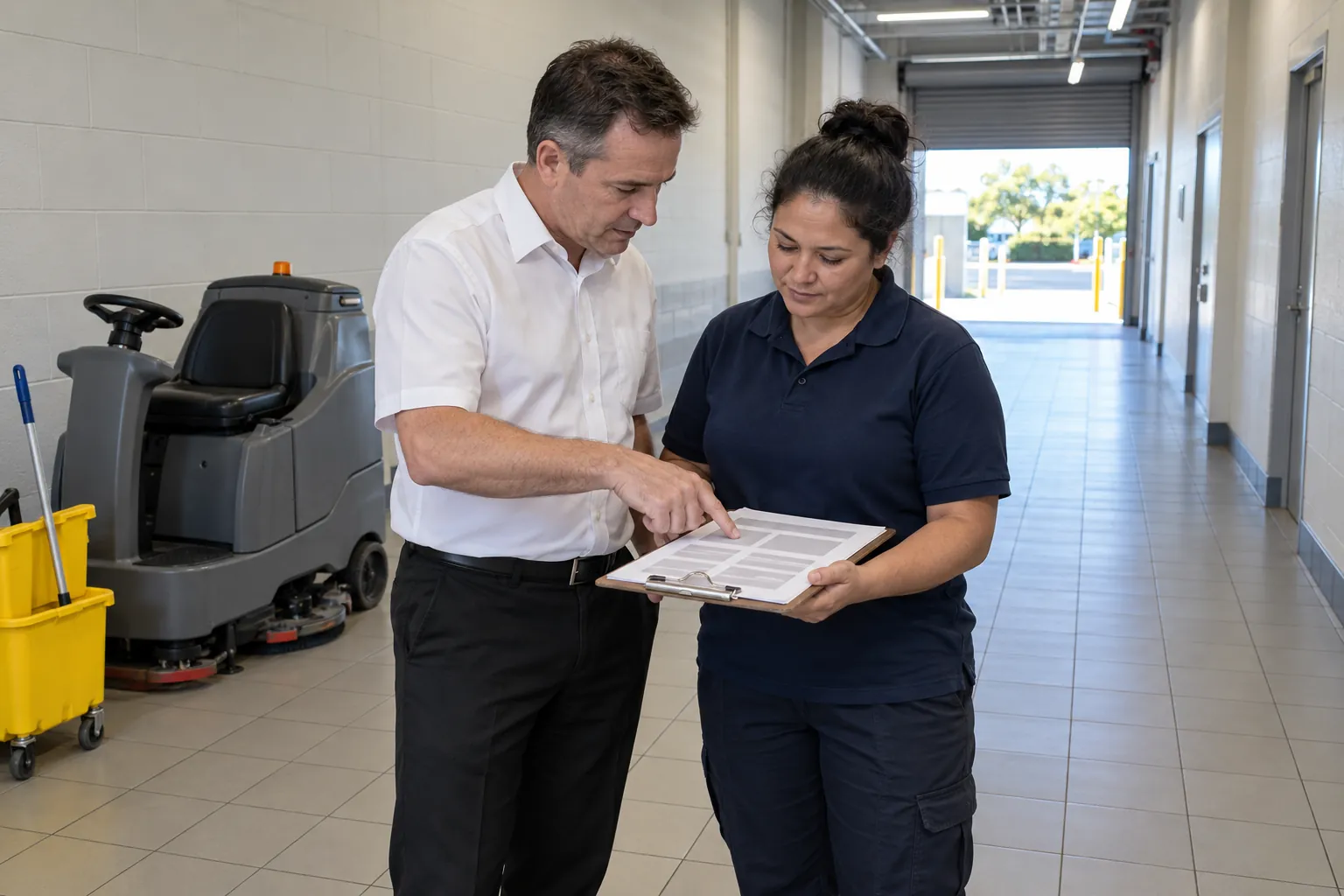
Safety is the other half. Section 19 of the model WHS Act, and of the Acts that follow it, requires a person conducting a business or undertaking to ensure, so far as is reasonably practicable, the health and safety of the workers it engages or directs. On a cleaning contract the owner or building manager and the contractor usually have duties about the same matters: chemicals, access, lone and night work, amenities, reporting hazards. Section 46 then requires each of them to "consult, co-operate and co-ordinate activities" with the others. CAF's safe work criteria look for the same thing in practice: who inducts the cleaners, who fixes the hazard a cleaner reports, and whether anyone can show it was fixed.
05
Why procurers use CAF, and what good evidence looks like
CAF's modern slavery page makes the central point about buyers: "procurers of cleaning services have significant power to determine the working conditions of cleaners, despite not being in an employment relationship with them." The price, the specification, the length of the contract and how it is managed decide what the contractor can afford to pay and how hard the cleaners have to work.
It is careful about terms, too: "Modern slavery does not include practices like substandard working conditions or underpayment of workers but these practices are also illegal and harmful." A large owner's modern slavery statement must, under section 16 of the Modern Slavery Act, describe "the actions taken ... to assess and address those risks, including due diligence and remediation processes" and "how the reporting entity assesses the effectiveness of such actions". CAF says membership and building certification can be used in answering those criteria. Naming CAF without evidence from the buildings answers neither.
Good evidence for a cleaning contract, whether or not CAF is involved, has four parts:
- A price that could be real. The hours the specification needs, multiplied by award rates with penalties and loadings, plus on-costs, fit inside the contract price.
- Pay that was real. Payroll records and pay slips that match the hours actually worked, verified by sample rather than taken on trust.
- Workloads that fit. The tasks in the specification can be done in the hours on the roster. Where they cannot, the contract changes, rather than the cleaners quietly skipping work or working unpaid.
- Voices that are heard. Cleaners can raise a problem without going through the supervisor they are complaining about, and the problem is followed to a fix.
The third part is where the site record matters most. A client who only knows what the monthly report says cannot tell whether a building is under-resourced. A record kept at the location, day by day, of what was cleaned, what was reported and what could not be done shows where the hours run out. It also protects cleaners blamed for work the hours never allowed.
06
Where the record fails, and what SiteClara does about it
Certification looks at payroll, contracts and what cleaners say. The day-to-day record of the work is usually weaker than any of them. The amenities sheet on the back of the door is initialled for the whole week on Monday. The periodic clean on the specification is invoiced but nobody can say which night it happened. A cleaner reports a broken dispenser or a leaking tap to whoever was passing, and nobody can show whether it was fixed. When the hours are short, the sheet still looks complete, so the workload problem stays hidden until a complaint or an audit.
SiteClara records work at the location. A printed QR poster, with an optional NFC tag behind it, sits at each place where checks are scheduled, such as an amenities block, a lift lobby, an end of trip facility or a car park level. The cleaner scans or taps on their own phone, with no app to install, and marks the scheduled check done, with a photo when the check asks for one, or says what held it up in their own words. A problem can be reported at the same tag, and it goes onto the team's list of open jobs until someone closes it.
The supervisor sees the day's checks and open jobs, gives a reason where a check was missed or held up, and approves a daily report that goes to nominated client or management contacts the next morning. That gives the contractor, the building manager and the owner the same record of what was done, what was not, and why, which is the kind of evidence that shows whether a specification fits its hours.
07
Questions people ask
What is the minimum pay for a cleaner in Australia?
For a contract cleaner, it is set by clause 15.1 of the Cleaning Services Award 2020. From 1 July 2026 the minimum is $1,028.90 a week, or $27.08 an hour, for a Cleaning Services Employee level 1, rising to $29.45 an hour at level 3. A casual cleaner is paid a 25% loading on top of the hourly rate (clause 11.2), and the award's penalty rates and allowances are paid on top where they apply. Part-time and casual cleaners must be paid for a minimum shift of one to four hours, depending on the size of the cleaning area, even if they work for a shorter time (clause 13.5). The rates change each July, so check the current award before pricing a contract.
Is there a toilet cleaning allowance under the Cleaning Services Award?
Yes. Clause 17.9 of the Cleaning Services Award 2020 says an employer of an employee "who is employed for the major portion of any day or shift to clean toilets" must pay a toilet cleaning allowance, which from 1 July 2026 is $3.69 a shift or $18.17 a week. A contract price built on the base rate alone for a cleaner who spends most of a shift on amenities will fall short.
08
Where to read more, and a list to take away
Start with CAF's own pages: building certification, contractor prequalification, and the Cleaners' guide to CAF, which is the clearest short account of the standard. CAF publishes current fees and eligibility on those pages. For the law, read the current Cleaning Services Award 2020; sections 535 and 550 of the Fair Work Act 2009; regulations 3.31 to 3.44 of the Fair Work Regulations 2009 on employee records; sections 19 and 46 of your state or territory's WHS Act, which follow the model WHS Act as the Commonwealth Work Health and Safety Act 2011 does (in Victoria, the Occupational Health and Safety Act 2004); and sections 5 and 16 of the Modern Slavery Act 2018.
Before you apply for certification or prequalification, or tender a contract that asks for it, check that:
- the contract price covers the specification's hours at current award rates, penalties and loadings, with on-costs;
- the price is reviewed when award rates change each July;
- all subcontracting is disclosed and approved;
- payroll and time records are made from hours actually worked, kept for seven years and readily accessible;
- cleaners get pay slips and can check them against the award;
- cleaners can raise a problem without going through the supervisor involved, and it is followed to a fix;
- the owner, building manager and contractor have agreed who inducts cleaners and who fixes reported hazards;
- the specification has been compared with what the hours actually allow, and changed where it does not fit;
- scheduled and periodic work leaves a record on the day it is done, including what could not be done and why.
Sources
Every document this guide quotes or links to, in the order it first cites them.
- Cleaning Accountability Framework cleaningaccountability.org.au
- Cleaners' guide to CAF cleaningaccountability.org.au
- Cleaning Services Award 2020 awards.fairwork.gov.au
- Fair Work Act 2009 legislation.gov.au
- Work Health and Safety Act 2011 legislation.gov.au
- Occupational Health and Safety Act 2004 legislation.vic.gov.au
- Modern Slavery Act 2018 legislation.gov.au
- Building certification cleaningaccountability.org.au
- Contractor prequalification cleaningaccountability.org.au
- CAF membership cleaningaccountability.org.au
- Cleaners' Hub cleaningaccountability.org.au
- Certified buildings cleaningaccountability.org.au
- Fair Work Regulations 2009 legislation.gov.au
- CAF's modern slavery page cleaningaccountability.org.au
Related guides
 CleaningCleaning contracts in Australia: what to put in them, and how to know they are workingWhat an Australian commercial cleaning contract should cover, how the Cleaning Services Award and Fair Work Act shape it, and how to show the work was done.
 CleaningHow to get commercial cleaning contracts in Australia, and keep themHow commercial cleaning contracts are bought in Australia, what buyers check, how to write a tender that scores, how to price to the award, and how to keep the work.
 CleaningCleaning tender: how to run one as the buyer in AustraliaRunning a cleaning tender as the buyer in Australia: the RFT, site inspections, the Procurement Rules, the Cleaning Services Award, evaluation and award.
 CleaningCommercial cleaning checklist: area by area, and how to know it is followedA commercial cleaning checklist for Australian offices and shared buildings, area by area, with the WHS duties behind it and how a supervisor checks it is followed.