Cleaning
Commercial cleaning checklist: area by area, and how to know it is followed
A commercial cleaning checklist is the area-by-area list of cleaning tasks the cleaners complete in an office or other commercial building, from emptying bins and cleaning the amenities to vacuuming carpet, in the order the work is done and with room to record what was done and what was found.
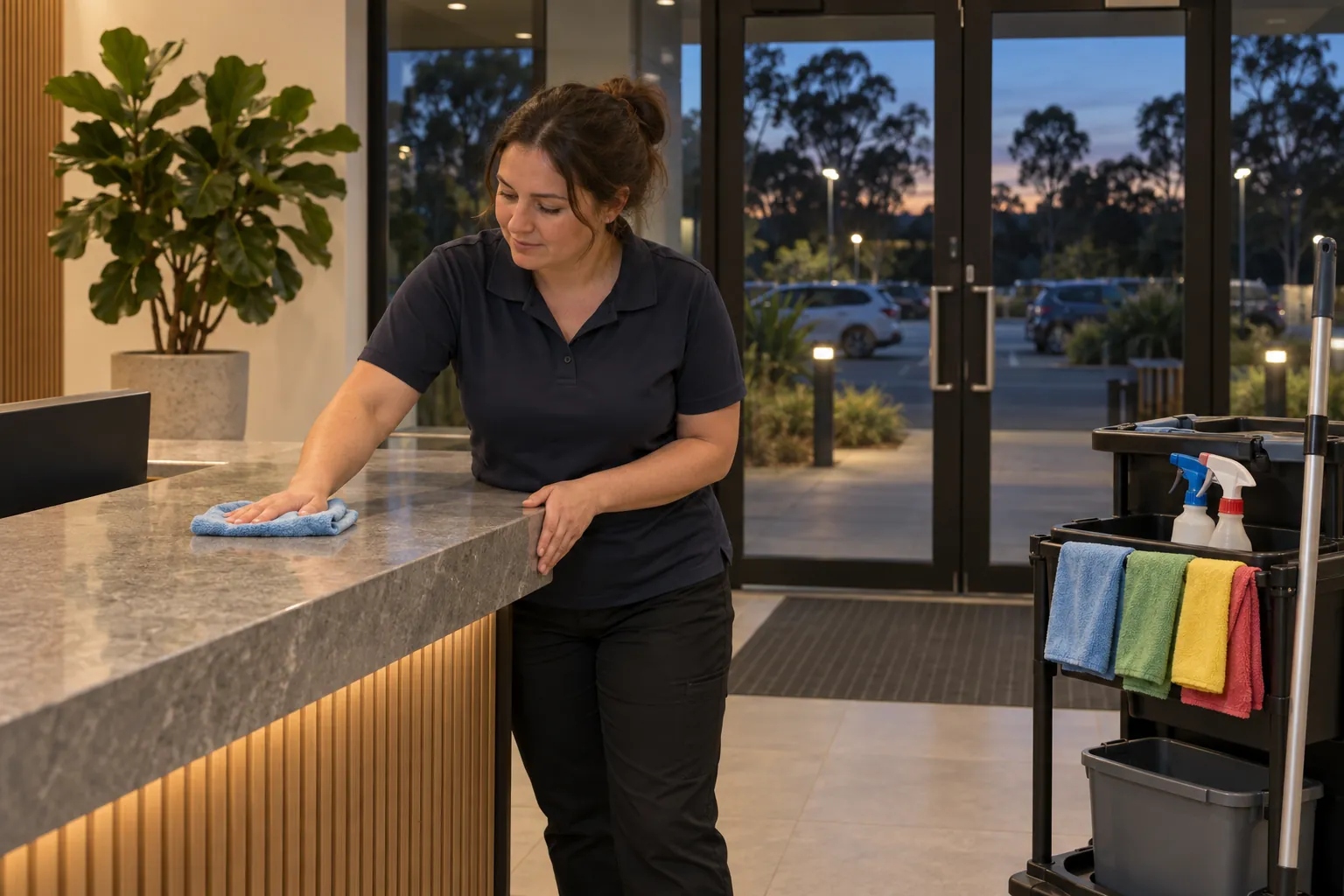
This guide sets one out area by area for Australian offices and other commercial buildings, explains the work health and safety duties it sits under, and covers how to use it on shift and how a supervisor can tell whether it is really being followed.
01
The duty behind a commercial cleaning checklist
No Australian law requires a commercial cleaning checklist by name. The law requires a workplace, and its facilities, kept clean and safe. A checklist is one practical way for a commercial cleaning service, and whoever pays for the cleaning, to show that the routine work behind that duty is being done.
In every state and territory except Victoria, the duty comes from a Work Health and Safety Act based on the national model law. Queensland's Work Health and Safety Act 2011 is typical. Section 19(3) requires a person conducting a business or undertaking (a PCBU) to ensure, so far as is reasonably practicable, "the provision and maintenance of a work environment without risks to health and safety", "the provision of adequate facilities for the welfare at work of workers", and that "the conditions at the workplace are monitored for the purpose of preventing illness or injury of workers".
The regulations make it specific. In the model Work Health and Safety Regulations, as adopted in Queensland's Work Health and Safety Regulation 2011 and in the Commonwealth's Work Health and Safety Regulations 2011, regulation 40 deals with general workplace facilities and requires, among other things, that "floors and other surfaces are designed, installed and maintained to allow work to be carried out without risk to health and safety". Regulation 41 requires adequate facilities for workers, "including toilets, drinking water, washing facilities and eating facilities", and requires them to be "maintained so as to be (a) in good working order; and (b) clean, safe and accessible."
The practical detail is in the code of practice Managing the work environment and facilities, a Safe Work Australia model code approved in each adopting jurisdiction (the link is the NSW version, August 2019). It says "The work environment must be maintained so that it remains in a clean and safe condition", that "Consumable items, including soap and toilet paper, should be replenished regularly", and that workplaces and facilities "should be cleaned regularly taking into account the type of work performed, the likelihood of contamination, the number of workers using them, including during shiftwork, and the type of facility, such as eating areas, toilets, handbasins and showers." That sentence is, in effect, the brief for a commercial cleaning checklist.
Victoria is different: it keeps its own Occupational Health and Safety Act 2004, and WorkSafe Victoria's Compliance code: Workplace facilities and the working environment covers how to maintain, clean and monitor workplaces. The words differ (employer rather than PCBU), but the checklist does the same job.
In a shared building the owner or owners corporation, the tenant, the facility manager and the cleaning contractor often hold the same duty, and section 46 of the WHS Act requires each to "consult, cooperate and coordinate activities" with the others. A clear checklist is one of the simplest ways to do that.
Three documents are often confused:
- The scope of works or cleaning specification is the contract: what is cleaned, to what standard and how often. See the cleaning contract guide.
- The cleaning schedule sets the daily, weekly, monthly and periodic frequencies for each area.
- The checklist is the working list for a shift or an area: the tasks, in the order they are done, with room to record that each was done and anything found.
This guide is about the third.
02
What a commercial cleaning checklist covers
Commercial buildings range from one tenancy in a suburban office park to a CBD tower with a shopping centre podium, but the same kinds of area turn up in nearly all of them. Divide the checklist by area, or zones, rather than writing one long list for the whole building, so each part can be completed and checked on its own. For a building that is only offices, the office cleaning checklist guide goes into more detail:
- Entrance, foyer and reception: the first thing visitors see and where most grit comes in.
- Lift lobbies and lifts: buttons, doors, mirrors and floors that every occupant touches or walks on.
- Open-plan offices, workstations and meeting rooms: bins, touch points, clear desk surfaces, tables and floors.
- Kitchenettes and breakout areas: sinks, benches, appliances, fridges and waste.
- Amenities, the toilets and bathrooms: toilets, urinals, basins, dispensers, floors and consumables, including accessible and parents' rooms.
- End of trip facilities: showers, change areas, lockers and drying rooms; showers are among the facilities the code says should be cleaned regularly. See the end of trip facilities guide.
- Corridors, fire stairs and exits: handrails, door furniture and floors, kept clear.
- High-touch surfaces across the building: door handles, light switches, push plates, lift buttons, printers and shared phones.
- Waste and recycling: internal bins, the loading dock collection point and the bin room.
- Car park and external areas, if they are in scope: litter, spills and pedestrian routes.
- Anything specialist, such as a staff gym, a consulting room, a retail floor, a childcare centre or a commercial kitchen, each with its own list.
Leave out anything the contract does not cover. If external glass is done by a rope access contractor twice a year, a line for it on the nightly list only invites a tick against work the team never does.
03
The checklist, area by area
The tasks below are a starting point for a typical office or mixed commercial building. Adjust them to the building, add lift lobbies, end of trip facilities and car parks where they are in scope, and take the frequencies from the schedule rather than writing them in twice.
Entrance, foyer and reception
- Vacuum entrance matting and shake out or reposition loose mats so edges lie flat.
- Sweep and mop or scrub hard floors; repeat in wet weather, when the foyer takes the most water.
- Clean the glass of entrance doors and screens at hand height.
- Wipe the reception desk, visitor seating, sign-in screen and door push plates.
- Empty bins and check the area is free of trip hazards.
Offices and workstations
- Empty waste and recycling bins and replace liners.
- Wipe clear desks; do not move papers or equipment unless the specification says so.
- Wipe shared keyboards, phones and printer panels where agreed.
- Vacuum carpets, with high-traffic walkways done daily, and spot-clean spills.
- Dust sills, ledges and partition tops within reach.
- Clear cups from meeting rooms, wipe tables and chairs, and reset the furniture.
Kitchenettes and breakout areas
- Clean and sanitise benches, sinks and taps.
- Wipe fronts, handles and controls of the fridge, microwave, boiling water unit and dishwasher.
- Load or unload the dishwasher if the contract includes it.
- Empty food waste, general waste and recycling, and check the co-mingled bin is not contaminated.
- Mop the floor and restock hand soap and paper towel.
- Where food is prepared for sale, the food business's own cleaning and sanitising obligations under Standard 3.2.2 of the Food Standards Code take precedence over this list.
Amenities
- Clean and disinfect toilet pans, seats, urinals and flush buttons.
- Clean basins, taps, mirrors, cubicle doors, locks and partitions.
- Restock toilet paper, soap, paper towel and sanitiser; check hand dryers work.
- Empty bins and check sanitary and nappy bins are within their service capacity.
- Mop the floor working towards the door, and report any leak, blockage or broken fitting.
Corridors, fire stairs and exits
- Vacuum or mop floors and stair treads.
- Wipe handrails, door handles and push plates.
- Check exits and paths of travel are clear of trolleys, stock and waste. Report a propped-open fire door rather than moving on.
- Keep the cleaners' storage room tidy and locked, with chemicals stored in labelled containers and trolleys parked out of the way.
Weekly, monthly and periodic
- Weekly: dust high ledges and skirtings, spot-clean marks on walls and doors, clean inside microwaves and fridges, polish internal glass, clean chair bases and bin exteriors.
- Monthly: dust grilles and vents within reach, clean switches and power points, wash internal bins.
- Periodic, often quarterly or yearly: extract carpets, strip and reseal or burnish hard floors, deep clean amenities and kitchenettes, clean behind and under fixed equipment, and external glass by a specialist contractor.
04
How to use the checklist on shift
A checklist only improves the cleaning if it matches how the work is really done, so that it guides the shift rather than being ticked at the end of it. A few habits make the difference.
- Write it in route order. The list should follow the path the cleaner walks, floor by floor, so it is read as the work progresses.
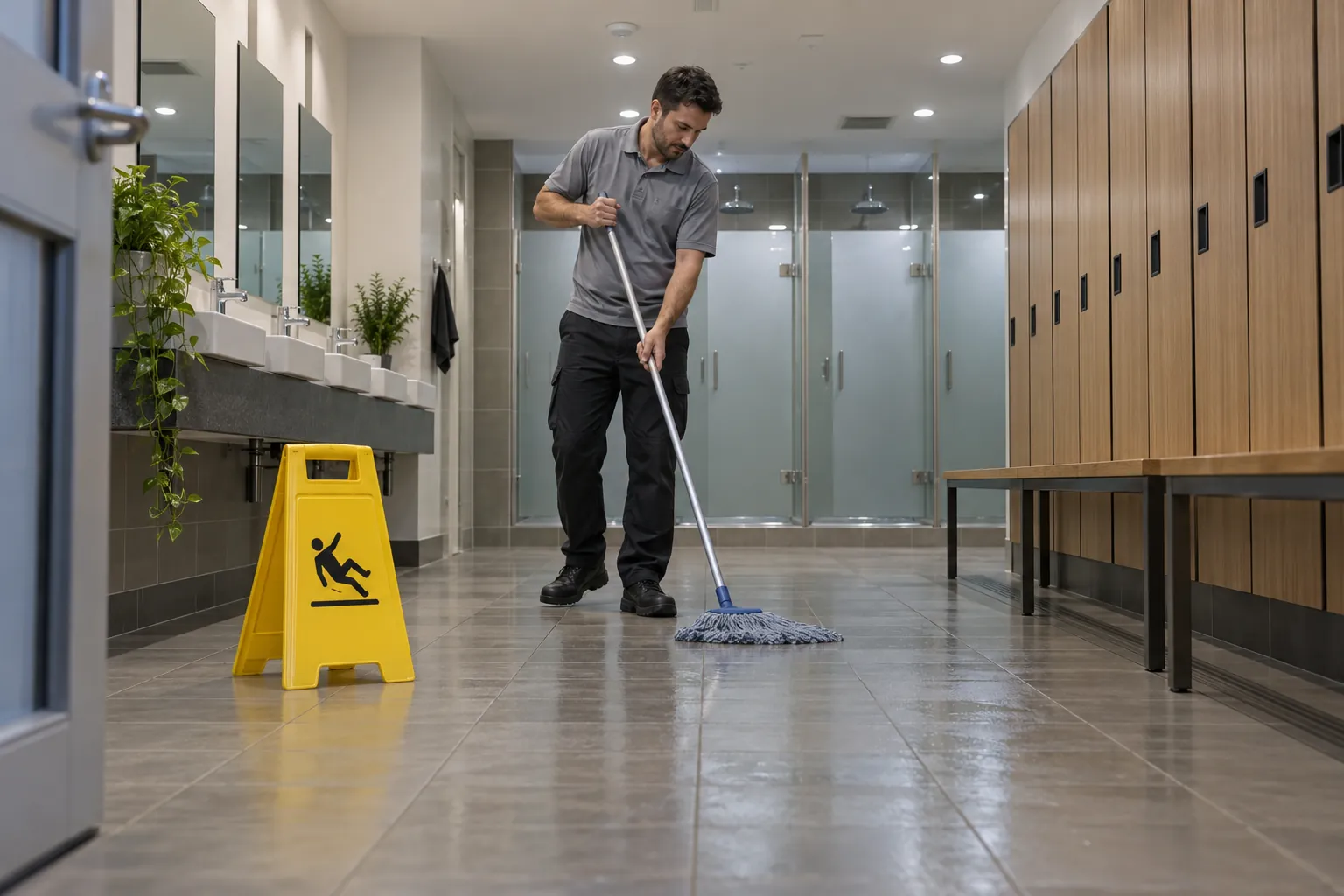
- Clean top to bottom, dry before wet, clean areas before dirty ones, with amenities last or with separate equipment, so dirt and germs are not carried from one area to the next.
- Put the colour code on the list. Separate colours of cloth, mop and bucket for amenities, general areas and kitchens keep toilet equipment off kitchen benches, a basic hygiene measure. Schemes vary between suppliers, so write this site's on the checklist.
- Name the chemicals, and keep them legal. The product, dilution and contact time come from the safety data sheet (SDS) and the label. Under the regulations the current SDS must be readily accessible to the workers who use the chemical, and the code of practice Managing risks of hazardous chemicals in the workplace says containers that have had chemicals "transferred into them (decanted) in the workplace" must be labelled correctly. A spray bottle filled from a drum counts.
- Watch the floor you have just made wet. The code warns that slips "may be increased by the use of some cleaning agents": signs out, the right dilution, and a dry path where people must walk.
- Record exceptions, not only ticks. A task not done because a room was locked or a meeting ran late should say so. So should anything found: a leaking tap, a blown light, a stain that will not come out, a broken dispenser.
- Plan for working alone. The code's example of isolated work is "a cleaner working by themselves at night in a city office building". Put check-in times on the list.
- Make the list fit the hours. If it takes longer than the hours on site, it will be completed on paper, not in the building. Time each area once and set the list, or the hours, to match.
Keep one checklist per area or per route, not one for the whole building. When something is missed, a list per area shows where; a single sheet for the building shows only that the shift ended.
05
How to check the checklist is being followed
A completed checklist shows the work was recorded. Whether it was done, and done well, needs someone else to look. The code of practice says workplace conditions "should be monitored on a regular basis", and that floors "must be inspected regularly and maintained to eliminate or minimise slip and trip hazards". In practice the checking comes in layers:
- The supervisor's walk-through. A short, regular inspection of a sample of areas against the checklist, at varied times, including first thing in the morning when the night's work is fresh. The cleaning supervisor duties guide covers the role.
- Joint inspections. A scored walk-through against the standards in the scope of works, often monthly and ideally with the client's facility or building manager, so both sides judge the same areas against the same words.
- Complaints and requests. Every complaint is a data point: where, when, and whether the checklist for that area showed the task as done.
- Completion against the schedule. How many scheduled tasks were done, and why the rest were not. A clean sweep every night with never an exception usually means nobody is looking closely.
Review the checklist whenever the building's use changes: a new tenant, a refurbished floor, different hours, a café opening in the foyer. Many offices are busiest mid-week and near empty on Mondays and Fridays, and a list written for five identical days wastes effort on the quiet ones.
06
Where the checklist record fails, and what SiteClara does about it
The paper checklist fails the same way everywhere. It is filled in by the person whose work it records, often at the end of the shift, and kept in the cleaners' store room. The amenities sheet on the back of the door is initialled for the whole week on Monday, and a contractor with twenty sites hears about a missed floor when the complaint arrives.
SiteClara records the work at the location. A printed QR poster, with an optional NFC tag behind it, goes at each area on the checklist, such as an amenities block, a lift lobby, a kitchenette or an end of trip facility. A member of the team scans the code or taps the tag on their own phone, with no app to install, and sees the scheduled checks due there. They mark each one done, with a photo when the check asks for one, or say what stopped them. The time and the person are recorded as it happens. A fault found on the round, such as a leaking tap or a broken dispenser, can be reported at the same tag and goes onto the team's list of open jobs until someone closes it.
The supervisor sees what is due, done and missed across the building, can give the reason a check was missed, and sees open jobs grouped by building and floor. At the end of the day they review it, add a note and approve a report, which goes to nominated client or management contacts the next morning, showing what was completed, what was reported and what is still open.
07
Questions people ask
What is included in commercial cleaning?
Whatever the scope of works says, but it starts from the work health and safety duty. The code of practice Managing the work environment and facilities says "The work environment must be maintained so that it remains in a clean and safe condition", that consumables such as soap and toilet paper should be replenished regularly, and that eating areas, toilets, handbasins and showers should be cleaned regularly. Its section on housekeeping adds that "spills on floors should be cleaned up immediately", walkways kept clear and "waste should be regularly removed". In practice that means bins, amenities, kitchens, floors and carpet, touch points and entrances, with periodic work such as carpet extraction and floor care on top.
How often should a commercial building be cleaned: daily, weekly or monthly?
The law sets no fixed timetable. The code of practice Managing the work environment and facilities says workplaces and facilities "should be cleaned regularly taking into account the type of work performed, the likelihood of contamination, the number of workers using them, including during shiftwork, and the type of facility". It is specific in one place: rubbish bins in eating areas "should be emptied at least daily". Most contracts clean amenities, kitchens, bins and high-traffic floors daily, and set weekly, monthly and periodic tasks in the cleaning schedule.
Is there a free commercial cleaning checklist template?
The regulators publish a free review checklist rather than a nightly cleaning list. Appendix B of the code of practice Managing the work environment and facilities asks, among other things, "Are facilities cleaned regularly?" and "Are toilets cleaned regularly and maintained in good working order?". It is useful for checking a building, but the task list itself has to be written for the building, and the area-by-area list in this guide is a starting point.
08
Where to read more, and a list to take away
Start with the code of practice Managing the work environment and facilities: section 2 on the work environment, floors and housekeeping, section 3 on toilets, washing and eating facilities, and Appendix B, a review checklist that asks, among other things, "Are toilets cleaned regularly". Each state regulator publishes the version approved for its jurisdiction. For chemicals, read Managing risks of hazardous chemicals in the workplace; in Victoria, WorkSafe Victoria's Compliance code: Workplace facilities and the working environment. Where food is prepared, Food Standards Australia New Zealand's Safe Food Australia explains Standard 3.2.2, with an appendix on cleaning and sanitising.
Before you hand a commercial cleaning checklist to the team, check that it:
- is divided by area and written in the order the work is done;
- matches the scope of works, with nothing on it the contract does not cover;
- takes its frequencies from the cleaning schedule, not a separate list;
- names the colour code and the product for each area, with the SDS to hand;
- has room to record tasks not done, and why, and faults found;
- includes check-in arrangements for anyone working alone;
- fits the hours on site when done properly;
- is checked by someone other than the person who completed it;
- has a review date, and is reviewed sooner when the building's use changes.
Sources
Every document this guide quotes or links to, in the order it first cites them.
- Work Health and Safety Act 2011 legislation.qld.gov.au
- Work Health and Safety Regulation 2011 legislation.qld.gov.au
- Work Health and Safety Regulations 2011 legislation.gov.au
- Managing the work environment and facilities safework.nsw.gov.au
- Occupational Health and Safety Act 2004 legislation.vic.gov.au
- Compliance code: Workplace facilities and the working environment worksafe.vic.gov.au
- Managing risks of hazardous chemicals in the workplace safework.nsw.gov.au
- Safe Food Australia foodstandards.gov.au
Related guides
 CleaningOffice cleaning checklist: what to clean, how often, and how to show it was doneAn office cleaning checklist for Australian workplaces: what WHS law expects, room-by-room tasks, how often, who does what, and how to show the list is kept.
 CleaningCleaning log sheet: what to record, who signs it, and what a signature provesWhat a cleaning log sheet should record in Australian workplaces and food businesses, the WHS and food safety rules behind it, and what a signature proves.
 CleaningCleaning supervisor duties: what the role involves in Australia, and what good looks likeWhat a cleaning supervisor does in Australia: the Cleaning Services Award, WHS duties, a typical shift, managing the team, checking the work and reporting.
 CleaningCleaning contracts in Australia: what to put in them, and how to know they are workingWhat an Australian commercial cleaning contract should cover, how the Cleaning Services Award and Fair Work Act shape it, and how to show the work was done.