Fire and water checks
Communal fire door checks in blocks of flats
Communal fire door checks are a legal duty in England: in a block of flats whose top storey is more than 11 metres above ground level, the responsible person must check every fire door in the communal areas at least every three months, under regulation 10 of the Fire Safety (England) Regulations 2022.
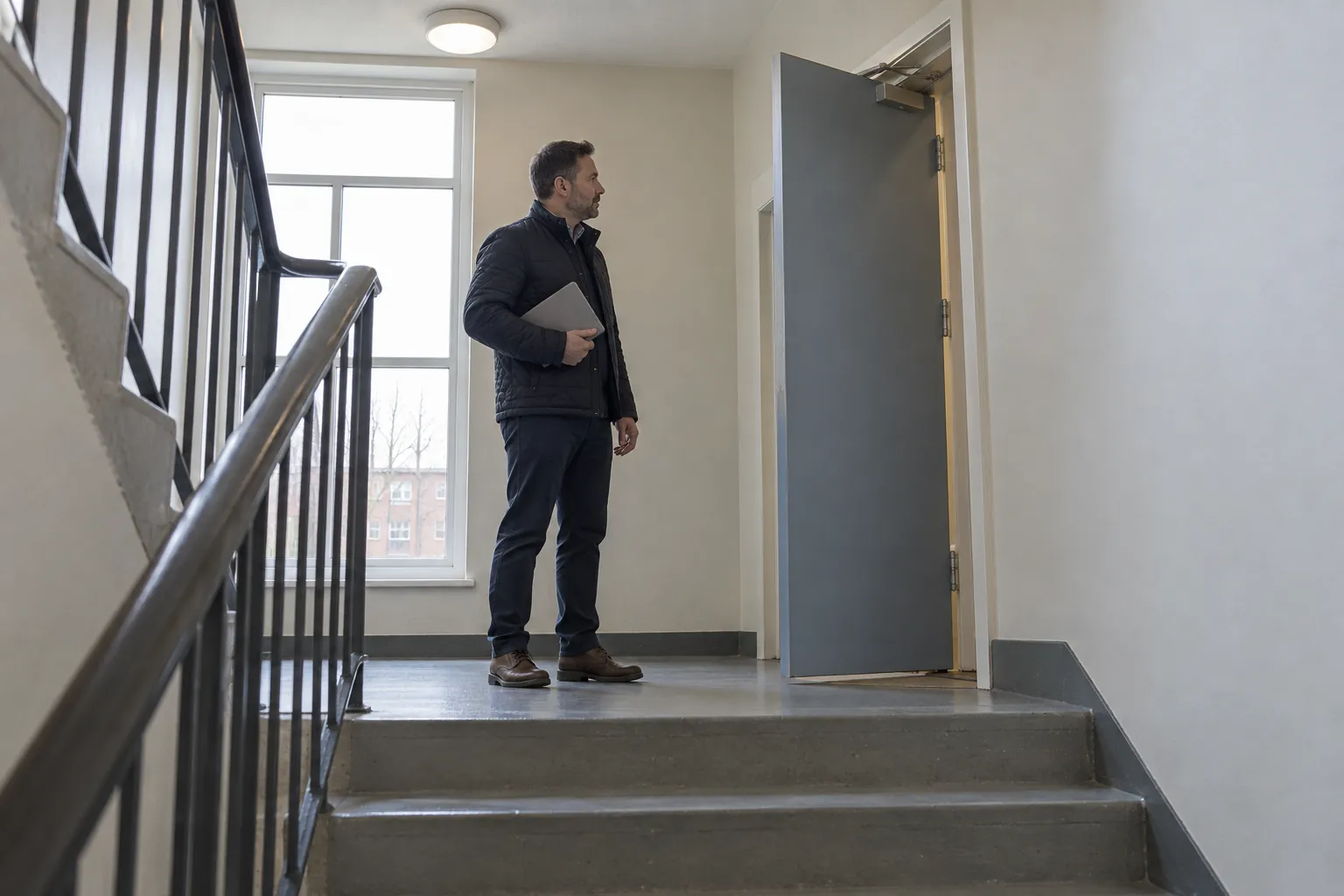
In those blocks the same regulation requires best endeavours to check each flat entrance door at least every 12 months, and both duties have applied since 23 January 2023. This guide explains what the regulations require, who does the checks, what a check looks at, and how to show it was done.
01
The Fire Safety (England) Regulations 2022
Communal fire door checks are required by regulation 10 of the Fire Safety (England) Regulations 2022: the responsible person for a block of flats in England above 11 metres, measured to the top storey, must check every communal fire door, including its self-closing device, at least every three months.
The communal areas of a block of flats, such as the entrance hall, corridors, stairs and landings, fall under the Regulatory Reform (Fire Safety) Order 2005, which places fire safety duties on the responsible person. The Fire Safety Act 2021 made clear that, in buildings containing two or more sets of domestic premises, the Order also covers the building's structure, external walls and the entrance doors to individual flats.
Fire doors are a central part of a block's passive fire protection. Each flat and each section of the common parts is designed as a compartment, and the fire resisting doors between them are what hold back the spread of fire and smoke long enough for residents to escape, and for firefighters to work. Many blocks are designed so that residents whose flat is not affected can stay where they are, and that depends on every door in the chain closing properly. A single wedged stair door, or a flat entrance door with its closer removed, can let fire and smoke into the escape route that everyone else relies on.
The Fire Safety (England) Regulations 2022, made under the Fire Safety Order, came into force on 23 January 2023. They implement recommendations from the Grenfell Tower Inquiry's first report, and regulation 10 deals with fire doors in multi-occupied residential buildings. In such buildings in England where the top storey is more than 11 metres above ground level, the responsible person must:
- check all fire doors in the communal areas at least every three months; and
- use their best endeavours to check all flat entrance doors at least every twelve months.
In every multi-occupied residential building with communal areas, whatever its height, the responsible person must also give residents information about fire doors: that they should be kept shut when not in use, that residents should not tamper with self-closing devices, and that faults or damage should be reported straight away.
Buildings of 18 metres or more, or at least seven storeys, have further duties under the same regulations, and many are also higher-risk buildings under the Building Safety Act 2022, with an accountable person registered with the Building Safety Regulator. Those duties sit alongside the fire door checks, not instead of them.
02
Who is responsible for the checks
In a block of flats the responsible person is whoever has control of the common parts. Depending on the building, that may be:
- the freeholder or landlord, including a local authority or housing association;
- a residents' management company or right to manage company, where the leaseholders run the building;
- a managing agent, who usually carries out the checks under contract on the responsible person's behalf, and may share responsibility to the extent that they have control of the premises.
Where there is more than one responsible person, they must co-operate and co-ordinate. The management agreement should say plainly who arranges the quarterly checks, who does them, who approaches residents about flat entrance doors, who keeps the records, and who pays for repairs.
Flat entrance doors are often part of the flat under the lease, so the leaseholder or tenant may own or be responsible for repairing the door while the responsible person has the duty to check it. That is why the duty for flat entrance doors is best endeavours: the responsible person needs access, and cannot always get it. Residents have a part to play too: keeping doors shut, not removing closers, and reporting faults.
Nothing in the fire safety regulations requires the quarterly checks to be done by a specialist. The government's guidance describes them as basic visual checks, not a fire door inspection, that a person with suitable knowledge can carry out, such as a caretaker, estate officer, block manager or concierge who has been shown what to look for. A fault they find may well need a fire door specialist to put right.
03
What a communal fire door check covers
The government's guidance sets out the kind of check it expects of fire doors in communal areas and flat entrance doors. Fire doors must close and seal properly to do their job, so the check concentrates on the things that stop them doing so. For each communal fire door, and each flat entrance door when access allows, the person checking looks at whether:
- the door closes by itself, fully and firmly into the frame, from any angle it is opened to, overcoming any latch;
- the self-closing device works and has not been disconnected, removed or damaged;
- the door is not wedged or propped open, and any hold-open device releases when it should;
- intumescent strips and smoke seals on the door or frame, where fitted, are undamaged, make contact with the door edge or frame, and are not painted over;
- the gap between the door and the frame is even and not excessive, and the door is not catching on the frame or floor;
- the hinges are secure, with no missing screws;
- any glazing in the door or around it is intact;
- the door and frame are free of damage, holes and unapproved alterations.
Flat entrance doors raise problems that communal doors rarely do: a resident has replaced the door with one that is not fire rated, fitted a cat flap or a new letterbox, removed the closer because it slammed, or added locks that damaged the frame. The check should note what is found and who was told, not try to settle the lease question on the doorstep.
04
Flat entrance doors and best endeavours
Best endeavours means making genuine, recorded attempts to get access, not giving up after one letter. A reasonable approach looks like this:
- write to each resident in advance, explaining the legal requirement, why the check matters and how long it takes;
- offer appointments at different times, including evenings or weekends where the block's residents work during the day;
- record each attempt: the date, what was offered, and the outcome;
- where access is refused or never offered, follow up, and consider whether the lease gives a right of access for inspections;
- note any risk the missing check leaves, for the fire risk assessor to consider.
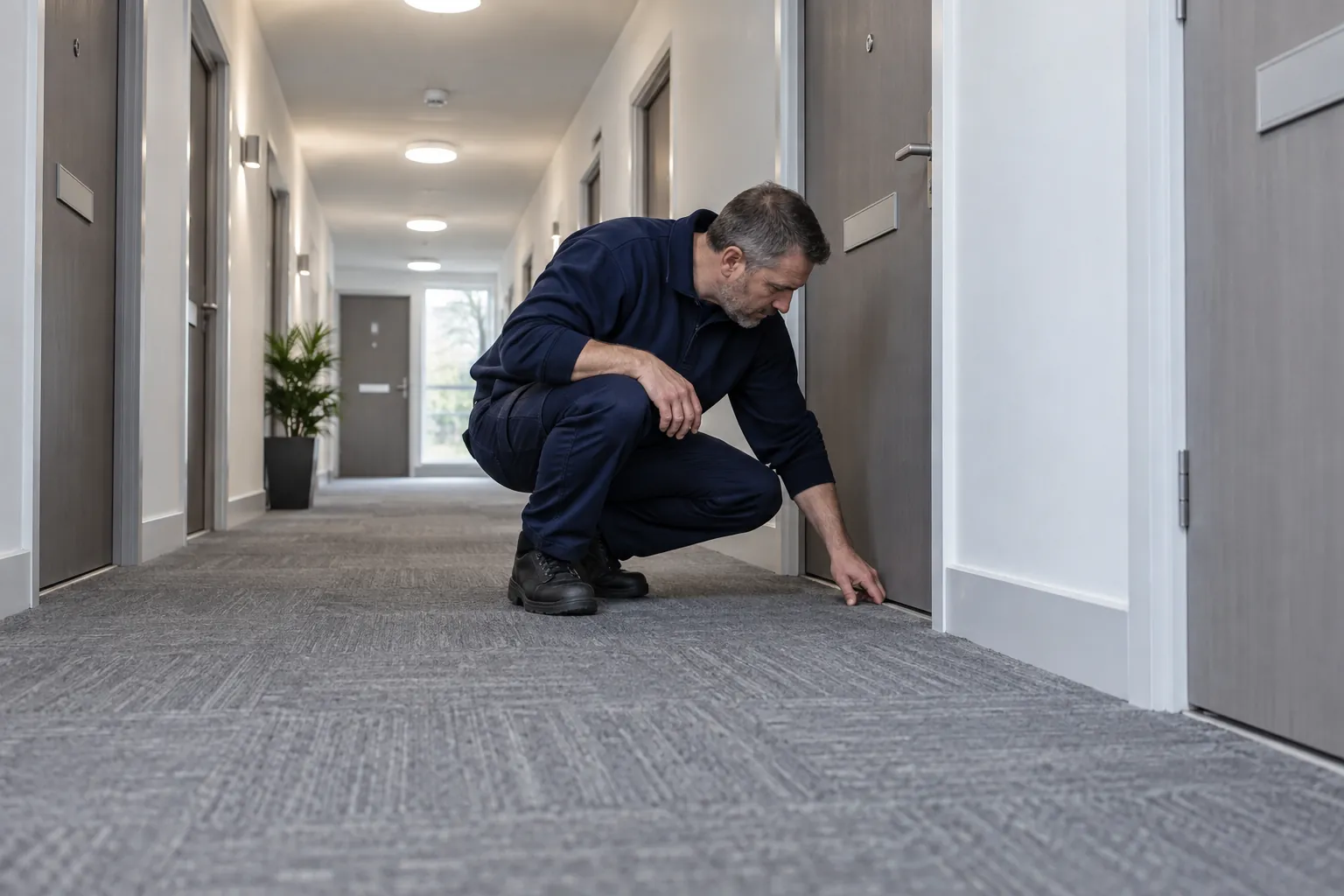
The outside face of a flat entrance door can often be checked from the corridor without access: closing action, gaps and seals on the frame, signs of damage. A partial check, recorded as partial, is better than none, and the record should be clear that the inside was not seen.
When a defect is found, the resident should be told in writing what it is and, where they are responsible for the door, what needs to happen. The responsible person should record the follow-up. Leaseholders and tenants can find independent advice on who pays for flat entrance doors from the Leasehold Advisory Service.
05
Keeping records, and telling residents
The regulations set the checks; they do not prescribe a form. But a responsible person who cannot show the checks happened will find it hard to show that they did, whether to the fire and rescue service, the fire risk assessor, an insurer or a lender. For each quarterly check, the record should show:
- the date and who carried it out;
- each door checked, by a reference such as a floor and door number, so a check of eleven doors out of twelve is visible;
- what was found at each door, including doors that passed;
- each fault reported, with a photo where it helps, who it went to, and when it was fixed;
- any door not checked, and why.
For flat entrance doors, keep the same detail plus the record of access attempts: regulation 10(5) requires the responsible person to keep a record of the steps taken to check flat entrance doors, including, where access was not granted in a 12-month period, the steps taken to try to get it. Keep copies of the fire door information sent to residents: it should go to each resident when they move in and at least once a year after that.
A pattern is often more useful than a single check. The same corridor door found wedged every quarter tells you something about how residents use the building, and may be a question for the fire risk assessor, such as whether a door on a hold-open device linked to the fire alarm would be safer than a door that is permanently propped.
06
Where the record fails, and what SiteClara does about it
A managing agent with a portfolio of blocks has four quarterly checks a year per building, each with its own list of doors, and a handful of people doing them. The check becomes a line on a contractor's invoice or a spreadsheet updated from memory, and the first anyone knows of a missed quarter is when a fire risk assessor, or the fire and rescue service, asks for the evidence.
SiteClara puts a printed QR poster at each location in the block, such as each landing or stair lobby, with an optional NFC tag behind it. The person doing the check scans the code or taps the tag on their own phone, with no app to install; they are enrolled by text and sign in with a link. They see the checks due at that location, such as the quarterly check of that landing's fire doors, and mark each one done, or explain what stopped them. A fault, such as a damaged seal or a closer that has been removed, is reported there with a photo and goes onto the team's list of jobs until someone closes it.
The supervisor sees what is due, done and missed across the block and can record why a check was missed; a job that needs the building manager can be escalated to them to answer. Each day the supervisor reviews and approves a report, which goes to nominated contacts, such as the managing agent's property manager or the client, at 8am the next morning, showing what was reported, completed and still open, and how the scheduled checks went, for example 12 of 12 completed. It is priced per building, with no per-person fees.
07
Questions people ask
Is there a legal requirement to inspect fire doors?
Yes: in England, regulation 10 of the Fire Safety (England) Regulations 2022 requires the responsible person for a block of flats above 11 metres to check communal fire doors at least every three months and to use best endeavours to check flat entrance doors at least every 12 months. In England and Wales, whatever the building's height, article 17 of the Regulatory Reform (Fire Safety) Order 2005 requires the responsible person, where necessary to safeguard relevant persons, to make sure the premises and the facilities, equipment and devices provided under the Order are subject to a suitable system of maintenance and kept in efficient working order and good repair. The Home Office's fact sheet on regulation 10 adds that, in blocks below 11 metres, the general duty to put in place fire precautions includes making sure fire doors, including flat entrance doors, are capable of providing adequate protection.
What is the new law on fire doors in the UK?
The Fire Safety (England) Regulations 2022, in force since 23 January 2023, brought in specific fire door duties, and they apply in England only: quarterly checks of communal fire doors and best-endeavours annual checks of flat entrance doors in blocks above 11 metres, and fire door information for residents of every block of flats with common parts that residents would use to escape in an emergency. The information must reach each new resident as soon as reasonably practicable after they move in, and every resident within each 12-month period.
08
Further reading, and a list to take away
GOV.UK publishes the guidance on the Fire Safety (England) Regulations 2022, including a fact sheet on fire doors (regulation 10) and template information for residents. The regulations themselves are on legislation.gov.uk. The Local Government Association's guide Fire safety in purpose-built blocks of flats, London Fire Brigade's guidance for property managers, the National Fire Chiefs Council, the BWF Fire Door Alliance and the Leasehold Advisory Service all publish further guidance. For fire doors in other buildings, see our guide to fire door checks.
For each block, check that:
- you know whether its top storey is above 11 metres, and so whether the quarterly and annual checks apply;
- the management agreement says who carries out, records and follows up the checks;
- every communal fire door and flat entrance door has a reference and is on a list;
- communal doors are checked at least every three months, and each check is recorded door by door;
- flat entrance door checks are attempted every year, with each attempt recorded;
- faults are reported, followed up and closed, and patterns go to the fire risk assessor;
- residents receive the fire door information when they move in and every year.
Sources
Every document this guide quotes or links to, in the order it first cites them.
- Regulation 10 of the Fire Safety (England) Regulations 2022 legislation.gov.uk
- Regulatory Reform (Fire Safety) Order 2005 legislation.gov.uk
- Fire Safety Act 2021 legislation.gov.uk
- Building Safety Act 2022 legislation.gov.uk
- Article 17 of the Regulatory Reform (Fire Safety) Order 2005 legislation.gov.uk
- Fact sheet on fire doors (regulation 10) gov.uk
Related guides
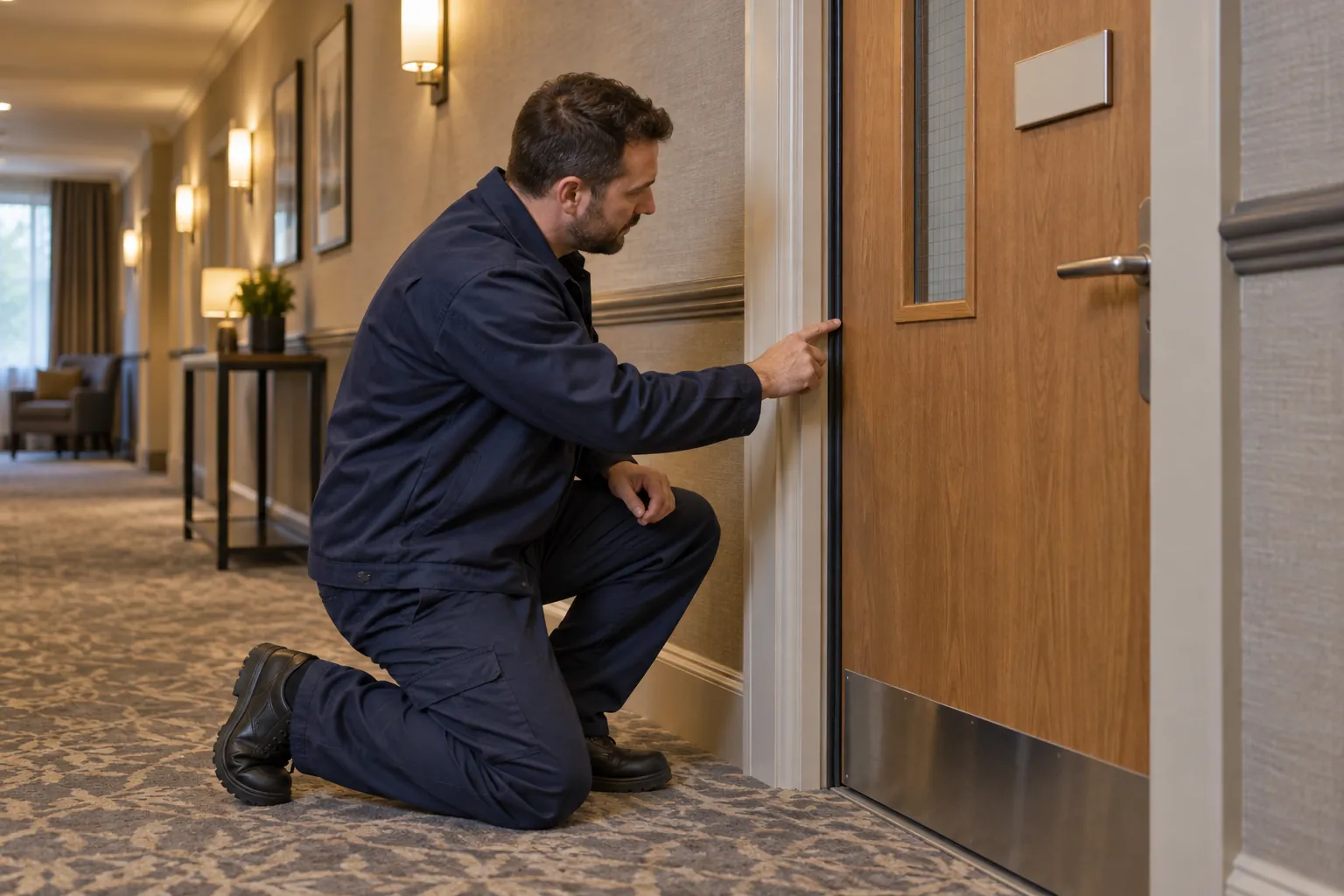 Fire and water checksFire door checks: what a routine check looks atFire door checks in any building: gaps, seals, closers, hinges, glazing and signs, how often to check, and when to call a fire door inspector.
 Premises and facilities managementManaging agent responsibilities in residential block managementWhat a managing agent does for a block of flats in England and Wales: service charges, the RICS code, repairs, fire safety in common parts, and records.
 CleaningCommunal area cleaning: what it covers, how often, and how to show it was doneWhat communal area cleaning should cover in blocks of flats and shared buildings, how often, who pays through the service charge, and how to show it was done.
 Fire and water checksFire safety checks in the workplace: what to check, how often, and who does itThe routine fire safety checks a UK workplace needs, from daily escape routes to the weekly alarm test, who does each one, and what the record should show.