Fire and water checks
Fire door checks: what a routine check looks at
Fire door checks are simple, regular visual checks that each fire door closes fully into its frame by itself, has no gap to its frame of more than 4 mm except at the bottom (the industry standard), and has its seals, hinges, glazing and signs intact.
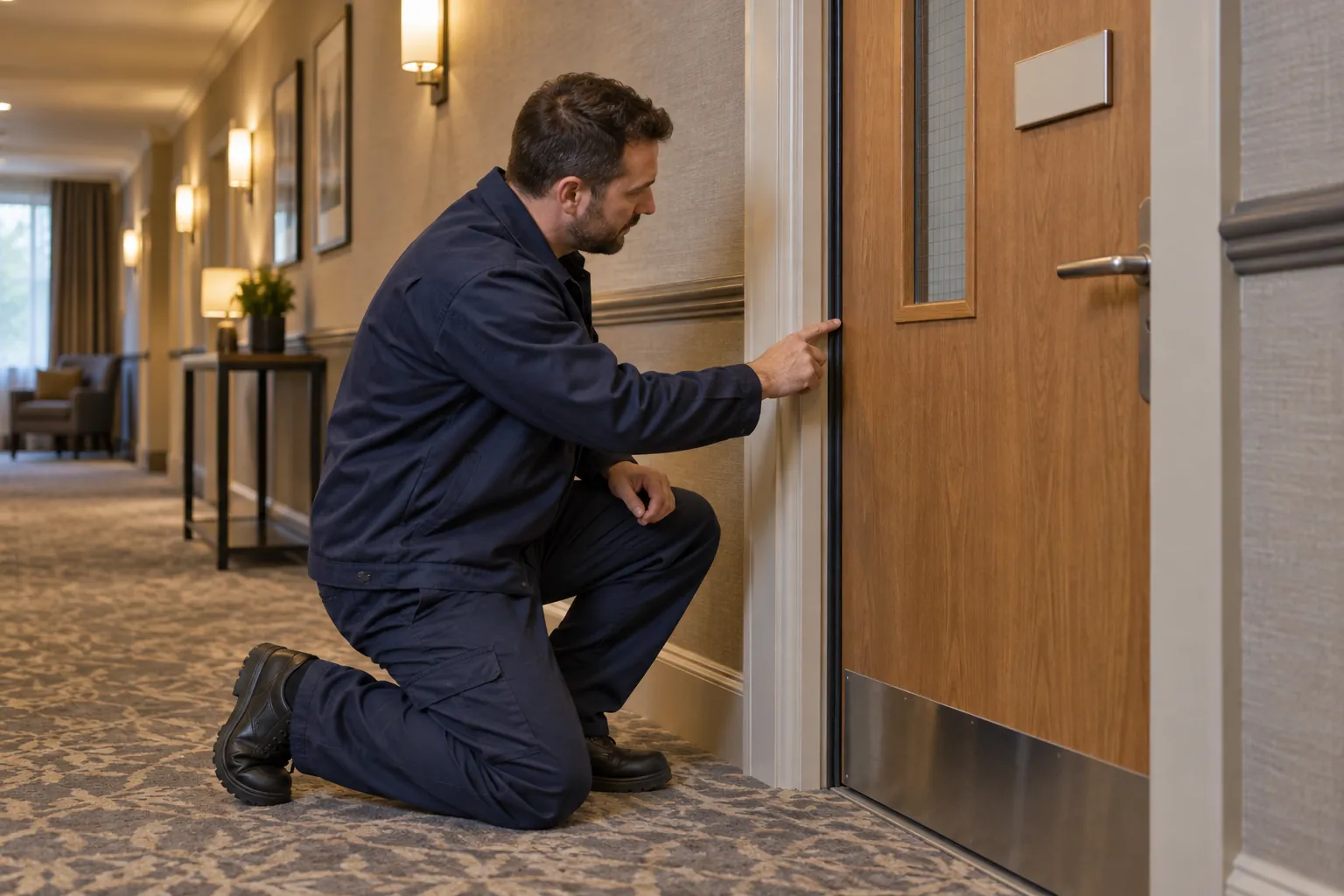
A fire door only works if it does all of that on the day it is needed. This guide covers what a routine fire door check looks at in an office, school, hotel, shop or any other building, how often to do it, and when a fault needs a fire door inspector rather than a note in the log.
01
What a fire door is for, and the duty to maintain it
In England and Wales, article 17 of the Regulatory Reform (Fire Safety) Order 2005 requires the responsible person, where necessary to safeguard the people the Order protects, to keep fire safety facilities, equipment and devices, fire doors among them, subject to a suitable system of maintenance and in efficient working order and good repair, and regular fire door checks are part of meeting that duty. A fire door is a door assembly, meaning the door leaf, frame, hinges, closer, seals, glazing and other hardware together, that has been tested and certified to resist fire for a set time. The rating is usually written as FD30 or FD60, for 30 or 60 minutes, with an S (FD30S) where the door also has smoke seals to hold back cold smoke. Fire doors are part of a building's passive fire protection: they maintain the compartmentation that divides it into sections, slow the spread of fire and smoke, and keep escape routes usable, giving the occupants time to escape in the event of a fire. A fire resisting door that is wedged open, or no longer fits its frame, gives none of that protection, however good its fire rating.
Where fire doors are needed is decided when the building is designed, under the Building Regulations; in England the guidance is Approved Document B. Once the building is in use, the duty to keep them working sits with the responsible person under the Regulatory Reform (Fire Safety) Order 2005 (the FSO) in England and Wales. Its legal duties apply to almost every non-domestic building and to the common parts of residential ones. The fire risk assessment should say how that maintenance is done. In Scotland the equivalent duties are in the Fire (Scotland) Act 2005, and in Northern Ireland in the Fire Safety Regulations (Northern Ireland) 2010.
For most workplaces the law sets the duty, not a checking frequency. The exception is residential blocks in England: the Fire Safety (England) Regulations 2022, in force since 23 January 2023, set specific checks of communal fire doors and flat entrance doors in a block of flats or other multi-occupied residential building over 11 metres. The Fire Safety Act 2021 had already made clear that flat entrance doors fall within the Order. Those rules, and who carries them out, are covered in our guide to communal fire door checks. This guide is about fire doors in any building.
02
Where fire doors are, and which get the most wear
Before a routine check can happen, someone needs a list of the fire doors in the building. The fire risk assessment or the building's fire strategy drawings usually show them. A typical workplace has fire doors on:
- Stairwells, protecting the escape stairs on every floor.
- Corridors, where cross-corridor doors divide a long escape route into sections.
- Lobbies between a stair and the rest of the floor.
- Higher-risk rooms: kitchens, plant rooms, boiler rooms, electrical intake rooms, server rooms and large store rooms.
- Riser and service cupboards, which are usually meant to be kept locked shut.
- Rooms opening onto an escape route, such as bedrooms in a hotel or care home, or offices off a single escape corridor.
Give each door a reference, such as a floor and a number, so a fault can be tied to one door and a record can show every door was checked. Mark which are the busiest. A stairwell door on a main route may open hundreds of times a day, and busy doors wear their hinges, closers and seals much faster than a plant room door that is opened once a month. They are also the doors most likely to be wedged open, because people find them heavy.
03
What a routine fire door check looks at
Routine checks are visual inspections with a practical test of the closer. They take a minute or two per door, and can be done by a trained member of staff. The aim is to find wear and tear, signs of damage and misuse before they become a defect that stops the door working. The BWF Fire Door Alliance and fire and rescue services publish simple versions; most cover the same ground:
- Not wedged or propped open. The door is closed, or held open only on a hold-open device that releases it when the fire alarm sounds. Wedges, fire extinguishers and furniture used as door stops should be removed and reported.
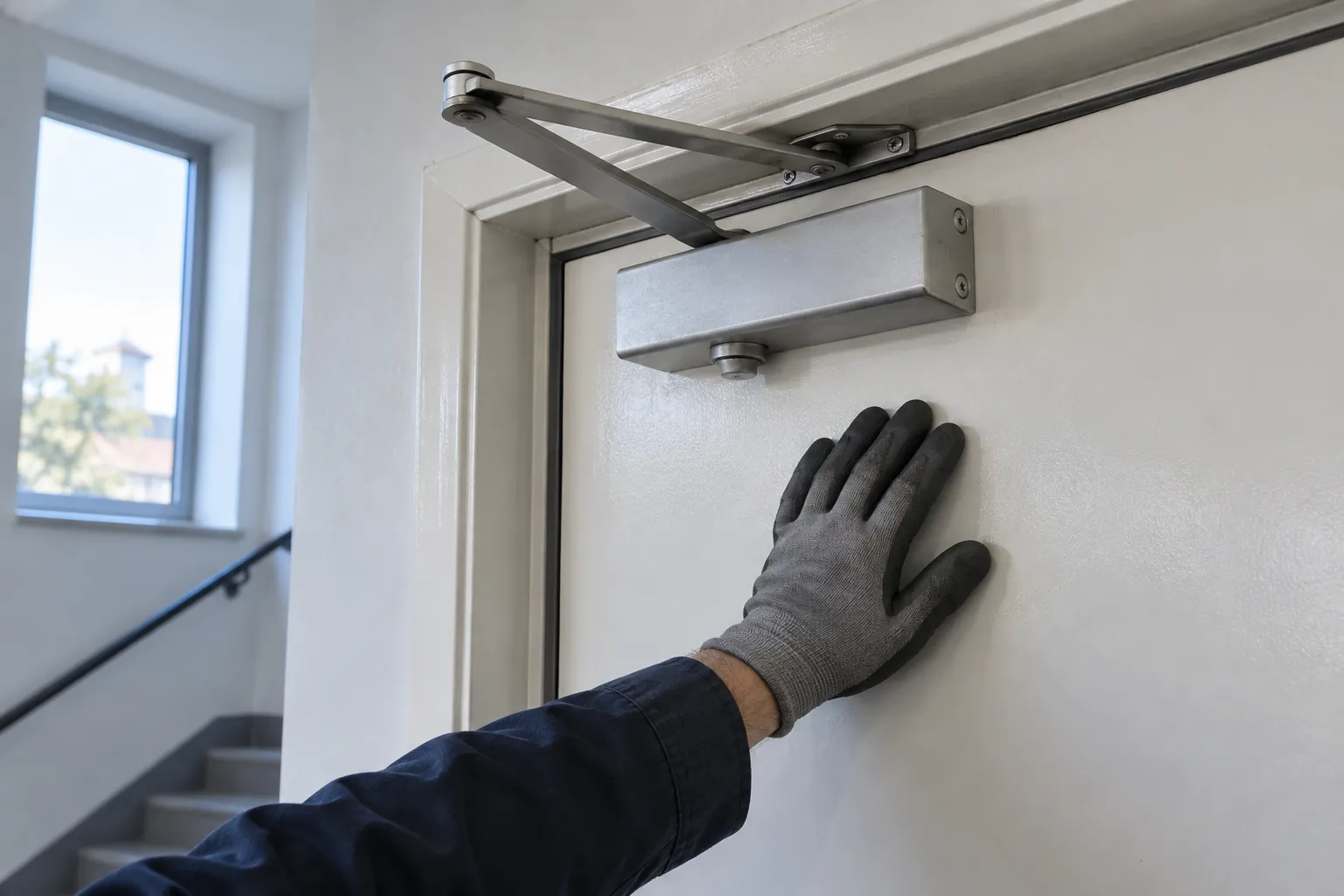
- It closes by itself. Open the door fully and let go, then open it to about 15 degrees and let go, the simple test suggested in the government's Fire Safety (England) Regulations 2022 fire door guidance, written for blocks of flats. Each time it should close fully onto the latch without sticking on the frame or floor, and without slamming. A door that stops short or has a disconnected or broken closer is a fault.
- The gaps are even. With the door closed, the gap along the top and sides should be even and, as the government's fire door guidance puts the industry standard, never more than 4 mm. The gap under the door should be as small as practicable without the door snagging on the floor, and the door's certification or manufacturer's information says what it may be. A gap that is too wide, or a door rubbing on the frame, suggests dropped hinges or movement.
- Seals are present and undamaged. Intumescent strips, which swell in heat to close the gap, and brush or blade smoke seals should be continuous, firmly fixed and not painted over, torn or missing.
- Hinges are secure. Usually three or more, with no missing or loose screws, no leaking oil and no sign of wear.
- Glazing is intact. Vision panels are unbroken, with their glazing beads and seals in place.
- The door and frame are undamaged. No holes, splits, delamination or unfilled holes from old fittings, and no alterations such as a new letterbox, cat flap or lock cut in without advice.
- The sign is in place. Most fire doors carry a "Fire door keep shut" sign; cupboards usually say "keep locked", and doors on hold-open devices say "keep clear".
- The label is there. Many certified fire doors carry a label or plug, often on the top or hinge edge, identifying the door. It is worth noting whether one is present, though a missing label does not by itself mean the door is not a fire door.
Any defect goes into the record and to whoever arranges repairs, with the door reference and, where it helps, a photo. A door that cannot close or latch should be treated as urgent, because until it is fixed it is not fit for purpose.
04
How often fire doors should be checked
There is no single statutory frequency for fire door checks in workplaces, but the duty to maintain fire doors means they need regular inspection. The fire risk assessment should set how often, based on how the building is used and how busy each door is. As a guide:
- Daily: a look on the walk-round that fire doors on escape routes are shut, not wedged, and closing properly. This is the check that catches most problems.
- Monthly or quarterly: the full routine check of every fire door, as in the list above, by a trained member of staff. Busy doors may need it more often.
- Every six months: many guides refer to BS 9999, which recommends fire doors are inspected at least every six months, with heavily used doors checked more often.
- Periodically, and after changes: fire door surveys by a competent fire door inspector, commissioned at the interval the fire risk assessment sets, and whenever doors are replaced, altered, damaged or suspected not to be what they should be.
In buildings in England with two or more sets of domestic premises, such as blocks of flats, that are above 11 metres in height, regulation 10 of the Fire Safety (England) Regulations 2022 requires the responsible person to check fire doors in communal areas at least every 3 months, and to use best endeavours to check flat entrance doors at least every 12 months. Those are legal requirements, not guidance.
05
A routine check or a fire door inspection
A routine check and a fire door inspection are different jobs, and both have a place.
- A routine check is what a trained member of staff can do: is the door shut, does it close, are the seals and hinges intact, is anything obviously broken. It finds wear and misuse early.
- A fire door inspection or survey is done by a competent person, often certificated under a scheme such as the Fire Door Inspection Scheme. It looks at whether each door is a correctly installed, certified fire door assembly: the door leaf, frame, ironmongery, glazing, gaps and seals against its certification, and whether any repairs have compromised its fire resistance. The result is a report on each door, with recommendations, and it is the evidence that the doors are compliant with their certification rather than simply closed.
Call a competent inspector or fire door specialist when:
- a routine check finds gaps well outside tolerance, a warped or split door, damaged glazing or a frame coming away;
- a door has been altered, has had hardware added, or has had old damage filled or patched;
- you do not know whether a door is a fire door, or the fire risk assessment says the doors need a survey;
- doors or frames are being replaced, because a replacement must match the rating and be installed as certified.
Repairs to fire doors should be done by someone competent, using compatible parts. Planing a door to stop it sticking, fitting a thicker seal to close a gap, or replacing hinges and closers with standard parts can all reduce the door's fire resistance without anyone noticing.
06
Where fire door records fail, and what SiteClara does about it
Fire door checks are easy to schedule and easy to lose track of. A building with sixty fire doors has sixty small checks every month, spread across floors and stairwells, and a single tick in the log for "fire doors checked" tells nobody which doors were looked at or what was found. The wedged door gets unwedged and wedged again the next day, and nobody sees the pattern.
SiteClara puts a printed QR poster by each fire door or group of doors, with an optional NFC tag behind it. Staff scan the code or tap the tag on their own phone, with no app to install; they are enrolled by text and sign in with a link. They see the checks due at that location, such as the monthly door check, and mark each one done, or explain what stopped them. A fault, such as a damaged seal, a broken closer or a door wedged open, is reported there with a photo and goes onto the team's list of jobs until someone closes it.
The supervisor sees what is due, done and missed across the building and can record why a check was missed; a job that needs the building manager can be escalated to them to answer. Each day the supervisor reviews and approves a report that goes to nominated management or client contacts at 8am the next morning, showing what was reported, completed and still open, and how the scheduled checks went, for example 12 of 12 completed. It is priced per building, with no per-person fees.
07
Questions people ask
What are the requirements for fire door inspections in the UK?
In England and Wales, article 17 of the Regulatory Reform (Fire Safety) Order 2005 requires the responsible person to keep fire safety facilities, equipment and devices, fire doors included, under a suitable system of maintenance and in efficient working order and good repair. The article sets no inspection frequency, so for workplaces the responsible person and the fire risk assessment set it. In England, buildings containing flats that are above 11 metres in height also need their communal fire doors checked at least every 3 months and their flat entrance doors, on a best-endeavours basis, at least every 12 months.
What is the new law on fire doors in the UK?
The main recent change is regulation 10 of the Fire Safety (England) Regulations 2022, which came into force on 23 January 2023 and applies in England to buildings with two or more sets of domestic premises and common parts. It requires the responsible person to tell residents that fire doors should be kept shut when not in use, that self-closing devices should not be tampered with and that faults should be reported, and, where the building is above 11 metres, to check communal fire doors every 3 months and use best endeavours to check flat entrance doors every 12 months. Fire doors in other buildings, such as offices and shops, remain under the general maintenance duty in article 17 of the Fire Safety Order.
Do you have to be qualified to inspect fire doors?
The law asks for competence rather than a particular qualification: article 18 of the Regulatory Reform (Fire Safety) Order 2005 requires the responsible person to appoint competent persons to help with fire safety measures, meaning people with sufficient training and experience or knowledge. For routine checks in blocks of flats, the government's fire door guidance says the checks should be simple and basic, need no specialist, and can be done with appropriate instruction by caretakers, managing agents, housing officers and maintenance personnel. Repairs or replacement found necessary must be done by a competent contractor, and the guidance says the checks are no substitute for periodic assessment of fire doors by fire safety specialists.
08
Further reading, and a list to take away
The BWF Fire Door Alliance, part of the British Woodworking Federation, publishes free guidance on checking and maintaining fire doors, and runs Fire Door Safety Week each year. The Fire Door Inspection Scheme certificates fire door inspectors. London Fire Brigade publishes guidance on fire doors for property managers, and GOV.UK publishes the Fire safety risk assessment guides for different types of premises. The relevant standards include BS 8214 for timber fire door assemblies and BS 9999 on fire safety in the design, management and use of buildings, published by BSI.
Before the next fire risk assessment review, check that:
- every fire door has a reference and is on a list;
- the fire risk assessment sets how often doors are checked, with busy doors more often;
- the people checking have been shown what to look for and what counts as a fault;
- hold-open devices are seen to release during the weekly fire alarm test;
- each fault is recorded against a door and followed through to repair;
- repairs and replacements are done by someone competent, with compatible parts;
- a competent inspector has surveyed the doors, and their recommendations have been acted on.
Sources
Every document this guide quotes or links to, in the order it first cites them.
- Regulatory Reform (Fire Safety) Order 2005 legislation.gov.uk
- Approved Document B gov.uk
- Fire Safety (England) Regulations 2022 legislation.gov.uk
- Fire Safety Act 2021 legislation.gov.uk
- Fire Safety (England) Regulations 2022 fire door guidance gov.uk
- Regulation 10 of the Fire Safety (England) Regulations 2022 legislation.gov.uk
- Regulatory Reform (Fire Safety) Order 2005 legislation.gov.uk
- Fire safety risk assessment gov.uk
Related guides
 Fire and water checksCommunal fire door checks in blocks of flatsWhat the Fire Safety (England) Regulations 2022 require of communal fire doors and flat entrance doors, who carries out the checks, and how to record them.
 Fire and water checksFire safety checks in the workplace: what to check, how often, and who does itThe routine fire safety checks a UK workplace needs, from daily escape routes to the weekly alarm test, who does each one, and what the record should show.
 Fire and water checksFire marshal checklist: the daily and weekly checks, and the job in an evacuationWhat a fire marshal or fire warden checks each day and week, their role in an evacuation, the law behind the role, and how to keep a record that stands up.
 Premises and facilities managementBuilding manager responsibilities: the duties, the daily work and the recordWhat a building manager is responsible for in UK commercial and residential buildings: legal duties, daily work, contractors and the records that prove it.