Premises and facilities management
Managing agent responsibilities in residential block management
A managing agent's responsibilities are the day-to-day running of a block of flats for whoever is responsible for managing it: service charge budgets, demands and accounts, repairs, insurance, contractors such as cleaners, health and fire safety risk assessments, regular visits and leaseholders' enquiries, the core services the RICS Service Charge Residential Management Code says leaseholders should normally expect.

The agent may act for the landlord, a residents' management company or a right to manage company. This guide covers what a managing agent is responsible for in England and Wales, the law and code behind the role, service charges, health and fire safety in the common parts, and what leaseholders are entitled to see.
01
What a managing agent is, and who they act for
A managing agent is a firm or individual appointed to carry out the day-to-day management of a residential block on behalf of whoever has the legal responsibility for it. In leasehold property that is usually one of three clients:
- The freeholder or landlord, who owns the building and has management obligations under the leases.
- A residents' management company (RMC), owned by the leaseholders and often named in the lease as responsible for management, run by RMC directors who are volunteers.
- A right to manage (RTM) company, formed by leaseholders under the Commonhold and Leasehold Reform Act 2002 to take over management functions from the landlord.
The managing agent acts on behalf of the client under a written management agreement. A useful division of roles and responsibilities: the client, whether a property owner or the directors of one of the resident management companies, is setting policy; the agent carries it out within the terms of the lease. The client keeps the ultimate legal responsibility: using a managing agent does not transfer the landlord's obligations under the lease or under health and safety and fire safety law. What the agent takes on is the work of meeting them, and a duty to the client to do that work with reasonable skill and care.
The phrase is also used in the private rented sector for letting agents who manage tenancies for landlords. That is a different job, with its own rules on deposits, licensing and tenancy law. This guide is about block management.
02
The law and the code behind the role
In England and Wales there is no general licensing scheme for residential managing agents, although the government has said it intends to regulate the sector more closely. The role is shaped instead by landlord and tenant legislation, a code of practice and membership of professional bodies:
- The lease: the starting point for everything, and the first document to read before you appoint a managing agent. It sets out the landlord's obligations to repair, insure and provide services, what can be charged through the service charge, and how.
- The Landlord and Tenant Act 1985: service charges must be reasonably incurred and for work or services of a reasonable standard (section 19); leaseholders must be consulted before qualifying works or long-term agreements above set limits (section 20); and leaseholders have rights to information about service charges.
- The Landlord and Tenant Act 1987: service charge money is held on trust for the leaseholders (section 42), demands must carry the landlord's name and address, and a tribunal can appoint a manager where management has failed.
- The RICS Service Charge Residential Management Code, published by the Royal Institution of Chartered Surveyors. Its 4th edition, approved by the Secretary of State under section 87 of the Leasehold Reform, Housing and Urban Development Act 1993 by an order in force from 7 April 2026, applies to residential leasehold property in England, and its best practice applies to every landlord and managing agent, not only RICS members. A breach is not an offence and does not of itself make anyone liable, but under section 87(7) an approved code is admissible in evidence before a court or tribunal, which must take any relevant provision into account, and RICS says it can also be used in redress scheme investigations.
- Redress: in England, anyone doing property management work must be a member of a government-approved or government-administered redress scheme, under article 5 of the Redress Schemes for Lettings Agency Work and Property Management Work (Requirement to Belong to a Scheme etc) (England) Order 2014, so leaseholders have somewhere to take a complaint that is not resolved.
Professional bodies set further standards for their members, including adequate professional indemnity insurance, client money protection or fidelity insurance cover, and continuing training. The Association of Residential Managing Agents (ARMA) and the Institute of Residential Property Management (IRPM), long the main bodies for block management, have combined as The Property Institute. The Leasehold and Freehold Reform Act 2024 will change several service charge rules as its provisions come into force, so check which parts apply at the time you read this.
03
The main responsibilities of a managing agent
Management agreements differ, but the role of a managing agent in a residential block usually covers:
- Financial management: preparing the annual service charge budget, issuing demands in the form the law requires, collecting payments, chasing arrears, and producing year-end accounts as set out in the lease. Where the landlord asks, the agent may also collect ground rent.
- Client money: holding service charge and reserve fund money in designated client accounts, separate from the agent's own money.
- Repairs and maintenance: arranging day-to-day repairs to the structure and common parts, planning cyclical maintenance such as external redecoration, and managing major works, including section 20 consultation.
- Services: appointing and supervising contractors for cleaning, gardening, lifts, door entry, lighting, waste and window cleaning, and checking the work is done.
- Insurance: arranging buildings insurance where the landlord is obliged to insure, handling claims, and being open about any commission received.
- Health and safety and fire safety in the common parts, as below.
- Leaseholders: answering enquiries and complaints, dealing with breaches of the lease such as nuisance or unauthorised alterations, and providing information for flat sales.
- Company secretarial work: for an RMC or RTM company, where agreed, keeping records, filing returns and supporting general meetings.
- Handover: when a new managing agent is appointed, taking over records, accounts, contracts and money from the previous one in an orderly way.
The management agreement should list each service, the fee for it, what counts as extra, how long the agreement runs and how either side can end it. Managing agent cost is usually a fixed annual fee per flat or per building for the core management services, with separate charges for major works and extra tasks; ask for the full fee schedule when choosing a managing agent. Many disputes between RMC directors and their agent come from tasks nobody wrote down.
04
Health and safety and fire safety in the common parts
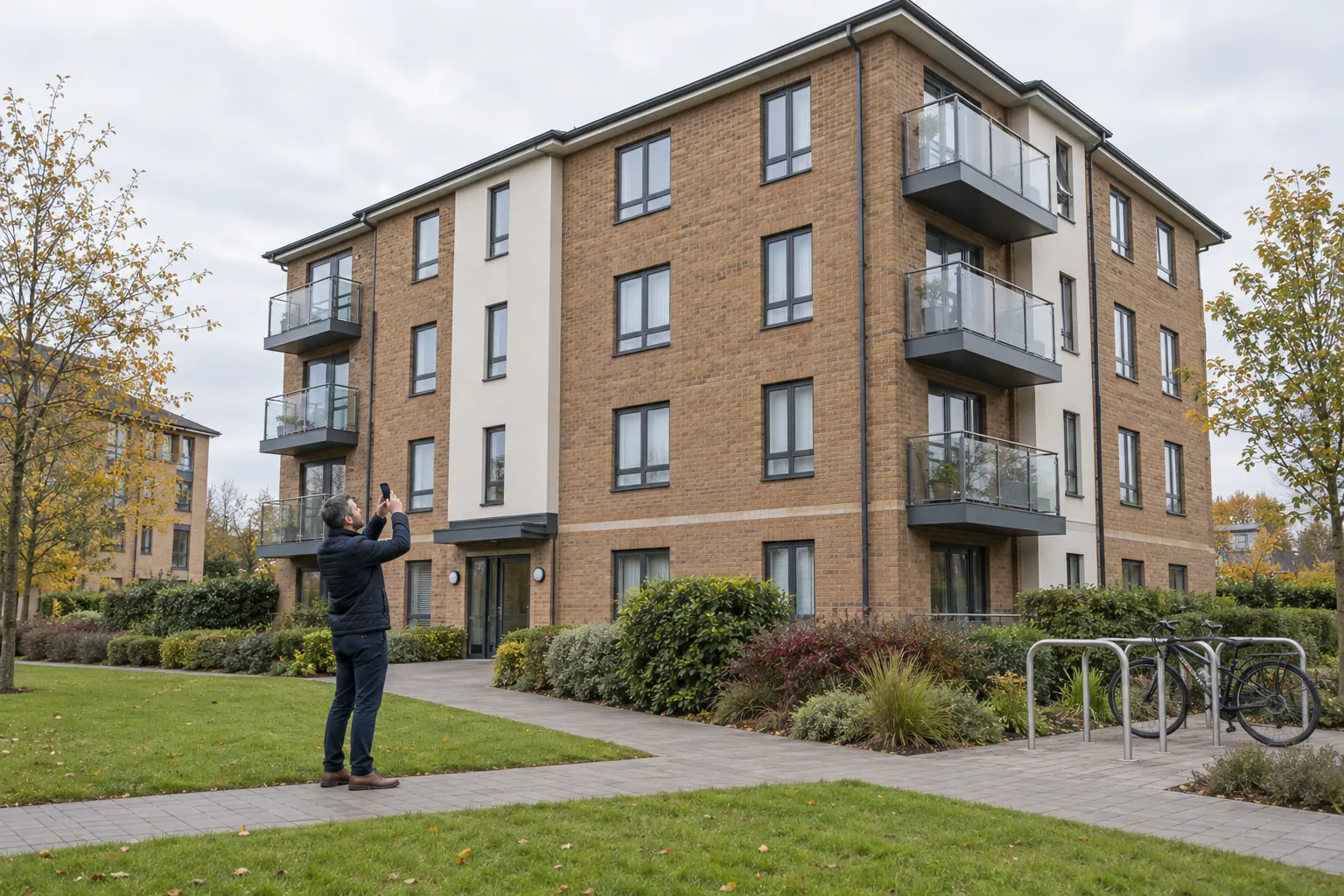
The common parts or communal areas of a block of flats, such as entrance halls, stairs, corridors, lifts, plant rooms and bin stores, carry legal requirements that fall on the landlord or one of the management companies above, and in practice on the managing agent who organises them.
- Fire safety: the Regulatory Reform (Fire Safety) Order 2005 applies to the common parts in England and Wales, and since the Fire Safety Act 2021 it also covers the structure, external walls and flat entrance doors of buildings with two or more sets of domestic premises. The responsible person must have a suitable and sufficient fire risk assessment and act on it.
- Fire Safety (England) Regulations 2022: in England, residents must be given fire safety instructions and information about fire doors; in buildings over 11 metres, communal fire doors must be checked every three months and flat entrance doors every year on a best-endeavours basis; buildings of at least 18 metres or seven storeys have further duties.
- Higher-risk buildings: in England, buildings of at least 18 metres or seven storeys with at least two residential units must be registered with the Building Safety Regulator under the Building Safety Act 2022, and have an accountable person with duties to assess and manage building safety risks.
- Asbestos: the duty to manage under the Control of Asbestos Regulations 2012 applies to the common parts.
- Water: a Legionella risk assessment for communal water systems, following HSE guidance.
- Electrical and lifts: periodic testing of the landlord's electrical installation, and regular thorough examination and servicing of lifts.
- Fire systems: servicing and routine testing of fire alarms, emergency lighting, smoke vents and dry risers where fitted.
- Contractors: making sure contractors working in the building do so safely, including window cleaning and other work at height.
Wales is developing its own building safety regime, and managing agents working there should follow Welsh Government guidance rather than assume the English regulations apply.
05
What leaseholders can expect and ask for
Leaseholders pay for the managing agent through the service charge, and the law gives them rights to see how their money is spent. They can:
- Ask for a summary of the costs making up the service charge, and inspect the accounts, receipts and other supporting documents.
- Be consulted before major works or long contracts, under section 20 of the Landlord and Tenant Act 1985.
- Challenge service charges they consider unreasonable at the First-tier Tribunal (Property Chamber) in England, or the Leasehold Valuation Tribunal in Wales.
- Ask for information about the buildings insurance.
- Complain through the agent's complaints procedure and then the redress scheme.
- Change the management, in some circumstances, through the right to manage or by applying to the tribunal to appoint a manager.
A good managing agent answers most of these questions before they are asked. Regular communication, clear budgets, early legal advice when a dispute starts, and evidence that the services charged for were delivered prevent more disputes than any procedure resolves. When leaseholders ask whether the cleaner really comes weekly, or whether the fire doors are checked, the agent should be able to show them.
06
Where the record fails, and what SiteClara does about it
A managing agent may look after dozens or hundreds of buildings, and a property manager may visit each one monthly or quarterly. Between visits, the agent relies on contractors' invoices and residents' emails. The cleaner's signing sheet stays in the cupboard, a failed light is reported to whoever answers the phone, and the first the agent hears of a missed cleaning visit is a complaint about the service charge.
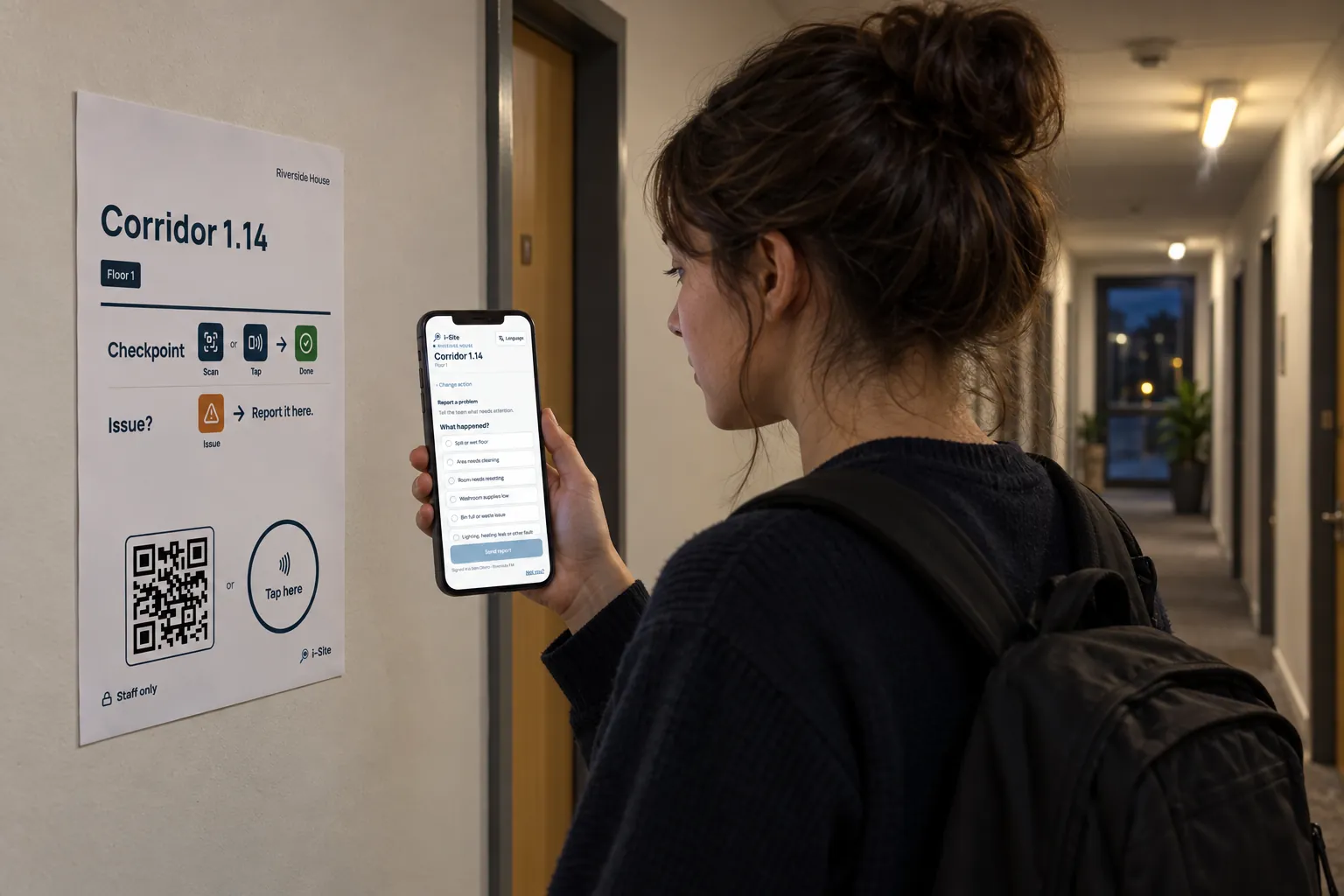
SiteClara puts a printed QR poster at each location in a building, such as the entrance, each landing, the bin store and the plant room, with an optional NFC tag behind it. The cleaner or site team scans the code or taps the tag on their own phone, with no app to install, sees the checks due there, and marks each one done or explains what stopped them, with a photo when it helps. A fault or hazard found on a visit, such as a propped fire door or clutter on a stair, goes onto the team's list of jobs, grouped by building and floor, until someone closes it, and can be escalated to the building manager.
The contractor's supervisor reviews the day, adds a note and approves a report, which goes to the managing agent or other nominated contacts at 8am the next morning, showing what was reported, what was completed, what is still open and how scheduled checks went. Buildings led by the owner can also allow residents to report issues from the posters. Pricing is per building, with no per-person fees.
07
Questions people ask
Can a freeholder appoint a managing agent?
Yes: a freeholder or landlord can appoint a managing agent to carry out their management obligations under the leases, and the RICS code says the landlord will nearly always keep the ultimate authority over any other manager. If the leaseholders have a recognised tenants' association, it can ask to be consulted, and under section 30B of the Landlord and Tenant Act 1985 the landlord must then name any proposed agent and give the association at least one month to comment before making the appointment.
Do managing agents need to be registered?
In England, the legal requirement is membership of a government-approved or government-administered redress scheme: anyone doing property management work must belong to one, under article 5 of the 2014 Redress Schemes Order. In Scotland, property factors, who do the same job for flats and shared land, must be on a register kept by the Scottish Ministers, and operating as a property factor while unregistered is an offence under section 12 of the Property Factors (Scotland) Act 2011.
How much does a managing agent charge?
No law or code sets a figure: the RICS Service Charge Residential Management Code declines to prescribe or recommend any fee arrangement, but says a managing agent's charges must be reasonable and proportionate to the tasks and agreed with the client in advance where the tasks are known, and should not be based on a percentage of service costs unless the lease prescribes it. The fee is usually recovered from leaseholders through the service charge, and under section 19 of the Landlord and Tenant Act 1985 costs count towards a service charge only to the extent that they are reasonably incurred.
08
Further reading, and a list to take away
The Leasehold Advisory Service (LEASE) publishes free guidance for leaseholders, landlords and RMC directors, including on using a managing agent. RICS publishes the Service Charge Residential Management Code, and The Property Institute publishes standards and guidance for block managers. The Home Office publishes guidance on the Fire Safety (England) Regulations 2022, and the Building Safety Regulator on higher-risk buildings.
If you are appointing a managing agent, or reviewing the one you have, check that:
- there is a written management agreement listing services, fees, extras, term and notice, and the maintenance requirements the agent is expected to plan for;
- the agent follows the RICS code and belongs to a redress scheme;
- client money is held in designated accounts, and professional indemnity insurance is in place;
- budgets and year-end accounts are produced as the lease requires;
- section 20 consultation is carried out before major works and long contracts;
- the fire risk assessment is current and its actions are tracked;
- fire door, fire system and other routine checks are scheduled and recorded;
- the agent can show that contracted services, such as cleaning, were delivered;
- leaseholders know how to report problems and how to complain.
Sources
Every document this guide quotes or links to, in the order it first cites them.
- Commonhold and Leasehold Reform Act 2002 legislation.gov.uk
- Landlord and Tenant Act 1985 legislation.gov.uk
- Landlord and Tenant Act 1987 legislation.gov.uk
- RICS Service Charge Residential Management Code rics.org
- Section 87 of the Leasehold Reform, Housing and Urban Development Act 1993 legislation.gov.uk
- Redress Schemes for Lettings Agency Work and Property Management Work (Requirement to Belong to a Scheme etc) (England) Order 2014 legislation.gov.uk
- Leasehold and Freehold Reform Act 2024 legislation.gov.uk
- Fire Safety Act 2021 legislation.gov.uk
- Section 30B of the Landlord and Tenant Act 1985 legislation.gov.uk
- Section 12 of the Property Factors (Scotland) Act 2011 legislation.gov.uk
- RICS Service Charge Residential Management Code rics.org
- Section 19 of the Landlord and Tenant Act 1985 legislation.gov.uk
Related guides
 CleaningCommunal area cleaning: what it covers, how often, and how to show it was doneWhat communal area cleaning should cover in blocks of flats and shared buildings, how often, who pays through the service charge, and how to show it was done.
 Fire and water checksCommunal fire door checks in blocks of flatsWhat the Fire Safety (England) Regulations 2022 require of communal fire doors and flat entrance doors, who carries out the checks, and how to record them.
 Premises and facilities managementBuilding manager responsibilities: the duties, the daily work and the recordWhat a building manager is responsible for in UK commercial and residential buildings: legal duties, daily work, contractors and the records that prove it.
 Premises and facilities managementFault reporting system: how faults are reported, prioritised and closedHow a fault reporting system for a building should work: how occupants report faults, how facilities teams log and prioritise them, and how a fault is closed.