Premises and facilities management
Near miss reports in Ireland: record the close call and put the cause right
A near miss report records an event at work that could have caused injury, ill health or damage but did not, so the workplace can investigate and prevent a recurrence.
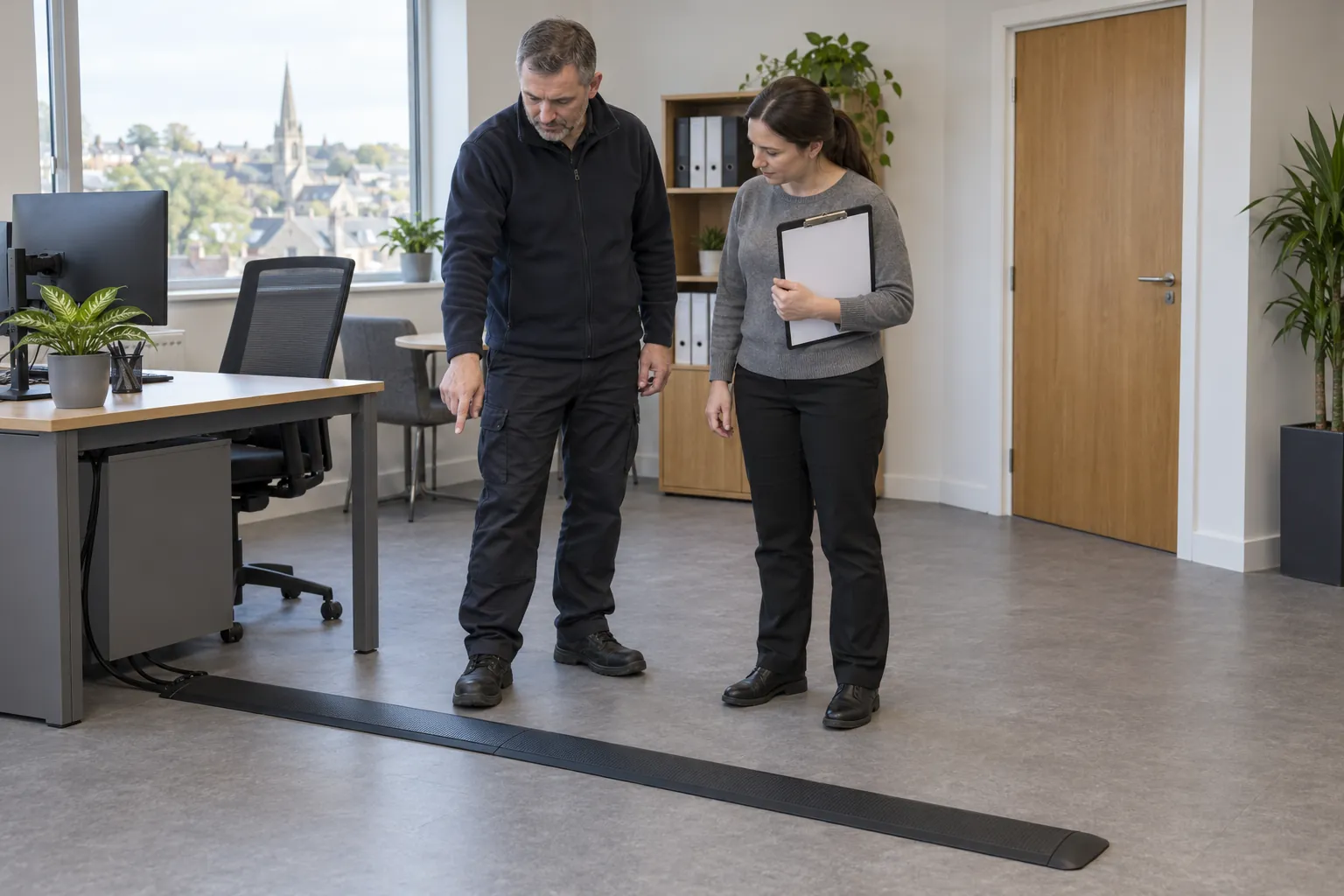
In Ireland, an internal near miss report and a notification to the Health and Safety Authority are different records: a dangerous occurrence can require notification even when nobody was injured. This guide gives cleaning, security and facilities teams a practical report form, a worked example and a way to keep the corrective action attached to the original event.
01
What a near miss report is, and what Irish law asks
An accident has caused harm. A near miss is the close call: a delivery cage rolls into a walkway just after a cleaner passes, or a loose ceiling tile falls beside an occupied desk. An unsafe condition is worth reporting too, even if nothing has happened yet. Keep those descriptions clear, but do not make workers settle a legal classification before they can tell someone about a hazard.
The HSA's Safety Representatives Resource Book, fourth edition (2026), treats recording near misses as good practice, including events that are not reportable to the Authority. It explains that these records help an organisation decide whether further controls are needed. The purpose is prevention: an empty accident column does not show that a loose handrail or a reversing-vehicle problem has disappeared.
There is also a duty to speak up about danger. Section 13(1)(h) of the Safety, Health and Welfare at Work Act 2005, as enacted, requires an employee to report dangerous work, defects or relevant breaches of which they are aware to the employer or another appropriate person as soon as practicable. This is a duty to report what is unsafe; it does not prescribe one universal near miss form or a fixed end-of-shift deadline.
A completed form supports that conversation. It does not make the danger safe. Decide who can restrict an area, stop the affected activity and call the appropriate help under the site's procedures. People must not wait for a report to be reviewed while a serious risk remains. Use the emergency route first where the situation demands it.
It is important to report incidents that show how hazards reach people, even when injuries were avoided. Near miss reporting adds an early warning to the workplace safety process. Its value is the opportunity to improve a specific arrangement before it causes harm or damage, rather than collecting forms for an audit.
02
What to include in a near miss report form
Keep the first report short enough to complete after the immediate danger has been dealt with. A practical near miss reporting form can use the following fields. They are a suggested workplace template, rather than the HSA's statutory notification form.
- Event and report details: a reference, the event date and time, and when the report was made. If the time is approximate, say so.
- Exact location: building, floor, room or external area, with enough detail for another person to find it. 'Loading-bay pedestrian gate' is better than 'outside'.
- Activity: what work was happening, which equipment or substance was involved, and who else could have been exposed.
- What happened: the sequence in plain words, the potential harm, and whether anyone was injured or anything was damaged. Record known outcomes; do not diagnose an injury.
- Immediate action: what was stopped, secured or isolated, who was told and when, and what risk remains. Distinguish a temporary barrier from a permanent repair.
- Evidence: observations, relevant photographs taken safely, and witness contact details where needed. Identify second-hand information and keep original accounts separate.
- Review and follow-up: the reviewing manager, the notification decision, proposed corrective actions, each action's owner and target date, and the evidence of completion.
The HSA's Safety and Health Management Systems guidance identifies the circumstances, immediate and underlying causes, consequences, recommendations and action ownership as useful incident-report information. In a small near miss these may fit on one page. An event with the potential for serious harm may need a competent investigation and a separate evidence file.
Write what you saw before writing why you think it happened. 'The cage moved across the marked walkway when the driver released it' is an observation. 'The brakes were defective' is a conclusion that needs checking. Leave room for unknowns. A form that forces a cause from a drop-down can turn a guess into the accepted account.
03
A near miss report example for a shared workplace
This fictional example shows the difference between the worker's first report and the manager's investigation. The dates and action deadlines illustrate a local decision; they are not statutory deadlines or a recommended interval for every workplace.
The initial report is useful without pretending to know the root cause. The manager might find an equipment fault, a poor storage arrangement or a handover problem between companies. The final report should explain which findings are supported, which actions address them, and who checked that the revised arrangement works during a real delivery.
A similar report can cover a slip on a freshly cleaned floor, a falling item from shelving or an electric cable across a stair. Describe the event and the credible harm, rather than labelling every inconvenience a near miss. A security incident about missing keys may need its own operational record; a key incident that leaves an escape route locked also needs a safety response.
04
Who reports a near miss, and when the HSA must be told
Give workers a named reporting route and an alternative when the supervisor is absent. A contract cleaner or security officer should know how to tell their own employer and how to alert the person controlling the building. Agree who informs the affected contractor and who manages any common-area restriction. Passing a report between companies must not leave the hazard waiting for an owner.
The internal report captures the event. The responsible person then checks the separate external reporting duty. S.I. No. 370 of 2016, as made, inserted Part 14 and Schedule 15 into the General Application Regulations. Regulation 224 defines a dangerous occurrence by reference to the listed events in Schedule 15. Regulation 225 requires those occurrences to be reported, even if no personal injury resulted. Do not decide that an event is exempt merely because everyone went home unhurt.
For a reportable dangerous occurrence, regulation 225 requires the responsible person to send the approved written report as soon as reasonably practicable and no later than 10 working days after the event. That is an external notification deadline, not a period to wait before controlling a hazard or telling a supervisor. The regulation also covers specified fatal and non-fatal accidents, with different requirements for a death. Consult the HSA's Accident and Dangerous Occurrence Reporting guidance and obtain advice where the classification is uncertain.
Is a near miss a reportable incident in Ireland?
Some near misses are reportable dangerous occurrences. Check the actual event against Schedule 15 of S.I. No. 370 of 2016; an internal description such as 'near miss' does not settle the notification duty. Record the decision and its reason, and use the HSA's reporting route when required.
The Irish HSA is the workplace regulator. Ireland's HSE is the Health Service Executive, whose incident systems and guidance concern health services. The British Health and Safety Executive and its RIDDOR reporting rules are a different jurisdiction. A form found through a search for 'HSE near miss report' needs its scope checked before it is used on an Irish facilities contract.

05
Investigate the cause, close the action and give feedback
Match the investigation to the possible consequences, not only the outcome on this occasion. Ask what stopped the event becoming an accident and whether that protection was reliable. A person jumping clear is not an adequate traffic-control measure. A cupboard that happens to be empty when a shelf collapses does not make the shelf safe.
- Preserve the account: retain the original report, gather relevant observations and ask witnesses separately what they saw. Do not ask workers to recreate a dangerous event for a photograph.
- Examine the system: check the work method, equipment, access, communication, workload and supervision. Establish why the existing precaution failed or was absent.
- Choose an effective control: consider removing the hazard or changing the arrangement before relying on another warning or a reminder. Have the appropriate competent person decide technical changes.
- Keep actions visible: each action needs an accountable owner, a target set for its risk and an escalation route if that target cannot be met. Show temporary controls alongside the permanent work.
- Verify and communicate: record what was changed and how it was checked. Tell the reporter and affected teams the outcome, without circulating unnecessary personal information.
If the event calls the existing risk assessment into question, review it. Section 19 of the 2005 Act, as enacted, requires review after a significant relevant change or where there is another reason to believe the assessment is no longer valid. A near miss may supply that reason. Update the relevant work instruction and safety statement where the review changes the arrangements.
Make it easy to report near misses without fear of being blamed for raising a concern. Encourage clear accounts and thank people for identifying a risk. Do not reward a team for having the fewest reports: silence and effective prevention can look identical in a spreadsheet. Read repeat locations and unresolved actions alongside the event descriptions, and ask the team what is still getting in the way.
Include near miss reporting in induction and supervisor training. Employees need to know what to report and managers need to know how to respond. For example, discuss an anonymised falling-object report with the next shift, then ask whether the revised storage arrangement removes the exposure in their work too. This helps the team learn from the event and test the improvement. A useful safety culture makes reported risks visible and shows employees what changed; the reporting system should support that conversation.
Set retention and access rules for the actual records you hold. Regulation 226 of S.I. No. 370 of 2016 requires a 10-year record for accidents and dangerous occurrences that must be reported under regulation 225. Do not present that as a blanket retention rule for every internal hazard note. The Data Protection Commission's data protection principles also require necessary, relevant data, appropriate confidentiality and justified storage periods. Separate operational learning from restricted witness or health information.
06
Where the record fails, and where SiteClara fits
A close call can disappear between the first conversation and the repair. The cleaner tells reception, reception emails a manager, and the next shift knows only that someone mentioned the loading bay. An investigation file may be thorough while the temporary barrier is removed too early. Keep the formal incident account, the urgent safety instructions and the routine follow-up connected, with each serving its own purpose.
SiteClara gives a cleaning, security or facilities team a working record at a location. A worker scans a QR poster or taps an NFC tag with their phone to report an issue or record a scheduled check. A report can include a note and photographs. Jobs stay on the team's list until closed. At a provider-led site, a supervisor reviews the day's recorded checks and photos before approving the next-morning report to nominated readers.
For the loading-bay example, that can support the routine check that the agreed pedestrian route remains clear, or the follow-up job for a repair. Keep the detailed near miss investigation and any HSA notification in the organisation's controlled safety records. Do not put witness statements, injury information or a legal notification decision into an ordinary location note just because it is convenient.
07
Official guidance and a checklist to take away
Read chapter 9 of the HSA's Safety Representatives Resource Book for reporting and feedback, its Safety and Health Management Systems guidance for investigations, and the Accident and Dangerous Occurrence Reporting guidance for current notification routes. Check Part 14 and Schedule 15 in the Irish Statute Book when deciding whether a close call is a dangerous occurrence.
Before introducing a near miss report form, check that:
- workers know the immediate safety response, the reporting contact and the out-of-hours alternative;
- the form asks what happened, where and when, what harm was possible and what was done immediately;
- observations and suspected causes are recorded separately;
- a named responsible person checks the HSA notification duty;
- temporary controls, corrective actions and completion evidence remain attached to the event;
- affected shifts and contractors hear about changes before doing the same work;
- the reporter receives useful feedback and the risk assessment is reviewed where needed;
- personal information has an appropriate access and retention policy.
Sources
Every document this guide quotes or links to, in the order it first cites them.
- Safety Representatives Resource Book, fourth edition (2026) hsa.ie
- Section 13(1)(h) of the Safety, Health and Welfare at Work Act 2005 irishstatutebook.ie
- Safety and Health Management Systems guidance hsa.ie
- S.I. No. 370 of 2016 irishstatutebook.ie
- Accident and Dangerous Occurrence Reporting guidance hsa.ie
- HSE is the Health Service Executive about.hse.ie
- RIDDOR reporting rules hse.gov.uk
- Section 19 of the 2005 Act irishstatutebook.ie
- Data Protection Commission's data protection principles dataprotection.ie
Related guides
 Premises and facilities managementSafety statement: what the 2005 Act requires, and how to show it is followedWhat a safety statement must contain under section 20 of the Safety, Health and Welfare at Work Act 2005, who needs one, when to review it and how to show it works.
 Premises and facilities managementHealth and safety inspection checklist: what to walk, what to record, and what the HSA looks forA workplace health and safety inspection in Ireland: the 2005 Act and 2007 Regulations, what to walk, how often, recording actions, and what an HSA inspector asks.
 Premises and facilities managementSlips, trips and falls: what Irish law requires, and how to prevent them day to dayPreventing slips, trips and falls in Irish workplaces: the 2005 Act and 2007 Regulations, spills, floor cleaning, entrances, stairs and the checks that show it.
 Security patrolsSite security checklist: what to check, how often, and how to show it was doneA site security checklist for Irish building sites and premises: the law behind it, what to check at opening, closing and out of hours, and a record that stands up.