Security patrols
Security officer report: what to write in Ireland, and how to make it hold up
A security officer report is the written record an officer makes of an incident on site or of the work done during a shift, and in Ireland the Private Security Authority's standard PSA 28:2013 sets the minimum an incident report must contain.
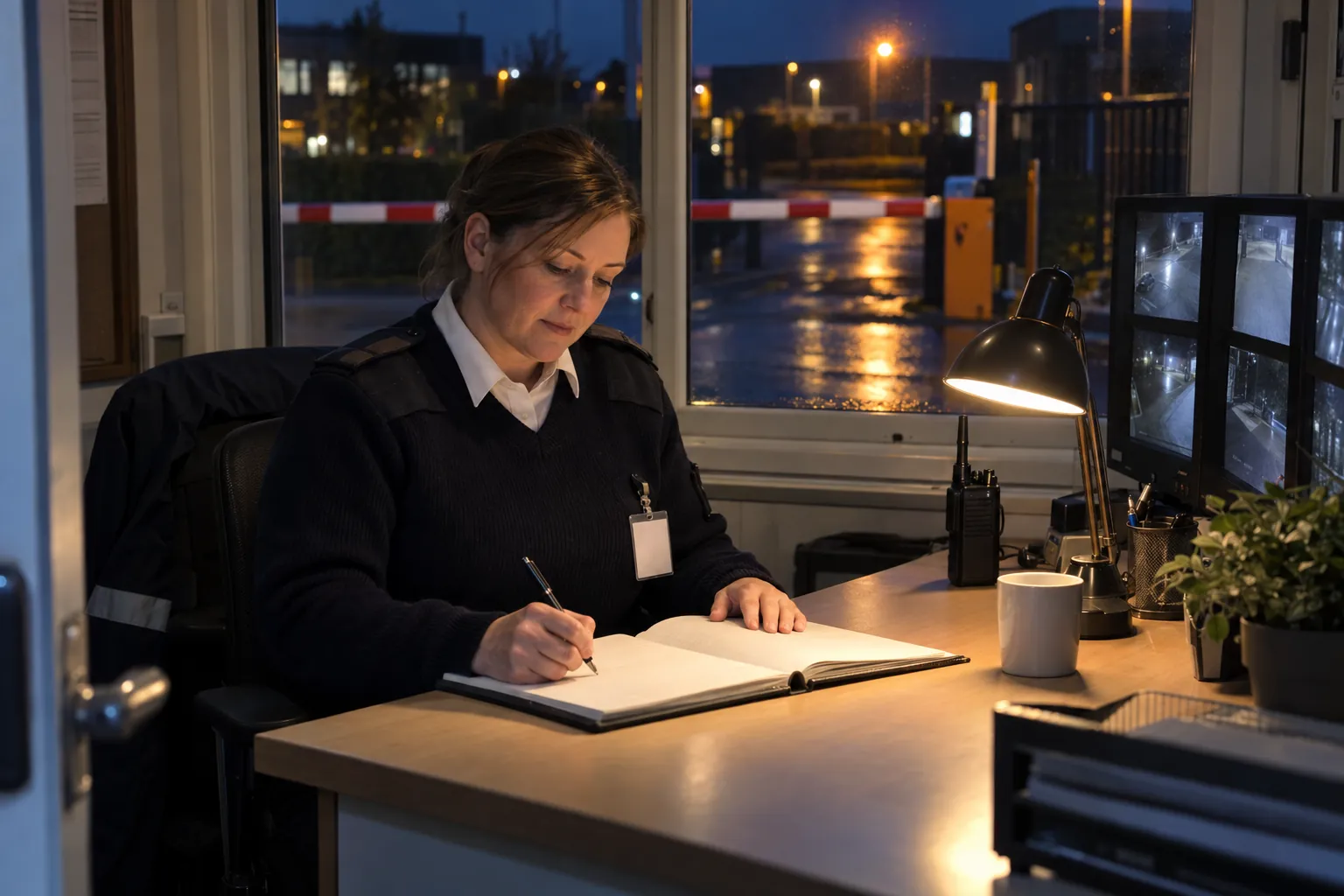
Most of what a security officer does on an Irish site is never seen by the client. The report is how it becomes visible: what was checked, what happened and what was done about it. This guide covers the reports officers write, what PSA 28 requires of an incident report, how to write one that is still useful when it is read months later, and what happens to it afterwards.
01
What a security officer report is, and the rules behind it
A security officer report is a written record, made by the officer on duty, of something that happened on site or of the work done during a shift. The client reads it, the security company relies on it, and it may end up with An Garda Síochána, an insurer, a solicitor or, in legal proceedings, a court. The licence is for a security guard; most companies and clients call the same person a security officer. A report that is vague, late or written from memory is worth little in any of those places.
In Ireland private security is regulated by the Private Security Authority (PSA) under the Private Security Services Act 2004. The PSA licenses both the security company (the contractor) and the individual officer. The Private Security (Licensing and Qualifications) Regulations 2022 (S.I. No. 574 of 2022) define a security guard (guarding) as a person who, for remuneration, "guards property for the purposes of preventing loss, damage or waste by crime, fire, carelessness or flood", or who guards or patrols premises where an event is taking place, and set the qualification for the licence as the QQI Level 4 Minor award in Security Guarding Skills (4N20604) or an equivalent.
In Ireland the licensing standard itself says what an incident report must contain. A contractor licensed for security guarding must comply with PSA 28:2013, Licensing Requirements for Door Supervision and Security Guarding (with PSA 31:2023, which the PSA also lists for the licence), the PSA's standard for Security Guard (Static) and Door Supervisor contractors. It took effect on 1 May 2014 and replaced I.S. 999 for licensing purposes. Contractors are audited against it by PSA-approved certification bodies, following the PSA's auditing guidelines for PSA 28:2013 (2025 edition). The PSA's page of standards required for licensing lists the standards for each licence.
PSA 28 does not prescribe a form. It sets the minimum content and the handling, and leaves the format to the company's procedures and the site's assignment instructions, which the standard defines as a "set of written instructions drawn up by the organisation in agreement with the customer specifying the contractual duties".
02
The reports an officer writes
Officers write several kinds of report, and confusing them is where many records go wrong. The usual set on a guarded site in Ireland is:
- The occurrence book or daily log: a running, time-ordered record of the shift – arrivals, patrols, keys issued, alarms, contractors, anything out of the ordinary. PSA 28 does not name it, but it does require "the recording of all appropriate routine and emergency matters" so that management can meet the company's contractual responsibilities.
- The patrol record: which areas were patrolled, when, and what was found – a door left open, a light out, a leak. PSA 28 requires patrol routes and reporting points and times in the assignment instructions, and patrols monitored and recorded "by mechanical, electronic or supervisory means", with the results open to the client.
- The incident report: a formal record of one event, written separately and in detail – an intrusion, a theft, an assault, a medical emergency, criminal damage, a fire alarm activation.
- The check-in call record: the routine call that verifies where an officer is and that they are all right. Under PSA 28 a record of all check-in calls from a client's site is kept for at least three years.
- The handover: what the incoming officer needs to know – open issues, keys out, contractors still on site, systems in fault. Handover requirements are one of the minimum contents of the assignment instructions.
- The key register: every issue and return of a client's keys, signed by the issuing officer and the recipient.
- The accident report: an injury at work, recorded under the employer's procedures and, where it is reportable, reported by the employer to the Health and Safety Authority.
The log records that something happened; the incident report explains it. A line in the occurrence book such as "22:40 three youths on the perimeter fence at the rear car park, Gardaí called, see incident report 0147" is how the two connect, and the incident number lets anyone reading one find the other.
03
What an incident report must contain under PSA 28
Clause 6.3.2 of PSA 28:2013 says that all incidents "shall be handled by the site supervisor in the first instance and recorded in the Incident Report or other suitable method", and that the Incident Report shall contain as a minimum:
- the date, time and place of the incident;
- the date and time of reporting, and by whom it was reported;
- the nature of the incident;
- the action taken, including onward reporting;
- further action to be taken;
- where possible, the names and addresses of all relevant persons present.
That is the floor, not the ceiling. A report that will be relied on later usually also carries:
- A precise location: building, floor, door or gate, not just "the site".
- A description in order, as the officer saw and heard it, with times against each step.
- Evidence: photographs, whether CCTV exists and which cameras cover the area, access control logs, items retained and who holds them.
- Who was told, and when: the control room, the supervisor, the client's facilities manager or duty manager, the Gardaí or the emergency services, with any Garda reference.
- The officer's name, PSA licence number and signature.
PSA 28 also governs what happens around the report. A record of all reported incidents is kept at the company's command and control system (the control room) for at least three years (6.3.3). Entries are numbered sequentially and serially and include the time, the date, a record of notification of the client and the name of the controller completing the record (6.3.4). Incidents involving violence must be recorded and investigated fully, and any remedial action acted on within a reasonable time (4.6.6).
04
How to write a report that holds up
A report is read by people who were not there, sometimes months later, and sometimes by someone looking for its weaknesses. The habits that make report writing reliable are well known:
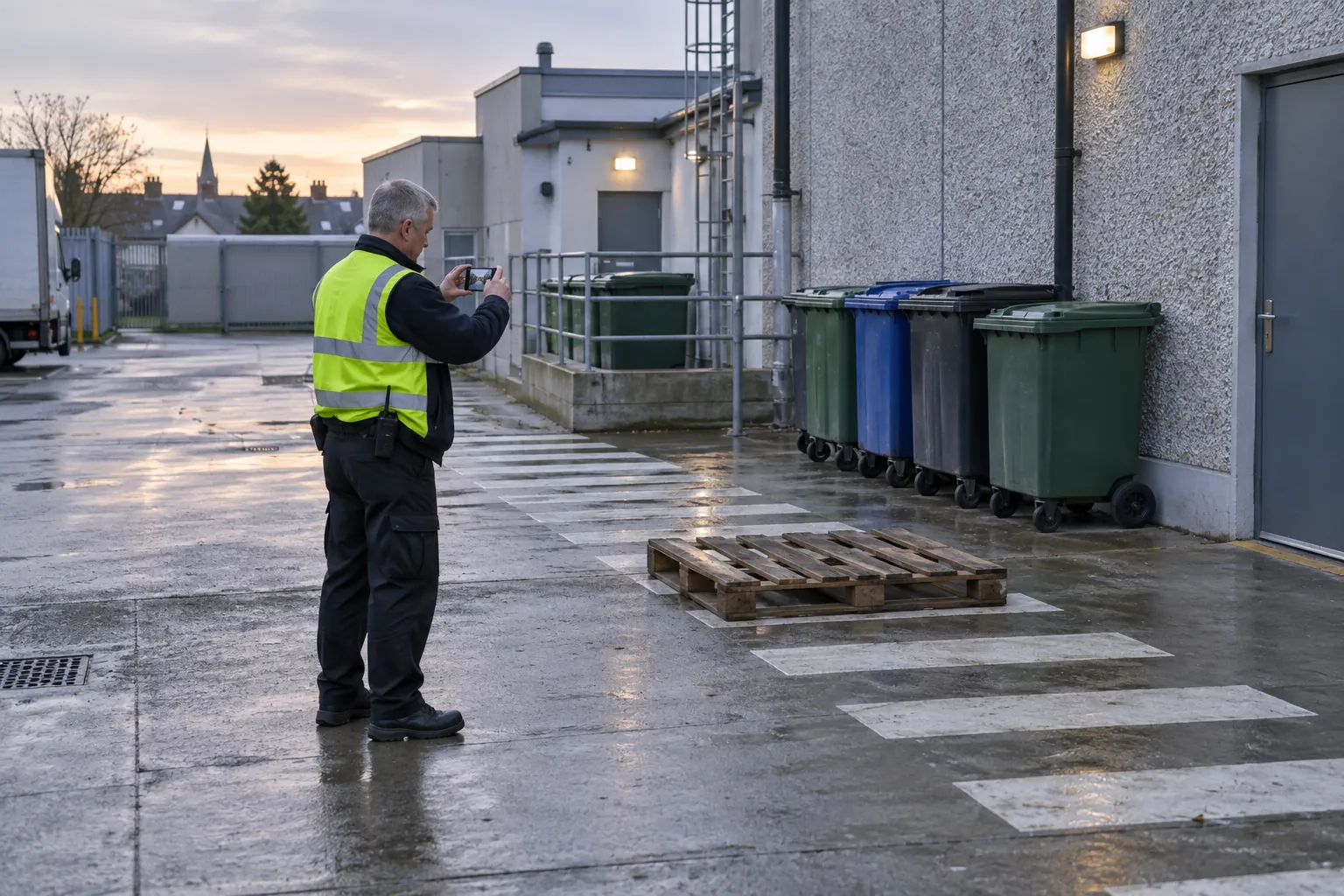
- Write it at the time, or as close to it as you can. A note made in a pocket notebook or on a phone at the time is worth more than a polished account written the next day.
- Keep it factual. Describe what you observed, not what you concluded: write "the man was shouting and swaying, and smelled of alcohol", not "he was drunk". Record what was said in the words used.
- Tell the events in chronological order, with a time against each step, and record your response to the situation and when you made it.
- Use plain, professional language. Avoid slang, and abbreviations the reader may not know.
- Be specific. "Fire door F3 on level 2 found wedged open" can be acted on; "doors insecure" cannot.
- Say what you did not see. If you arrived at the scene after the event, say so, and say who told you what happened and who else was involved.
- Do not alter it afterwards. If something needs correcting, add a dated note. Rewritten entries invite questions, and PSA 28 expects incident entries to be numbered sequentially and serially.
- Read it once before it goes, for times, names and locations.
PSA 28 puts the site layer on top of the officer's general training: the company must document a site-specific training plan in line with the assignment instructions, and train each officer on it when they are first deployed there (5.3.3 and 5.3.4). That is the place to show new officers the site's report form, the occurrence book, who to ring and how quickly.
Handwritten reports are acceptable if they are legible, complete and kept safely. Many companies now use a digital reporting system, which helps with legibility and speed, but the rules above apply either way: a clear report on paper beats a vague one in an app.
05
What happens after a report is submitted
A report nobody reads improves nothing. PSA 28 requires every officer to be told in writing who they report to, and how incidents or problems are reported to the client's management and to the company's own management, in urgent and non-urgent cases (6.3.1). It also requires an escalation policy for client liaison (6.3.5) and a facility for senior management to check and review reports and reporting procedures periodically (6.3.7). On a well-run contract that means:
- The client is told, in the way and within the time the assignment instructions set, with serious matters passed on at once by phone or radio rather than waiting for the paperwork.
- Faults are raised with whoever fixes them – a broken lock, a failed light, a camera out of action – and the report says who they were reported to.
- Patterns are spotted: repeated incidents at one gate, at one time of night or involving one kind of visitor point to a change in patrol routes, lighting or access control.
- Footage is preserved. The Data Protection Commission's Guidance on the Use of CCTV for Data Controllers (updated November 2023) says that for a normal security system it would be difficult to justify keeping footage beyond one month, except where it identifies an issue such as a break-in or theft and is kept for that investigation. Ask for the relevant footage to be kept straight away, not at the end of the month.
- Reportable injuries go to the HSA. The Health and Safety Authority's page on accident and dangerous occurrence reporting explains that an employer must report an injury to an employee from an accident at work where the employee cannot carry out their normal work for more than three consecutive days, excluding the day of the accident, and that non-fatal accidents should be reported within ten working days. The officer's report is often what the employer relies on to make that report.
When the certification body audits the contractor against PSA 28, the auditor inspects the incident records against clauses 6.3.2 to 6.3.4, and the auditing guidelines say that "any incident not recorded should be detailed in the audit report". The same reports feed any regular review with the client, which is much easier when every report says what was done, and when.
06
Where security reports fail, and where SiteClara fits
The incident report is usually the strongest record on a site, because something happened and someone had to write it down. The weak records are the routine ones. A patrol logged as "all areas checked, all in order" every two hours for a month tells the client nothing about which doors were tried. A fault noted in the occurrence book at 03:00 may never reach the people who fix it. A facilities manager who asks whether an officer actually went to the service yard last night gets an assurance rather than a record, even though PSA 28 expects patrol results to be available for the client to inspect.
SiteClara is a way to record the routine part. A printed QR poster, with an optional NFC tag behind it, is placed at each location that matters: a gate, a plant room door, a fire exit, a service yard. The officer scans the code or taps the tag on their own phone, with no app to install, and marks the scheduled check done or says what stopped them. The time and the named person are recorded as it happens, with a photo where one helps. An issue found on the round – a door that will not secure, a light out, a leak – is reported there and goes onto the team's list of open jobs until someone closes it.
The supervisor sees what was due, done and missed, and can record why a check was missed from their company's own list of reasons. At the end of the day the supervisor reviews the totals and photos, adds a note and approves the daily report, which goes to nominated managers or client contacts the next morning, showing what was reported, what is still open and how the scheduled checks went.
07
Questions people ask
What should a security report include?
Clause 6.3.2 of PSA 28:2013, Licensing Requirements for Door Supervision and Security Guarding sets the minimum for an incident report in Ireland: the date, time and place of the incident; the date and time of reporting and by whom it was reported; the nature of the incident; the action taken, including onward reporting; further action to be taken; and, where possible, the names and addresses of all relevant persons present. Clause 6.3.4 adds that entries are numbered sequentially and serially and record when the client was notified.
How to write a report as a security officer?
Start with the method your company has given you: under clause 6.3.1 of PSA 28:2013, every officer must be told in writing who they report to and how incidents or problems are reported to the client's management and the company's own, in urgent and non-urgent cases. Then make sure the report covers every item in clause 6.3.2, and describe what happened in the order it happened.
What are the two types of security reports?
No Irish rule names two types, but PSA 28:2013 draws the line most companies use: clause 6.2.1 requires the recording of "all appropriate routine and emergency matters", and clause 6.3.2 requires every incident to be recorded in an incident report or by another suitable method. In practice that means the routine record of the shift, such as the daily log and the patrol record, and the incident report written for a single event.
How to write a daily security report?
Record the routine matters of the shift as they happen: patrols, check-in calls, keys, visitors, alarms and faults. PSA 28:2013 requires patrols to be monitored and recorded, with the results available for the client to inspect, and a record of all check-in calls from a client's site kept for at least three years (6.3.6). Anything that is an incident goes in its own incident report, cross-referenced from the daily log by its number.
08
Further reading, and a list to take away
The PSA publishes PSA 28:2013 and its auditing guidelines on its page of standards required for licensing. The Irish Statute Book carries the 2004 Act and the 2022 regulations. The HSA explains accident reporting, and the Data Protection Commission's CCTV guidance covers security companies that operate cameras for clients.
Before the next shift, check that:
- the assignment instructions say which incidents must be reported, to whom and how quickly, and set out patrol routes and reporting points;
- every officer has been told in writing who they report to, for urgent and non-urgent matters;
- the incident report form asks for everything in clause 6.3.2 of PSA 28, plus a precise location and the officer's licence number;
- incident entries are numbered in sequence and record when the client was told;
- officers know the difference between an occurrence book entry and an incident report;
- faults found on patrol go to someone who will fix them, and the report says who;
- someone asks for CCTV footage to be kept as soon as an incident needs it;
- reports are stored securely and kept for at least three years.
Sources
Every document this guide quotes or links to, in the order it first cites them.
- Private Security Services Act 2004 irishstatutebook.ie
- Private Security (Licensing and Qualifications) Regulations 2022 (S.I. No. 574 of 2022) irishstatutebook.ie
- PSA 28:2013, Licensing Requirements for Door Supervision and Security Guarding psa-gov.ie
- Auditing guidelines for PSA 28:2013 (2025 edition) psa-gov.ie
- PSA's page of standards required for licensing psa-gov.ie
- Submitting a report to the PSA psa-gov.ie
- Data Protection Act 2018 irishstatutebook.ie
- Guidance on the Use of CCTV for Data Controllers dataprotection.ie
- Accident and dangerous occurrence reporting hsa.ie
Related guides
 Security patrolsDaily occurrence book: what to record, and how to keep one that stands upThe daily occurrence book on an Irish security site: what to record, how to write entries, how it fits PSA 28:2013's records and incident reports, and retention.
 Security patrolsSecurity officer duties in Ireland: what the role involves, and how it is checkedSecurity officer duties in Ireland: the PSA licence, patrols, access control, incidents, what an officer cannot do, and how duties are set and checked on site.
 Security patrolsSite security checklist: what to check, how often, and how to show it was doneA site security checklist for Irish building sites and premises: the law behind it, what to check at opening, closing and out of hours, and a record that stands up.
 Security patrolsRetail security in Ireland: what it covers, what the law allows, and how it is checkedRetail security in Ireland: the PSA licence, shoplifting and the limits of arrest, violence towards shop staff, CCTV, and the opening and closing checks.