Security patrols
Security officer duties in Ireland: what the role involves, and how it is checked
A security officer's duties are to protect a building, its people and its property by patrolling, controlling who comes in, monitoring the alarms and CCTV, responding to incidents and emergencies, and recording what happens on the shift.
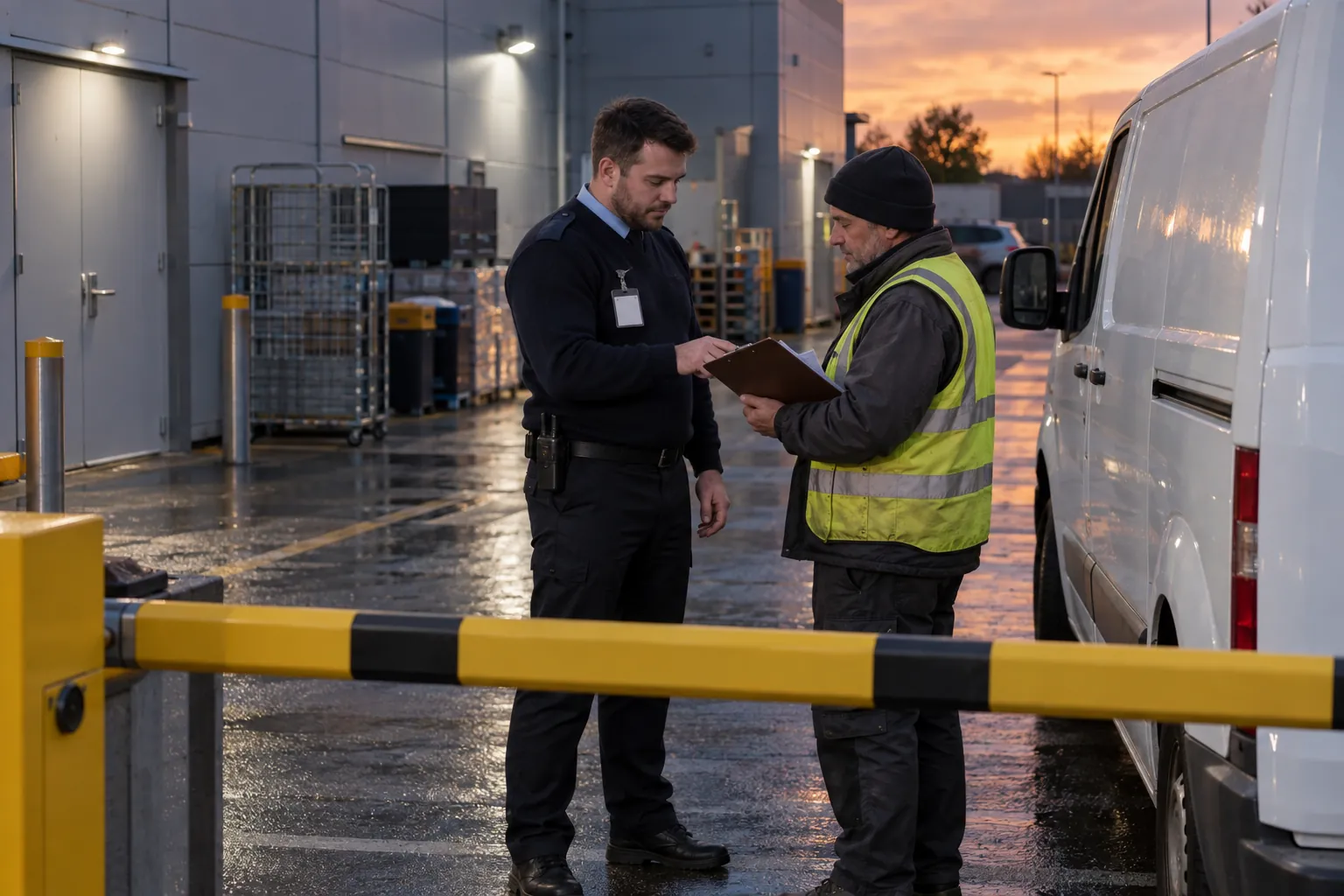
The job is easy to describe and hard to see. In Ireland the role is licensed by the Private Security Authority under the Private Security Services Acts, and contract security firms are audited against the PSA's own standard. This guide sets out the duties of a security officer, how they differ between sites, the limits of the role under Irish law, and how a client or supervisor can tell the duties are being carried out.
01
What a security officer is, and the licence behind the role
A security officer, or security guard – the two titles describe the same job in Ireland – protects premises, property and people against unauthorised access, theft, damage and disorder, and is the first to respond to an emergency until the Gardaí, the fire service or an ambulance arrive. Most work for contract security firms that supply guarding to clients; others are employed in-house by the organisation whose building they protect.
Private security in Ireland is regulated by the Private Security Authority (PSA), the licensing body set up under the Private Security Services Act 2004, which has since been amended, including by the Civil Law (Miscellaneous Provisions) Act 2011 and the Private Security Services (Amendment) Act 2021; together they are cited as the Private Security Services Acts 2004 to 2021. Section 2 of the 2004 Act defines the job:
The definition covers in-house guards as well as contract officers, and the supervisor who inspects guards on patrol, so an in-house team should check the PSA's current requirements before assuming it sits outside the scheme.
Section 37 makes it an offence to provide a security service, or to hold yourself out as available to provide one, without a licence authorising that particular service, once the section is in force for that service. Section 38 makes it an offence to employ an unlicensed person, or engage an unlicensed contractor, to provide a service that needs a licence. Under section 29 the PSA issues an identity card to each licensed individual, who must have it with them while working and must produce it on request to the person they are providing the service for; a member of the Garda Síochána or a PSA inspector can also ask to see it.
Contractors in the security guarding sector are licensed against the PSA's standard PSA 28:2013, PSA Licensing Requirements – Door Supervision and Security Guarding, and are audited against it by PSA-approved certification bodies. The PSA's Auditing Guidelines for Certification Bodies for PSA 28:2013 (2025 edition) set out what an auditor inspects, and much of what follows about training, assignment instructions and records comes from them. The basic training qualification the guidelines name for a security guard is the Guarding Skills QQI Level 4 Minor Award (4N1118) or equivalent.
02
The core duties of a security officer
The job description changes from site to site, but the main duties of a security officer are much the same wherever the work is:
- Being alert: spotting a door that does not latch, someone trying handles or a gap in the hoarding, and dealing with it before it becomes a break-in or an injury.
- Keeping a visible presence, in the firm's uniform with the PSA identity card, which is the simplest deterrent there is.
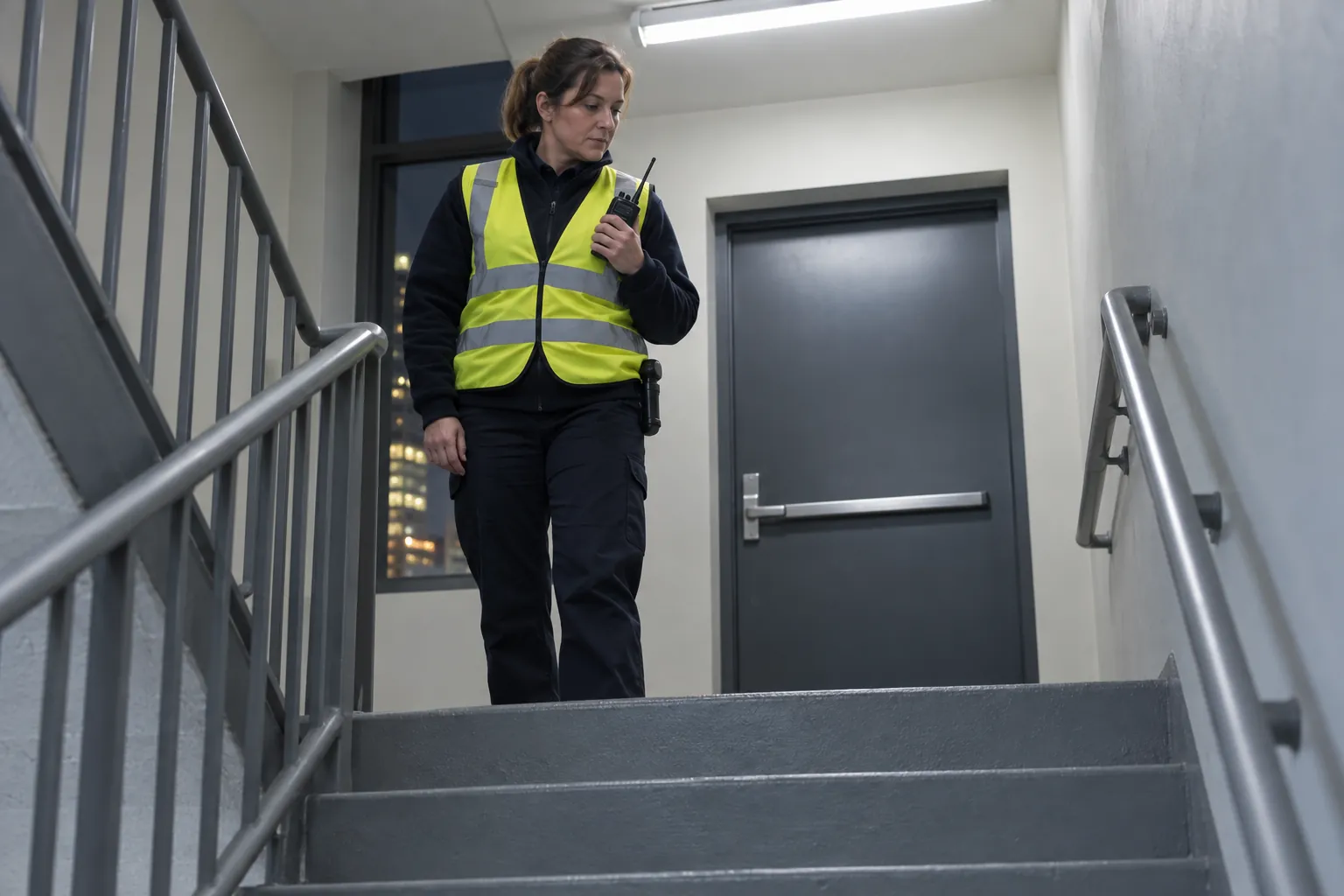
- Patrolling the building and grounds on set routes and at set times, and at irregular times too, checking doors, windows, gates, roller shutters, fire exits, plant rooms and car parks.
- Access control: checking passes, signing in visitors and contractors, issuing and recovering keys, fobs and badges, and refusing entry to people who should not be there.
- Monitoring systems: CCTV, intruder alarm panels, access control and the fire alarm panel where the officer's post has them.
- Responding to alarms and incidents: investigating activations, dealing with intruders, disputes and suspicious behaviour, and calling the Gardaí when the situation needs them.
- Responding to emergencies: fire evacuations, medical emergencies and first aid, floods and power failures, and meeting the emergency services at the door.
- Keeping records: the occurrence book, patrol records, incident reports, the key register and the visitor book.
- Reporting faults and hazards: broken locks, failed lighting, leaks, obstructed escape routes and anything unsafe, to whoever fixes them. Section 13(1)(h) of the Safety, Health and Welfare at Work Act 2005 requires every employee to report defects that might endanger anyone as soon as practicable.
- Helping people: as the first person many visitors meet, giving directions, answering questions and staying calm with people who are upset.
- Handing over to the next shift, with open issues, keys out and anything that needs watching.
03
How the duties vary between sites
Security officers have different responsibilities in different settings, and the site's assignment instructions are where those differences are written down. Some common settings in Ireland:
- Office blocks and multi-tenanted buildings: often a reception duty as much as a guarding one – visitors, passes, deliveries, lifts and the car park – with locking-up patrols in the evening.
- Shopping centres and retail security: a visible presence in the mall or on the shop floor, dealing with shoplifting in line with the retailer's policy, supporting staff with difficult customers, and securing the premises at close.
- Apartment developments: concierge and patrol work for an owners' management company, usually through its managing agent, covering entrances, bin stores, car parks and communal areas.
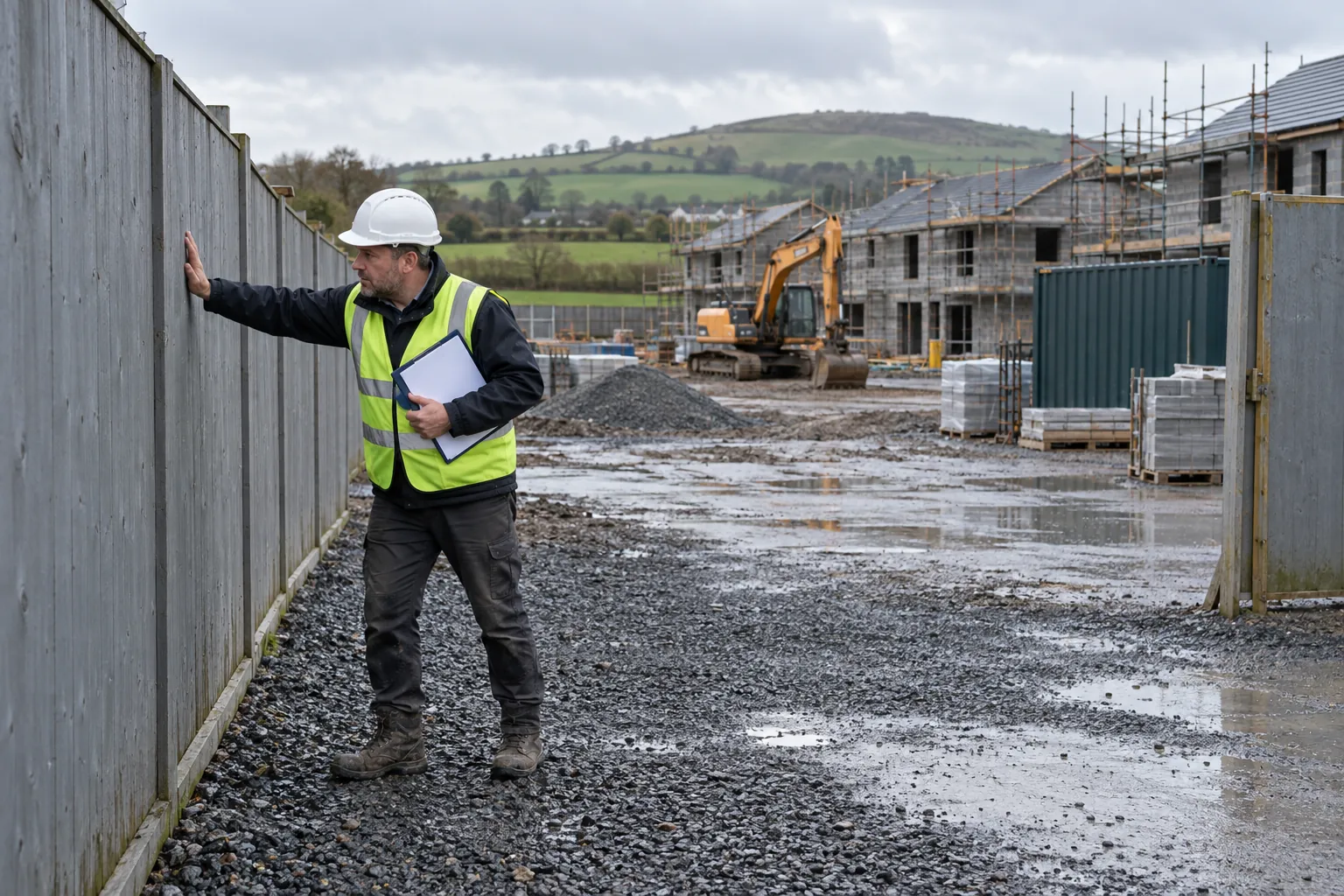
- Construction sites and vacant buildings: perimeter patrols, gate control, checking plant and materials, and deterring trespass and theft, often through the night.
- Warehouses and industrial estates: gatehouse duties, vehicle and load checks, and patrols of large yards and buildings.
- Hospitals, colleges and public buildings: open sites with many entrances, where the work leans towards de-escalation, welfare and helping people rather than keeping them out.
- Events: controlling and directing the movement of people at a venue, which the section 2 definition also treats as the work of a security guard.
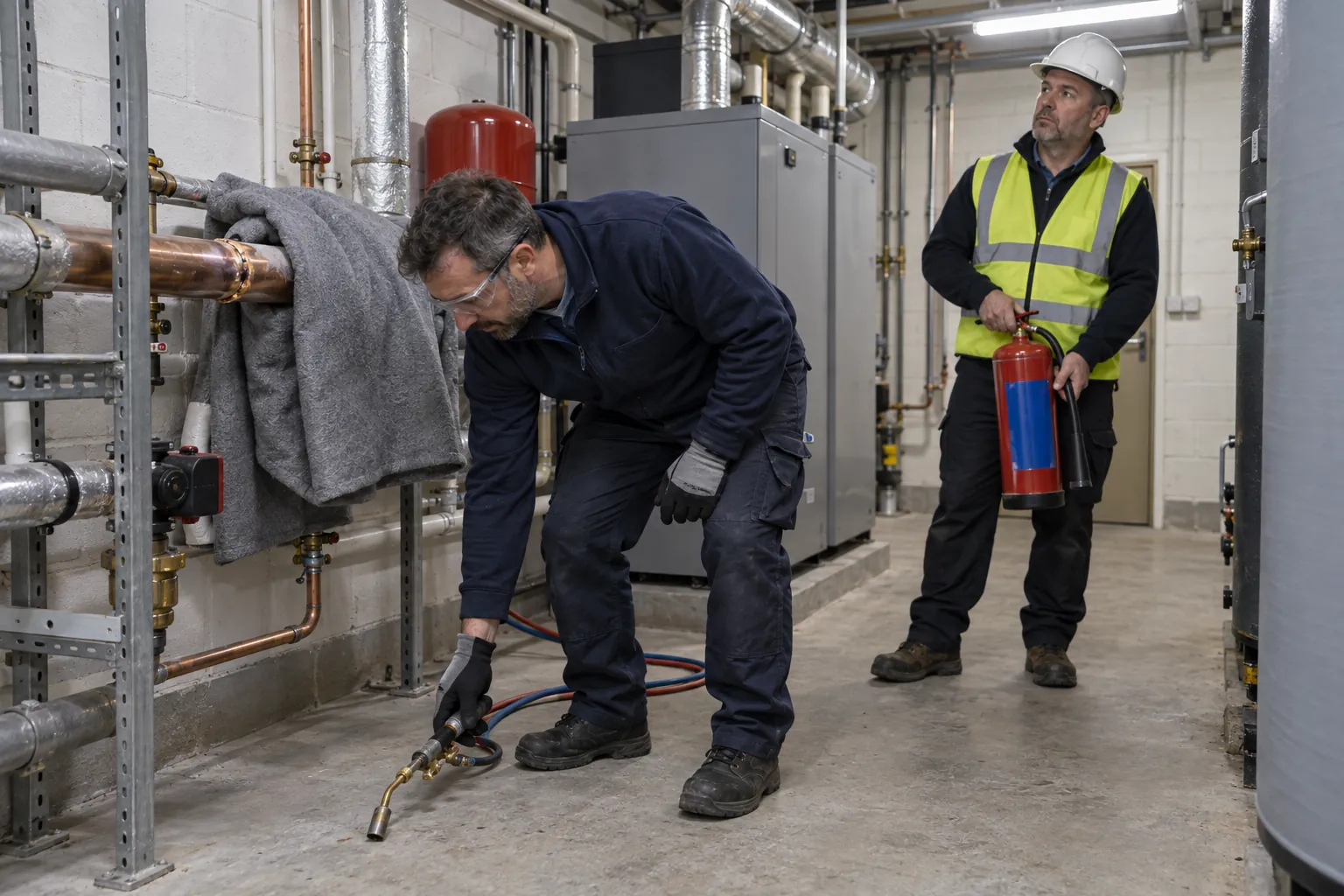
Extra duties may include a fire watch during hot works or while a fire alarm is out of action, key holding and alarm response, lone worker checks, or covering reception. Whatever they are, they belong in the assignment instructions.
Security officers often work alone and at night, which the Health and Safety Authority recognises: its guidance on lone workers lists security among the people who work outside normal hours, and says that the risk assessment required by section 19 of the 2005 Act determines whether an employee may work alone. Its suggested controls include phone or radio contact, controlled periodic checks and automatic warning devices. Supervision is a management decision: "It should not be left to individuals to decide whether they require assistance."
04
What a security officer cannot do
Part of knowing the duties of a security officer is knowing their limits. A PSA licence is permission to provide a security service. It does not turn an officer into a Garda.
- Arrest is the ordinary citizen's power, and a narrow one. Section 4 of the Criminal Law Act 1997 lets any person arrest without warrant someone who is, or whom they reasonably suspect to be, in the act of committing an arrestable offence, or guilty of one that has been committed. A person other than a Garda may only do so where they reasonably suspect that the person would otherwise try to avoid, or is avoiding, arrest by a Garda, and must hand them over to the Garda Síochána as soon as practicable.
- Searches follow the site's written procedure. A bag search should be done only with the person's agreement and in the way the assignment instructions set out; the remedy for a refusal is normally that the person is not admitted, and anything more is a matter for the Gardaí.
- Escape routes stay open. Section 18(2) of the Fire Services Act 1981 puts a duty on every person having control over premises the section covers (among them places the public has access to, such as shops, and places used for sleeping accommodation, care, entertainment, or teaching and training) to take all reasonable measures to guard against fire and to ensure, as far as is reasonably practicable, the safety of people there if a fire breaks out. Chaining or locking a fire exit while people are inside, for whatever security reason, works against that duty.
- No work outside the licence. A licence authorises a particular service. An officer licensed as a security guard cannot take on another licensed role, such as door supervision on licensed premises, without the licence for it.
- CCTV and personal data are handled lawfully. The Data Protection Commission's Guidance on the Use of CCTV for Data Controllers treats a security company operating cameras for a client as a possible data processor acting under contract, and says that for a normal security system it would be difficult to justify keeping footage beyond one month unless it shows an incident under investigation.
When an incident goes beyond these limits, the duty is to observe, record, protect people and call the Gardaí. When unsure, the officer should ask the control room or supervisor before acting, not after.
05
How duties are set and checked
The duties on any site should come from three documents: the contract, which sets the service; the risk assessment, which says what the security measures are for; and the assignment instructions, which tell the officer exactly what to do, when and how. The PSA's auditing guidelines expect assignment instructions to be available on site and to include how to contact the firm's command and control system and the number of personnel involved and their responsibilities. For patrols, they should provide for check-in calls before and after visiting an alarm activation.
The guidelines also expect training on file: induction before operational duties begin, with a signed declaration; the Guarding Skills award; and site-related training against a site-specific plan for anyone starting or changing assignment, with the new officer supernumerary while it happens.
The contractor then checks the work. The usual methods, several of which a PSA 28 audit looks at, are:
- Supervisory visits, announced and unannounced, including at night, to check the officer is alert, in uniform, carrying the PSA identity card and following the assignment instructions. The auditing guidelines expect the uniform to be readily distinguishable from the civil protection services, and a written record where a client has asked that it not be worn.
- Check-in calls to the control room. Where a firm uses a manned site, a mobile unit or a looped check-in system as its command and control, the guidelines expect calls at least once every two hours, or more often if the risk assessment requires, a register of the calls and incident details, and set procedures for a call that is not made. The guidelines add that door and retail security staff check in at the start and end of each shift.
- Record reviews: reading the occurrence book, incident reports and patrol records for completeness, and for patterns that point to a change in what the site needs. The guidelines expect the firm's senior management to check and review reports and reporting procedures quarterly.
- Patrol evidence: a record showing each point on the route was visited, when and by whom, and for mobile patrols the check sheet and the register of keys.
- Client feedback: complaints, response times and patrols completed against those scheduled.
- Training and licence records: licence and identity card details, induction, site training, first aid and anything specific to the site.
Pay and conditions are checked too. For contract security, the Employment Regulation Order for the security industry (S.I. No. 319 of 2024, as amended, most recently by S.I. No. 475 of 2026 from 28 September 2026) sets minimum rates and conditions for people employed by a security firm to provide a security service for its contract clients, and the Workplace Relations Commission enforces it.
06
Where the evidence of the duties fails, and where SiteClara fits
Most of what a good security officer does leaves no trace. A patrol that finds nothing is written up as "all in order", and a client who never sees a problem may start to wonder what the guarding is for. The patrol entries written at six in the morning for the whole night, the broken lock noted in the book but never passed to maintenance, and the check nobody can show happened are where a client's confidence in a security contract wears away.
SiteClara gives the routine duties a record. A printed QR poster, with an optional NFC tag behind it, sits at each point on the patrol: a gate, a fire exit, a plant room, a car park level, a bin store. The officer scans the code or taps the tag on their own phone, with no app to install, and marks the scheduled check done, or says what stopped them. The time and the named officer are recorded as it happens, with a photo when one helps. A fault found on the round is reported there and goes onto the team's list of open jobs until someone closes it.
The security supervisor sees what is due, done and missed, records why a check was missed from the company's own list of reasons, and works from a queue of open jobs grouped by building and floor, escalating one to the building manager when it needs them. At the end of the day the supervisor reviews the totals and photos, adds a note and approves the daily report, which goes to nominated managers or client contacts the next morning, showing what was reported, what is still open and how the scheduled checks went.
07
Questions people ask
What are the duties of a security officer?
To guard and patrol premises, protect the people and property there, and respond to whatever happens on the shift. Section 2(1) of the Private Security Services Act 2004 defines a security guard as a person who "for remuneration guards or patrols or provides any other protective services in relation to persons or property", including monitoring security equipment, supervising and inspecting security guards while they are guarding or patrolling, and directing the movement of people at an event. In practice that means patrols, access control, CCTV and alarm monitoring, incident and emergency response, and keeping records, as set out in the site's assignment instructions.
What are the basic security duties?
The basics are the ones every new officer in Ireland is trained in. The QQI component specification for Guarding Skills (4N1118), the basic training award for a security guard, says its purpose is to equip a learner "to work under supervision as a security officer performing practical security duties and procedures and responding to security situations". Its learning outcomes include carrying out "the duties and procedures required of a security officer", responding "appropriately to security incidents and emergencies", dealing with a suspect, loss prevention, preserving a scene of crime, recording incidents and liaising with the appropriate agencies, and using communication and customer service skills.
What are your duties and responsibilities as a security officer?
Your duties are the ones in the site's assignment instructions, and your responsibilities include your own safety and other people's. Section 13(1) of the Safety, Health and Welfare at Work Act 2005 requires every employee, while at work, to take reasonable care to protect their own safety, health and welfare and that of anyone affected by what they do, not to be under the influence of an intoxicant to the extent that they endanger anyone, and to report defects that might endanger anyone to their employer or another appropriate person as soon as practicable.
08
Further reading, and a list to take away
The primary sources, all free to read:
- The Private Security Services Act 2004 (revised): sections 2, 29, 37 and 38.
- The PSA's Auditing Guidelines for Certification Bodies for PSA 28:2013.
- The Safety, Health and Welfare at Work Act 2005, section 8, the employer's duties, and section 13, the employee's.
- The HSA's guidance on lone workers.
- The Data Protection Commission's Guidance on the Use of CCTV for Data Controllers.
- Section 4 of the Criminal Law Act 1997.
Before an officer starts on a new site, check that:
- they hold a PSA licence for the service, and carry the identity card;
- they have had induction and site-related training, and it is recorded on their file;
- they have read the site's assignment instructions, which are kept on site;
- they know the patrol routes, the points to check and the times;
- they know how and when to check in with the control room, and what happens if a call is missed;
- they know who to call for each kind of incident, and the emergency and evacuation procedures;
- they know how to record patrols, incidents, keys and faults, and who reads the records;
- they understand what they may and may not do, including arrest, searches, fire exits and CCTV;
- their supervisor has a plan for visits and record reviews.
Sources
Every document this guide quotes or links to, in the order it first cites them.
- Private Security Services Act 2004 revisedacts.lawreform.ie
- Auditing Guidelines for Certification Bodies for PSA 28:2013 (2025 edition) psa-gov.ie
- Guidance on lone workers hsa.ie
- Criminal Law Act 1997 revisedacts.lawreform.ie
- Fire Services Act 1981 irishstatutebook.ie
- Guidance on the Use of CCTV for Data Controllers dataprotection.ie
- Employment Regulation Order for the security industry workplacerelations.ie
- QQI component specification for Guarding Skills (4N1118) qsdocs.qqi.ie
- Safety, Health and Welfare at Work Act 2005 revisedacts.lawreform.ie
- Safety, Health and Welfare at Work Act 2005, section 8 irishstatutebook.ie
- Section 13 irishstatutebook.ie
Related guides
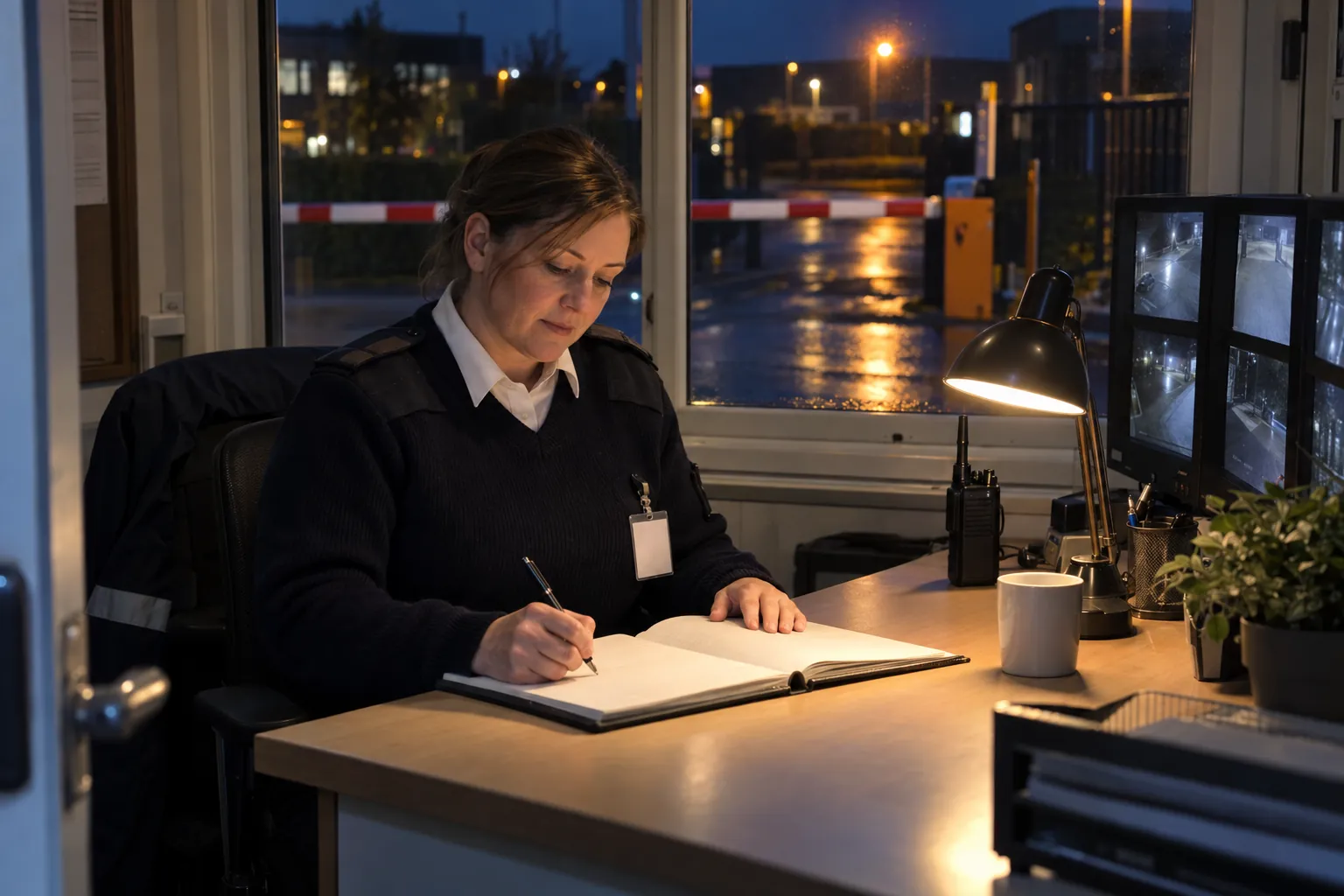 Security patrolsSecurity officer report: what to write in Ireland, and how to make it hold upThe reports a security officer in Ireland writes on shift, what the PSA's guarding standard requires of an incident report, and how to write one that holds up.
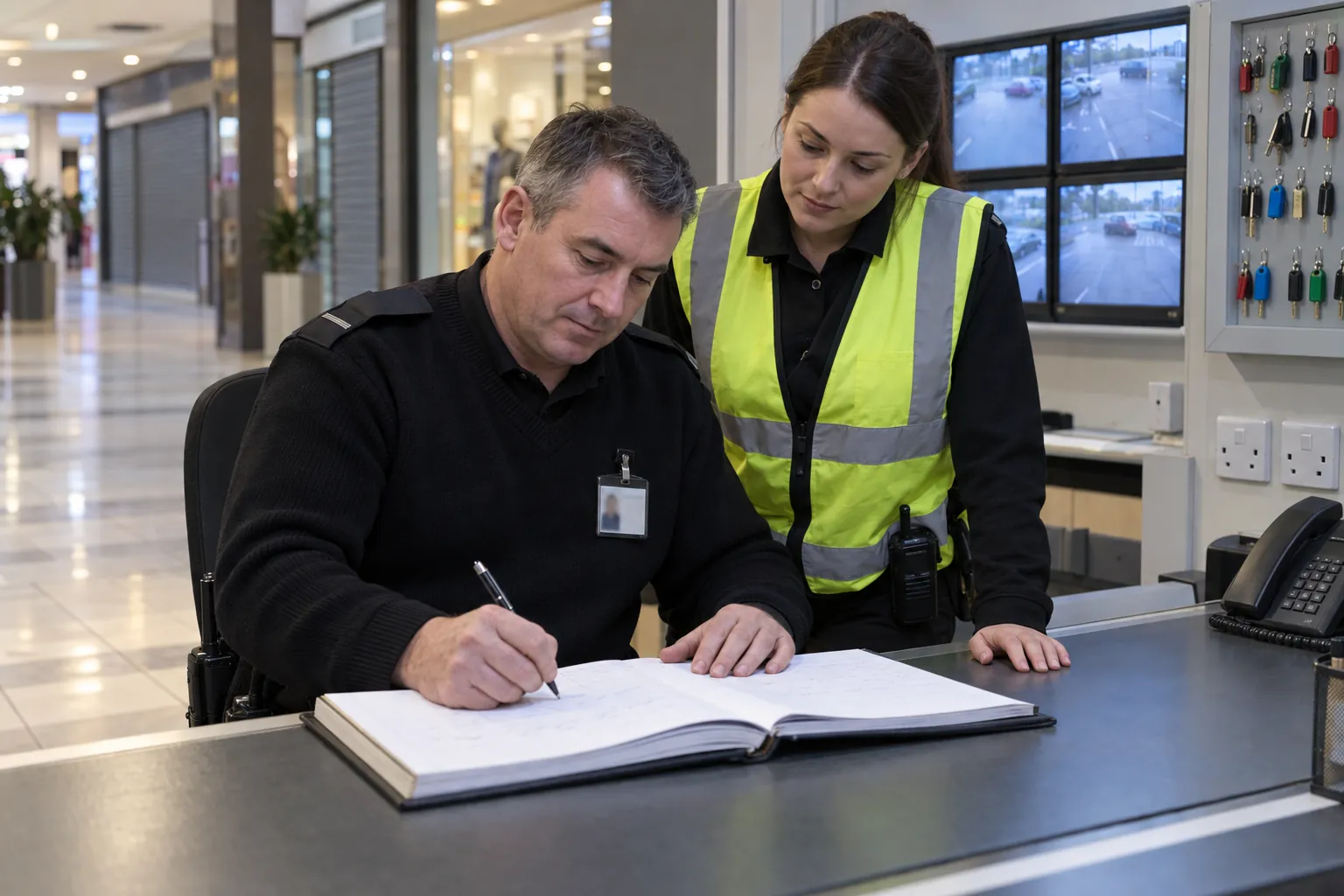 Security patrolsDaily occurrence book: what to record, and how to keep one that stands upThe daily occurrence book on an Irish security site: what to record, how to write entries, how it fits PSA 28:2013's records and incident reports, and retention.
 Security patrolsSite security checklist: what to check, how often, and how to show it was doneA site security checklist for Irish building sites and premises: the law behind it, what to check at opening, closing and out of hours, and a record that stands up.
 Security patrolsRetail security in Ireland: what it covers, what the law allows, and how it is checkedRetail security in Ireland: the PSA licence, shoplifting and the limits of arrest, violence towards shop staff, CCTV, and the opening and closing checks.
 Fire and water checksFire watch: what it is in Ireland, when you need one and what to recordWhat a fire watch is under Irish law and guidance, when a building needs one, what the fire watcher does after hot work or during an alarm fault, and what to record.