Premises and facilities management
Fixed wire testing: what the law requires, how often, and what the EICR tells you
Fixed wire testing is the periodic inspection and testing of a building's fixed electrical installation, from the incoming supply and distribution boards to the wiring, sockets, lighting and wired-in plant, by a competent person who records the result on an Electrical Installation Condition Report (EICR) to BS 7671.
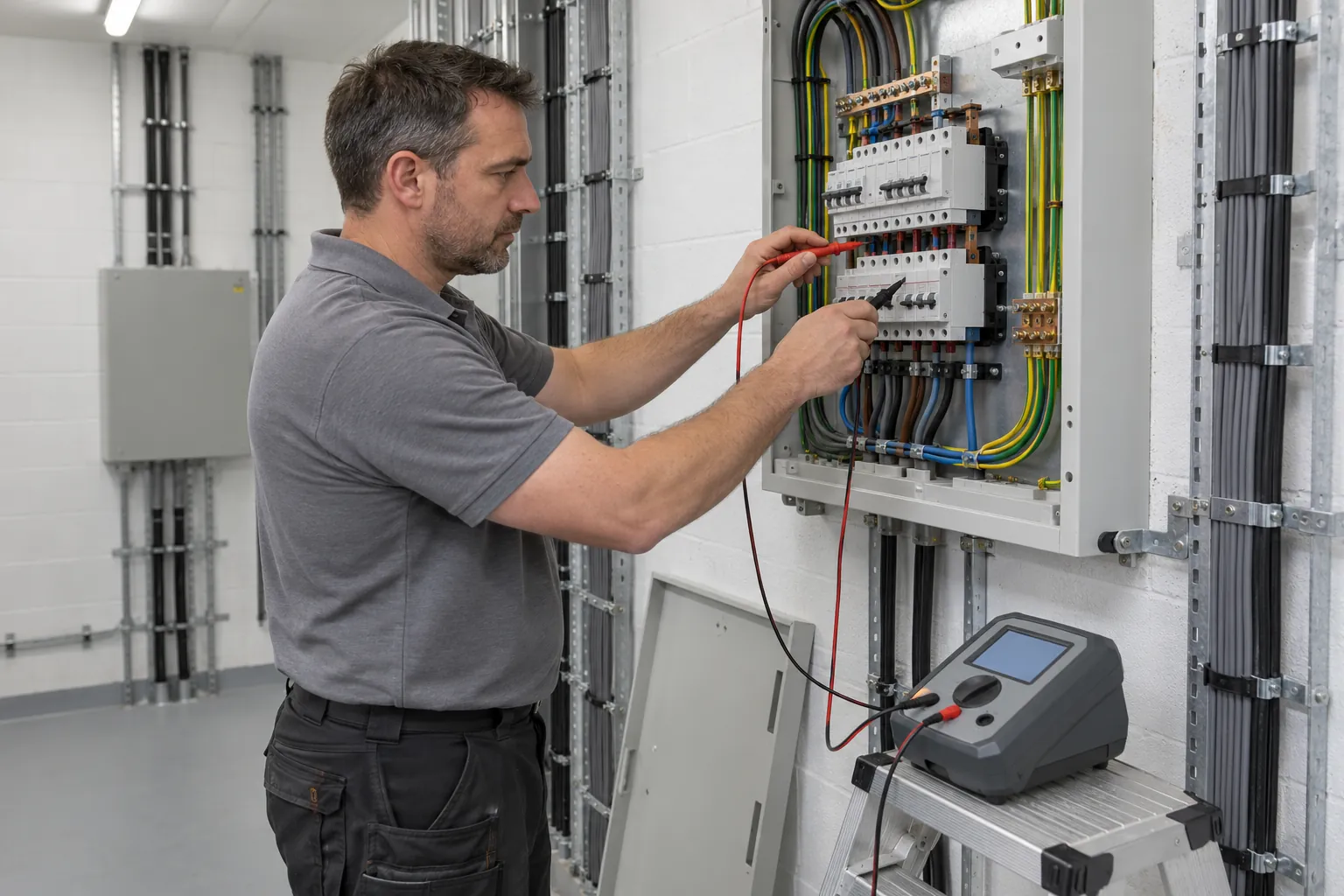
In Great Britain no regulation names it or sets an interval for commercial premises: the Electricity at Work Regulations 1989 require electrical systems to be maintained so as to prevent danger, and periodic inspection and testing is how a dutyholder shows that the fixed installation has been. HSE says there is no legal requirement for inspection and testing at set intervals, so the familiar five years for a business is a recommendation, and the inspector's report says when the next one is due. This guide covers what the law says, what the test covers, how to read an EICR and its codes, how often to test, who can do it, and what to keep between visits.
01
Is fixed wire testing a legal requirement?
The duty behind fixed wire testing is regulation 4(2) of the Electricity at Work Regulations 1989, which applies in England, Wales and Scotland: "As may be necessary to prevent danger, all systems shall be maintained so as to prevent, so far as is reasonably practicable, such danger." A system, as the Regulations define it, includes the source of supply and all the equipment connected to it, so the building's wiring, switchgear, distribution boards and sockets are all within the duty. Regulation 2 defines danger as the risk of injury, and injury as death or personal injury from electric shock, electric burn, electrical explosion or arcing, or from fire or explosion initiated by electrical energy.
The Regulations do not mention testing, a report or an interval. HSE's guidance, The Electricity at Work Regulations 1989: Guidance on Regulations (HSR25, third edition, 2015), says that the obligation to maintain arises only if danger would otherwise result, that inspection and, where necessary, testing of equipment is an essential part of any preventive maintenance programme, and that adjusting how often it is done in the light of experience is a matter for the judgement of the dutyholder. HSE's health and social care FAQs say it most plainly: "There is no legal requirement for inspection and testing at set intervals. The legal requirement is simply to maintain the installation in a safe condition."
So fixed wire testing is not itself a legal requirement, but maintaining the fixed installation is, and periodic inspection and testing is the practical way to know it has been carried out: HSR25 adds that, without effective monitoring, dutyholders cannot be certain that the requirement for maintenance has been complied with.
The standard the work is done to is BS 7671, Requirements for Electrical Installations, also known as the IET Wiring Regulations. HSR25 describes it as non-statutory, "a code of practice which is widely recognised and accepted in the UK and compliance with it is likely to achieve compliance with relevant aspects of the Electricity at Work Regulations 1989". The current version is BS 7671:2018+A4:2026, published on 15 April 2026; BSI says the previous version, BS 7671:2018+A2:2022+A3:2024, is withdrawn on 15 October 2026.
The duty falls on every employer and self-employed person, and on employees, for matters within their control (regulation 3). In commercial properties let to several tenants, that means working out who is responsible for each part of the installation, since the landlord's supply and common parts and each tenant's own circuits are often in different hands; check what the lease says about testing and repairs. In Northern Ireland the equivalent duty is in the Electricity at Work Regulations (Northern Ireland) 1991, and HSENI's electrical safety guidance says there should be a systematic procedure in place to regularly check the electrical system.
02
What fixed wire testing covers, and what it does not
HSE describes the fixed electrical installation as including the incoming supply cables, switchgear, distribution boards and socket outlets. The Department for Education's Good estate management for schools: health and safety gives a fuller list of what fixed electrical system testing reaches, which fits any non-domestic building:
- all electrical wiring;
- external lighting and supplies;
- main panels and distribution boards;
- lighting;
- socket outlets;
- air conditioning and other fixed plant.
It does not cover the equipment that plugs into the sockets. Kettles, vacuum cleaners, floor scrubbers and extension leads are portable appliances, maintained by user checks, formal visual inspections and, where needed, a combined inspection and test: see PAT testing. BS 7671 also applies only to installations operating at up to 1000 V a.c. or 1500 V d.c., so it does not reach high-voltage equipment such as a large site's own substation.
A periodic inspection has two parts. The visual inspection is a structured look at the condition of the installation for damage, deterioration and defects, recorded on a schedule of inspection. The electrical testing is done with instruments, circuit by circuit, and the IET's BS 7671:2018+A4:2026 model forms for certification and reporting show what is recorded: continuity of protective conductors, insulation resistance, polarity, earth fault loop impedance (Zs), and the operation of residual current devices (RCDs) and arc fault detection devices (AFDDs).
Not everything is reached. Unless the client and the inspector agree otherwise before the inspection, the model report says that cables concealed within trunking and conduits, under floors, in roof spaces and generally within the fabric of the building have not been inspected. The inspector may inspect a sample of cable terminations rather than every one, and the model form says the extent and location of the sampling is indicated in Section D of the report. Parts of the building that could not be reached on the day, or circuits that could not be switched off, are recorded as limitations. A report can only vouch for what it says it covered.
03
The EICR: how to read the report and its codes
The result of fixed wire testing is an Electrical Installation Condition Report, set out in the model forms published with BS 7671. The guidance for recipients printed on the form says its purpose is to confirm, so far as reasonably practicable, whether or not the installation is in a satisfactory condition for continued service at the date of inspection and testing. It is not a certificate for new work, and it is only valid if accompanied by its schedules of inspection, circuit details and test results.
The parts a premises or facilities manager needs to read are:
- Section D, extent and limitations. What was inspected and tested, what was agreed to be left out and why, and what could not be reached on the day, agreed beforehand with the person ordering the report and, the guidance says, other interested parties such as an insurance company.
- Section E, the summary. An overall assessment of satisfactory or unsatisfactory for continued service. The form says an unsatisfactory assessment indicates that dangerous (C1) or potentially dangerous (C2) conditions have been identified.
- Section F, the recommendation for next inspection. A date by which the installation should be inspected and tested again, with the reasons for it.
- Section K, the observations, each with a classification code.
The codes on the BS 7671:2018+A4:2026 forms are:
- C1 – Danger present. Risk of injury. Immediate remedial action is necessary. Wherever practicable the inspector makes the item safe on discovery; where that is not possible, the owner or user is given written notification as a matter of urgency.
- C2 – Potentially dangerous – urgent remedial action is necessary. The guidance recommends that a skilled person competent in electrical installation work does the remedial work as a matter of urgency.
- C3 – Improvement recommended. Advisory: it does not affect the overall assessment, though the work may improve safety.
- FI – Further investigation is advised. A potential issue the inspector could not classify within the limits of the inspection. On the Amendment 4 form it does not affect the overall assessment, but further investigation is recommended so a code can be reached.
Two points on the form are easy to miss. An installation designed to an earlier edition is not necessarily unsafe or in need of upgrading; the report records what might give rise to danger, not every difference from today's rules. And the form's guidance says the report should be kept in a safe place and made available to anyone inspecting or working on the installation in future. Check which version a report was made to: the form states the amendment the work followed, and older forms word the codes slightly differently.
04
How often fixed wire testing is needed
No law sets an interval for a commercial building, whether offices, shops or industrial premises. The IET's inspection and testing FAQs explain where the interval comes from: for a new installation the initial frequency is recommended by the electrical designer, and subsequent intervals by the competent person carrying out the inspection and testing, determined by "the type of installation and equipment, its use and operation, the frequency and quality of maintenance and the external influences, to which it may be subjected".
The usual starting point is the table of recommended initial frequencies of inspection in the IET's Guidance Note 3: Inspection & Testing (10th edition, 2026), which the IET says are recommendations, not legal requirements. Recommendations published elsewhere for common buildings include:
- Businesses: at least every 5 years, in Electrical Safety First's answer on how long an EICR lasts, which gives swimming pools every year and caravans every 3 years.
- Residential premises such as care homes: every 5 years, which HSE's health and social care FAQs attribute to BS 7671, varied on the advice of a competent person.
- Schools: the Department for Education says the frequency and type of inspection should be based on the risk assessment for the installation and the prevailing conditions.
The date in Section F of the last EICR is the inspector's recommendation for this installation, and it may be shorter than five years, depending on the condition and use of the installation. The model form says the interval should take into account the overall condition of the installation, and the IET's factors include use and operation and external influences, so heavy use, an industrial process or a damp or dusty environment points to a shorter interval. The decision still rests with the dutyholder: HSE's electrical safety FAQs say that installations should be tested often enough that there is little chance of deterioration leading to danger.
Those factors change when the building does. A change of use, a refurbishment, a tenant's fit-out or an unsatisfactory report is a reason to ask whether the next inspection should come sooner, and a report with many limitations may need a return visit to the parts it could not reach.

05
Who can carry it out, and what to keep
The law asks for competence, not a named qualification. Regulation 16 of the Electricity at Work Regulations 1989 says no person shall be engaged in any work activity where technical knowledge or experience is necessary to prevent danger unless they have that knowledge or experience, or are suitably supervised. HSE's FAQs say a competent person, normally an electrician, should carry out the inspection and testing, and the Department for Education tells schools that all electrical testing must be conducted by a suitably qualified electrician.
BS 7671 asks for a skilled person, defined, as the IET's FAQs quote, as one who "possesses, as appropriate to the nature of the electrical work to be undertaken, adequate education, training and practical skills, and who is able to perceive risks and avoid hazards which electricity can create". One qualification for periodic inspection is City & Guilds' Initial and Periodic Electrical Inspection and Testing (2391), intended for practising electricians. When you appoint a contractor, ask what the inspector holds, how they will sample and record limitations, and how they will plan the circuits that must be switched off so that the disruption to occupants is kept low.
Keeping records is not a legal requirement, but HSR25 says records can aid demonstration of compliance and that maintenance records, including test results, preferably kept throughout the working life of an electrical system, allow the condition of the equipment and the effectiveness of maintenance to be monitored. A fixed wiring file that does its job holds:
- The current EICR, complete, with every schedule, and the previous ones, so the condition can be compared over time.
- The agreed extent and limitations, and a plan for any part that was not inspected.
- Every C1, C2 and FI observation with its outcome: what was done, by whom, when, and the paperwork from the electrician who did it.
- The next inspection date, who decided it, and the reasons if it differs from the report's recommendation.
- The routine checks between inspections: visual checks of sockets, switches and boards, the six-monthly RCD and AFDD test-button checks, and the faults they found.
- Drawings and distribution board schedules, kept up to date after alterations, so the next inspector can find every circuit.
Make the report easy to find: insurers, a new tenant or a buyer may ask for it. In a multi-let building, agree who holds the report for each part of the installation.
06
Where the record fails, and what SiteClara does about it
The EICR is the visible part of looking after a fixed installation: a contractor spends a few days on site and a report arrives. The years between are where the record fails. A cracked socket faceplate is mentioned to whoever is passing and forgotten. Nobody presses the RCD test button because nobody owns the task. A riser cupboard the inspector could not open is listed as a limitation, and nobody arranges a return visit. At the next inspection, nobody can say what was looked at in between.
SiteClara puts a printed QR poster, with an optional NFC tag behind it, at each location where a check happens, such as a plant room, an electrical riser cupboard or a staff kitchen. The person doing the check scans the code or taps the tag on their own phone, with no app to install, sees the checks due there, such as the six-monthly RCD test-button check on that floor's distribution board or a monthly look at the sockets and switches along a corridor, and marks each one done or explains what stopped them, with a photo when one is asked for. The time and the named person are recorded as it happens. A damaged socket or a scorched faceplate is reported at the location, with a photo, and goes onto the team's list of jobs until someone closes it.
The supervisor sees what is due, done and missed, and records the reason a check was missed. Each day they review and approve a report that goes to nominated management or client contacts at 8am the next morning, showing what was reported, completed and still open, and how the scheduled checks went, for example 6 of 6 completed. That gives the visual checks between inspections a record made at the time, and a fault an owner and an outcome.
07
Questions people ask
Is fixed wire testing the same as an EICR?
Nearly. Fixed wire testing is the inspection and testing; the Electrical Installation Condition Report is the document that records it, on the model forms published with BS 7671. The IET's inspection and testing FAQs say any observations the inspector notices during the inspection and testing are required to be recorded on an EICR, each with a classification code according to the degree of urgency; the codes as worded today are on the IET's BS 7671:2018+A4:2026 model forms.
How often do you need to do fixed wire testing?
As often as the installation needs to stay safe: HSE's health and social care FAQs say there is no legal requirement for inspection and testing at set intervals. The IET's inspection and testing FAQs say intervals after the first are recommended by the competent person carrying out the inspection and testing, and the EICR records that recommendation in Section F as a date, with the reasons for it.
Is an EICR a legal requirement for commercial property?
No law requires an EICR for a commercial building by name. The Electricity at Work Regulations 1989 require the installation to be maintained so as to prevent danger, and an EICR to BS 7671 is the usual evidence that it has been. The five-yearly report required by England's 2020 regulations applies to privately rented homes, not to workplaces.
Do you need 2391 to carry out an EICR?
Not by law. Regulation 16 of the Electricity at Work Regulations 1989 requires the knowledge or experience to prevent danger, not a particular certificate, and BS 7671 asks for a skilled person. City & Guilds' Initial and Periodic Electrical Inspection and Testing (2391) is intended for practising electricians who want to expand their skills in initial verification and periodic inspection.
08
Further reading, and a list to take away
Start with HSE's HSR25 for what the Regulations require and how BS 7671 relates to them. The IET's BS 7671:2018+A4:2026 model forms for certification and reporting carry the current codes and the guidance for recipients printed with every EICR, and its inspection and testing FAQs explain who recommends the interval. Schools have the Department for Education's Good estate management for schools; Northern Ireland has HSENI's electrical safety page.
To keep the fixed installation safe and show that it is:
- work out who controls each part of the installation, and who holds each report;
- find the current EICR and check it is complete, with every schedule and the extent and limitations;
- put the Section F date in the maintenance plan, shortened where the condition or use of the building calls for it;
- appoint a competent inspector, and agree the extent, sampling and access before they arrive;
- act on every C1 and C2 at once, investigate every FI, and decide on each C3;
- keep the paperwork for the remedial work beside the report it answers;
- between inspections, have trained staff look at sockets, switches and boards, and press the RCD and AFDD test buttons every six months;
- keep every report for the life of the installation, and pass them on when the building changes hands.
Sources
Every document this guide quotes or links to, in the order it first cites them.
- Regulation 4(2) of the Electricity at Work Regulations 1989 legislation.gov.uk
- The Electricity at Work Regulations 1989: Guidance on Regulations (HSR25, third edition, 2015) hse.gov.uk
- Health and social care FAQs hse.gov.uk
- BS 7671:2018+A4:2026 knowledge.bsigroup.com
- Electrical safety guidance hseni.gov.uk
- Regulation 3 of the Electrical Safety Standards in the Private Rented Sector (England) Regulations 2020 legislation.gov.uk
- Good estate management for schools: health and safety gov.uk
- BS 7671:2018+A4:2026 model forms for certification and reporting electrical.theiet.org
- Inspection and testing FAQs electrical.theiet.org
- Guidance Note 3: Inspection & Testing (10th edition, 2026) shop.theiet.org
- Electrical Safety First's answer on how long an EICR lasts electricalsafetyfirst.org.uk
- Electrical safety FAQs hse.gov.uk
- Regulation 16 of the Electricity at Work Regulations 1989 legislation.gov.uk
- Initial and Periodic Electrical Inspection and Testing (2391) cityandguilds.com
Related guides
 Premises and facilities managementPAT testing: what the law requires, how often, and who can do itWhat PAT testing is, what the Electricity at Work Regulations 1989 require, how often to check and test each kind of equipment, who can do it, and what to record.
 Premises and facilities managementBuilding compliance checklist: the statutory picture for a UK buildingBuilding compliance checklist for UK non-domestic buildings: fire, electrical, gas, water, asbestos, lifts, access and energy, who is responsible, how often.
 Premises and facilities managementPlanned preventative maintenance: how to plan it and prove it was donePlanned preventative maintenance (PPM): what it is, how to build an asset register and schedule, statutory versus discretionary tasks, and evidencing the work.
 Premises and facilities managementPremises manager: what the job involves, and how to run it wellWhat a premises manager does in a college, charity, housing provider or trust: the compliance calendar, contractors, security, budgets and reporting.