Premises and facilities management
PAT testing: what the law requires, how often, and who can do it
PAT testing (portable appliance testing) is the routine inspection and, where needed, electrical testing of plug-in electrical appliances in the workplace to check they are safe to use.

In Great Britain it is not itself a legal requirement: the Electricity at Work Regulations 1989 require electrical equipment that could cause danger to be maintained, but do not say how or how often. That gap is where most of the myths come from, such as the annual test for everything, the electrician-only rule and the sticker as proof of compliance. HSE's own guidance sets out a straightforward, inexpensive approach built on user checks, formal visual inspections and, for some equipment, a combined inspection and test. This guide covers what the law says, what counts as portable equipment, the three levels of check, how often each is needed, who can do them, and what to record.
01
What the law requires, and what it does not
The duty behind PAT testing is regulation 4(2) of the Electricity at Work Regulations 1989, which applies in England, Wales and Scotland: "As may be necessary to prevent danger, all systems shall be maintained so as to prevent, so far as is reasonably practicable, such danger." A system, in the Regulations, includes the electrical equipment connected to it, so the kettle, the floor scrubber and the extension lead behind the reception desk are all within the duty.
What the regulation does not do is prescribe a method. The Health and Safety Executive's PAT – Portable appliance testing FAQs put it plainly: the Regulations "do not specify what needs to be done, by whom or how frequently", so they do not make inspection or testing of appliances a legal requirement, nor make it a legal requirement to do it annually.
HSE's The Electricity at Work Regulations 1989: Guidance on Regulations (HSR25, third edition, 2015) adds that inspection and, where necessary, testing is an essential part of any preventive maintenance programme, and that how often is a matter for the dutyholder's judgement. Regulation 5 of the Provision and Use of Work Equipment Regulations 1998 also requires every employer to ensure that work equipment is maintained in an efficient state, in efficient working order and in good repair.
In Northern Ireland the equivalent duty is in the Electricity at Work Regulations (Northern Ireland) 1991, enforced by HSENI, whose electrical safety guidance says there should be a systematic procedure in place to regularly check the electrical system including any portable equipment.
The duty is the employer's, and HSE's leaflet Maintaining portable electric equipment in low-risk environments (INDG236, rev3, 2013) says it reaches any electrical equipment your employees use in the workplace, whether their own or supplied by you, and is shared for leased equipment such as a photocopier.
02
What counts as portable equipment
INDG236 defines a portable or movable appliance as any item that can be moved, connected or disconnected from an electrical supply, generally with a lead and a plug. In an ordinary office, school, shop or hotel, the electrical appliances it covers are:
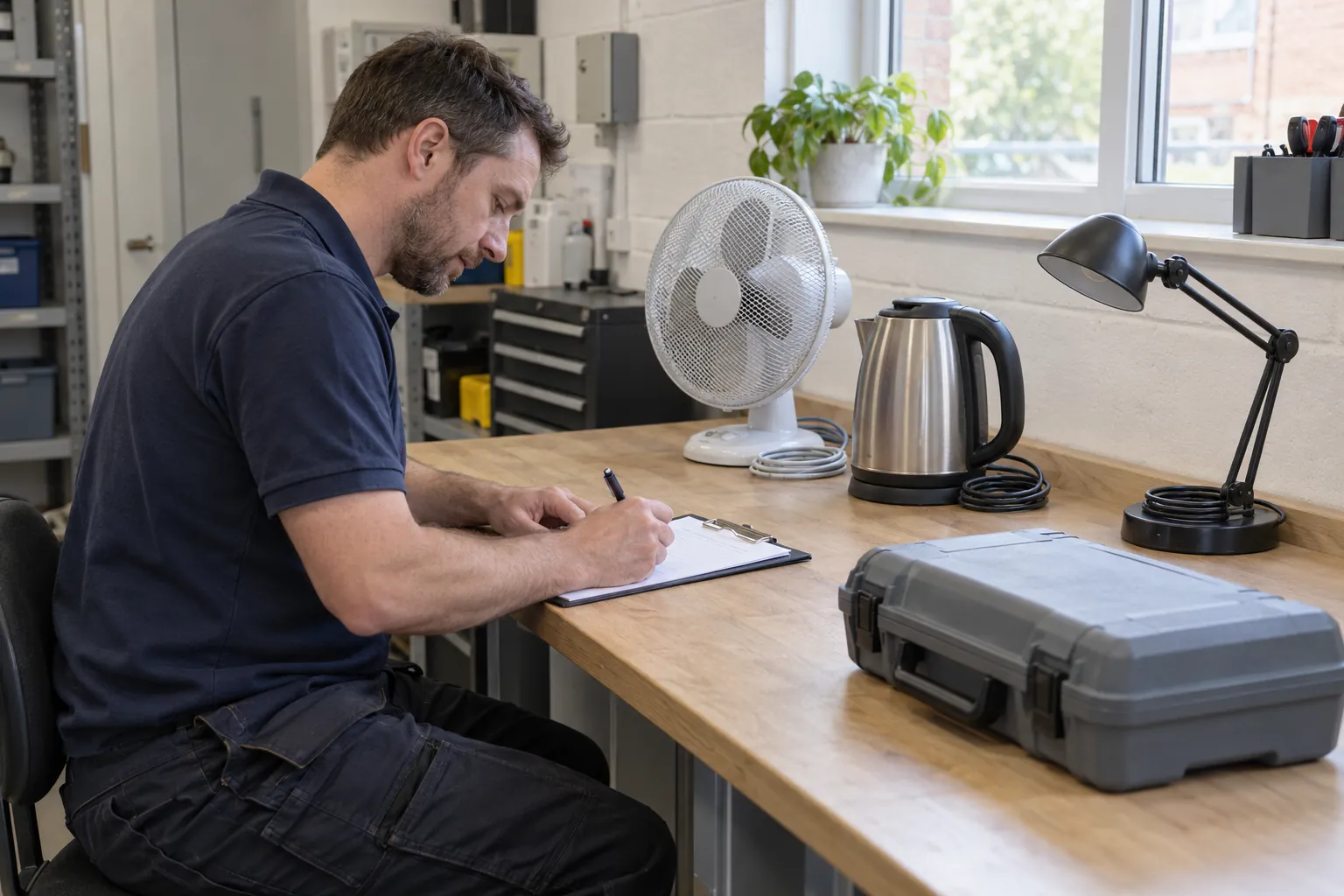
- Easily moved items: kettles, vacuum cleaners, floor polishers, heaters, fans, desk lamps, projectors, irons and small kitchen equipment.
- Larger items rarely moved: fridges, microwaves, water chillers, photocopiers, vending machines, washing machines and desktop computers.
- Hand-held items wired in without a plug, such as a wall-mounted hairdryer.
- Mains chargers for phones and battery equipment, though battery-operated equipment itself is not included.
- Extension leads, multi-way adaptors and connection leads.
Large wired-in items that are not designed to be moved, such as a water boiler, are not portable appliances: INDG236 places them under the maintenance of the fixed installation, which is a separate regime (the wiring, the distribution boards and the sockets themselves, for which BS 7671 gives advice on inspection and testing).
The other distinction that decides what a piece of equipment needs is how it is built. Class I equipment is earthed: if the earth connection fails, a fault can make the outside live, so INDG236 recommends a portable appliance test to make sure the earth connection is sound. Class II equipment is double insulated and carries the Class II symbol; it does not rely on an earth, will not need a portable appliance test, and is maintained by user checks and visual inspections because the integrity of its casing is the safety feature. If you cannot see the symbol, INDG236 says to assume the item is Class I.
03
The three levels of check: user checks, formal visual inspection and the PAT test
HSE's main guidance, Maintaining portable electrical equipment (HSG107, third edition, 2013), says failure to maintain equipment is a major cause of electrical accidents involving portable equipment, and describes a maintenance plan with three parts. The first two are where most faults are found, and both can be done by a trained member of your own staff.
- User checks. The person using the equipment looks at it before use, with it disconnected, for damage to the lead or plug, taped joints, coloured wires showing where the lead enters the plug, a damaged casing or loose parts, burn marks or staining from overheating, and signs it has been wet or used somewhere unsuitable. A fault means the item comes out of use and is reported.
- Formal visual inspection. The same checks, done systematically by someone given the task, plus whether the equipment is used as the manufacturer intended, suits the job, and whether users have reported problems. Where the plug can be opened, the inspector checks for internal damage, the correct fuse (a proper fuse, not wire or a nail), wires on the right terminals and a cord grip holding the outer sheath; with a moulded plug only the fuse can be checked. HSG107 says these inspections are necessary because they can reveal most potentially dangerous faults.
- Combined inspection and test, the PAT test itself. Some faults, such as a broken earth wire inside a flexible cable, deteriorating insulation or contamination inside the equipment, cannot be found by looking. HSG107 says a combined inspection and test is likely to be justified when equipment may be defective and looking cannot confirm it, after any repair or modification, and at intervals suited to the equipment, its use and its environment.
HSE's FAQs say the same thing from the other direction: most electrical safety defects can be found by visual examination, but some can only be found by testing, and some defects cannot be found by testing alone. A PAT pass without anyone looking at the plug is not enough, and INDG236 adds that a test only indicates an appliance's safety at the time of the test, so user checks continue between tests.
04
PAT testing frequency: how often to check and test
There is no legal frequency: HSG107 says the likelihood and severity of accidents vary with the type of equipment, the way it is used and the environment it is used in, so the interval should too. Table 1 in INDG236 gives suggested initial intervals for low-risk environments such as offices, shops, and some parts of hotels and residential care homes, meant as a starting point to adjust in the light of what you find:
- Battery-operated equipment (less than 40 volts) and extra low voltage equipment (less than 50 volts AC, such as telephone equipment and low-voltage desk lights): no user checks, no formal visual inspection and no test.
- Desktop computers and screens, photocopiers and fax machines (not hand-held, rarely moved): no user checks; formal visual inspection every 2–4 years; no test if double insulated, otherwise up to every 5 years.
- Class II equipment, not hand-held, moved occasionally (fans, table lamps): no user checks; formal visual inspection every 2–4 years; no test.
- Class II equipment, hand-held (some floor cleaners, some kitchen equipment): user checks; formal visual inspection every 6 months to 1 year; no test.
- Class I (earthed) equipment (electric kettles, some floor cleaners, some kitchen equipment, irons): user checks; formal visual inspection every 6 months to 1 year; combined inspection and test every 1–2 years.
- Cables, leads and plugs connected to the above, mains extension leads and battery chargers: user checks; formal visual inspection every 6 months to 4 years and a combined inspection and test every 1–5 years, depending on the equipment they serve.
Harsher environments need much shorter intervals. HSG107's version of the table covers equipment hire (an inspection before issue and after return, and a test before issue), construction sites, where equipment is tested before first use on site and then again at set intervals, and heavy and light industry. HSE's FAQs give the principle: a power tool used on a construction site should be examined more frequently than a lamp in a hotel bedroom. In an ordinary building, the table puts the most frequent checks on kettles, floor cleaners, kitchen equipment and the leads that serve them.
Three rules from the guidance shape a sensible schedule:
- Review the intervals. HSG107 says the suggested frequencies are not legal requirements; if checks find few faults the intervals may be extended, and if faults are common they should be shortened. HSE's own example is a high street travel agency whose manager settled on a visual inspection of computers, printers and fax every 5 years, but a visual inspection of the heavily used vacuum cleaner every 6 months and a test after twelve months.
- Group by the shortest interval. If equipment is tested together, use the shortest interval in the group, or group items by their interval.
- The tester does not set the date. INDG236 and HSG107 both say the person carrying out the test should not decide when the next one is due: that is the dutyholder's decision, made on a risk assessment basis.
05
Records, labels and what good evidence looks like
There is no legal requirement to keep PAT records or to label equipment. HSE's FAQs say so, and add that a record or labelling can be a useful management tool for monitoring and reviewing the effectiveness of the maintenance scheme, and to demonstrate that a scheme exists. HSR25 goes further: records can aid demonstration of compliance, and "without effective monitoring, dutyholders cannot be certain that the requirement for maintenance has been complied with".
A record that actually helps you manage the risk holds:
- An inventory of the portable equipment in each area, its class, and the interval decided for each kind of check.
- Formal visual inspection results: date, who inspected, what was inspected and what was found, passes included.
- Test results, with readings where the instrument gives them, so trends show (HSG107 warns that a different instrument may read differently).
- Faults and their outcome: taken out of use, repaired by a competent person, retested or disposed of.
- Unauthorised equipment found in use, such as personal heaters, and the decision taken.
- Reviews of the intervals, and the reasons for any change.
Faulty equipment needs a visible outcome. HSG107 says a fault found by a user should be reported to the relevant manager and the equipment taken out of use immediately, and that managers should make sure it is not used again until a competent person has repaired it, for example by labelling it as faulty and, where it has a rewireable plug, removing the plug. New equipment should arrive safe and does not need a formal test, though HSE recommends a simple visual check that it has not been damaged.
06
Where the record fails, and what SiteClara does about it
The PAT test is the visible part of electrical maintenance: a contractor visits, stickers appear, a certificate arrives. The checks HSE says find most faults are the invisible part. User checks leave no trace, the visual inspection of the kitchen or the cleaners' store slips because nobody asks for it, and a scorched plug is mentioned to whoever is passing, then forgotten. At the next test visit, nobody can say what was looked at in between.
SiteClara puts a printed QR poster, with an optional NFC tag behind it, at each location where a check happens, such as a staff kitchen, a cleaners' store or a plant room corridor. The person doing the check scans the code or taps the tag on their own phone, with no app to install, sees the checks due there, such as the six-monthly visual inspection of that kitchen's appliances, and marks each one done or explains what stopped them, with a photo when one is asked for. The time and the named person are recorded as it happens. A damaged lead or a scorched plug is reported at the location, with a photo, and goes onto the team's list of jobs until someone closes it.
The supervisor sees what is due, done and missed, and records the reason a check was missed. Each day they review and approve a report that goes to nominated management or client contacts at 8am the next morning, showing what was reported, completed and still open, and how the scheduled checks went, for example 9 of 9 completed. That gives the visual inspections between tests a record made at the time, and a fault an owner and an outcome.
07
Questions people ask
Is PAT testing a legal requirement?
Not as such. The Electricity at Work Regulations 1989 require any electrical equipment that could cause injury to be maintained in a safe condition, but HSE's PAT – Portable appliance testing FAQs say the Regulations do not specify what needs to be done, by whom or how frequently, so neither inspection and testing nor an annual test is itself a legal requirement. Some form of maintenance, chosen by risk, is.
Is there a British Standard for PAT testing?
Yes, though the law does not require you to follow it. BSI publishes BS EN 50699:2020, Recurrent tests of electrical equipment, which specifies the test procedures for recurrent tests of current-using electrical equipment and appliances. HSE's own guidance on what to do is HSG107 and INDG236, and the other reference for the testing itself is the Institution of Engineering and Technology's Code of Practice for In-service Inspection and Testing of Electrical Equipment (5th edition, 2020), a code of practice rather than a British Standard, which gives guidance on in-service inspection and testing to determine whether electrical equipment is safe for continued use, taking account of the risks the equipment is exposed to, the environment it is used in and the skill of the user.
Does a PAT test have to be done by an electrician?
No. HSE's leaflet Maintaining portable electric equipment in low-risk environments (INDG236) says a portable appliance test does not need to be carried out by an electrician, but needs greater knowledge and experience than inspection alone, the right equipment for the task, and the ability to use it and interpret the results.
Do hired tools need PAT testing?
HSE's PAT – Portable appliance testing FAQs strongly recommend that equipment suppliers formally inspect and test equipment before each hire, and say the person hiring it should also take appropriate steps to ensure it remains safe to use throughout the hire period.
08
Further reading, and a list to take away
Start with HSE's INDG236 for offices, shops and the low-risk parts of a hotel or school, and HSG107 for kitchens, laundries and every other environment, with the fuller table of intervals and a one-page summary of a maintenance plan. HSE's PAT FAQs answer the common myths. In Northern Ireland, start with HSENI's electrical safety page.
To keep portable equipment safe and show that it is:
- list the portable equipment in each area, by class and by how hard it is used;
- decide intervals for user checks, formal visual inspections and tests from a risk assessment, using HSE's table as a starting point;
- give users simple training and a short checklist, and make reporting a fault easy;
- train someone to carry out formal visual inspections, and record them, including the passes;
- use a competent person, with the right instrument, for combined inspection and testing;
- take faulty equipment out of use at once, label it, and record its repair or disposal;
- deal with equipment brought in from home;
- review the fault record and adjust the intervals, rather than testing everything every year by habit.
Sources
Every document this guide quotes or links to, in the order it first cites them.
- Regulation 4(2) of the Electricity at Work Regulations 1989 legislation.gov.uk
- PAT – Portable appliance testing FAQs hse.gov.uk
- The Electricity at Work Regulations 1989: Guidance on Regulations (HSR25, third edition, 2015) hse.gov.uk
- Regulation 5 of the Provision and Use of Work Equipment Regulations 1998 legislation.gov.uk
- Electrical safety guidance hseni.gov.uk
- Maintaining portable electric equipment in low-risk environments (INDG236, rev3, 2013) hse.gov.uk
- Maintaining portable electrical equipment (HSG107, third edition, 2013) hse.gov.uk
- BS EN 50699:2020, Recurrent tests of electrical equipment knowledge.bsigroup.com
- Code of Practice for In-service Inspection and Testing of Electrical Equipment (5th edition, 2020) shop.theiet.org
Related guides
 Premises and facilities managementBuilding maintenance checklist: what to check, how often, and who byA building maintenance checklist for UK non-domestic buildings: daily to annual tasks for fabric, services, safety systems and grounds, and who does each.
 Premises and facilities managementPlanned preventative maintenance: how to plan it and prove it was donePlanned preventative maintenance (PPM): what it is, how to build an asset register and schedule, statutory versus discretionary tasks, and evidencing the work.
 Premises and facilities managementHealth and safety inspection checklist: what to look at, and what to do nextHow to run a workplace health and safety inspection: the legal basis, what to walk and look at, how often, recording findings and actions, and involving staff.
 Premises and facilities managementPremises manager: what the job involves, and how to run it wellWhat a premises manager does in a college, charity, housing provider or trust: the compliance calendar, contractors, security, budgets and reporting.