Premises and facilities management
HSG179: what HSE expects of anyone running a swimming pool
HSG179 is the Health and Safety Executive's guidance Health and safety in swimming pools, fourth edition, 2018, which tells pool operators, from a leisure centre or hotel pool to a school or club pool used by the public, how to meet their legal duties through a risk assessment, supervision set by that assessment, and written pool safe operating procedures made up of a Normal Operating Plan (NOP) and an Emergency Action Plan (EAP).
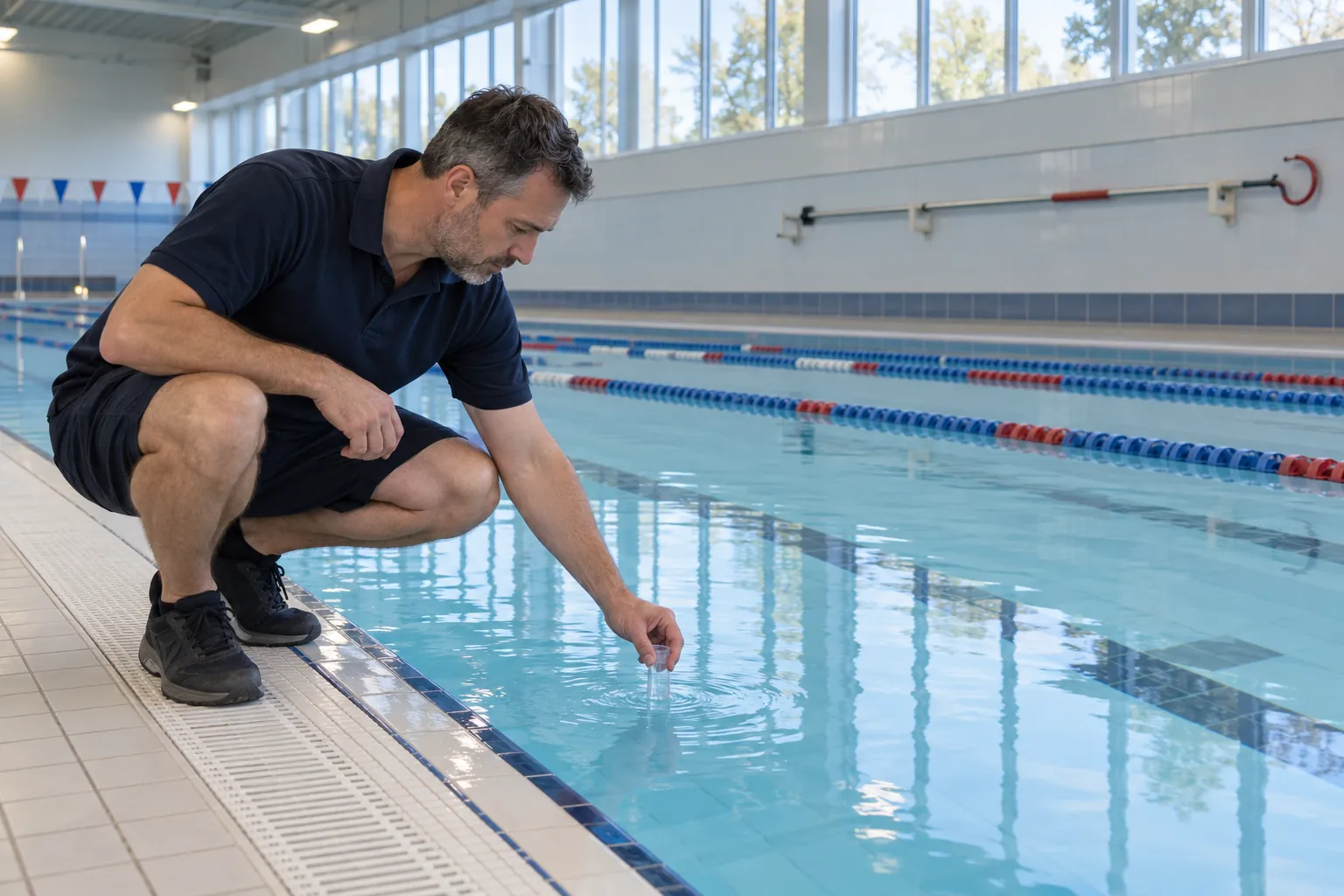
It is guidance rather than law, but it is the document an environmental health officer or HSE inspector may refer to when they visit. This guide sets out what HSG179 asks for, the routine checks it and the PWTAG Code of Practice set, how often pool water should be tested, and what the record should show.
01
What HSG179 is, and the law behind it
HSG179 Health and safety in swimming pools is free from the Health and Safety Executive (HSE). The current version is the fourth edition, published in 2018 and reissued with minor amendments; HSE describes it as the fourth edition of Managing health and safety in swimming pools, which is why both titles are still searched for. It is aimed at the pool operator: the designated person or organisation responsible for operating the pool.
There is no law written only for swimming pools. HSE's page on swimming pool safety says operators must meet their general duties. HSG179 names the key legislation as the Health and Safety at Work etc. Act 1974, the Management of Health and Safety at Work Regulations 1999, COSHH and RIDDOR; the duties that matter most at a pool are:
- Section 3 of the Health and Safety at Work etc. Act 1974: so far as is reasonably practicable, people not in your employment, which at a pool means every swimmer, parent and visitor, must not be exposed to risks to their health or safety.
- Regulation 3 of the Management of Health and Safety at Work Regulations 1999: a suitable and sufficient assessment of the risks to employees and others, reviewed when it may no longer be valid or there has been a significant change, and recorded where you employ five or more people.
- Regulation 8 of the Management of Health and Safety at Work Regulations 1999: procedures for serious and imminent danger, and enough competent people nominated to carry out an evacuation.
- COSHH for the pool chemicals and the micro-organisms in pool water, and RIDDOR for reporting certain injuries and dangerous occurrences.
HSG179 itself is not compulsory, but HSE says that if you follow it you will normally be doing enough to comply with the law. Where it says must, there is an explicit legal requirement behind the words.
It applies to pools used by the public, including leisure, hotel, club, therapeutic and school pools, water parks, and paddling pools that are part of a larger complex. It does not apply to a private pool at home, a stand-alone paddling pool in a park, or a stand-alone spa pool, which HSE covers in HSG282, Control of legionella and other infectious agents in spa-pool systems.
02
The NOP and the EAP: the pool safe operating procedures
HSG179 says pool safe operating procedures (PSOPs), based on the risk assessment, are commonly used across the industry, and that a PSOP consists of two plans covering the pool, the changing facilities and the plant:
- The Normal Operating Plan (NOP) sets out the way the pool operates day to day: the layout, the equipment, the manner of use, who uses it and when. The PWTAG Code of Practice calls it the normal operational plan.
- The Emergency Action Plan (EAP) gives specific instructions on what every member of staff does in an emergency.
Across HSG179, the procedures collect the risk factors at your pool and their controls, the supervision for each kind of session, the maximum period of uninterrupted supervision and the breaks, the rules for diving, slides and inflatables, and how admissions are controlled. HSG179 points to BS EN 15288-2 for a suggested structure.
Most pool EAPs, HSG179 says, address the same basic requirements: get people away from immediate danger, handle casualties, deal with the people who are not injured, summon, direct and help the emergency services, and protect property. It must cover toxic chemical spillage, a release of toxic gas, and fire and explosion, including the usual way chlorine gas is released at a pool: circulation stops or slows while automatic dosing carries on, hypochlorite and acid build up and react, and the gas reaches the pool hall when circulation restarts. Pools must also have a procedure for faecal fouling that staff are trained in, and the EAP should cover a casualty in the water, including a suspected spinal injury, and evacuation with roll calls.
HSG179 expects staff at every level to understand the plans and their part in them, checked as part of routine training. A club or school hiring the pool should be completely familiar with the sections that apply to them, particularly the emergency arrangements, and contractors with the parts that affect their work.
03
Supervision, lifeguards and pools with no one on poolside
HSG179 does not set a lifeguard ratio. The level of supervision is for your site-specific risk assessment, considering the kind of pool, its design, depth, glare and blind spots, who uses it, how busy it gets, its features and how admission works, for example unrestricted access for hotel residents.
Constant poolside supervision by lifeguards, it says, provides the best assurance of pool users' safety. To decide how many, HSG179 suggests a Lifeguard Zone Visibility Test, a practical exercise to find what a lifeguard cannot see from their position, and gives an indicative table for conventional rectangular pools in unprogrammed sessions: one lifeguard for a 25 m by 10 m pool, two when busy; two for a 25 m by 12.5 m pool; four for a 50 m by 20 m pool, six when busy. The table is not a legal requirement, and where only one lifeguard is on poolside there should be a way, such as an assistance alarm, to summon help quickly.
Lifeguards must be competent for their duties; an up-to-date qualification from a national awarding body is the best way to show it, alongside site-specific training on the PSOP, and HSG179 recommends records of each training session. On duty spells it cites the Royal Life Saving Society UK's advice of no longer than 60 minutes at the poolside, and never more than 90 minutes under any conditions.
Many hotel and school pools are not constantly supervised. HSG179 allows that where the risk assessment justifies it, but the operator must then put effective controls in place, such as supervision at specified times, poolside checks at agreed intervals, rescue equipment, an alarm to summon help, signs saying the pool is not staffed, and control of numbers and lone swimmers. There must still be a safe system to identify someone in difficulty and carry out a rescue, for example designated on-call competent staff who can respond immediately to any emergency and are trained to reach the poolside in time to perform a rescue and give emergency first aid, and the arrangements should be tested with an unannounced, realistic drill.
04
The routine checks, and how often pool water is tested
HSG179 leaves detailed water treatment to the Pool Water Treatment Advisory Group and its Code of Practice, The management and treatment of swimming pool water (July 2021, last updated July 2025); HSE's swimming pool safety page says regulators, HSE and local authorities, consider PWTAG guidance the standard to be achieved. On pool water testing frequency, the Code recommends chemical tests of disinfectant and pH:
- before the pool opens, every two hours while it is open, and after it closes, where dosing is not monitored and controlled automatically, with the frequency set by the risk assessment;
- at least three times a day by manual test where automatic monitoring is fitted, with the controller checked daily against a manual test;
- taken at 100 to 300 mm depth at the deep end, furthest from the inlets;
- more often where combined chlorine needs controlling.
The Code also recommends microbiological testing every month by a UKAS-accredited laboratory (weekly for hydrotherapy pools), with a chemical test taken at the same time and place, and extra samples before a new or reopened pool is used, after contamination, if the treatment system is in difficulty and after an adverse result.
Around the water, HSG179 itself sets a run of routine checks that a pool's daily and weekly sheets should carry:
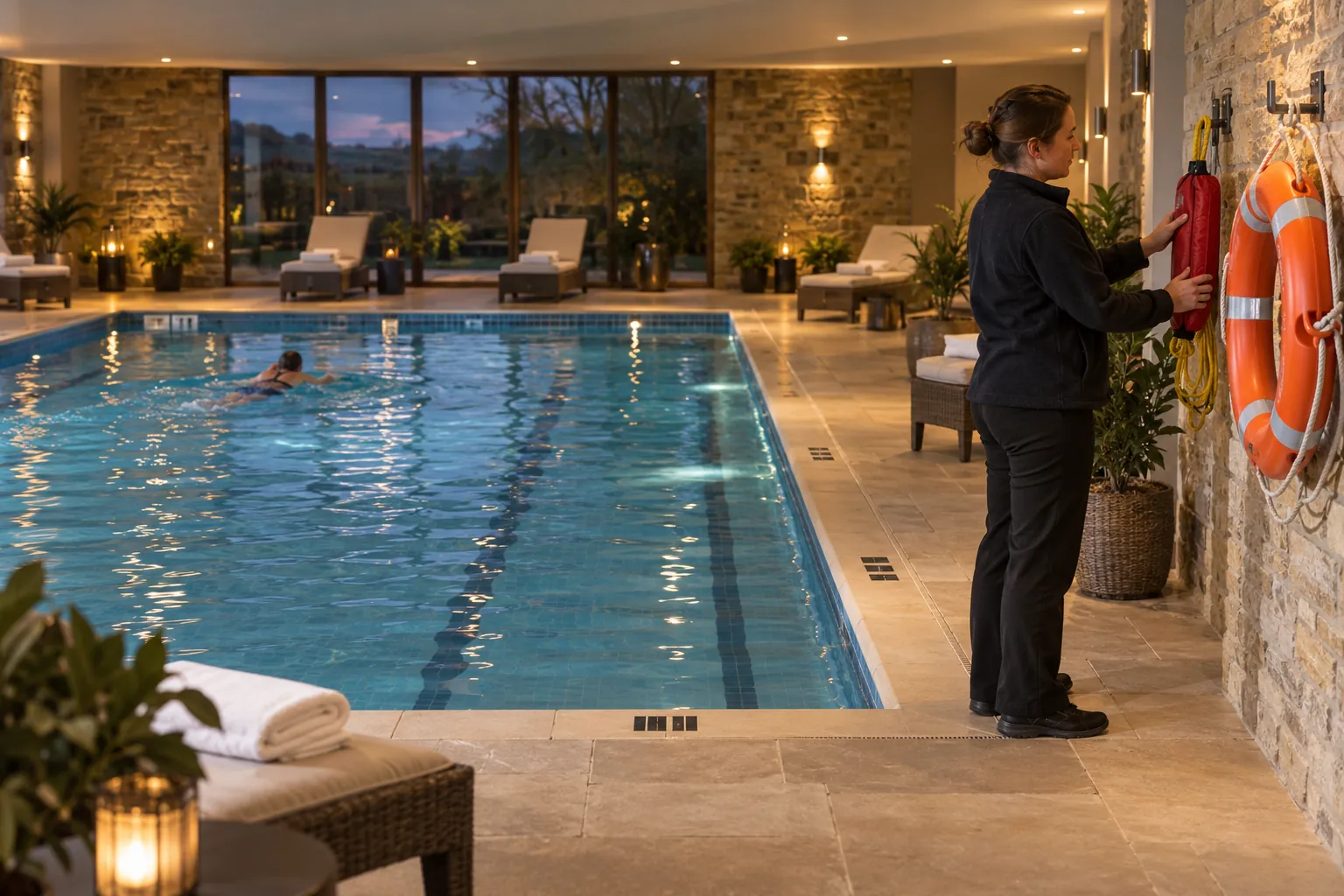
- Rescue equipment identified by the risk assessment, kept in its proper place and checked daily.
- Residual current devices on supplies to wet areas: the test button operated daily, a formal visual inspection weekly, and a test by an electrician every three months.
- Lighting: central controls for emergency lighting checked daily and in line with BS EN 50172, and illumination values for the pool lighting checked annually for deterioration.
- Eyewash and drench showers near the chemicals: maintained to the manufacturer's instructions and tested weekly.
- Alarms for fire, plant failure and help: tested to the manufacturer's instructions and the PSOP; HSG179 suggests keeping a record of the checks.
- Poolside mirrors checked regularly so they have not moved and are not obscured, damaged or covered, and drowning detection systems and poolside CCTV tested and maintained to the manufacturer's instructions.
- Spa pools within the complex: a system of regular checks where they are not individually supervised, and legionella control as HSG282 sets out.
Hot and cold water systems also carry a legionella risk, and HSG179 says all showers should be managed under HSE's L8 code on legionella; the flushing and temperature checks are in our guide to legionella checks. The plant room should be secure, the chemicals stored as the COSHH assessment says, and floors and spillages kept so that surfaces are not slippery. Most of these come together on the first round of the day, part of a pool's opening and closing checks.
05
What the record should show, and who checks it
HSG179 asks for records of the risk assessment, training sessions, equipment and alarm checks, and incidents and near misses, so that safety arrangements stay relevant. The PWTAG Code's example list of records adds the pool water log, the monthly bacteriological results, the incident and faecal accident log, calibration of the automatic monitoring, monthly inspection of safety equipment and personal protective equipment, and training in chemical handling and water testing, and says records should be kept for at least five years.
A record of the routine that an inspector, insurer or client can rely on as evidence of compliance shows, for each check:
- The item or place: which pool, which plant item, which rescue station.
- The date and time it was done, against the time it was due.
- Who did it, by name.
- The result: a reading for a water test, not a tick, and the target range beside it.
- What was done about a failure: the pool closed, the dosing adjusted, the duty manager told, and when it was put right.
- The checks that were missed, with the reason, rather than a blank.
Review the NOP, the EAP and the risk assessment when something changes: a new feature or programme, different users, an incident or near miss. Where a leisure trust or management company runs the pool for an owner, HSG179 says to agree in the contract who is responsible for what, such as the building fabric against day-to-day water treatment and supervision.
The local authority is the enforcing authority for most pools, so the visit usually comes from an environmental health officer. HSE enforces where the local authority itself operates the pool, and at pools in educational establishments and Ministry of Defence premises.
06
Where the pool record fails, and what SiteClara does about it
Few pools fail HSG179 for want of a NOP. They fail in the routine: the two-hourly test written up at the end of the shift, the hotel's poolside checks that stopped when the receptionist who did them left, the eyewash that was on nobody's list. On paper the gap shows only when someone reads the folder, often the environmental health officer.
SiteClara puts a printed QR poster, with an NFC tag behind it if staff should tap, at each place a check is due: the plant room, each poolside rescue station, the changing rooms, the spa. Staff scan or tap with their own phone, with no app to install, see the checks due there, such as the opening check or the two-hourly poolside check, and mark each one done or explain what stopped them, with a photo when one is asked for. The time and the named person are recorded as it happens. A problem found on a check, such as a missing throw bag, is reported there and goes onto the team's list of jobs until someone closes it.
The duty manager or supervisor sees which checks are due, done and missed, and records why one was missed. Each day they review the checks and photos, add a note and approve a report that goes to nominated management or client contacts the next morning. That suits an operator running a pool for a council, school or hotel owner.
07
Questions people ask
Is HSG179 a legal requirement?
No. HSG179 Health and safety in swimming pools says following the guidance is not compulsory, unless specifically stated, but that if you do follow it you will normally be doing enough to comply with the law, and inspectors may refer to it. The law itself is the Health and Safety at Work etc. Act 1974 and the regulations made under it; HSE's swimming pool safety page says there are no specific health and safety laws for swimming pools.
What is the difference between an NOP and an EAP?
Both are parts of the pool safe operating procedures. Paragraph 29 of HSG179 Health and safety in swimming pools says the Normal Operating Plan sets out the way a pool operates on a daily basis, including its layout, equipment, manner of use and users, and the Emergency Action Plan gives specific instructions on the action all staff take if there is an emergency, for the pool, the changing facilities and the plant.
How often should pool water be tested?
The PWTAG Code of Practice, The management and treatment of swimming pool water recommends tests of disinfectant and pH before the pool opens, every two hours while it is open and after it closes where dosing is not controlled automatically, and no less than three times a day with automatic control, with the frequency set by the risk assessment. It also recommends microbiological testing each month by a UKAS-accredited laboratory, and weekly for hydrotherapy pools.
Does a hotel pool need a lifeguard?
Not always. HSE's swimming pool safety page says a risk assessment may find that constant supervision is not required, but a member of staff will then need to be on call and able to respond immediately to emergencies whenever the pool is in use. Paragraph 112 of HSG179 Health and safety in swimming pools lists the other controls, such as poolside checks at agreed intervals, rescue equipment, an alarm to summon help and signs that the pool is not staffed.
How many lifeguards does a pool need?
There is no fixed number. HSG179 Health and safety in swimming pools gives a table of indicative lifeguard numbers for conventional rectangular pools, based on a Lifeguard Zone Visibility Test, and says it is not a legal requirement but a starting point; the number for your pool comes from your site-specific risk assessment.
Where can I get the HSG179 PDF?
HSE publishes HSG179 Health and safety in swimming pools as a free download from its publications site. The page describes it as the fourth edition of Managing health and safety in swimming pools, published in 2018 and reissued with minor amendments.
08
Where to read the official guidance, and a list to take away
HSE publishes HSG179 Health and safety in swimming pools as a free download, with a shorter page on swimming pool safety and HSG282 for spa pools. The Pool Water Treatment Advisory Group publishes its Code of Practice, technical notes and the Swimming Pool Water book. The Royal Life Saving Society UK publishes the lifeguarding guidance HSG179 refers to.
For a pool you run, make sure that:
- there is a current, written risk assessment covering staff and pool users, reviewed after any change or incident;
- the NOP describes how the pool runs in each kind of session, including supervision, breaks and feature rules;
- the EAP covers a casualty in the water, spinal injury, faecal fouling, chemical spillage, toxic gas, fire and evacuation, and staff have practised it;
- hirers and contractors have seen the parts of the NOP and EAP that apply to them;
- pool water is tested before opening, every two hours while open and after closing, or as your risk assessment sets, and sampled monthly by an accredited laboratory;
- rescue equipment is checked daily, RCDs and emergency lighting as HSG179 sets out, and eyewash stations weekly;
- every check records the time, the person and the result, and missed checks are recorded with a reason;
- records are kept for at least five years and can be found when the inspector asks.
Sources
Every document this guide quotes or links to, in the order it first cites them.
- HSG179 Health and safety in swimming pools hse.gov.uk
- Swimming pool safety hse.gov.uk
- Health and Safety at Work etc. Act 1974 legislation.gov.uk
- Management of Health and Safety at Work Regulations 1999 legislation.gov.uk
- Management of Health and Safety at Work Regulations 1999 legislation.gov.uk
- HSG282, Control of legionella and other infectious agents in spa-pool systems hse.gov.uk
- Code of Practice, The management and treatment of swimming pool water pwtag.org
Related guides
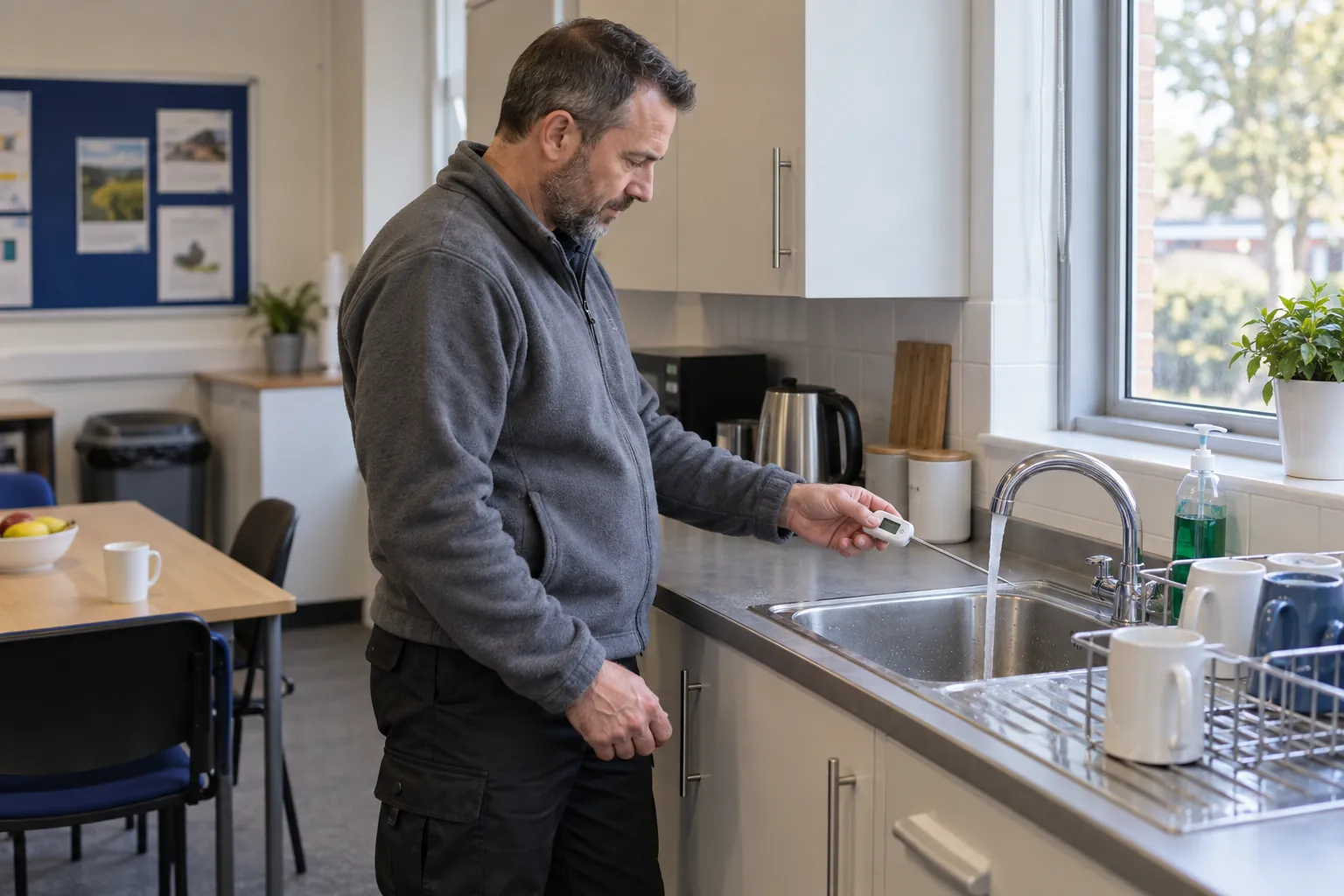 Fire and water checksLegionella checks: the routine monitoring, and the record that shows it was doneThe routine legionella checks in hot and cold water systems under HSE's L8 and HSG274: flushing, temperatures, who does them and what the record should show.
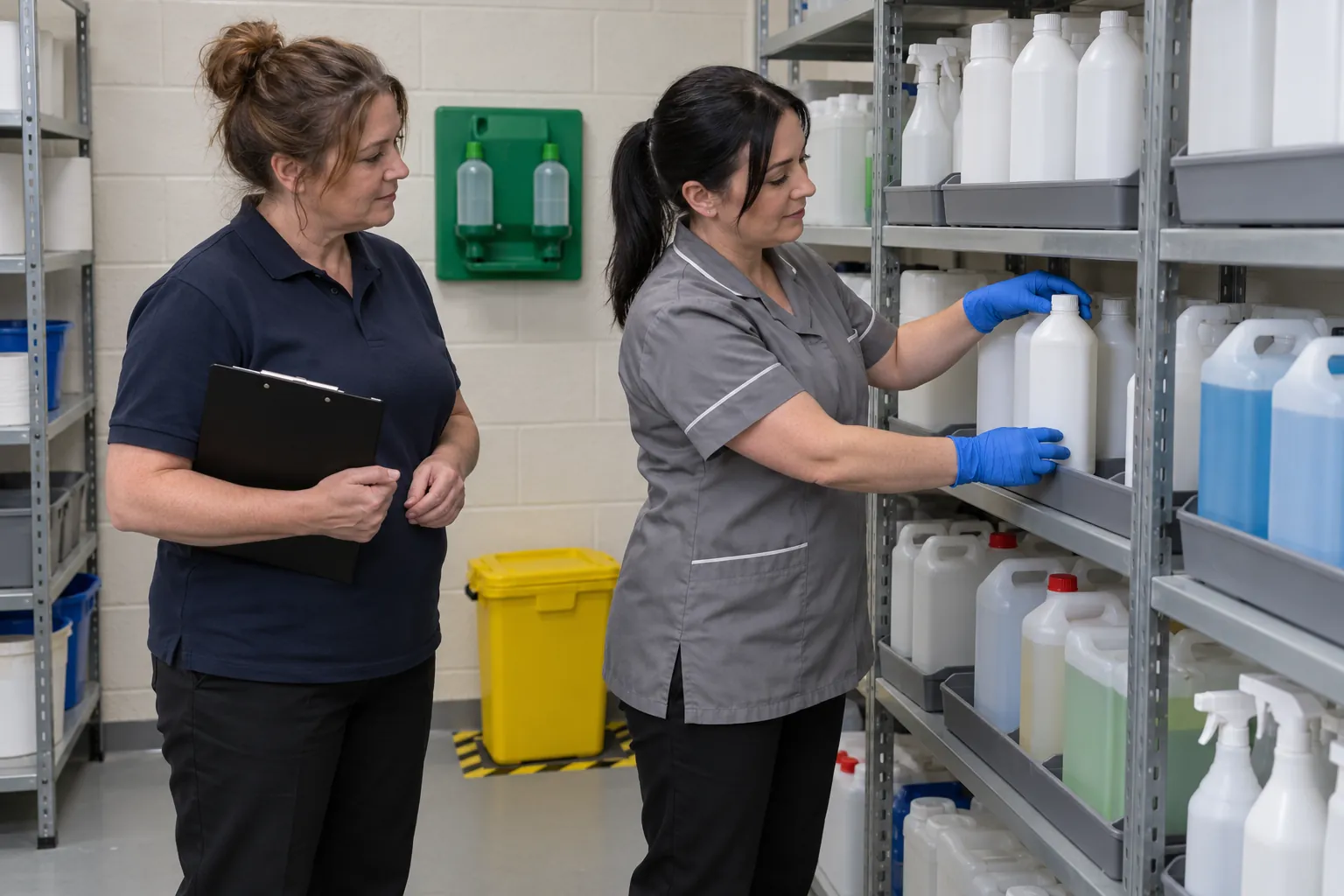 CleaningCOSHH assessment: the five steps, and the checks that keep it trueWhat a COSHH assessment is, the five steps, what to record for cleaning products, how to keep a COSHH register, and the checks that keep the controls working.
 Premises and facilities managementOpening and closing checks: the kitchen, the bar and the shop floorThe SFBB opening and closing checks for kitchens, what to add for a bar or shop, the fire exit checks at opening, and how the daily diary and 4-weekly review work.
 Premises and facilities managementRIDDOR reporting: what must be reported, by when, and by whomRIDDOR reporting explained: the reportable injuries, the over-seven-day rule, the 10 and 15 day deadlines, how to report to HSE and who in a building must report.