Fire and water checks
Legionella checks: the routine monitoring, and the record that shows it was done
Legionella checks are the routine monitoring the Health and Safety Executive's technical guidance HSG274 sets out for hot and cold water systems: weekly flushing of little-used outlets, monthly temperature readings at the sentinel taps and the calorifier, quarterly cleaning of showerheads and a yearly inspection of the cold water tank.
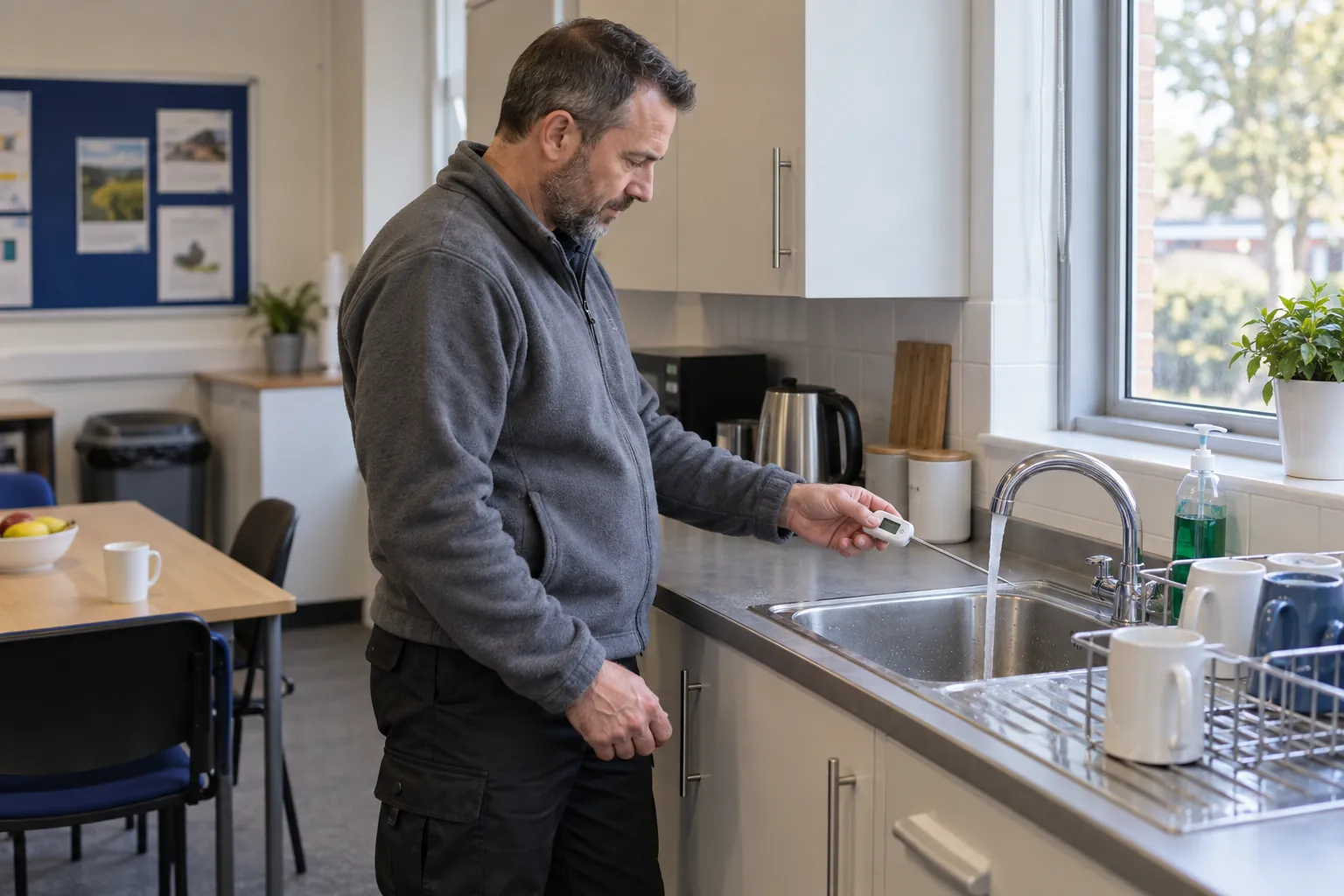
Most of the work of controlling legionella in a building is not the risk assessment. It is the routine: flushing the shower nobody uses, running the tap furthest from the boiler with a thermometer in the stream, writing the reading down. This guide covers those routine checks in hot and cold water systems, who does them, and what makes the record worth keeping.
01
The duty behind legionella checks
Employers and anyone in control of premises, landlords included, must identify and assess the sources of legionella risk, prevent or control that risk and keep the correct records, as the Health and Safety Executive sets out in Legionnaires' disease – what you must do. The routine checks are how that control is shown to be working.
Legionella bacteria are commonly found in water. At low levels in natural water sources they rarely cause harm, but in a building's water system they can multiply, and people can be infected by breathing in small water droplets, from a shower, a spray tap or a cooling tower. The illness they cause, Legionnaires' disease, is a serious form of pneumonia, and people who are older, who smoke or who have weakened immune systems are at higher risk.
In Great Britain the legal duty to control that risk comes from the Health and Safety at Work etc. Act 1974, the Control of Substances Hazardous to Health Regulations 2002 (COSHH) and the Management of Health and Safety at Work Regulations 1999. Controlling the risk of legionella is a legal requirement, not a recommendation, and the Health and Safety Executive (HSE) explains how to meet it in two documents:
- ACOP L8, the Approved Code of Practice Legionnaires' disease: The control of legionella bacteria in water systems, which sets out the duties: identify and assess the risk, prepare a written scheme to prevent or control it, put the scheme into practice, keep records, and appoint a person to take managerial responsibility.
- HSG274, the technical guidance. Part 2 covers hot and cold water systems, the systems in almost every office, school, care home, hotel and block of flats, and it sets out the routine checks and their frequencies.
The duty sits with the employer or the person in control of the premises, usually called the duty holder. They must have a competent person carry out a legionella risk assessment and a written scheme of control based on it. Landlords of rented homes have the same duty to assess and control the risk, although for a simple domestic system the assessment is often short. Northern Ireland has its own equivalent regulations, enforced by the Health and Safety Executive for Northern Ireland.
This guide is about what happens after the assessment and the scheme are written: the routine checks that show the scheme is being followed. It is not a guide to the risk assessment, which belongs to a competent person.
02
What routine legionella checks cover
Most hot and cold water systems rely on temperature control: keep cold water cold, keep hot water hot, and keep it moving. Legionella growth is fastest between about 20°C and 45°C, especially in stagnant water, scale and sludge. The routine checks test whether those three conditions hold. In a typical building they include:
- Flushing little-used outlets: taps, showers and hoses that are not used every week are run through so that stagnant water does not sit in the pipework.
- Sentinel outlet temperatures: the hot and cold taps nearest to and furthest from the water heater or tank, checked with a thermometer to show the whole system is at temperature.
- Calorifier and water heater temperatures: the temperature of the hot water leaving the heater and returning to it.
- Cold water tanks: the water temperature of the stored water and of the incoming mains, and a visual inspection of the tank for debris, corrosion and a secure lid.
- Showerheads and hoses: cleaned and descaled, because scale gives bacteria somewhere to live.
- Representative outlets: a rotation through other taps in the building so that, over the year, every part of the system is checked.
- Thermostatic mixing valves, where fitted, checked and serviced as the scheme sets out.
Buildings with cooling towers, evaporative condensers, spa pools or other higher-risk systems need further checks, including water treatment and microbiological sampling, covered in other parts of HSG274. Those systems belong with a water treatment specialist and are outside the scope of this guide.
03
How often, and to what temperature
The written scheme sets the frequencies for your building, and it may ask for more than the minimum. HSG274 Part 2 gives the usual routine for a hot and cold water system:
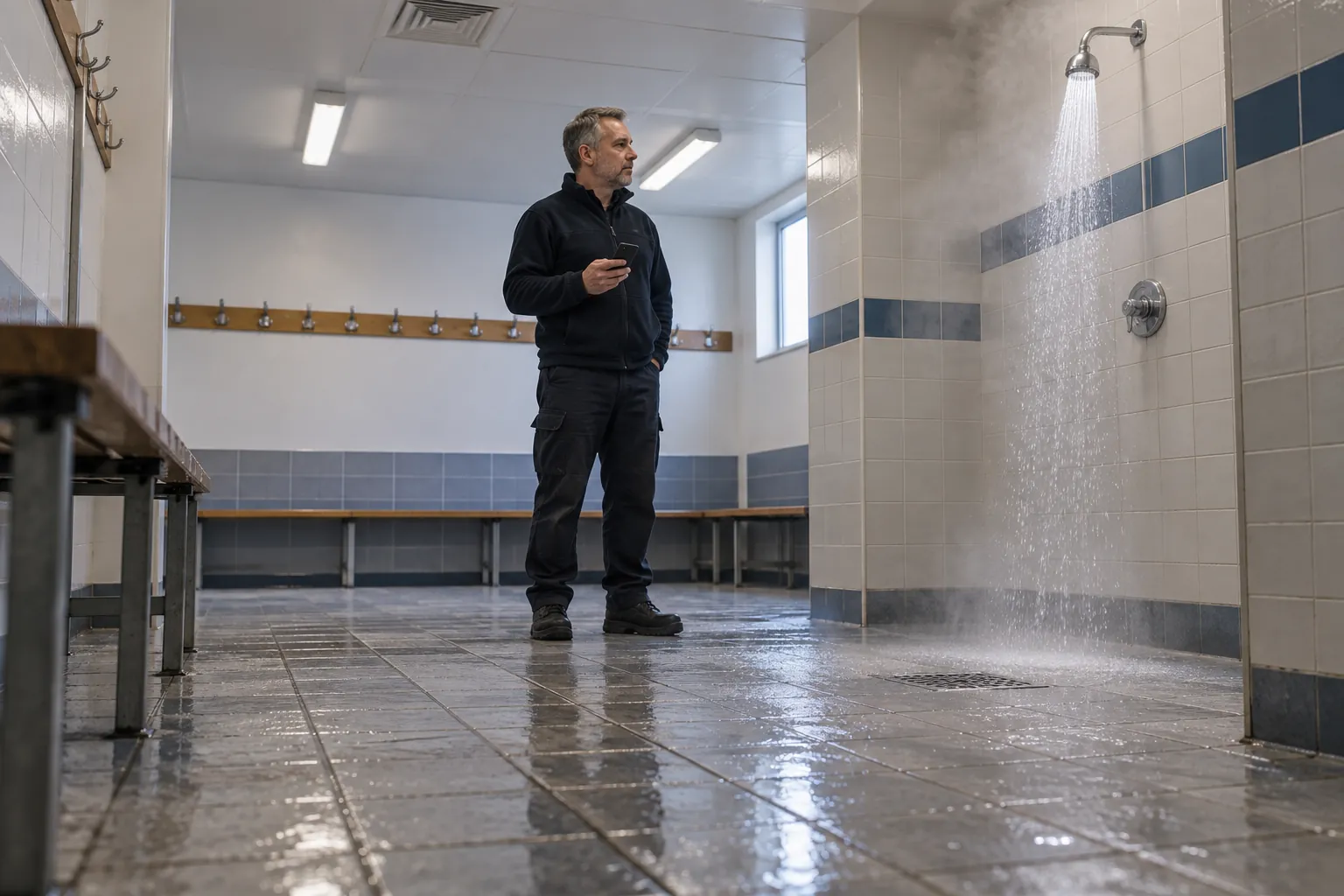
- Weekly: flush outlets that are used less often than once a week. Where an outlet is rarely needed at all, the risk assessment may recommend removing it and the pipe that feeds it, which removes the check.
- Monthly: check the hot and cold sentinel outlets, and the flow and return temperatures at the calorifier or water heater.
- Quarterly: clean and descale showerheads and hoses, or more often if scale builds up quickly.
- Annually, in summer: check the temperature in the cold water storage tank, away from the ball valve, and of the incoming mains water, or as often as temperature profiling shows is needed. HSE's shorter web checklist for hot and cold water systems asks for the temperature at the ball valve outlet every six months, so follow the frequency your written scheme sets.
- Annually: visually inspect cold water storage tanks, and carry out remedial work where necessary.
Beyond the sentinel outlets, a representative selection of other outlets is checked on a rotation, so that over time the whole system is shown to reach the right temperatures. The temperatures the checks look for, set out in HSG274 Part 2 and, in shorter form, in HSE's web checklist, are:
- Hot water stored at 60°C or above, leaving the calorifier at 60°C or above and returning at 50°C or above.
- Hot outlets reaching at least 50°C within one minute of running, or 55°C in healthcare premises.
- Cold outlets below 20°C after running for up to two minutes, and cold water stored below 20°C.
A reading outside those limits is not a pass with a note beside it. It means the scheme is not controlling the risk at that point, and it needs investigating: a heater set too low, a dead leg, a tank in a warm plant room, a mixing valve in the wrong place. The written scheme should say who is told and what happens next.
04
Who carries out the checks
L8 expects the duty holder to appoint a person with day-to-day responsibility for managing the risk, often called the responsible person. In a large building they may be the facilities manager or the estates manager; in a small one, the premises manager or the owner. They do not have to take every reading themselves, but they must make sure the checks happen and the records are kept.
The routine checks are usually shared out:
- Site staff, caretakers and cleaners often flush little-used outlets, because they are in those rooms every week anyway. It is a simple task, as long as they know which outlets, how long to run them, and to avoid creating spray.
- A trained member of the premises team often takes the monthly sentinel temperatures, with a calibrated thermometer and a set route.
- A water hygiene or water treatment contractor usually does the tank inspections, calorifier work, mixing valve servicing and any sampling, and reviews the risk assessment when the building or its use changes.
Whoever does the check needs legionella training that fits the task. Someone flushing a shower does not need the knowledge of the competent person who wrote the risk assessment, but they do need to know why the check matters and what to do if they find a problem, such as brown water, a tap that never runs hot, or a shower that is clearly never used.
Legionella testing, meaning collecting water samples and sending them to a laboratory that is UKAS accredited to detect the presence of legionella, is not usually part of the routine for a well-controlled hot and cold water system: HSE's page on testing and monitoring your water system says microbiological monitoring is not usually required for these enclosed systems. The risk assessment says when sampling is needed, for example where there is doubt about the control regime or recommended temperatures are not consistently achieved.
05
What a good record of legionella checks shows
L8 requires records of the risk assessment, the written scheme, and the results of monitoring, inspection, testing and checks, including the dates they were carried out. The results of monitoring should be kept for at least five years. The record is how the duty holder shows an inspector from the HSE or the local authority, an insurer or a client that the scheme is working and the building is compliant, and it is the first thing asked for after a case of Legionnaires' disease.
A useful record of the routine checks carries:
- The outlet or plant item, identified the same way as in the written scheme, so that "sentinel hot, second floor east" means one tap.
- The date and the time the check was done, written at the time.
- The name of the person who did it.
- The reading, in degrees, not a tick. A column of ticks beside "above 50°C" hides a system drifting from 58°C to 51°C over a winter.
- For flushing, which outlets were run, and for how long if the scheme sets a time.
- What happened when a check failed: who was told, what was done, and the reading after the fix.
- Missed checks, with the reason: a locked room, a closed wing, a member of staff off sick.
The flushing record is where the evidence is usually thinnest. It is a weekly job done by whoever is passing, often in rooms nobody else visits, and a sheet that shows every shower flushed every Monday for a year, in the same pen, is not easily believed. The temperature record usually lives in a log book kept by the premises team, and the tank and calorifier work in the contractor's service reports. The duty holder needs all three to tell the same story about water safety in the building.
06
Where the record fails, and what SiteClara does about it
Most failures in the routine are not failures of knowledge. They are a weekly flush that stopped when the caretaker changed, a sentinel check missed in August because the building was quiet, a reading of 42°C written down and never passed on. On paper, nobody sees the gap until someone reads the log book, which is often the contractor on their annual visit.
SiteClara puts a printed QR poster, with an NFC tag behind it if you want staff to tap, at the locations in the scheme: the shower in the unused changing room, the sentinel outlets, the plant room door. Staff scan or tap with their own phone, with no app to install, and see the checks due at that location. They mark each one done, or explain what stopped them, with a photo when one helps, such as the thermometer in the stream. The time and the person are recorded as it happens.
The supervisor sees which checks are due, done and missed, and can record why one was missed. A problem found on a check, such as a tap that will not run hot, is reported there and goes onto the team's list of jobs until someone closes it, and can be escalated to the building manager. Each day the supervisor approves a report that goes to nominated management or client contacts the next morning, showing how the scheduled checks went.
07
Questions people ask
Is a legionella check a legal requirement?
Yes: employers and anyone in control of premises, including landlords, must assess and control the risk from legionella and keep records, under the Health and Safety at Work etc. Act 1974 and the COSHH Regulations, as HSE explains in what you must do. Routine laboratory testing is not usually part of it: HSE says in Legionella and landlords' responsibilities that health and safety law does not require landlords to obtain or produce a 'legionella test certificate', and that temperature monitoring is a reliable method for confirming a water system is under control.
How often should legionella be checked?
The risk assessment and written scheme set the frequency, but for a hot and cold water system HSE's checklist has little-used outlets flushed weekly, sentinel outlet temperatures checked monthly, showerheads cleaned and descaled quarterly and cold water storage tanks inspected at least annually. Sampling the water for legionella is not usually needed in a hot and cold water system, but for open systems such as cooling towers and spa pools HSE says routine testing should be carried out at least quarterly.
How long should you run a shower to avoid legionella?
HSE's technical guidance, HSG274 Part 2, says that flushing an outlet that is not in regular use weekly "for several minutes" can significantly reduce the risk, and its checklist says to flush until the temperature at the outlet stabilises and is comparable to the supply water. Flush to drain without creating spray, and once a flushing regime has started, keep it going and log it.
08
Further reading, and a list to take away
The Health and Safety Executive publishes Legionnaires' disease: The control of legionella bacteria in water systems (L8) and Legionnaires' disease: Technical guidance (HSG274), including Part 2 on hot and cold water systems, free on its website, along with a shorter leaflet for duty holders and pages on legionella risks in residential lettings. The Care Quality Commission publishes guidance for registered care services, and the Legionella Control Association publishes a code of conduct for service providers.
For the routine checks in your building, make sure that:
- there is a current risk assessment and a written scheme, and you know who wrote them and when they are next reviewed;
- a responsible person is named, and everyone doing checks knows who that is;
- every little-used outlet is listed, and someone owns the weekly flush for each one;
- sentinel outlets are identified and their temperatures are recorded as readings, not ticks;
- a failed reading has a written next step and a named person to tell;
- missed checks are recorded with a reason, not left blank;
- thermometers are calibrated, and records are kept for at least five years;
- the scheme is reviewed when the building, its use or its occupants change.
Sources
Every document this guide quotes or links to, in the order it first cites them.
- Legionnaires' disease – what you must do hse.gov.uk
- Health and Safety at Work etc. Act 1974 legislation.gov.uk
- Control of Substances Hazardous to Health Regulations 2002 legislation.gov.uk
- Management of Health and Safety at Work Regulations 1999 legislation.gov.uk
- ACOP L8 hse.gov.uk
- HSG274 hse.gov.uk
- Hot and cold water systems hse.gov.uk
- Testing and monitoring your water system hse.gov.uk
- Legionella and landlords' responsibilities hse.gov.uk
- HSG274 Part 2 hse.gov.uk
Related guides
 Premises and facilities managementBuilding manager responsibilities: the duties, the daily work and the recordWhat a building manager is responsible for in UK commercial and residential buildings: legal duties, daily work, contractors and the records that prove it.
 Premises and facilities managementSchool site manager duties: the role, the routine checks and the recordWhat a school site manager does: security, health and safety checks, repairs, cleaning and contractors, how often checks are due, and how to record them.
 Premises and facilities managementVoid property inspection: what to check, how often, and what to recordHow to inspect an empty commercial or residential property: security, weather, water, fire and the insurer's conditions, and the record that shows it was done.