Premises and facilities management
Playground inspection: the three levels of check, who does them, and the record
A playground inspection is a check of play equipment, its safety surfacing and the area around it for damage, wear and hazards, made at three levels in UK practice built on BS EN 1176-7:2020: a quick routine visual check by the operator's own staff, daily or weekly depending on use, a more detailed operational inspection monthly or quarterly, and at least one inspection a year by an independent, suitably qualified inspector.
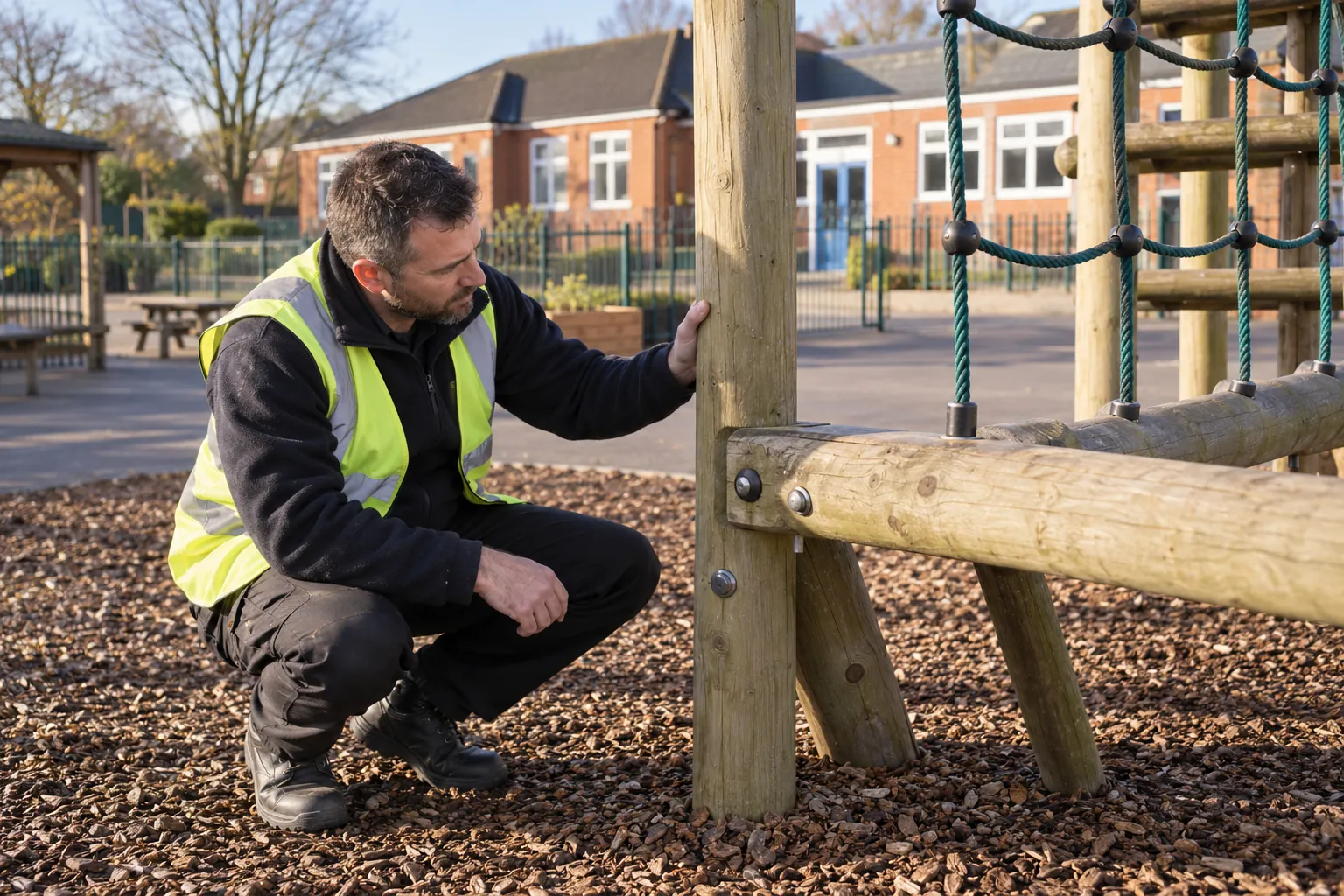
No Act or regulation sets how often playground inspections must be made, but the general duties of the Health and Safety at Work etc. Act 1974 and the occupiers' liability Acts mean whoever runs the play area must keep it reasonably safe for the children who use it and be able to show how. This guide covers the duty, the three levels, what each one looks at, who carries them out, and what a good record of them shows.
01
Is playground inspection a legal requirement?
No law in Great Britain says "inspect the playground every week". The duty is general, and inspection is how an operator meets it. Section 3 of the Health and Safety at Work etc. Act 1974 requires every employer to conduct its undertaking so as to ensure, so far as is reasonably practicable, that people not in its employment, such as pupils, residents and members of the public, are not exposed to risks to their health or safety. Regulation 3 of the Management of Health and Safety at Work Regulations 1999 requires a suitable and sufficient assessment of those risks, with the significant findings recorded where the employer has five or more employees.
Alongside the criminal law sits civil liability. In England and Wales, section 2 of the Occupiers' Liability Act 1957 gives every occupier a "common duty of care" to take such care as is reasonable to see that visitors will be reasonably safe, and adds that "an occupier must be prepared for children to be less careful than adults". Scotland has its own Occupiers' Liability (Scotland) Act 1960, which sets a duty of reasonable care in all the circumstances. A school, a parish or town council, a housing provider, a pub with a garden or a holiday park that provides play equipment is the occupier of that play area.
The recognised benchmark for meeting those duties is the BS EN 1176 series. Its part 7, BS EN 1176-7:2020 Playground equipment and surfacing – Guidance on installation, inspection, maintenance and operation, published by BSI on 31 July 2020 and replacing the 2008 edition, is written for playground operators to help them develop an inspection and maintenance regime for each playground. It covers the equipment, the surfacing and ancillary items such as gates, fences, benches and shades. A British Standard is not law, but it is what an inspector, an insurer or a court will measure an operator's arrangements against.
02
The three levels of playground inspection
Operators, councils and inspection bodies in the UK use the same three tiers, and the Register of Play Inspectors International (RPII) certificates outdoor inspectors at each of them: routine, operational and annual.
- Routine visual inspection. RoSPA Play Safety describes the routine inspection of play areas as "a quick and simple visual check" whose primary function is "to identify faults or dangers arising from vandalism or breakage". It can be carried out by staff other than specialists. Wokingham Borough Council's guidance for schools, Inspections of equipment, describes it as daily, weekly or before-use inspection of the basic condition of the equipment, with records kept.
- Operational inspection. A more detailed check of how the equipment works, its stability and wear to components. RoSPA's page on operational inspections describes them as checking "the operation and stability of the equipment and wear to components", carried out monthly or quarterly around the annual inspection, and the Wokingham guidance sets the frequency by use or by the manufacturer's guidance. Trained staff can do it.
- Annual inspection. At least one inspection a year by an independent, suitably qualified inspector, looking at long-term wear, structural problems and compliance with the standards. RoSPA's guidance on annual inspections of playgrounds describes what it covers and what the report gives back.
The three are not alternatives. The annual inspection catches what only a specialist will see, but it is one day in 365; the routine check is what finds the broken glass on a Monday morning or the seat a vandal cut through on Saturday night. Somerset Council's playground safety guidance for its schools sets out the same pattern: an annual formal inspection, a termly formal visual inspection, and the school's own checks daily or weekly depending on use.
03
The routine check: what to look at and how often
How often depends on the site. A busy school playground used every break, or a public park with a history of vandalism, needs a look every day before use; a small play area at a quiet business park may be safe on a weekly round. Set the frequency in the play area's risk assessment, and write down why.
A routine visual inspection walks the whole area, not only the equipment. Following the headings RoSPA uses, it typically covers:
- The site: fences and barriers intact, gates opening and closing properly, paths clear, signs present and readable, no litter, broken glass, dog fouling or sharp objects, and planting not overgrown into the play space.
- Ancillary items: seats and bins secure and undamaged.
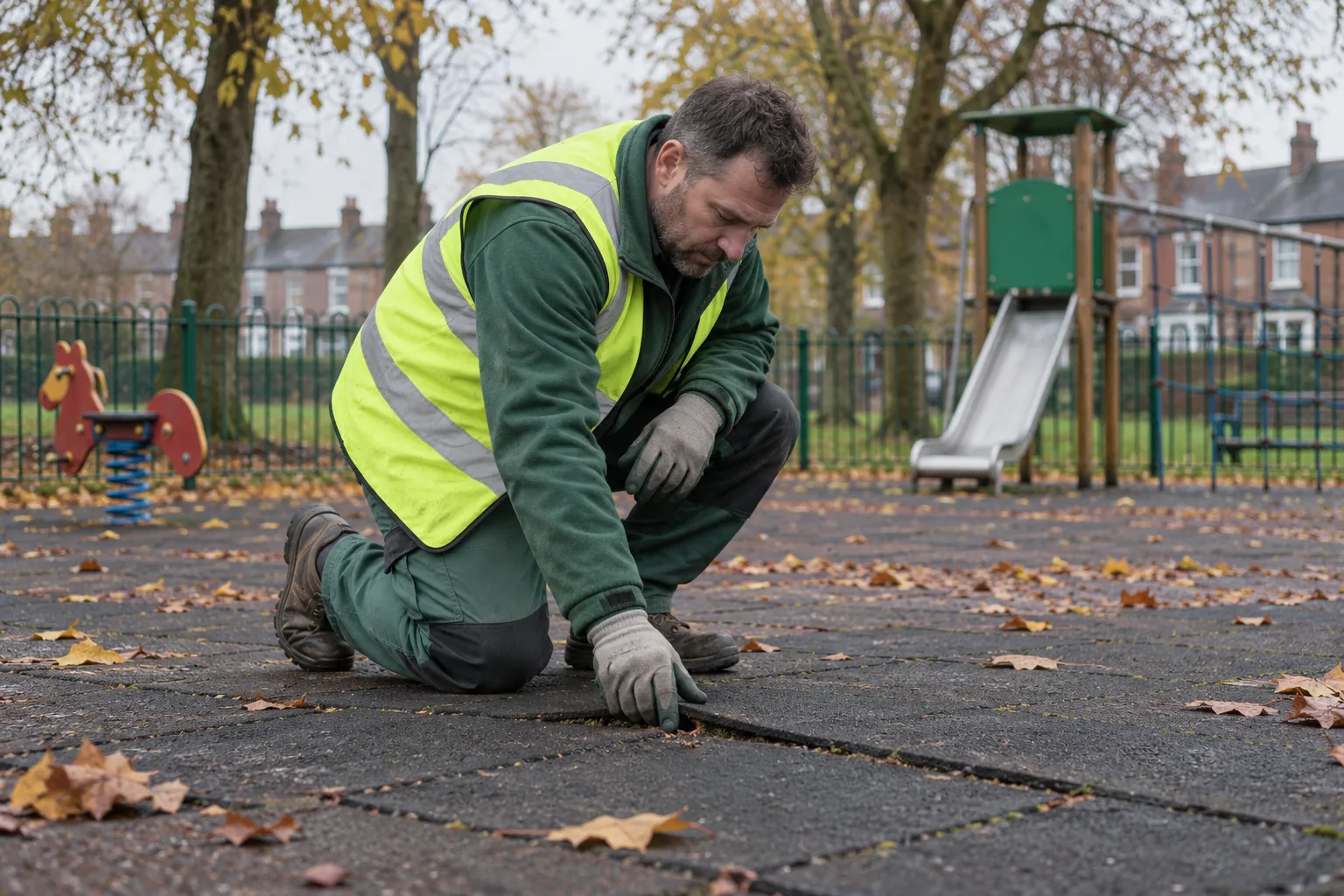
- Surfacing: impact-absorbing surfacing undamaged, rubber tiles not lifting, and loose fill such as bark or sand at its proper depth under and around the equipment, not kicked away from the landing zones.
- Swings: chains unbroken, seats fixed on securely and undamaged.
- Slides: steps and chute intact and clear of obstructions.
- Roundabouts and moving equipment: turning smoothly, with any speed governor working.
- Climbing frames, ropes and nets: every bar present and secure, ropes and nets undamaged, connectors in place.
- Sand play: sand free of debris.
Somerset's weekly checklist for schools adds fixings, moving parts and entrapment points, drainage and standing water. Weather changes the list: ice on platforms, leaves on surfacing, and hot metal slides in sun are all routine findings.
When a check finds a fault, the Wokingham guidance is plain: appropriate action must be taken immediately. A fault that could injure someone is made safe or the item taken out of use there and then, by closing it off or removing the part, and reported to whoever can arrange the repairs. The record says what was found, what was done and who was told.
04
Operational and annual inspections, and who carries them out
The operational inspection goes further than looking. It tests moving parts, checks bearings and fixings for wear, looks at the condition of chains, shackles and ropes, and at the stability of the equipment in the ground. It needs someone trained to know what acceptable wear looks like. RoSPA Play Safety, for example, offers a two-day Operational Playground Inspection training course for those responsible for the monthly to quarterly inspections, so organisations can train their own staff to do it; others buy the service from an inspection company.
The annual inspection is the specialist one. RoSPA has its own annual inspections carried out by "an independent and highly experienced specialist company", and Wokingham's guidance tells schools that BS EN 1176 and the Health and Safety Executive strongly recommend at least one inspection every year from an independent, suitably qualified body. RoSPA lists what an annual inspection examines: site design, ancillary items, equipment and surfacing safety, compliance with the relevant standards, damage or deterioration caused by wear, mechanical or structural failure, and vandalism.
The report is the useful part. It should give the findings item by item, with suggested remedial action and an indication of the risk. A report on file with its high-risk items still open is worse than no report at all, because it shows the operator knew. Work through it: decide each action, give it an owner and a date, and record when it was done.
A new or altered play area also needs a post-installation inspection before it opens, which the RPII lists among the inspections its inspectors carry out.
05
When a child is hurt: incidents and reporting
Most play area injuries are the ordinary bumps and falls of play, and the balanced approach applies: a fall is not, by itself, a sign of failure. What matters after an accident is whether the equipment or its condition played a part, and the inspection record is the first thing anyone will ask for.
Under regulation 5 of the Reporting of Injuries, Diseases and Dangerous Occurrences Regulations 2013 (RIDDOR), an injury to a person not at work is reportable when it results from a work-related accident and the person is taken from the site to hospital for treatment. The HSE's guidance for schools, Incident reporting in schools (EDIS1), says most playground accidents due to collisions, slips, trips and falls are not normally reportable, but they are where the injury results in a pupil being killed or taken directly to hospital and arose because, for example, "the condition of the premises or equipment was poor, eg badly maintained play equipment", or supervision was inadequate.
After any accident on equipment, check the item before it is used again, record what was found, and keep the routine and annual records for the period. They show whether the fault was there before, whether it was seen, and what was done.
06
Where the record fails, and where SiteClara fits
The annual report usually exists; it arrives as a document and goes into a file. The routine check is where the record goes thin. A weekly sheet in the site office gets ticked in a batch on Friday, a caretaker's daily walk round the playground before the gates open leaves no trace at all, and when the regular person is on leave nobody is quite sure whether anyone looked. A loose seat or a missing bolt seen by a lunchtime supervisor is mentioned in passing and forgotten.
SiteClara records the check at the play area. A printed QR poster, with an optional NFC tag behind it, goes at the entrance to each play area, or at each piece of equipment where checks are done separately, so each is its own location with its own scheduled check. The site manager or caretaker scans the code or taps the tag on their own phone, with no app to install, sees the check due there, and marks it done or explains what stopped them, with the time, their name and a photo when one is asked for. A fault found on the walk, or reported by a member of staff, goes onto the team's list of jobs until someone puts it right and closes it.
Each day a supervisor reviews what was due, done and missed, records the reason a check was missed, and approves a daily report that goes to nominated contacts, such as the head, the business manager or the parish clerk, at 8am the next morning. A routine check skipped on a Tuesday shows on Wednesday, not when the annual inspector or an insurer asks to see the record.
07
Questions people ask
How often should a playground be inspected?
A playground should have a routine visual check daily, weekly or before use, an operational inspection monthly or quarterly, and at least one independent inspection a year. Wokingham Borough Council's guidance for schools, Inspections of equipment, sets the operational inspection "on a monthly or quarterly basis depending on use or as indicated by the manufacturer", and says BS EN 1176 and the Health and Safety Executive strongly recommend at least one inspection every year from an independent, suitably qualified body. The play area's risk assessment sets the actual frequency for each site.
What is a playground inspector?
A playground inspector is a person trained to inspect play equipment, its surfacing and the area around it, and to report the faults found with their level of risk. In the UK the Register of Play Inspectors International (RPII), set up by the Association of Play Industries, the Institute of Leisure and Amenity Management, Fields in Trust and RoSPA, is "the official UK body for examining, accrediting and certificating inflatable, indoor and outdoor play inspectors", and keeps a register of the inspectors it has certificated.
Where can I find training for playground inspections?
RoSPA Play Safety runs a one-day Routine Playground Inspection course for "those who carry out routine (daily/weekly) play area inspections" and a two-day Operational Playground Inspection course for those responsible for the monthly to quarterly inspections, at its own venues or on an organisation's premises. The RPII's routine or operational exam can be taken on the course for an extra charge, and the RPII accredits training courses and approves their syllabuses.
08
Further reading, and a list to take away
BSI publishes BS EN 1176-7:2020, the guidance on installation, inspection, maintenance and operation, and the other parts of the BS EN 1176 series for particular types of equipment. RoSPA Play Safety publishes free guidance on routine, operational and annual inspections. The HSE publishes Children's play and leisure: promoting a balanced approach and, for schools, Incident reporting in schools. Your local authority or trust may have its own play equipment policy and checklist, as Somerset and Wokingham do for their schools.
To check your own playground inspection regime, make sure that:
- the play area has a risk assessment that sets how often each level of inspection is done;
- someone is named for the routine check, and someone covers it when they are away;
- operational inspections are done by a trained person, monthly or quarterly;
- an independent, suitably qualified inspector inspects at least once a year, and new equipment before it opens;
- every action in the annual report has an owner, a date and a record of when it was done;
- a fault found on any check is made safe at once and reported to someone who can fix it;
- each routine check is recorded at the time, with the date, the name and what was found;
- the records can be found quickly after an accident or when an insurer asks.
Sources
Every document this guide quotes or links to, in the order it first cites them.
- Health and Safety at Work etc. Act 1974 legislation.gov.uk
- Management of Health and Safety at Work Regulations 1999 legislation.gov.uk
- Occupiers' Liability Act 1957 legislation.gov.uk
- Occupiers' Liability (Scotland) Act 1960 legislation.gov.uk
- BS EN 1176-7:2020 Playground equipment and surfacing – Guidance on installation, inspection, maintenance and operation knowledge.bsigroup.com
- Children's play and leisure: promoting a balanced approach hse.gov.uk
- Register of Play Inspectors International playinspectors.com
- Routine inspection of play areas rospaplaysafety.co.uk
- Inspections of equipment wsh.wokingham.gov.uk
- Operational inspections rospaplaysafety.co.uk
- Annual inspections of playgrounds rospaplaysafety.co.uk
- Playground safety guidance external.somerset.gov.uk
- Operational Playground Inspection training course rospaplaysafety.co.uk
- Reporting of Injuries, Diseases and Dangerous Occurrences Regulations 2013 legislation.gov.uk
- Incident reporting in schools hse.gov.uk
- Routine Playground Inspection course rospaplaysafety.co.uk
Related guides
 Premises and facilities managementSchool site manager duties: the role, the routine checks and the recordWhat a school site manager does: security, health and safety checks, repairs, cleaning and contractors, how often checks are due, and how to record them.
 Premises and facilities managementCaretaker duties: what the job involves, and how to show it was doneCaretaker duties in halls, churches, offices, flats and schools: opening and locking, routine checks, minor repairs, cleaning and working alone safely.
 Premises and facilities managementHealth and safety inspection checklist: what to look at, and what to do nextHow to run a workplace health and safety inspection: the legal basis, what to walk and look at, how often, recording findings and actions, and involving staff.
 Premises and facilities managementAccident book: who must keep one, what goes in it, and how to keep it lawfullyWho must keep an accident book in the UK, what each entry must record, whether it can be online, how long to keep it, and how to handle it under UK GDPR.