Premises and facilities management
Accident book: who must keep one, what goes in it, and how to keep it lawfully
An accident book is the record in which an injury caused by an accident at work is written down, and under regulation 25 of the Social Security (Claims and Payments) Regulations 1979 every employer with 10 or more people normally employed at the same time on the same premises, and every factory, mine and quarry, must keep one readily accessible and preserve each entry for at least three years.

The same record usually serves the Reporting of Injuries, Diseases and Dangerous Occurrences Regulations 2013 (RIDDOR), which require injuries that keep a worker off for more than three days to be recorded. This guide covers who must keep an accident book, what each entry must contain, whether it can be kept online, how long to keep it, how to handle it under data protection law, and what should happen once an entry is made.
01
The law: who must keep an accident book
The duty to keep an accident book in Great Britain comes from social security law, not health and safety law. Regulation 25 of the Social Security (Claims and Payments) Regulations 1979 applies to every owner or occupier (being an employer) of a mine, a quarry or premises covered by the Factories Act 1961, and to "every employer by whom 10 or more persons are normally employed at the same time on or about the same premises in connection with a trade or business". Each of them must:
- keep readily accessible "a means (whether in a book or books or by electronic means), in a form approved by the Secretary of State", by which an employee, or someone acting on their behalf, can record the particulars of any accident causing them personal injury;
- preserve every such record "for the period of at least 3 years from the date of its entry".
The point of the record is the injured person's claim. Regulation 24 of the same Regulations requires an employee who is injured in an accident at work to give notice to the employer, a supervisor or a person the employer has named, "as soon as is practicable", and says that a prompt entry in the accident book counts as that notice. If the employee later claims industrial injuries benefit, the entry is the evidence that the accident was reported at the time. Regulation 25(1) also requires the employer to take reasonable steps to investigate every accident notified this way, and to record the circumstances it finds if they differ from what the notice says.
The Health and Safety Executive puts the rule more simply in its guidance on reporting accidents and ill health at work: "If you have more than 10 employees, you must keep an accident book under social security law." The regulation's own test is 10 or more people normally employed at the same time on or about the same premises, so count the people who work there together, not the headcount across every site.
Health and safety law adds a second duty. Regulation 12 of RIDDOR 2013 requires the responsible person to keep a record of every reportable incident, diagnosis and dangerous occurrence, and of every injury that keeps a worker away from work, or unable to do their normal work, for more than three consecutive days (not counting the day of the accident). Each entry must be kept for at least three years, at the workplace or the responsible person's usual place of business. HSE's page on types of reportable incidents says that for an over-three-day injury "recording it in your accident book (under social security law) will be enough", which is why most employers keep one book that does both jobs.
02
What an accident book entry must record
The particulars an entry must hold are set out in Schedule 4 to the 1979 Regulations:
- the full name, address and occupation of the injured person;
- the date and time of the accident;
- the place where the accident happened;
- the cause and nature of the injury;
- the name, address and occupation of the person giving the notice, if it is not the injured person.
That is the legal minimum, and although it is short, every entry should be complete. Most employers record more, because the entry is also the starting point for an investigation and, sometimes, a claim. A useful entry, or accident book template, also captures:
- Exactly where: the building, floor and room or area, not just "the office";
- What the person was doing at the time, in their own words where possible;
- What happened, as facts: "slipped on water near the drinks machine", not "was careless";
- Any first aid given, and by whom, and whether the person went home, to a GP or to hospital;
- Witnesses, by name, so they can be asked while they still remember;
- The signature of the person making the entry and the date it was written.
HSE publishes the standard book, the Accident book (BI 510, 2018 edition), which HSE describes as enabling businesses "to comply with legal requirements under social security and health and safety legislation". The HSE Books listing for BI 510 says it contains 50 perforated accident record forms, so each completed record can be torn out and filed away from the book, and adds: "You must store this information in line with GDPR and your organisation's data protection policies."
03
Small employers, other people on site, and keeping it online
Fewer than 10 employees. An employer below the regulation 25 threshold (and not running a factory, mine or quarry) is not required by social security law to keep an accident book. RIDDOR still applies to every employer: reportable incidents and over-three-day injuries must still be recorded and kept for three years. In practice the simplest way for a small employer to record accidents and meet RIDDOR is to keep the same accident book anyway.
Visitors, contractors and the public. The 1979 Regulations are about employees and their benefit claims. RIDDOR goes further: an accident to someone who is not at work, such as a visitor or customer, must be reported if they are taken directly from the scene to hospital for treatment, and anything reportable must be recorded. Many sites therefore record every injury on the premises in the same way, whoever was hurt, which also makes patterns easier to see.
Shared and multi-employer buildings. The duty belongs to the employer, so a cleaner employed by a contractor is recorded in the contractor's book, and an office tenant's employee in the tenant's. In a managed building it helps to agree who records what, and for the building manager to be told of any accident in the common parts so the cause can be dealt with, without copying anyone's personal details into a second record.
Online or electronic accident books. Since 1993 regulation 25(3)(a) has said the means of recording may be "in a book or books or by electronic means". An online accident book, a form on the intranet or an accident module in a health and safety system is lawful, provided it captures at least the Schedule 4 particulars, is readily accessible to employees (including those without a work computer), keeps each entry for three years, and is secure. Check that people can make an entry themselves, as the regulation intends, and that a record cannot be quietly edited after it is made.
04
Accident books, UK GDPR and how long to keep entries
An accident book entry about an identifiable person's injury is health data. The Information Commissioner's Office guidance How do we handle sickness and injury records? says that holding injury records "involves processing special category data" under the UK GDPR, and that employers can likely rely on legal obligation or legitimate interests as the lawful basis, and on the employment law condition for processing. That condition is set out in Schedule 1 to the Data Protection Act 2018. The same guidance says:
- keep records "containing details of a worker's illness or medical condition separate from other less sensitive information" where possible;
- do not make individual injury records available to others "unless it is necessary for them to do their jobs";
- take "appropriate measures to keep sickness and injury records secure".
That is why an open accident book on the reception desk, where the next person can read every previous entry, is the classic failure. HSE's own advice is to "protect people's personal details by storing records confidentially in a secure place". With the BI 510 book, remove each completed form and file it securely; with an electronic system, limit who can read entries.
How long to keep accident book records. Both laws set a minimum of three years: from the date of entry under regulation 25, and from the date the RIDDOR record was made under regulation 12. Data protection law then says not to keep personal data for longer than you need it, so decide a retention period, write it into your records policy with the reason (an insurer's requirement, for example, or the time in which a claim could be brought), and destroy entries securely when it ends.
05
After the entry: investigate, report, learn
An accident book that is filled in and never read meets the letter of the law and nothing else. Every entry should start a short sequence:
- Decide whether it is reportable under RIDDOR. HSE's page When do I need to report an incident? sets the clock: deaths, specified injuries to workers, non-workers taken to hospital for treatment and dangerous occurrences must be notified without delay and a report received within 10 days; an injury that keeps a worker off, or off normal duties, for more than seven consecutive days must be reported within 15 days of the accident. Watch over-three-day entries: they become reportable if the absence passes seven days.
- Investigate. Regulation 25(1) requires reasonable steps to investigate. A paper cut needs a line; a fall on the stairs needs a look at the stairs.
- Put the cause right. HSE's workbook Investigating accidents and incidents (HSG245) takes employers through gathering the information, analysing it, choosing risk controls and following an action plan through. The action is the part that prevents the next entry.
- Look for patterns. HSE notes that keeping records "helps you to identify patterns of accidents and injuries, so you can better assess and manage risk in your workplace". Review entries, without names, at least quarterly to track workplace accidents over time: the same entrance, the same task, the same time of day.
06
Where the record fails, and where SiteClara fits
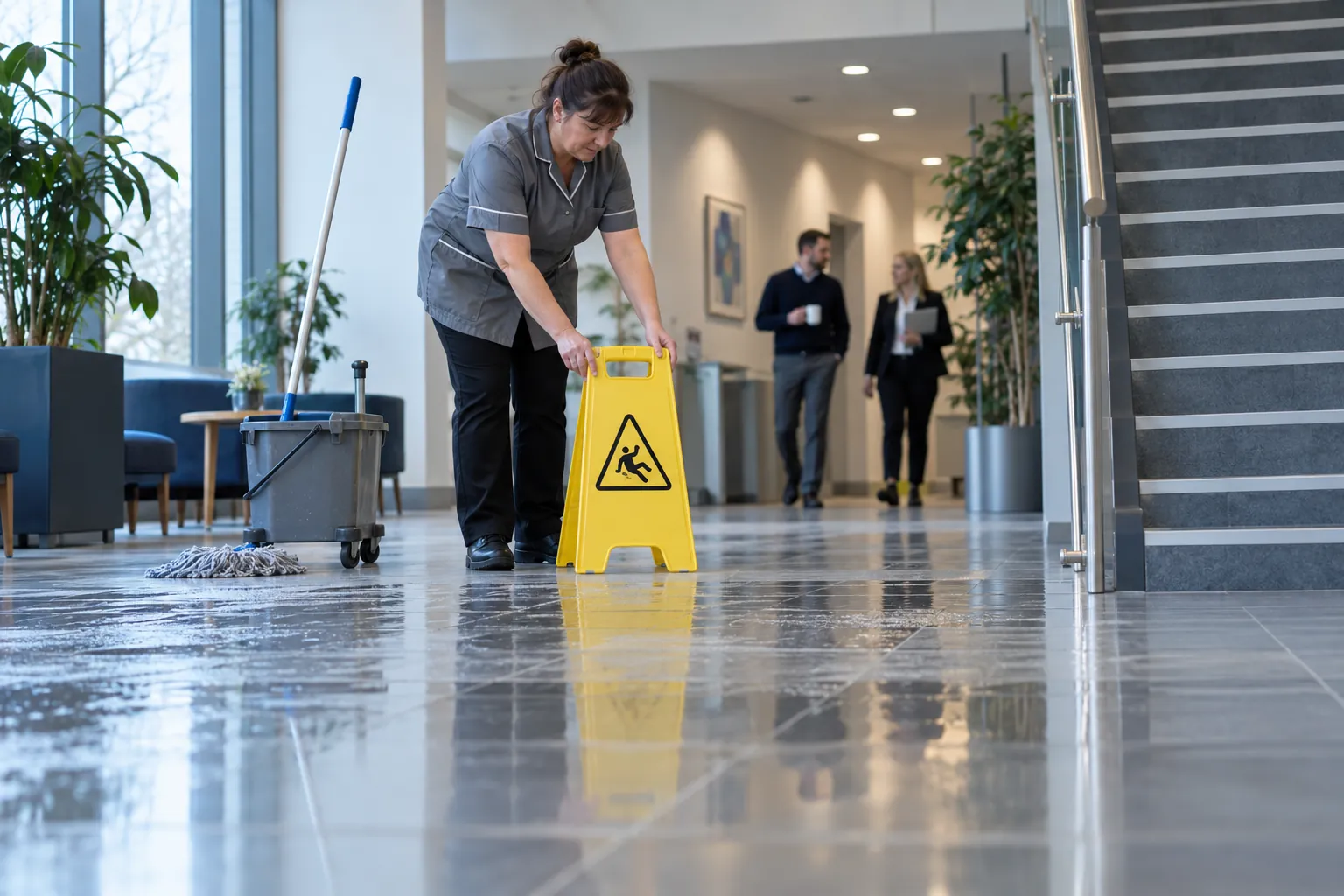
The accident book records the injury. It rarely records the building as it was beforehand. After a slip in a corridor the questions are about the hour before: had the spill been reported, had anyone checked that area, was the stair light out the day before and did anyone pass it on? Too often the answers are a cleaning sheet initialled in advance, a fault mentioned to whoever was passing, and nothing in writing at all.
SiteClara records the routine checks and the reported faults that sit alongside the accident book. A printed QR poster, with an optional NFC tag behind it, goes at each location: an entrance, a stairwell, a washroom, a kitchen. Staff scan the code or tap the tag on their own phone, with no app to install, and mark a scheduled check done or explain what stopped them, such as a walk round from a health and safety inspection checklist, with the time, their name and a photo when one is asked for. A hazard someone notices, a wet floor or a broken step, can be reported there with a photo and goes onto the team's list of jobs until someone closes it.
Each day a supervisor reviews what was due, done and missed, records the reason a check was missed, and approves a daily report that goes to nominated management or client contacts at 8am the next morning. When an accident does happen, the investigation can see what was checked at that location, when and by whom, and whether the hazard had already been reported.
07
Questions people ask
Is it a legal requirement to have an accident book?
Yes, for an employer with 10 or more people normally employed at the same time on or about the same premises, and for any factory, mine or quarry, under regulation 25 of the Social Security (Claims and Payments) Regulations 1979. Smaller employers are not required to keep one, but regulation 12 of RIDDOR 2013 still requires a record of every reportable incident and every over-three-day injury, kept for at least three years.
Can an accident book be online?
Yes. Regulation 25(3)(a) of the Social Security (Claims and Payments) Regulations 1979 allows the record to be kept "in a book or books or by electronic means", as long as it is readily accessible, records the Schedule 4 particulars, and each entry is preserved for at least three years from the date of its entry.
Who can see the accident book?
Only people who need to see an entry to do their job: the ICO's guidance How do we handle sickness and injury records? says employers should not make individual injury records available to others "unless it is necessary for them to do their jobs". Holding injury records involves processing special category data, so the same guidance says to take "appropriate measures to keep sickness and injury records secure".
Does everything in the accident book have to be reported to HSE?
No. HSE's page Types of reportable incidents says an injury that keeps a worker away from work, or off their normal duties, for more than three consecutive days must be recorded but not reported, and that "recording it in your accident book (under social security law) will be enough". Deaths, specified injuries, non-workers taken to hospital for treatment, over-seven-day injuries and dangerous occurrences are reported, on the timescales in HSE's When do I need to report an incident?
08
Further reading, and a list to take away
The law is short and worth reading in the original on legislation.gov.uk. HSE publishes the BI 510 accident book, its RIDDOR guidance on what to report and when, and HSG245 on investigating accidents. The ICO's employment guidance covers injury records under the UK GDPR, and HSENI covers Northern Ireland.
Before the next entry is made, check your compliance against this list:
- you know whether regulation 25 applies to each of your premises, counting the people normally employed there at the same time;
- the accident book, or the electronic form, is readily accessible to every employee on every shift;
- each entry captures the Schedule 4 particulars, plus where exactly, what happened and any witnesses;
- completed entries are removed or locked away so other staff cannot read them;
- someone checks every entry for RIDDOR, including over-three-day absences that pass seven days;
- every accident is investigated in proportion, and the cause is put right;
- entries are kept for at least three years, under a written retention period, then destroyed securely;
- entries are reviewed for patterns at least quarterly.
Sources
Every document this guide quotes or links to, in the order it first cites them.
- Regulation 25 of the Social Security (Claims and Payments) Regulations 1979 legislation.gov.uk
- Regulation 24 of the same Regulations legislation.gov.uk
- Guidance on reporting accidents and ill health at work hse.gov.uk
- Regulation 12 of RIDDOR 2013 legislation.gov.uk
- Types of reportable incidents hse.gov.uk
- Guidance on accident records hseni.gov.uk
- Schedule 4 to the 1979 Regulations legislation.gov.uk
- The Accident book (BI 510, 2018 edition) hse.gov.uk
- HSE Books listing for BI 510 books.hse.gov.uk
- How do we handle sickness and injury records? ico.org.uk
- Data Protection Act 2018 legislation.gov.uk
- When do I need to report an incident? hse.gov.uk
- Investigating accidents and incidents (HSG245) hse.gov.uk
- First aid frequently asked questions hse.gov.uk
Related guides
 Premises and facilities managementRIDDOR reporting: what must be reported, by when, and by whomRIDDOR reporting explained: the reportable injuries, the over-seven-day rule, the 10 and 15 day deadlines, how to report to HSE and who in a building must report.
 Premises and facilities managementNear miss reporting: what counts, what to record, and what happens nextNear miss reporting explained: what counts as a near miss, when one must go to HSE, what a near miss report form records, and how to get people to report.
 Premises and facilities managementFirst aid kit checklist: what goes in a workplace first aid box, and how to keep it stockedWhat should be in a first aid box at work in the UK, from HSE's suggested contents to BS 8599-1, and how often to check, restock and record each kit.
 Premises and facilities managementHealth and safety inspection checklist: what to look at, and what to do nextHow to run a workplace health and safety inspection: the legal basis, what to walk and look at, how often, recording findings and actions, and involving staff.