Premises and facilities management
TM44 inspection: the air conditioning energy inspection, who needs one and how often
A TM44 inspection is the energy inspection of an air conditioning system that the Energy Performance of Buildings (England and Wales) Regulations 2012 require at least every five years, carried out by an accredited energy assessor, wherever the system has an effective rated output of more than 12 kW.
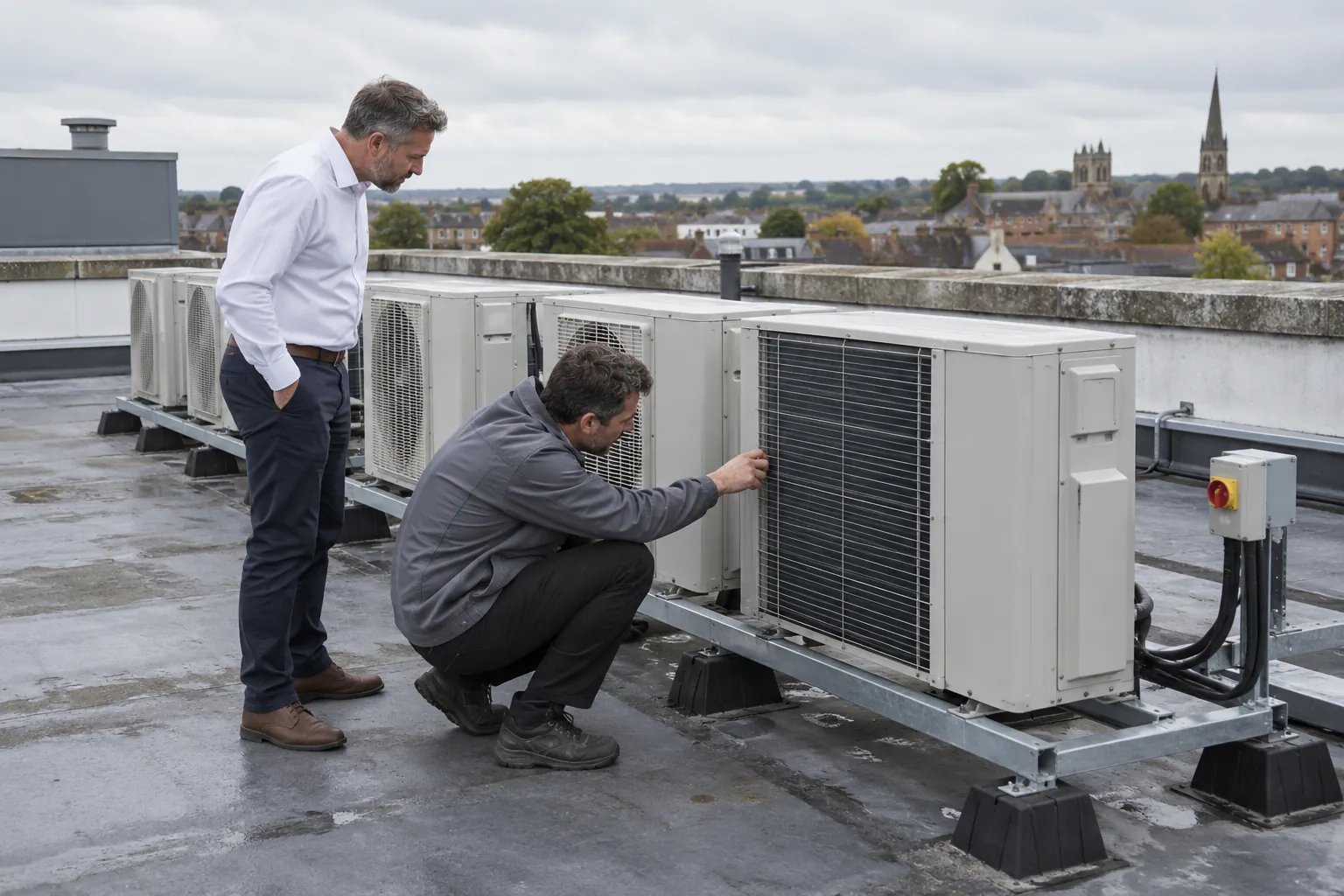
It takes its name from CIBSE's TM44, the guidance assessors follow, and it ends in a report that is lodged on the national register and must be kept by whoever controls the system. This guide covers which systems need one, who is responsible, how often, what the assessor looks at, what the report contains, the penalties, and the routine between inspections that decides what the next report says.
01
What a TM44 inspection is, and the law behind it
In England and Wales the duty sits in Part 4 of the Energy Performance of Buildings (England and Wales) Regulations 2012, regulations 17 to 21. Regulation 18 says: "It is the duty of the relevant person in relation to an air-conditioning system to which this Part applies to ensure that accessible parts of the system are inspected by an energy assessor at regular intervals not exceeding five years." The relevant person, for an air conditioning system, is the person who controls its operation.
"TM44" is not in the regulations. It is the Chartered Institution of Building Services Engineers' technical memorandum TM44: Inspection of air conditioning systems, whose current edition is 2012, superseding the 2007 one. CIBSE describes it as the guidance for the regular inspection of air conditioning systems of more than 12 kW, used in the UK, the Republic of Ireland, Malta and Gibraltar. The government's own A guide to air conditioning inspections in buildings (updated 18 September 2024, England and Wales only) incorporates extracts from it. So "TM44 inspection", "air conditioning inspection" and "air conditioning energy assessment" all mean the same thing in practice.
The purpose is energy, not safety. The government guide says the inspection aims to "improve efficiency, reduce energy consumption, reduce operating costs and reduce carbon emissions", and the report points out how existing systems can be run better or where older, less efficient equipment could be replaced. It is not a service visit, a refrigerant leak check or an electrical test.
Scotland has its own rule. Regulation 17 of the Building (Scotland) Regulations 2004 makes it a continuing requirement on the owner to ensure that accessible parts of every air conditioning system in a building are inspected at intervals not exceeding five years, and that the owner, or the occupier where the owner is not the occupier, is given a report with recommendations for cost-effective improvement. Systems with a total effective output rating of less than 12 kW, and systems solely for processes in a building, are exempt. Northern Ireland also requires inspection of systems of 12 kW or more at intervals not exceeding five years, enforced by district councils, as nidirect's page on air conditioning energy inspections explains. The rest of this guide follows the England and Wales rules.
02
Which air conditioning systems need one, and who is responsible
Regulation 17 applies the duty to "air-conditioning systems with an effective rated output of more than 12kW". The effective rated output is the maximum output the manufacturer specifies and guarantees during continuous operation, so it comes from the equipment's data plate or catalogue information, not from what the system usually delivers. The regulations define an air conditioning system as all the components needed to provide air treatment "in which the temperature is controlled or can be lowered", including systems that also control ventilation, humidity and air cleanliness.
The rule that catches most buildings is aggregation. Where the relevant person can control the temperature of more than one unit in a building, regulation 17(2) treats each unit as a component of a single system. In the government guide's words: "One or more air conditioning units within a building controlled by a single person are considered to comprise a single air conditioning system." Four 5 kW split units in an office suite, all controlled by one tenant, are a 20 kW system: their combined output is what counts, and the system needs an inspection, even though no single unit comes near 12 kW.
Who is responsible depends on who controls the system, not who owns the building:
- A central system serving a multi-let building: the government guide says the building owner or manager is responsible for ensuring there is an inspection report for it.
- Equipment a tenant installed: the occupier is responsible for the report on the units they control.
- A system run under a facilities management or servicing contract: the guide notes that the contract may specify the facilities management or servicing company as the controller, with responsibility for ensuring that inspections are carried out. Even then, the guide says the landlord or building occupier keeps a parallel duty to make sure the system has been inspected.
- Process cooling: the England and Wales regulations contain no exemption for systems that are not for occupants' comfort, though the government guide says it is not written for dedicated process cooling systems. In Scotland, systems solely for processes are exempt.
A landlord's or managing agent's first job is therefore a list: every cooling system in the building, its rated output, who controls it, and which units count together. Leases and service contracts should say who arranges TM44 inspections, because the penalty falls on the relevant person whatever the contract assumed.
03
How often, the first inspection, and a change of relevant person
Inspections must be at regular intervals not exceeding five years, so a system needs an inspection at least every five years. Five years is the maximum, not a target, and nothing stops an earlier inspection after a major change to the system.
The first inspection had to happen before "the relevant date" in regulation 18(3):
- for a system first put into service on or after 1 January 2008, the last day of the five years beginning with the day it was first put into service;
- for an older system with an effective rated output of more than 250 kW, 4 January 2009;
- for an older system of more than 12 kW, 4 January 2011.
Two rules matter when a building changes hands or a tenant moves in. Under regulation 20, the relevant person must keep the most recent air conditioning inspection report, and when the relevant person changes, the previous one must give the report to the new one. Under regulation 21, if the new relevant person is not given a report, they must have the system inspected within three months of the day they became the relevant person. Asking for the TM44 report belongs on every acquisition, lease and contract mobilisation checklist.
Because the report is lodged on a national register, a lost copy is rarely lost for good. The government's Find an energy certificate service searches air conditioning inspection certificates and reports for England, Wales and Northern Ireland by address or reference number, with a separate service for Scotland. It is also the quickest way for an incoming manager to find out when the last inspection was done.
04
Who carries out the inspection, and what the energy assessor checks
Only an energy assessor can carry out the inspection: in the regulations, an individual who is a member of an approved accreditation scheme, in other words an accredited energy assessor. The government guide says data gatherers may collect information for an assessor under contract, and the assessor must be able to verify the data and supervise how and by whom it is collected; the report is the assessor's. Check the assessor's scheme and membership number on the register before the visit.
The visit goes faster, and the report says more, if the records are ready. The government guide asks owners to provide a list of relevant records, sight of the principal documents before the site visit, and site records made readily available, including catalogue information and details from installation, commissioning and maintenance. In practice that means:
- a list of the systems and units, with locations, rated outputs and refrigerant types;
- the operation and maintenance manuals and commissioning records;
- the maintenance contract, service reports and the record of filter changes and cleaning;
- the controls: set points, time schedules, zones and where the sensors are;
- the previous inspection report and what was done about its recommendations;
- metered energy use, where it can be separated out.
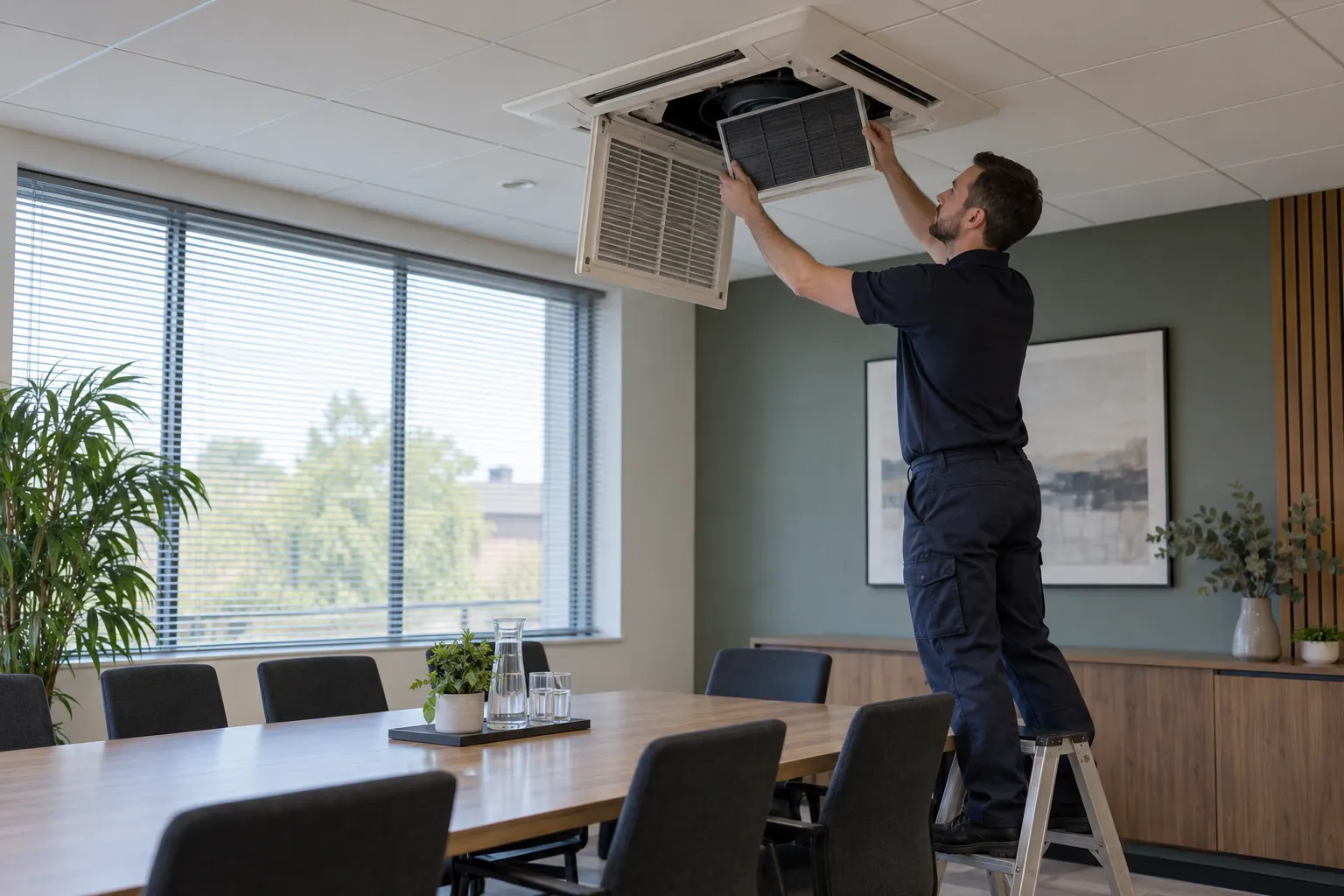
On site, the government guide says refrigeration equipment and its heat exchangers are "checked briefly", looking for damage or poor maintenance that would significantly reduce efficiency; air moving systems are "an important factor" where they deliver the cooling; and the controls are assessed "in more detail": the temperatures the spaces are set to, the hours they are conditioned for, and whether the control zones, sensors and their locations are appropriate, including the potential for cooling to run at the same time as heating. The guide adds that the quality, extent and accessibility of the information provided beforehand has important consequences for the effectiveness and cost of the inspection.
05
What the report contains, the register and the penalties
Regulation 19 sets what the written report must contain:
- an assessment of the system's efficiency, and of its sizing compared with the cooling requirements of the building, in other words whether the system is the right size for the cooling the building needs;
- advice on cost-effective improvement to the system's energy performance, on replacing the system and on alternative solutions;
- since 28 December 2020, consideration of the system's capability to optimise its performance under typical operating conditions;
- the register reference number, the building's address, the assessor's name and employer, the date of inspection and the accreditation scheme.
The assessor lodges the report on the register before issuing it, and the government guide says reports produced after 6 April 2012 must be registered to be valid. It also says, plainly: "There is no legal requirement to act on the recommendations." The legal duty is to have the inspection and keep the report. The recommended improvements are where the value is, and a report whose findings are filed and forgotten is likely to repeat them at the next inspection.
Penalties for non-compliance. Enforcement in England and Wales is by the local weights and measures authority, in practice Trading Standards. An officer can require the relevant person to produce the inspection report within seven days, up to six months after the last day the person was subject to the duty. Under Part 7 of the 2012 Regulations, the penalty charge is £300 for failing to have the system inspected, to keep the report, to pass it on, or to inspect within three months after a change of relevant person, and £200 for failing to produce a report when required.
06
Where the record fails, and what SiteClara does about it
The TM44 report itself is rarely the problem: an assessor produces it, the register holds it, and someone diarises the next one. The weak point is the five years in between. The assessor's recommendations, such as setting the cooling dead band apart from the heating, cutting the hours a meeting floor is conditioned or cleaning the filters more often, depend on routine checks that nobody records. A filter change is noted on a service sheet in the plant room, a unit left running all weekend is mentioned to whoever was passing, and the complaint that a room is too cold goes into an email. When the next assessor asks how the system has been maintained and run, there is little to show.
SiteClara records those routine checks where they happen. A printed QR poster at each location, such as the plant room, a roof plant area or a floor's comms room, with an NFC tag behind it if you want staff to tap, lets staff scan or tap on their own phone, with no app to install, to mark a scheduled check done or explain what stopped them, with a photo when it helps: the filter seen clean, the controller's set point, the timeclock after a change of hours. A problem found, or reported by a building user, such as a unit dripping or a room cooling out of hours, goes onto the team's list of jobs until someone closes it. The supervisor sees what was due, done and missed, can record why a check was missed, and each day approves a report that goes to nominated management or client contacts at 8am the next morning.
That gives the facilities manager a working record of how the system was looked after between inspections, which is the material an assessor asks for and the evidence that last time's recommendations were followed through.
07
Questions people ask
Is a TM44 inspection a legal requirement?
Yes, for an air conditioning system with an effective rated output of more than 12 kW: regulation 18 of the Energy Performance of Buildings (England and Wales) Regulations 2012 requires the person who controls it to have it inspected by an energy assessor at intervals not exceeding five years. Units controlled by one person count together towards the 12 kW. Scotland and Northern Ireland have equivalent requirements under their own rules.
What does TM44 mean?
TM44 is the number of a CIBSE technical memorandum, TM44: Inspection of air conditioning systems, the guidance energy assessors follow when inspecting air conditioning for energy efficiency. The current edition is 2012. The legal duty itself comes from the energy performance regulations, not from TM44.
Who can carry out a TM44 inspection?
Only an accredited energy assessor: the government's A guide to air conditioning inspections in buildings says an inspection "must be carried out by an energy assessor who is a current member of an accreditation scheme". A data gatherer may collect information under the assessor's supervision, but the report is the assessor's, and the assessor lodges the report on the register before issuing it.
Do you have to act on the recommendations in a TM44 report?
No. The government's A guide to air conditioning inspections in buildings says "There is no legal requirement to act on the recommendations." The duty is to have the inspection and keep the most recent report, though the recommendations show how to cut the system's energy use and running costs.
What is the penalty for not having a TM44 inspection?
In England and Wales, Trading Standards can issue a £300 penalty charge notice for failing to have a system inspected or to keep the report, and £200 for failing to produce the report within seven days when asked, under Part 7 of the Energy Performance of Buildings (England and Wales) Regulations 2012. These are fixed penalty charges rather than fines set by a court, and a notice must be given within six months of the breach, or of its last day if the breach continues.
08
Further reading, and a list to take away
Start with the government's A guide to air conditioning inspections in buildings and the 2012 Regulations for England and Wales, CIBSE's TM44 for the method, regulation 17 of the Building (Scotland) Regulations 2004 for Scotland and nidirect for Northern Ireland.
To check your TM44 compliance:
- every cooling system in the building is listed with its rated output and who controls it, and units controlled by one person are added together;
- each system over 12 kW has a lodged report less than five years old, found on the register;
- leases and maintenance contracts say who arranges TM44 inspections;
- the most recent report is kept with the building log book or maintenance records, and handed on when control changes;
- a new controller without a report has the system inspected within three months;
- records are ready for the assessor before the visit: manuals, commissioning, servicing, controls and the last report;
- the recommendations have an owner and a decision, not just a filing place;
- F gas leak checks are kept as a separate record.
Sources
Every document this guide quotes or links to, in the order it first cites them.
- Energy Performance of Buildings (England and Wales) Regulations 2012 legislation.gov.uk
- Regulation 18 legislation.gov.uk
- TM44: Inspection of air conditioning systems cibse.org
- A guide to air conditioning inspections in buildings gov.uk
- Regulation 17 of the Building (Scotland) Regulations 2004 legislation.gov.uk
- Nidirect's page on air conditioning energy inspections nidirect.gov.uk
- Regulation 17 legislation.gov.uk
- Regulation 20 legislation.gov.uk
- Regulation 21 legislation.gov.uk
- Find an energy certificate gov.uk
- Regulation 19 legislation.gov.uk
- Checking F gas equipment for leaks gov.uk
- Part 7 of the 2012 Regulations legislation.gov.uk
Related guides
 Premises and facilities managementBuilding compliance checklist: the statutory picture for a UK buildingBuilding compliance checklist for UK non-domestic buildings: fire, electrical, gas, water, asbestos, lifts, access and energy, who is responsible, how often.
 Premises and facilities managementPlanned preventative maintenance: how to plan it and prove it was donePlanned preventative maintenance (PPM): what it is, how to build an asset register and schedule, statutory versus discretionary tasks, and evidencing the work.
 Premises and facilities managementFixed wire testing: what the law requires, how often, and what the EICR tells youWhat fixed wire testing is, what the Electricity at Work Regulations 1989 require, how often a commercial building needs an EICR, the codes, and what to keep.
 Premises and facilities managementFacilities manager responsibilities: what the role covers, and how to show it is doneWhat a facilities manager is responsible for across services and sites: compliance, contractors, budgets, space, health and safety, and reporting.