Cleaning
Warehouse cleaning checklist: clear routes and recorded work
A warehouse cleaning checklist identifies the floors, picking and packing areas, loading zones, waste points and welfare facilities to clean, with the method, frequency and responsible team for each task.
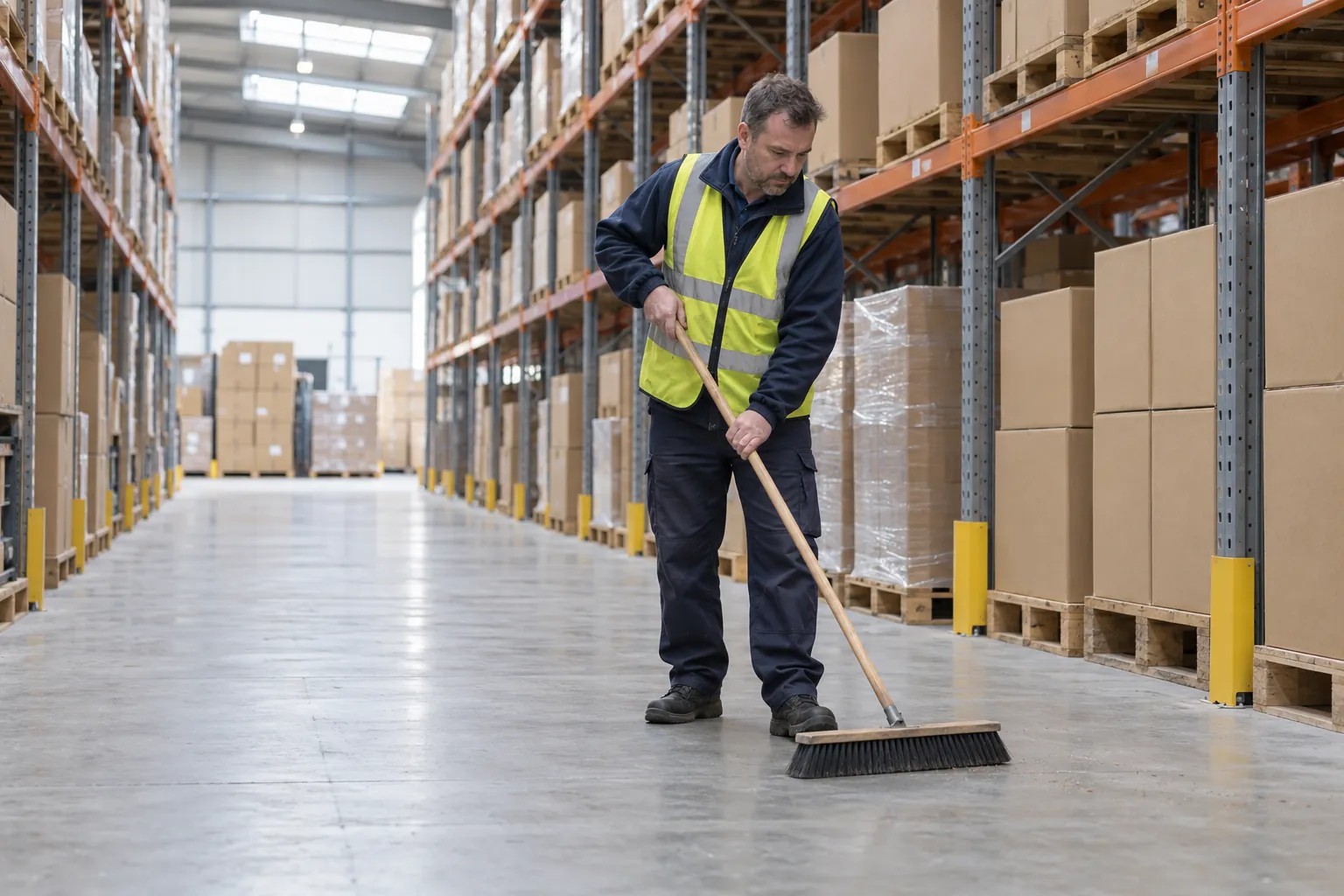
It should include immediate action for spills and loose packaging as well as planned daily and periodic work. Cleaning must fit the site's vehicle movements and hazards, and a completed tick should not conceal an area that could not safely be reached.
01
Cleanliness duties and the scope of the warehouse checklist
A busy warehouse needs a plan for removing contamination and waste without sending a cleaner into moving traffic or spreading dust over goods. Start with a walk of the site, using its traffic plan and risk assessments. Mark the cleaning zones, their hazards, access arrangements and expected result, then decide which team can do the work safely.
For Great Britain, HSE's Workplace health, safety and welfare guidance, L24, reproduces the workplace cleanliness and waste requirements in regulation 9 of the Workplace (Health, Safety and Welfare) Regulations 1992. Workplaces and their furniture, furnishings and fittings must be sufficiently clean, and waste must not accumulate outside suitable receptacles so far as reasonably practicable. The guidance ties cleaning frequency to the nature of the business. It does not prescribe one daily warehouse checklist for all operations.
HSE's Warehousing and storage guide, HSG76 discusses housekeeping, floor contamination, slips, work equipment and vehicle movements in the warehouse setting. A checklist supports these arrangements but is only one part of them. Racking inspections, forklift checks, fire safety inspections and specialist maintenance remain their own work, even when a cleaner happens to spot a defect.
This guide is a starting point for ordinary storage and distribution premises. Cold stores, food warehouses and sites storing hazardous substances need additional methods and controls for their particular risks. Northern Ireland has its own Workplace (Health, Safety and Welfare) Regulations 1993; operators should check the applicable local requirements rather than treating the Great Britain legislation cited here as their own.
The warehouse cleaning checklist should support the site's health and safety arrangements and agreed service standards. It does not establish compliance by itself. Operations and cleaning teams need the same zone names, so employees can report a blocked route clearly and a supervisor can direct the next action.
02
What the warehouse cleaning checklist should cover
Break the warehouse into areas that can be safely handed over and checked. A single row for the entire warehouse does not show which aisle was inaccessible or which loading bay was still active. Match the zone names to the floor plan and use the same names in the cleaning specification and fault reports.
- Goods receiving and loading: loose packaging, pallet fragments and visible contamination on accessible floors; condition around doors and the safe routes used by people. Report damaged surfaces or leaking goods through the site's procedure.
- Aisles and pedestrian routes: litter, strapping, stretch wrap, dust and other contamination, with routes left clear and safe. The cleaning task does not authorise moving stored goods into another route.
- Picking, packing and dispatch: work surfaces, accessible floors, packaging waste points and shared touch points. Protect goods and equipment during the work and use the method appropriate to the contamination.
- Storage areas and accessible racking surroundings: remove the planned waste and dust from safe positions. Report visible racking damage; do not climb racking, disturb loads or treat a wipe-down as a structural inspection.
- Waste areas: empty designated bins before overflow, separate the site's waste streams, and leave the collection area usable. Put broken pallets and other bulky waste in the agreed place rather than an exit route.
- Welfare areas: toilets, washbasins, changing areas, break rooms and tea points, with soap, toilet paper and other supplies replenished. Keep their cleaning equipment separate where the method requires it.
- Offices and external approaches: clean the agreed office areas, entrance matting and pedestrian approaches. Plan yard work with vehicle control, weather and surface condition in mind.
Specify the observable result for each area. For an aisle it might be loose debris removed, floor dry, and the agreed pedestrian route available. For a welfare room it might be clean fittings, bins usable and supplies stocked. A shiny floor alone does not prove that an industrial contaminant has been safely removed.
Check the agreed routes to emergency exits during the cleaning round and report any obstruction through the site's procedure. Wipe accessible door handles and welfare touch points with suitable products; do not use the same tools for dirty industrial residue and break-room surfaces. Specify when staff should sweep ordinary packaging debris and when the material requires another method.
03
Immediate, daily, weekly and periodic cleaning tasks
Use these categories as a suggested planning framework. Adjust the intervals to the site, contamination, shifts and approved cleaning method. The HSG76 guidance calls for prompt action on floor contamination and a suitable cleaning regime; it does not make the illustrative weekly and monthly tasks below legal intervals.
- Immediately when found: make a spill or loose-debris hazard safe and report it. Clean ordinary contamination through the approved method. Unknown chemicals, leaking hazardous goods and other unusual spills require the site's emergency or spill procedure and trained personnel.
- At the agreed daily or shift interval: clean high-use accessible aisles, picking and packing zones; remove packaging waste; empty bins; clean welfare facilities and restock supplies; deal with entrance contamination. Arrange access before entering a vehicle area.
- During the shift where necessary: check busy waste points and welfare areas, and deal with new contamination. An end-of-day clean cannot control a hazard left through the working day.
- Weekly planning tasks: consider detailed cleaning of accessible corners, lower-use floor areas and welfare fittings beyond the daily method. Schedule access to locations that are normally occupied by stock or equipment.
- Monthly or other periodic tasks: plan high-level and specialist deep cleaning, review recurring floor contamination, and check the cleaning equipment programme. Set the actual task interval from risk, condition and equipment instructions.
Do not put a generic 'sweep dust' instruction into every storage area. L24 warns that cleaning methods must not create harmful dust exposure. Identify the material and choose a suitable method and equipment through the risk assessment, particularly where powders or hazardous residues are present. A domestic vacuum is not a universal industrial cleaning tool.
Record postponed work with the reason and the next safe opportunity. If a zone is blocked by a live dispatch operation, it should be recorded as unable to complete rather than quietly excluded from the cleaning round. Management then decides how to provide access and control any immediate risk.
04
Clean safely around vehicles, machinery and wet floors
A warehouse cleaner is a pedestrian working in a site designed partly for moving vehicles. HSE's guidance on separating pedestrians and vehicles recommends separate routes wherever possible and protection for people working near vehicle routes. Agree when a zone is available, who controls vehicle access and how it is returned to operations. High-visibility clothing and a shouted warning do not replace those arrangements.
HSG76 describes contamination such as water, oil, powders and loose plastic as slip risks. Use a method suited to the material and surface. For wet cleaning, keep people away until the area can be safely used, following the site's controls. HSE's cleaning slips guidance explains that signs warn of a hazard but do not stop people walking into it.
Keep cleaning separate from equipment repair and inspection. Clean machinery only within the agreed safe procedure, including isolation where required. Do not remove guards, reach into moving equipment or drive unfamiliar handling equipment to create access. Report broken equipment, floor damage or blocked routes to the responsible team.
For hazardous substances, use the assessment and controls appropriate to the site. For Great Britain, HSE's COSHH assessment guidance explains how to identify hazardous substances, exposure and precautions. Keep products labelled and use the approved dilution and protective equipment. Do not tackle a leaking container simply because the cleaner carries a mop.
High-level cleaning needs planned access and competent people. For Great Britain, use HSE's working-at-height guidance when arranging that work. Racking and stacked pallets are not access equipment. Contractors need the site's induction, traffic arrangements and hazard information before the work begins.

05
A warehouse cleaning record that explains exceptions
Keep the planned cleaning schedule separate from the outcome. The schedule should identify the zone, task, safe method, interval or trigger, responsible team and access arrangement. A completed-work record adds the actual date and time, person or team, result, exception, fault report and recheck. This can be a paper sheet, spreadsheet or location-based record.
Use clear outcomes such as done, unable, needs further cleaning and fault reported. A postponed cleaning task and a completed clean with a newly discovered floor defect are different facts. Give the supervisor enough detail to arrange the next action without assuming the worker refused the task or the area was necessarily unsafe throughout the day.
Inspect a defined sample or the full round according to the site's arrangements. Check visible contamination, waste points, welfare supplies and the return of the agreed route. Record the scope of the inspection; a supervisor visiting one packing bench has not inspected every aisle.
Assign responsibility for warehouse cleaning tasks explicitly. Warehouse staff may remove packaging as work proceeds, the cleaning team may complete the agreed floor and welfare round, and maintenance may investigate a leak or damaged surface. Make the handover between these teams clear. Regular supervisor checks and service audits can review the quality of that handover, but neither replaces a competent safety inspection of racking or machinery.
Review recurring problems with operations. If the same zone is inaccessible every afternoon, change the access window or resources. If oil returns after every clean, investigate the source through maintenance. Repeating a mop task without addressing a leak makes the cleaning record busy while the problem remains. Keep repair reports and specialist inspections alongside the cleaning record.
06
Where the warehouse cleaning record fails
A sheet signed in the office can make a partly accessible warehouse look completely cleaned. Verbal handovers can also lose the difference between a new spill, a persistent leak and planned deep cleaning. The record should make the actual zone and outcome clear, with the unresolved work visible to the next responsible person.
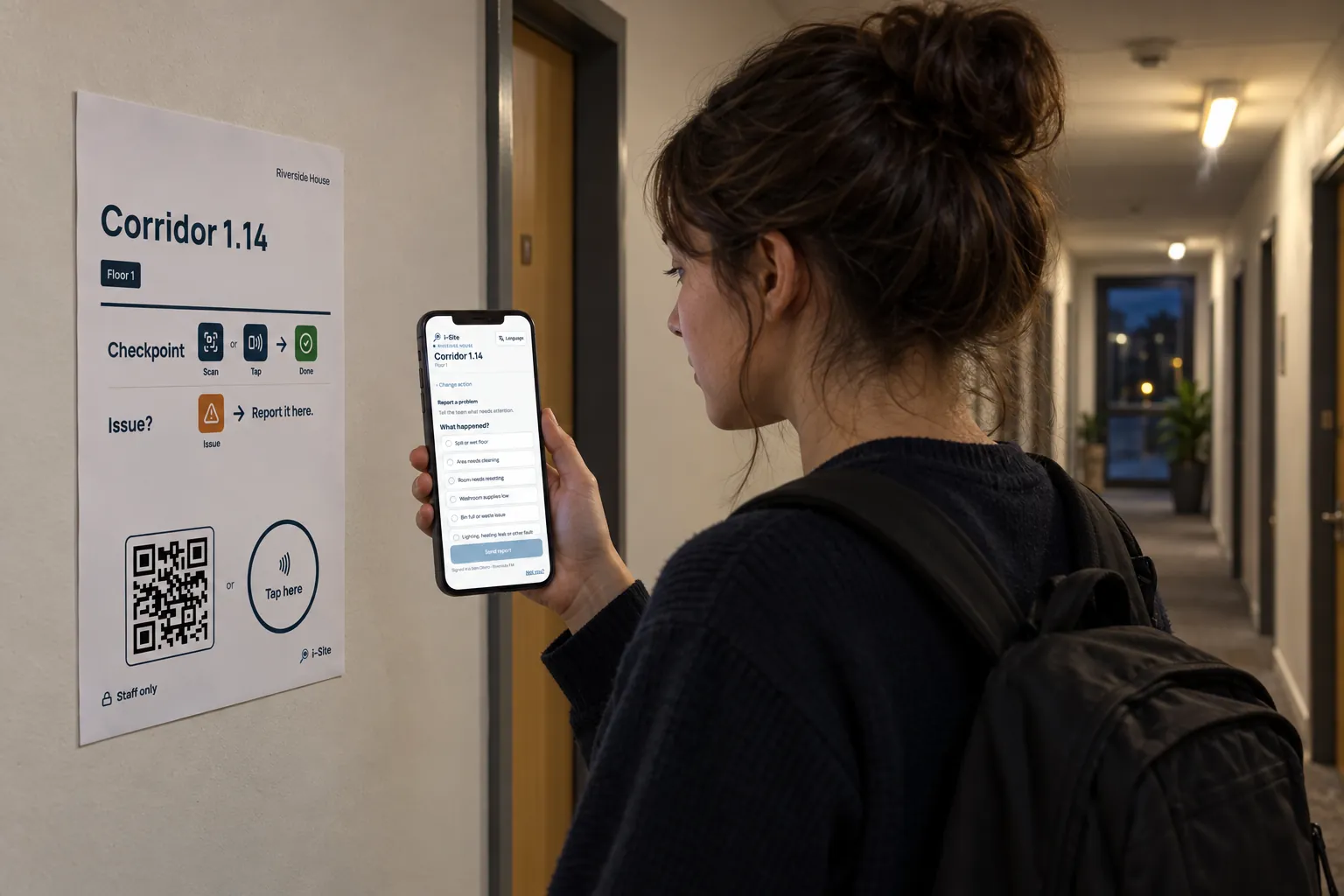
SiteClara supports checks at configured locations. Enrolled staff scan a QR code or tap an NFC tag, answer the task checklist and record completed work. They can report an issue with a note and optional photos. Scheduled checks can record an unable result with a reason, and a supervisor reviews the daily report before approval.
For a warehouse round, those locations can be the agreed cleaning zones and welfare areas. A worker can record that a task was blocked without implying it was completed, and a separate report can carry the floor defect or leaking fixture. The site still provides safe access, chooses the method and decides the remedial work. A visit photograph alone does not complete a scheduled check.
07
Official guidance and a short working list
Use HSE's Warehousing and storage guide, HSG76, for the warehouse context, L24 for the Great Britain workplace requirements, and HSE's pedestrian and vehicle separation guidance for access planning. Apply the site's own risk assessments, traffic plan and equipment instructions to the cleaning work.
- Divide the site into named cleaning zones.
- Specify safe methods and the result expected in each zone.
- Deal with immediate hazards through the correct procedure.
- Plan access around vehicle and equipment operations.
- Separate daily cleaning from periodic and specialist work.
- Record blocked access and faults without using a complete tick.
- Review recurring contamination and unavailable zones with operations.
Trial the checklist on one shift. Ask a cleaner and an operations supervisor to follow a task from safe access to handback, then follow an exception to its next action. Revise anything that exists only on paper before extending the checklist to the whole warehouse.
Sources
Every document this guide quotes or links to, in the order it first cites them.
- HSE's Workplace health, safety and welfare guidance, L24 hse.gov.uk
- HSE's Warehousing and storage guide, HSG76 hse.gov.uk
- Workplace (Health, Safety and Welfare) Regulations 1993 legislation.gov.uk
- HSE's guidance on separating pedestrians and vehicles hse.gov.uk
- Cleaning slips guidance hse.gov.uk
- HSE's COSHH assessment guidance hse.gov.uk
- HSE's working-at-height guidance hse.gov.uk
Related guides
 CleaningCommercial cleaning checklist: area by area, and how to use itA commercial cleaning checklist for offices and shared premises, area by area, with how to use it on shift, what to record and how a supervisor checks it.
 CleaningCleaning specification: what it should say, and how to show it is metWhat a cleaning specification should contain, input and output standards, setting frequencies by area, and how to show the specification is being delivered.
 Premises and facilities managementHealth and safety inspection checklist: what to look at, and what to do nextHow to run a workplace health and safety inspection: the legal basis, what to walk and look at, how often, recording findings and actions, and involving staff.
 Premises and facilities managementFault reporting system: how faults are reported, prioritised and closedHow a fault reporting system for a building should work: how occupants report faults, how facilities teams log and prioritise them, and how a fault is closed.