Security patrols
The Clery daily crime log: what goes in it, when, and how to keep it right
A daily crime log is the public record that a college or university with a campus police or security department must keep under the federal Clery Act, listing each crime reported to that department with its nature, date, time, general location and disposition.
Every institution that takes part in federal student aid and has such a department must keep one, and anyone can walk in and read it. It is the most immediate part of the Clery Act: not the annual statistics, but a running record of each crime reported, updated within two business days. This guide covers who has to keep one, what each entry must say, the geography it covers, what can be held back, public inspection, and how officers' patrol reports and notes turn into entries that are complete and on time.
01
What the daily crime log is, and who has to keep one
The daily crime log comes from the federal law most people know as the Clery Act, section 485(f) of the Higher Education Act, codified at 20 U.S.C. 1092(f). Since the Stop Campus Hazing Act of December 23, 2024, the subsection may be cited as the Jeanne Clery Campus Safety Act. It applies to institutions that participate in the federal student aid programs, other than foreign institutions. The statute says that an institution that "maintains a police or security department of any kind shall make, keep, and maintain a daily log, written in a form that can be easily understood, recording all crimes reported to such police or security department".
The Department of Education's regulation, 34 CFR 668.46, Institutional security policies and crime statistics (quoted here from the July 1, 2025 edition of the Code of Federal Regulations), sets the detail in paragraph (f). An institution that maintains a campus police or a campus security department "must maintain a written, easily understood daily crime log that records, by the date the crime was reported, any crime that occurred within its Clery geography" and that is reported to the campus police or security department. Each entry must include:
- "the nature, date, time, and general location of each crime"; and
- "the disposition of the complaint, if known."
Three points follow from that wording and are often missed. First, the trigger is having a police or security department; the statute says "of any kind", so it is not limited to sworn officers. A university police department with sworn law enforcement officers and a nonsworn campus security office both count. Second, the log is not limited to the crimes counted in the annual security report statistics: it records any crime reported, from a stolen bicycle to trespass to vandalism in a stairwell. Third, it is ordered by the date the crime was reported, not the date it happened, so a theft discovered on Monday that happened over spring break goes in on Monday.
02
What goes in the log: geography, crimes and the five fields
The log has its own, slightly wider geography. For the annual statistics, Clery geography means buildings and property on campus, noncampus buildings and property, and public property within or immediately adjacent to and accessible from the campus. For the crime log, the regulation adds "areas within the patrol jurisdiction of the campus police or the campus security department." If your officers patrol the blocks around campus under an agreement with the city, a crime reported to them there belongs in the log even though it will never appear in the annual statistics.
In practice, an entry is made when all of the following are true:
- Someone reports a crime to the campus police or security department. The report may come from a victim, a witness, a staff member, another agency or an officer who finds it on patrol.
- The crime occurred within the crime log's Clery geography, including the patrol jurisdiction.
- It is a crime, not only a policy or conduct violation. A noise complaint in a residence hall is not a log entry; a criminal mischief report about a smashed window is.
The five fields are the minimum. Most campus logs use a table with one row per report and columns like these:
- Case or report number, so later updates can be matched to the entry; not required by the rule.
- Date and time reported, which drives the order of the log and the two-day clock.
- Date and time occurred, often a range, such as "between 10 p.m. Friday and 7 a.m. Saturday" for a burglary found in the morning.
- Nature: the offense in plain words, such as "theft of bicycle", "burglary" or "criminal mischief (damage to vending machine)". "Easily understood" rules out internal codes on their own.
- General location: enough for a reader to know roughly where, such as the building name, a parking lot or a street block, but not a room number that identifies a person.
- Disposition: open, closed, referred to another agency, arrest, cleared, unfounded or pending, as known, using terms the reader can follow.
Keep personal information out. The log names no victims, and the rule lets an institution leave out information where disclosure is prohibited by law or would jeopardize the confidentiality of the victim. The location should be general for the same reason: "Residence hall, north campus" rather than a floor and room.
03
The two-business-day rule, updates and dispositions
Under 34 CFR 668.46(f)(2), the institution "must make an entry or an addition to an entry to the log within two business days" of the report reaching the campus police or security department. A business day is defined in the same section as "Monday through Friday, excluding any day when the institution is closed." A report taken at 11 p.m. on a Friday is due in the log by the end of Tuesday; a report taken during a closure, such as a winter break when the institution is closed, gets more time.
The clock runs again whenever something new is learned. The statute is explicit: if new information about an entry becomes available, it "shall be recorded in the log not later than two business days after the information becomes available." That is how dispositions work. An entry may start as "theft of laptop, open", become "referred to city police" a week later, and "arrest" a month after that, each change made within two business days of the department learning of it.
A report that is investigated and turns out to be false is usually handled the same way: a common practice is to keep the entry and change its disposition to "unfounded", rather than delete it, since the crime was still reported. For the annual statistics, 34 CFR 668.46(c)(2)(iii) says that "only sworn or commissioned law enforcement personnel may 'unfound' a crime report", after a full investigation leads to a formal determination that the report "is false or baseless." Where a case is referred to another agency, such as the city police, the log should say so and be updated when that agency's outcome is known.
The weak point is almost always the handoff between the officer who took the report and whoever keeps the log. A workable routine looks like this:
- At the scene or desk. The officer takes the report and writes it up on the shift's incident report, noting the time reported, the time or range of occurrence, the exact location and what was said.
- Before the end of the shift. The incident is flagged as a possible crime in the pass-down log or dispatch system, so the next shift and the records clerk both know it exists.
- Next business day. A named person, usually a records clerk, dispatcher or the Clery coordinator, classifies the report, decides whether it is a crime within the geography, and makes the entry.
- Weekly. Open entries are reviewed against case files, and any disposition change is added within two business days of it being known.
- On any withholding decision. The reason and the date to review it are recorded, so the information is added once the risk has passed.
Plan too for reports that never pass through dispatch, such as a resident director told about a theft over breakfast. Officials with significant responsibility for student and campus activities are campus security authorities under the regulation, and your procedures should say how what they hear reaches the department. That matters for timing: the statute, 20 U.S.C. 1092(f)(4)(B), makes entries open to inspection within two business days "of the initial report being made to the department or a campus security authority", not only to the department.
04
What may be withheld, and for how long
The log is public by design, so the regulation allows only narrow exceptions, and requires the information to be released once they no longer apply.
- Victim confidentiality or a legal bar. An entry need not be made within two business days where disclosure "is prohibited by law or would jeopardize the confidentiality of the victim." A common approach is to make an entry with the identifying detail generalized, not to leave the crime out.
- Investigation and safety. Under 668.46(f)(3), information may be withheld "if there is clear and convincing evidence" that releasing it would jeopardize an ongoing criminal investigation or the safety of an individual, cause a suspect to flee or evade detection, or result in the destruction of evidence.
- Only what causes the harm. Paragraph (f)(4) limits withholding to "only that information that would cause the adverse effects". If the location would tip off a suspect but the offense would not, the entry goes in without the location.
- Release later. Withheld information must be disclosed once the adverse effect "is no longer likely to occur."
"Clear and convincing evidence" is a high bar, and a general preference by investigators to keep things quiet does not meet it. The decision should be made by someone with authority, written down with the reason, and reviewed on a set date. A withholding with no review date is how an entry ends up missing for good, and that gap is what a program reviewer will look for.
05
Public inspection, and checking the log is right
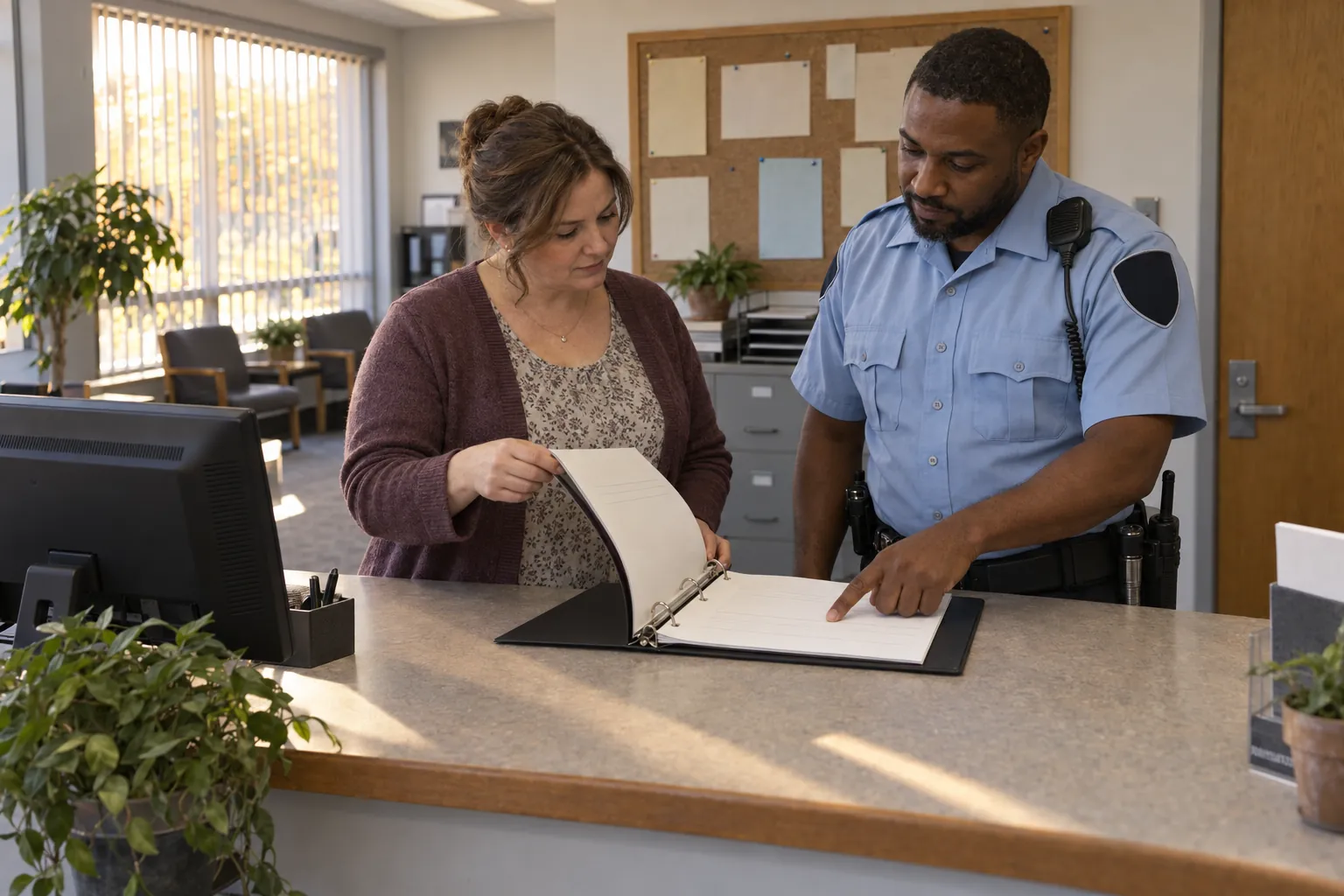
Paragraph (f)(5) sets the access rule: the institution "must make the crime log for the most recent 60-day period open to public inspection during normal business hours", and any older portion must be made available within two business days of a request. The 2025–2026 Federal Student Aid Handbook repeats the same obligations. Whatever is posted online, the desk officer should know where the current 60 days are kept and what to do when a member of the public asks. The point is that students, employees and the wider campus community can see what has been reported without waiting for the annual report.
Good practice for the front desk:
- keep the current 60 days in a binder or on a public terminal at the police or security office, with no login needed;
- log requests for older entries and meet them within two business days;
- make sure the printed or posted version matches the working copy, including updated dispositions.
The log also has to agree with everything else the institution publishes. Crimes in the log that are Clery crimes on Clery geography should appear in the annual statistics, and entries should line up with incident reports, dispatch records and any timely warnings. A monthly self-audit catches most problems. A supervisor or the Clery coordinator can take a sample of incident reports from the month and check:
- Was each reported crime entered, and within two business days of the report?
- Is the nature easily understood, and is the location general but useful?
- Has every disposition change been recorded within two business days?
- Is every withholding documented, with a reason and a review date?
- Do the patrol-only areas show up in the log where crimes were reported there?
Stakes are real. The FSA Handbook notes that the Department may limit, suspend or end a school's participation in the aid programs for failing to comply with consumer information requirements, and may impose civil fines for each violation. The maximum fine is adjusted for inflation: under 34 CFR 36.2, as last amended January 21, 2025, it is $71,545 per violation (the 2025–2026 FSA Handbook still quotes the 2023 figure of $67,544).
06
Where the record fails, and where SiteClara fits
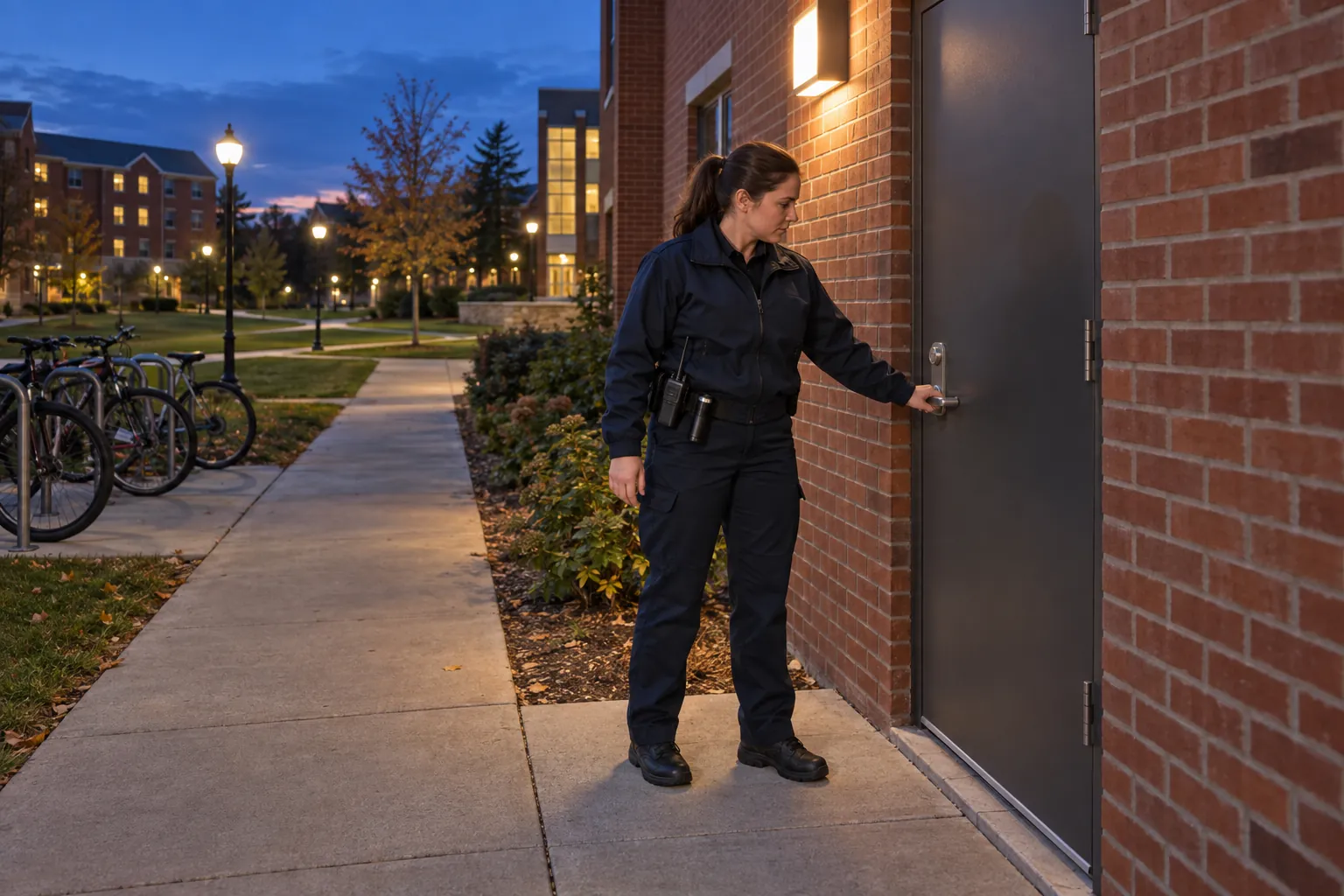
Crime logs rarely fail at the desk. They fail upstream, in the patrol and building records that should tell the department what happened and when. An officer on the overnight tour finds a residence hall side door propped and a bike rack cut, mentions it at shift change, and the pass-down note says only "door issue, bikes". A custodian reports a forced vending machine to whoever is walking past. A lock check on the parking structure stairwells is initialed for the whole week in advance. When the log clerk comes to make an entry, the time reported, the exact location and who found it are guesswork, and the two business days are already running.
SiteClara works on that routine layer, not on the crime log. A printed QR poster goes at each location on the tour, such as a residence hall entrance, a stairwell, a parking level or a loading dock, with an optional NFC tag behind it. Officers and staff scan the code or tap the tag on their own phone, with no app to install, and sign in with a link. They see the checks due at that location and mark each one done, or say what stopped them. A problem, such as a door that will not latch, a broken light or damage to a fixture, is reported there with a photo and goes onto the team's list of jobs until someone closes it.
The supervisor sees what was due, done and missed on each round, and can record why a check was missed. Each day the supervisor reviews and approves a report that goes to nominated management or client contacts at 8 a.m. the next morning, showing what was reported, what was completed and what is still open, and how the scheduled checks went. That gives the department a timed, located record of patrol checks and building defects to draw on when it builds its own entries.
07
Where to read more, and a list to take away
Read the rule itself first: paragraph (f) of 34 CFR 668.46, Institutional security policies and crime statistics, with the definitions of business day, campus security authority and Clery geography in paragraph (a). The statute is 20 U.S.C. 1092(f), paragraph (4). The Department's own summary is in the 2025–2026 Federal Student Aid Handbook, Volume 2, Chapter 6: Consumer Information and School Reporting, and institutions' published statistics are on the Department's Campus Safety and Security website. The eCFR carries the current text of the regulation between annual editions; check it for amendments before relying on this guide.
Before the next audit, check that:
- you know whether your institution maintains a campus police or security department, and who decides that for contract or shared arrangements;
- the crime log's geography, including every area within the patrol jurisdiction, is mapped and known to officers and the records clerk;
- one named person, with a backup, makes entries within two business days of each report, counting only days the institution is open;
- each entry has the nature, date, time, general location and disposition, in plain words, with no victim identifiers;
- disposition changes are added within two business days of being known;
- every withholding is written down with its reason and a review date, and released when the risk has passed;
- the last 60 days can be inspected at the office during business hours, and older entries within two business days;
- incident reports, pass-down notes, patrol records and post orders tell officers what to record and where it goes;
- a monthly sample of incident reports is checked against the log, and the log against the annual statistics.
Sources
Every document this guide quotes or links to, in the order it first cites them.
- 20 U.S.C. 1092(f) govinfo.gov
- 34 CFR 668.46, Institutional security policies and crime statistics govinfo.gov
- 34 CFR 668.49, Institutional fire safety policies and fire statistics govinfo.gov
- The 2025–2026 Federal Student Aid Handbook, Volume 2, Chapter 6: Consumer Information and School Reporting fsapartners.ed.gov
- Campus Safety and Security website ope.ed.gov
Related guides
 Security patrolsSecurity daily activity report: what to include, and how to write one that holds upThe security daily activity report (DAR): what to record, how to write entries that hold up, how it differs from an incident report, and how to review and keep it.
 Security patrolsSecurity incident report: what to write, and how to make it hold upHow a US security officer writes an incident report: what to include, state rules on report writing and reporting to regulators, and how to make it hold up later.
 Security patrolsRA rounds: what resident assistants check, and how to show a round was walkedWhat RA rounds cover in a residence hall, the Clery Act and fire safety rules behind them, how to route what you find, and what a round record should show.
 Security patrolsSecurity pass-down log: what to hand over, and how to make the shift change stickThe security pass-down log: what the outgoing officer hands over, how to run the shift change, how to write entries that stay useful, and how to review and keep it.