Security patrols
Security pass-down log: what to hand over, and how to make the shift change stick
A pass-down log is the shift-to-shift record in which outgoing security officers write down what the incoming shift needs to know, act on or finish: open incidents, systems out of service, access changes, keys and equipment, and promises still to keep.

It is how one shift tells the next about the door alarm that is bypassed, the contractor still on the roof, the camera that went dark at 3 a.m., the former employee who is not to be let in. When it works, the incoming officer starts the shift already knowing what is open. When it fails, the same problem is discovered three times and fixed by nobody. This guide covers what a pass-down log is, what goes in it, how to run the shift change itself, how to write entries that stay useful, and how to review and keep the log.
01
What a security pass-down log is
A pass-down log is the written record of what one shift hands to the next: anything that happened, changed or broke during the shift that the incoming officer needs to act on, watch for or finish. Sites call it the pass down log, passdown log, pass-down book, turnover log or shift change log. Some keep a bound book at the security console; others fold it into the officer's electronic report.
The need comes from how security is staffed. The Bureau of Labor Statistics' Occupational Outlook Handbook entry for security guards notes that guards "usually work in shifts of about 8 hours, with rotating schedules" and, because many buildings are open 24 hours a day, "often must work around the clock." A post covered around the clock changes hands at least three times a day, and every change is a chance for something to be lost.
It is not the same record as the daily activity report. The DAR is the running account of the whole shift; the pass-down log is the short list of what is still open when it ends. Some sites add a pass-down section to the DAR, which works if the open items are easy to find.
No federal law requires a pass-down log, and no state law we know of prescribes its format. The contract and the post orders make it a requirement, and should say how relief is carried out and what is handed over. State licensing brings it in through training. In California, the Bureau of Security and Investigative Services' security guard training requirements make "Observation & Documentation" and "Communication and its Significance" two of the four mandatory four-hour courses. In New York, the Department of State's security guard training requirements include a 16-hour on-the-job course "relevant to the duties of guards, requirements of the work site, and the needs of the employer", which is where the site's own relief routine belongs. Check the licensing board in your own state.
02
What goes in the pass-down log
The test for every entry is simple: does the next officer need to do something about this, or watch for it? If so, it goes in the pass-down log. A typical log carries:
- Open incidents and follow-ups: an incident still being handled, or police or the property manager expected to call back, with the incident report number.
- Systems out or bypassed: a camera down, a reader offline, a door alarm shunted, a gate stuck open, with who was told and any work order number. Where a fire system is impaired and a fire watch is in place, the incoming officer needs the route, the interval and who is walking it.
- Access changes: a badge deactivated, a trespass notice issued, a BOLO received, a new contractor list.
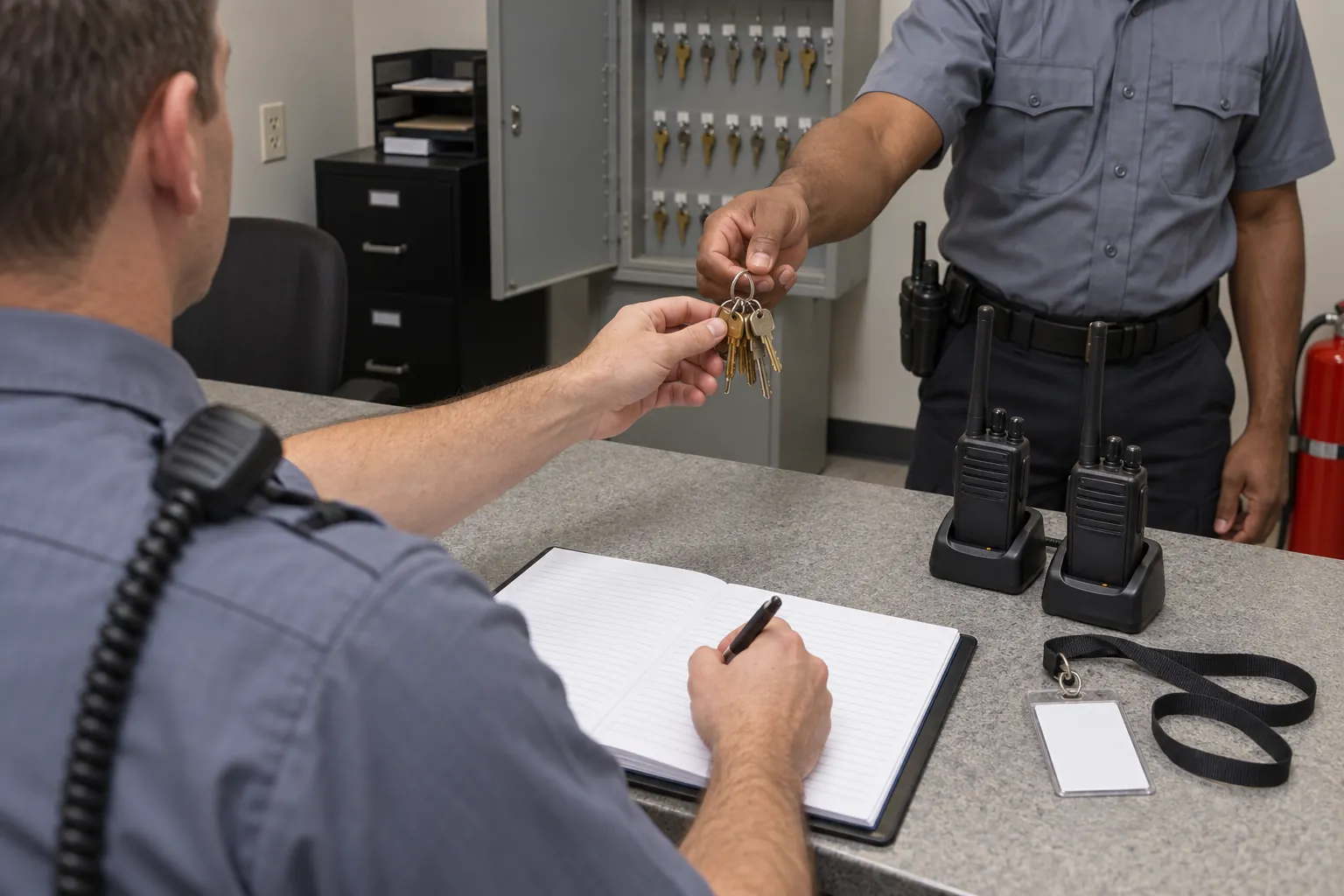
- Keys, radios and equipment: what is out, missing or under repair, and the count at relief. See the guide to key control.
- People and vehicles expected: after-hours contractors, deliveries, a late event, a tenant working through the night.
- Changes to instructions: a temporary order from the client, with who gave it and until when. If it lasts more than a shift or two, update the post orders, not just the log.
- Building conditions: a leak, a light out, an elevator out of service, a slip hazard coned off, and who it was reported to.
- Promises made: a tenant told someone would check a door at 2 a.m. An unwritten promise is broken at the shift change.
Just as important is what stays out. The log is read by every officer on the post, so it is not the place for opinions about colleagues or tenants, rumors, or more personal information than the next officer needs. Describe people by what they did, and their appearance only as far as the next officer must recognize them. The Department of Homeland Security's guidance on what suspicious activity is is plain: "Factors such as race, ethnicity, sex, national origin, religion, or disability are not suspicious." Full details of an incident belong in the incident report.
03
How to run the shift change
The log is only half of a pass-down. The other half is the conversation at relief, and most failures happen there, when a hurried handover becomes "nothing much happened" on the way out the door.
Healthcare has studied hand-offs in depth. In Sentinel Event Alert 58: Inadequate hand-off communication (September 2017), The Joint Commission observes that "a common problem regarding hand-offs, or hand-overs, centers on communication: expectations can be out of balance between the sender of the information and the receiver." Its suggested actions include standardizing the critical content, handing over "both verbally (preferably face to face) and in written form", allowing "ample time and opportunities to ask questions", and avoiding hand-offs made "using solely electronic or paper communications." It was written for patient care, but the lesson carries over: a written log and a conversation together, in a set form, with time for questions.
A shift change that works usually runs like this:
- The incoming officer arrives in time to read the log before taking over, as the post orders set.
- The outgoing officer completes the pass-down before relief, not during it.
- They go through it face to face. The outgoing officer walks through each open item; the incoming officer asks about anything unclear.
- Keys, radios and equipment are counted and the count recorded, with anything missing noted there and then.
- Both officers sign or initial the pass-down, with the time. Responsibility passes when the incoming officer accepts the post, not when the schedule says.
- The post is never left uncovered. If relief does not arrive, the post orders say whom to call and whether to stay; the call goes in the log.
Other trades in the building already work to a formal handover rule. Where engineers have equipment locked out, OSHA's lockout/tagout standard, 29 CFR 1910.147, requires at paragraph (f)(4) procedures during shift changes "to ensure the continuity of lockout or tagout protection". That duty falls on the employer doing the work, not on security, but the principle is the one a post should adopt: protection passes from one person to the next without a gap. If officers are told a mechanical room is locked out and must not be entered, that instruction stays in the pass-down log until the engineer clears it.
04
How to write pass-down entries that stay useful
A pass-down entry is read by someone who was not there, often at the start of a long night, so it should make sense on its own. The conventions that make a DAR hold up apply here too. Under Federal Rule of Evidence 803(6), as amended to December 1, 2024, a business record can be admitted if it "was made at or near the time by–or from information transmitted by–someone with knowledge" and "making the record was a regular practice of that activity", unless the other side shows that the source or the method of preparation indicates "a lack of trustworthiness." Rule 803(7) lets the absence of an entry in a regularly kept record be offered to prove something did not happen. State courts apply their own rules, and this is not legal advice, but a log kept every shift, at the time and in the same way, is a better record for everyone.
- One item per entry, each with the date and time it was raised, so items can be closed one at a time.
- Say where, exactly, using the names in the post orders: "Door 4, north loading dock", not "back door".
- Say what, and what has been done: "Camera 12 (P2 ramp) offline since 01:40. Called alarm company 01:45, ticket number noted, technician due after 07:00."
- Say what the next officer must do: "Walk P2 ramp on every round until camera restored." An entry with no action is information; an entry with an action is a task.
- Say who owns it: security, the building engineer, the property manager, the alarm company, the client.
- Close it in writing. When an item is resolved, the officer who closes it writes when, how and who confirmed it. An item that is never closed is carried forward, not dropped.
- Never erase. On paper, draw a single line through an error, initial it and never tear out a page. On a device, the system should keep the original entry and the change, with who made it and when.
Keep open items at the top and carry them forward in full each shift rather than writing "see previous". An item open for three shifts is no longer a pass-down; it is a problem for the supervisor.
05
Reviewing, keeping and changing the log
The pass-down log needs a reader above the post. The security supervisor should read it at least daily for three things: items open too long, items passed to someone else with no sign they were fixed, and the same problem reappearing. A door alarm shunted every night or a light reported out four times is worth more to the client in an account review than any single entry.
Some entries must go further. If an entry records a workplace violence incident at a California worksite, since July 1, 2024 Labor Code section 6401.9 requires most employers to record "every workplace violence incident" in a violent incident log, omitting personal identifying information such as names and addresses, and to keep it "for a minimum of five years." At a multiemployer worksite, the employer whose employees experienced the incident records it. The pass-down entry may be where the information first appears, but it is not that log. See California workplace violence prevention, and for campuses the Clery daily crime log.
There is no general federal retention period for a pass-down log. Keep it as long as the contract, the company's records policy, the insurer and any state licensing rule require, and long enough to answer a claim; when a lawsuit is expected, the attorney may ask for logs to be preserved. The log holds names, license plates and security weaknesses, so keep it where only authorized people can read it, never open at a lobby desk.
Paper or electronic? A bound book needs no signal or battery, but it stays at the post and the supervisor sees it only on a visit. An electronic log time-stamps each entry, keeps changes, can carry a photo of the problem and can be viewed by the supervisor and the rest of the security team the same morning. It only helps if officers still read it at relief and still talk to each other.
06
Where the pass-down log fails, and where SiteClara fits
The pass-down log carries what the officer remembered to write down. It is weak at two things. It proves little about the routine: "all rounds completed, nothing to pass down" reads the same whether every door was tried or none was. And it is a poor task list: a light reported out on four nights running is four entries, not one job with an owner, so problems are handed around rather than fixed.
SiteClara records the routine part of the shift where it happens and keeps problems on a shared list until they are closed. A printed QR poster, with an optional NFC tag behind it, goes at each checkpoint the post orders name: a stairwell door, a loading dock, a roof access, a parking level. The officer scans the code or taps the tag on their own phone, with no app to install, sees the checks due at that point and marks them done, or says what stopped them. The time and the named officer are recorded as it happens, with a photo when one is asked for. A problem found on the round is reported at that point and goes onto the team's list of open jobs, where the next shift sees it without anyone having to copy it forward, and it stays there until someone closes it.
The security supervisor sees what was due, done and missed, with the reason where one was given, and a job that needs the building manager can be escalated to them to answer. Each day the supervisor reviews the totals and photos, adds a note and approves a report that goes to nominated management or client contacts at 8 a.m. the next morning, showing what was reported, what was completed, what is still open and how the scheduled checks went.
07
Further reading, and a list to take away
Start with the post orders and the licensing board in the state where the post is. The Joint Commission's Sentinel Event Alert 58 is the clearest short account of why hand-offs fail, though it was written for hospitals. The Federal Rules of Evidence explain why a record made at the time as a regular practice carries weight, and California employers should read Labor Code section 6401.9.
Before the next shift change, check that:
- the post orders say where the pass-down is written, when relief happens and what is counted;
- the incoming officer has time to read the log before taking the post;
- every open item says where, what has been done, what the next officer must do and who owns it;
- open items are carried forward in full until someone closes them;
- keys, radios and equipment are counted at relief, and both officers sign with the time;
- the post orders say what happens if relief does not arrive;
- a supervisor reads the log daily and chases items open for more than a shift or two;
- the log is kept securely, and you know how long it is kept.
Sources
Every document this guide quotes or links to, in the order it first cites them.
- Occupational Outlook Handbook entry for security guards bls.gov
- Security guard training requirements bsis.ca.gov
- Security guard training requirements dos.ny.gov
- Guidance on what suspicious activity is dhs.gov
- Sentinel Event Alert 58: Inadequate hand-off communication jointcommission.org
- 29 CFR 1910.147 osha.gov
- Federal Rule of Evidence 803(6) uscourts.gov
- Labor Code section 6401.9 leginfo.legislature.ca.gov
Related guides
 Security patrolsSecurity daily activity report: what to include, and how to write one that holds upThe security daily activity report (DAR): what to record, how to write entries that hold up, how it differs from an incident report, and how to review and keep it.
 Security patrolsSecurity post orders: what they should say, and how to know they are followedSecurity post orders in the US: what they are, what state rules say, what to include, how to write, sign and review them, and how to check they are followed.
 Security patrolsSecurity guard shift checklist: what to check from post-up to pass-downA security guard shift checklist for US sites: what to check at post-up, on each round and at shift change, the state rules behind it, and how to prove it.
 Security patrolsKey control: how to know who holds every key, and prove itA key control program for US buildings: the key register, issuing and returning keys, audits, lost keys and rekeying, and what OSHA, HIPAA and Texas law say.