Security patrols
RA rounds: what resident assistants check, and how to show a round was walked
RA rounds are the scheduled walks a resident assistant (RA) on duty makes through a college residence hall, checking its floors, stairwells, lounges, laundry rooms and exterior doors.
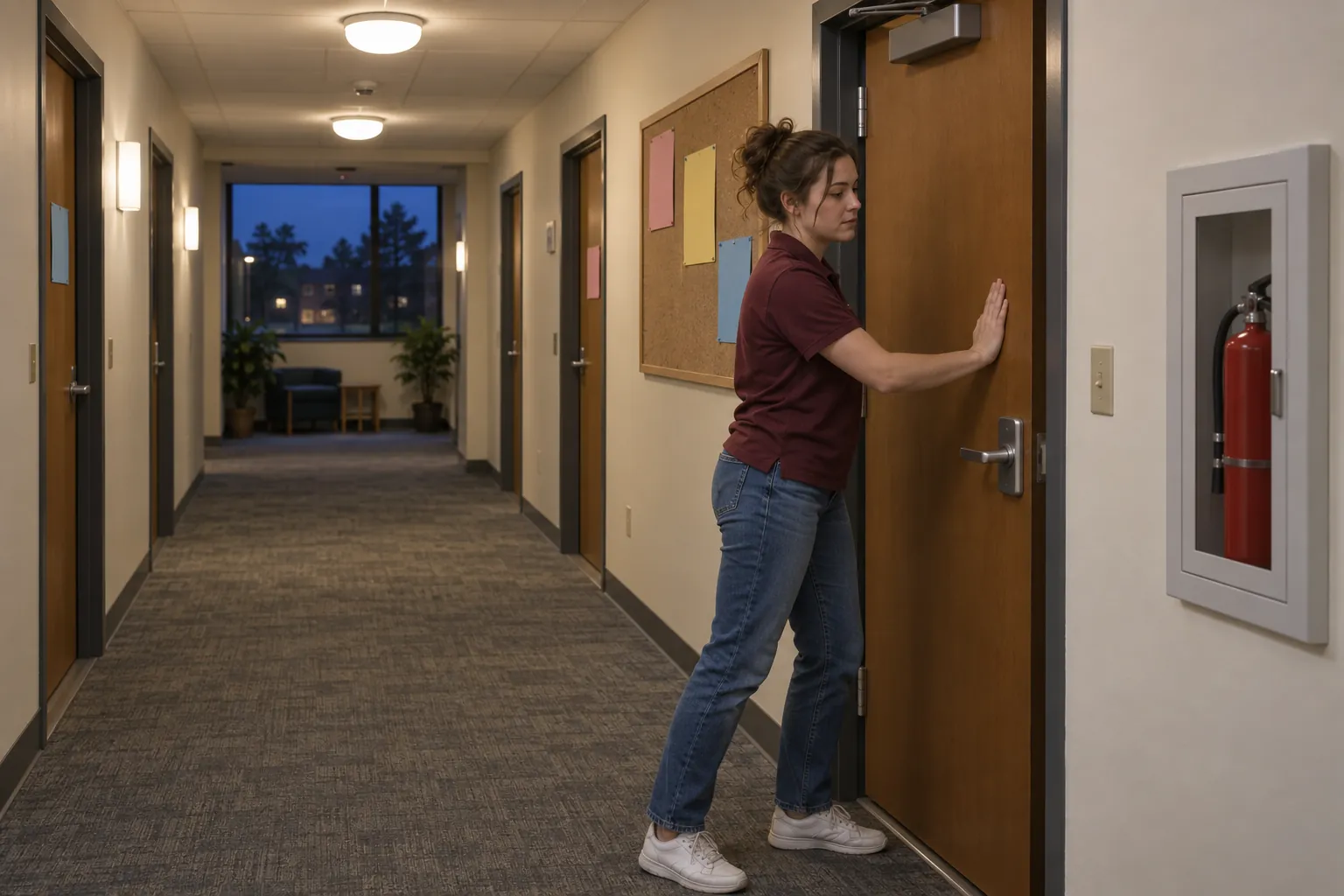
They are where a propped door, a tampered smoke detector, a broken light or a student in trouble gets noticed. No federal rule tells a college how to run them, but the Clery Act's reporting, fire log and missing student duties all depend on what housing staff see and pass on. This guide covers what a round should include, who does what, how to route what you find, and what a round record should show.
01
What RA rounds are, and the rules behind them
A round is a scheduled walk of a building by the resident assistant (RA, or resident advisor at some schools) on duty. The housing or residence life department decides when rounds happen, which areas they cover and what the RA does with what they find, usually in a duty protocol or RA manual. Rounds are a housing practice, not a statutory patrol, and no federal regulation sets how often they happen. They sit alongside the rules a college with on-campus housing does have to follow, and those rules explain why the round matters.
The first is the Jeanne Clery Act, the campus security disclosure provision of the Higher Education Act at 20 U.S.C. 1092(f). Since the Stop Campus Hazing Act of December 23, 2024, the subsection may be cited as the Jeanne Clery Campus Safety Act. The Department of Education's regulation, 34 CFR 668.46, is where the detail lives. Three parts touch rounds directly:
- Campus security authorities. Section 668.46(a) includes among campus security authorities (CSAs) an official with "significant responsibility for student and campus activities, including, but not limited to, student housing, student discipline, and campus judicial proceedings." Housing staff can fall inside that definition, so the institution has to decide whether its RAs are CSAs and tell them how to pass a crime report on.
- Security of residences. Section 668.46(b)(3) requires the annual security report to include "a statement of policies concerning security of and access to campus facilities, including campus residences, and security considerations used in the maintenance of campus facilities." Rounds are one of the ways a housing department carries that policy out.
- Missing students. Under 20 U.S.C. 1092(j) and 34 CFR 668.46(h), an institution with on-campus housing must have a missing student notification policy for students who live there. It must notify the student's designated contact, a custodial parent or guardian if the student is under 18 and not emancipated, and local law enforcement within 24 hours of a determination that the student is missing. An RA's knowledge of their floor is often where that process starts.
The second is fire safety. Under 20 U.S.C. 1092(i) and 34 CFR 668.49, an institution that maintains on-campus student housing publishes an annual fire safety report and keeps a written fire log. The regulation defines a fire as "any instance of open flame or other burning in a place not intended to contain the burning or in an uncontrolled manner," which catches the burned popcorn, the candle and the scorched trash can as well as the fire that brings the fire department. Each fire is logged by the date it was reported, with its nature, date, time and general location, within two business days of the institution receiving the information. The report also covers fire drills, the rules on portable electrical appliances, smoking and open flames in student housing, and evacuation procedures, all things an RA sees on a round.
The third is the local fire code. A residence hall may be under the International Fire Code or NFPA 1, often with the NFPA 101 Life Safety Code, each with local amendments. An NFPA document is a standard until a jurisdiction adopts it, and the authority having jurisdiction (AHJ), usually the fire marshal, decides what applies. RAs do not inspect fire systems, but they walk past them most often.
02
What an RA round covers
Every housing department writes its own route, but most rounds cover the same ground. A typical round includes:
- Exterior doors and access points: each door closes, latches and is locked when it should be, nothing is propped or taped, card readers work, and no one is waiting to follow residents in.
- Stairwells: fire doors closed and not wedged open, lighting working, nothing stored on landings, no signs of anyone sleeping or gathering there.
- Hallways on every floor: exits clear, exit signs lit, nothing blocking corridors, no furniture moved out of rooms, bulletin boards intact.
- Fire and life safety equipment: extinguisher cabinets not empty or broken into, pull stations not covered or damaged, smoke detectors in common areas not bagged or covered, sprinkler heads not hung with decorations or lights.
- Lounges, study rooms and kitchens: no unattended cooking, appliances switched off, no open flames, furniture in place, nothing damaged overnight.
- Laundry rooms and trash rooms: dryer lint and trash not piled up, doors closing, no water on the floor, nothing smoldering.
- Community restrooms: no flooding, broken fixtures or lights out.
- Noise, gatherings and behavior: quiet hours, guests, visible alcohol or drugs where the policy prohibits them, anything that looks like hazing, and anyone who seems unwell or in distress.
Two kinds of finding come out of that list: facility problems for maintenance or custodial staff, such as a door that will not latch or a leak, and findings about people, such as a crime, a fire or a student in crisis. Each needs its own clear path.
Health and safety inspections of individual rooms are a different exercise with their own procedure. A round stays in common areas unless the housing department's policy says otherwise.
03
Frequency, and who does what
The housing department sets the schedule in its duty protocol: how many rounds a night, roughly when, which buildings and floors each duty RA covers, and whether weekends and break periods differ. Set it to the building and the calendar: a first-year hall on a Friday night in September needs more than a graduate apartment building in July. Set a window and a route, and let the RA vary the order, so rounds are not predictable.
Who does what, in a typical residence life structure:
- The duty RA walks the rounds, deals with what can be dealt with at once, calls for help with what cannot, and records what they did and found.
- The hall director, area coordinator or professional staff on call takes escalations, decides on anything involving student conduct or welfare, and reviews the duty log.
- Campus police or campus security respond to crimes, emergencies and anything the RA should not handle alone, and keep the daily crime log. Where security officers also tour the halls, coordinate their tours with RA rounds.
- Facilities, maintenance and custodial staff fix what the round reports, through the work order system.
- The fire marshal or environmental health and safety office owns fire drills, the fire log and fire system inspection, testing and maintenance.
RAs are students first. The protocol should say plainly what an RA does not do alone: confront someone who is violent, enter a room without cause, search belongings, or handle a medical emergency beyond calling for help. Training should walk the route on foot, not only in a slide deck.
04
What to do with what you find
The value of a round is in what happens next. Write the routing into the duty protocol so every RA does the same thing:
- An emergency: a fire, a medical emergency, violence or a threat. Call 911 or campus police as the protocol says, then the on-call staff member. Pull the fire alarm for a fire and follow the building's evacuation procedure.
- A crime, or something that may be one: theft, vandalism, forced entry, a weapon, an assault reported to you. Report it to campus police or security as your institution's CSA procedure says, promptly and with the time and exact location. That report is what the police or security department draw on when they decide on a daily crime log entry or a timely warning.
- A fire of any size, including one already out: report it so it reaches the fire log. A burned pan in a floor kitchen that set off nothing is still a fire under 34 CFR 668.49 if something burned where it should not have.
- A student who cannot be found, or a report that someone has not been seen: tell the on-call staff member or campus police at once, as the missing student policy says. The 24-hour clock in that policy runs from a determination that the student is missing, and the sooner the report, the sooner that determination can be made.
- A student in distress: follow the institution's wellness protocol and call the on-call professional staff member. In an emergency call 911. The 988 Suicide & Crisis Lifeline can be reached by call, text or chat, and your counseling center will have its own after-hours line.
- A policy violation: document it on the conduct or incident report form the department uses, with facts rather than conclusions.
- A facility problem: a work order, with the location, what is wrong and a photo where it helps. Anything that affects security or life safety, such as a door that will not latch, a fire door that will not close or an exit sign out, should be flagged as urgent and told to the on-call staff member, not left in the ordinary queue overnight.
05
What a good round record shows
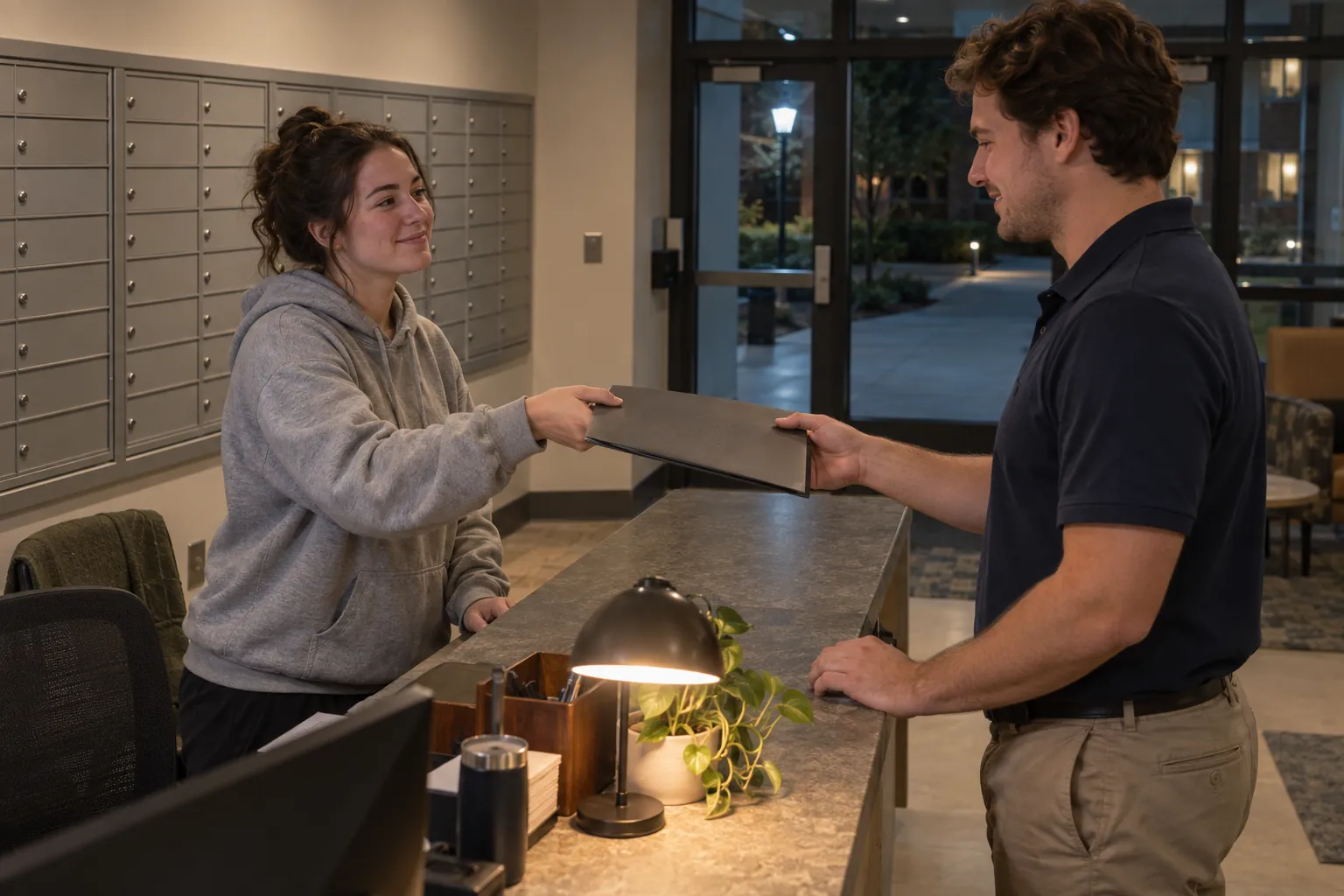
Most housing departments keep a duty log, on paper or in a form, where the duty RA records their rounds and what they found. A good record is one the hall director can rely on the next morning, and one that holds up when someone asks, weeks later, whether that side door was checked that night. For each round it should show:
- who walked it, by name;
- when it started and ended, and the time of each finding;
- which areas were covered, and any that were skipped and why;
- each finding, with its exact location: the floor, the stairwell, the door;
- what was done about it, and who it was passed to: a work order raised, campus police called, on-call staff told;
- anything still open at the end of the shift, for the next duty RA or the day staff.
Write findings as facts. "East stairwell door, second floor, wedged open with a shoe at 11:40 p.m.; removed, door closed and latched" is useful. "Doors OK" says nothing about which doors, and "floor was loud" says nothing anyone can act on. Records naming students are part of the institution's student records, so keep them where its records policy says and share them only with those who need them.
The duty log also needs a handover. When duty passes from one RA to another, or to day staff, what is still open should pass with it: the lounge door waiting for a locksmith, the student the on-call staff member asked to be checked on. The same discipline applies in security operations as a pass-down log.
Review closes the loop. The hall director reads the log, follows up what is open and looks for patterns: the same door propped four nights running is a hardware problem, a behavior problem or both.
06
Where the record fails, and where SiteClara fits
Rounds tend to fail quietly. A clipboard at the front desk is initialed for 10 p.m., midnight and 2 a.m. in one sitting. A duty log entry reads "rounds completed, all quiet" with no times and no floors. A propped side door is mentioned to the next RA in passing and never reaches facilities. A burned pan in a floor kitchen is cleaned up and nobody tells the fire safety office. When the hall director, or later the Clery compliance officer, asks what was checked and when, the answer is a memory.
SiteClara works on that routine layer. A printed QR poster goes at each point on the route, such as an exterior door, a stairwell landing, a floor lounge or a laundry room, with an optional NFC tag behind it. The duty RA scans the code or taps the tag on their own phone, with no app to install, and signs in with a link. They see the checks due at that location and mark each one done, or say what stopped them. The time and the named person are recorded as it happens, with a photo when the check asks for one. A problem, such as a door that will not latch or a light out, is reported there with a photo and goes onto the team's list of jobs until someone closes it.
The supervisor, here the hall director or area coordinator, sees what was due, done and missed on each round, and can record why a check was missed. Each day they review the checks and photos, add a note and approve a report that goes to nominated contacts at 8 a.m. the next morning, showing what was reported, what was completed, what is still open and how the scheduled checks went. That gives housing a timed, located record of rounds and building problems to review, and to draw on when campus police or the fire safety office build their own records.
07
Questions people ask
What are RA rounds?
They are the walks the duty RA makes through the building during their on-call shift, and each university sets how many. Texas State University's Resident Assistants page says its on-call RAs walk their assigned building twice a night on what it calls rounds, that duty runs from 5:00 p.m. until 8:00 a.m. the next morning on weekdays and 24 hours on weekends, and that an RA is typically on duty once every 4 to 8 days.
What is an RA in a dorm?
An RA, or resident assistant, is a student the college employs to live in a residence hall and look after its residents. UNC Wilmington's Resident Assistant page lists the position's major areas of responsibility as community building, programming, peer helping, policy enforcement and administration, and expects RAs to share responsibility for duty nights and hall security and to report hall emergencies whether or not they are on duty.
Do RAs at college get paid?
Usually yes, though the form differs from one college to the next and is often housing rather than wages alone. UNC Wilmington's Resident Assistant page describes a monthly stipend plus a scholarship to cover room and meal plan costs, and Salisbury University's Resident Assistant Job Description says an RA's pay for the academic year is roughly equivalent to room and board in the hall they are assigned to.
Can you be an RA as a sophomore?
At many universities, yes, and each sets its own requirements. Texas State University's Resident Assistants page asks for sophomore standing or above by the time of appointment, at least one long semester living on campus, 15 college credits and a GPA of 2.5 or higher, while UNC Wilmington's Resident Assistant page recruits current first-year students with a term and cumulative GPA of 2.50 to serve the following academic year.
08
Further reading, and a list to take away
The statute is 20 U.S.C. 1092, with the Clery Act at subsection (f), fire safety at (i) and missing persons at (j). The regulations are 34 CFR 668.46 for campus security and 34 CFR 668.49 for fire safety. The Department of Education's summary for institutions is in the Federal Student Aid Handbook, Volume 2, Chapter 6. For the fire code that applies to a particular hall, ask the local fire marshal, and see the NFPA 101 Life Safety Code where it is adopted. For how the police or security department turns reports into entries, see the Clery daily crime log guide.
Before the next term, check that:
- the duty protocol names the route for each hall, the round windows and which doors and areas are on every round;
- RAs know whether they are campus security authorities and exactly how to pass on a crime report;
- every fire, however small, reaches the fire safety office for the fire log;
- RAs know the missing student policy and who to tell at once;
- security and life safety faults are raised as urgent work orders and told to on-call staff;
- the duty log records who, when, where, what was found and who it was passed to, not "all quiet";
- open items are handed over at each change of duty;
- the hall director reviews the log and follows up repeat findings;
- RAs have walked the route in training and know what they do not handle alone.
Sources
Every document this guide quotes or links to, in the order it first cites them.
- 20 U.S.C. 1092(f) govinfo.gov
- 34 CFR 668.46 govinfo.gov
- 34 CFR 668.49 govinfo.gov
- NFPA 101 Life Safety Code nfpa.org
- 988 Suicide & Crisis Lifeline 988lifeline.org
- Texas State University's Resident Assistants page reslife.txst.edu
- UNC Wilmington's Resident Assistant page uncw.edu
- Salisbury University's Resident Assistant Job Description salisbury.edu
- The Federal Student Aid Handbook, Volume 2, Chapter 6 fsapartners.ed.gov
Related guides
 Security patrolsThe Clery daily crime log: what goes in it, when, and how to keep it rightThe Clery Act daily crime log under 34 CFR 668.46(f): who keeps one, what each entry needs, the two-business-day rule, what may be withheld and public inspection.
 Security patrolsSecurity pass-down log: what to hand over, and how to make the shift change stickThe security pass-down log: what the outgoing officer hands over, how to run the shift change, how to write entries that stay useful, and how to review and keep it.
 Security patrolsSecurity daily activity report: what to include, and how to write one that holds upThe security daily activity report (DAR): what to record, how to write entries that hold up, how it differs from an incident report, and how to review and keep it.
 CleaningResidence hall cleaning: dorms, community bathrooms and the summer turnoverCleaning college residence halls and dorms: community bathrooms, lounges, kitchens, room inspections, outbreaks and the summer turnover, with the rules that apply.