Security patrols
Gated community security: running the gatehouse and patrols, and proving it
Gated community security is the protection of a private residential community through controlled access at its gates, surveillance and a patrol of its streets, perimeter and amenities, delivered by gate officers, access control systems or both.
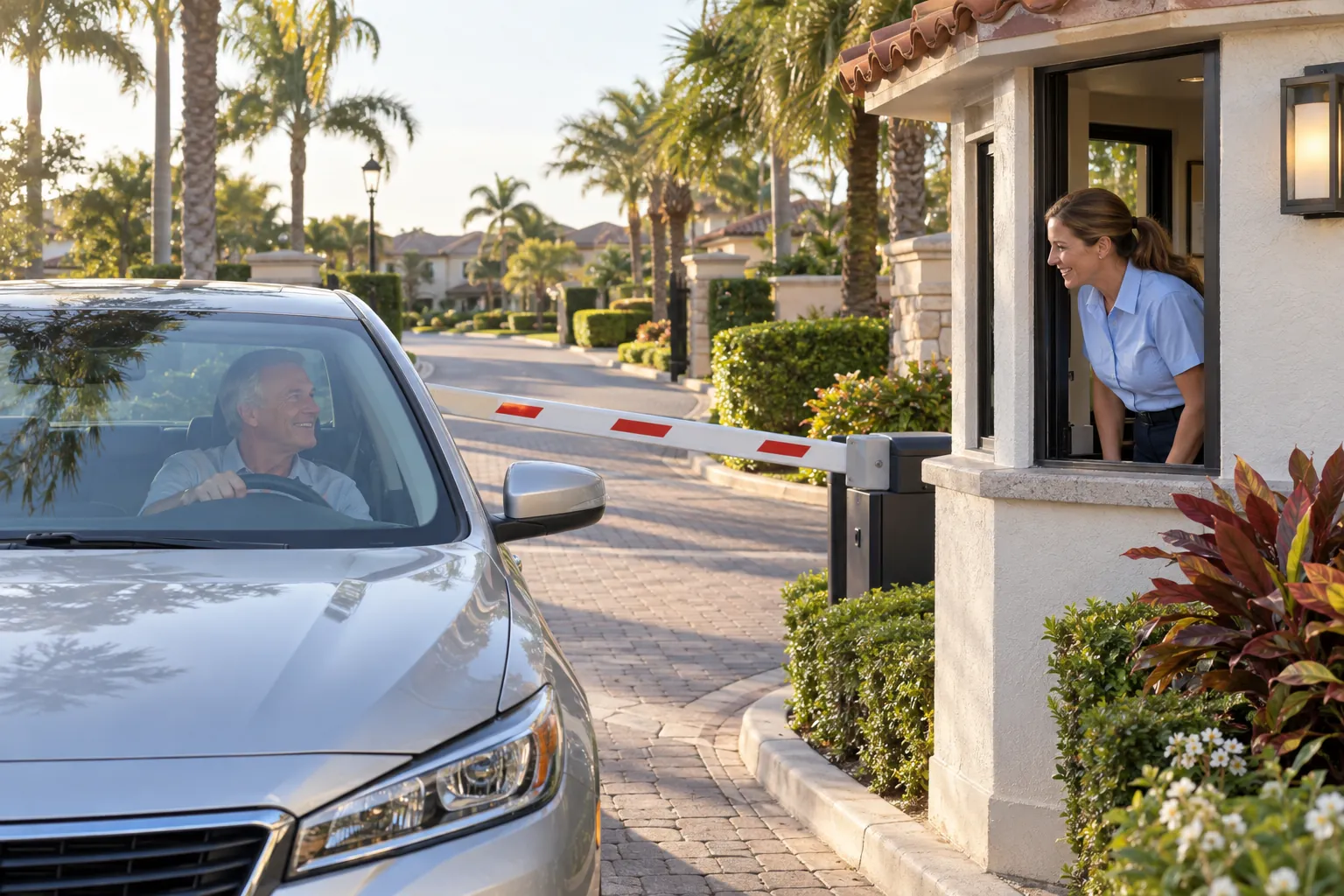
A gate and a guardhouse promise residents that someone is watching who comes in and that the community is being walked. Whether that promise holds depends on the people staffing it, the post orders they work to and the record they leave. This guide covers who may do the work under state licensing law, what gated community security covers in practice, how the gatehouse and the roving patrol should run, and what an HOA board or community manager should expect to see.
01
What gated community security is, and whose rules apply
Gated community security is the staffed protection of a private residential community behind a controlled entrance: a gatehouse officer who checks visitors, vendors and deliveries against what residents have authorized, and usually a roving patrol that drives or walks the streets, the perimeter and the amenities. Some gated communities have no officer at all and rely on access control systems alone: a keypad, card reader or call box at the gate, with cameras for surveillance of the vehicles coming and going. Most gated communities are run by a homeowners association (HOA) or condominium association, which sets the level of service through its board and budget, and many hire a licensed security contractor to deliver it. Others employ their own gate attendants directly.
No single federal law governs the service. The rules that bite are state private security licensing statutes, and they differ from state to state in who needs a license, how much training comes first and whether in-house staff are covered. Three examples show the range:
- Florida. Under Chapter 493, Florida Statutes, a "security officer" is anyone who, for consideration, "guards persons or property" (s. 493.6101(19)). Section 493.6301 says that "any individual who performs the services of a security officer shall have a Class 'D' license", and a security agency needs a Class B license. Section 493.6303 requires a Class D applicant to complete at least 40 hours of professional training at a licensed school. An armed officer also needs a Class G license (s. 493.6115). Section 493.6102(4) exempts an unarmed person "employed exclusively to work on the premises of her or his employer", which is how some associations employ their own gate attendants.
- California. The Private Security Services Act (Business and Professions Code, section 7580 onward) licenses private patrol operators and registers the security guards they employ, overseen by the Bureau of Security and Investigative Services (BSIS). Under section 7583.6, an applicant completes a course on the power to arrest and the appropriate use of force before registration, then 32 hours of training in security officer skills within six months (16 of them within 30 days), and eight hours of review or practice every year. An association that employs its own uniformed, unarmed officers who deal with the public is not outside the system either: they are proprietary private security officers, defined in section 7574.01 and required to register under section 7574.10.
- Texas. The Texas Department of Public Safety Private Security Program regulates the private security profession in the state, including licensing and background checks.
Check the state before you hire or staff a gate. Ask the contractor for its company license and for each officer's individual license or registration, and check them against the state regulator's online lookup. If the association employs gate staff itself, take advice on whether its state treats them as exempt proprietary employees or requires them to register. Nothing in a licensing statute turns a private officer into a police officer, and Florida's statute makes impersonating a law enforcement officer, including by wearing a uniform or showing a badge or credentials that would cause a reasonable person to believe the wearer is one, a ground for disciplinary action (s. 493.6118(1)(i)).
02
What gated community security covers in practice
The contract and the post orders define the service. Across most communities, the work falls into the same few duties:
- Access control at the gate: admitting residents, checking visitors against the resident's guest list or a call to the resident, admitting vendors, contractors and delivery drivers under the association's rules, and refusing or turning back anyone not authorized.
- Roving patrol: driving or walking the streets, the perimeter wall or fence, the secondary and exit-only gates, and the common areas at set times, and noting what was found.
- Amenity checks: the clubhouse, pool, fitness center, tennis and pickleball courts, playgrounds and mail kiosks, opened and closed on time, with doors locked, gates latched and lights working.
- Gate equipment: gate arms, swing and slide gates, card readers, call boxes and cameras working, with faults reported to the community manager the same shift.
- Lighting and hazards: streetlights and amenity lights out, a damaged fence panel, a fallen limb across a sidewalk, standing water, an open irrigation box.
- Parking and rules: vehicles parked against the association's rules, noted and reported under the enforcement policy the board has adopted.
- Incidents and emergencies: calling 911 when needed, meeting and directing responders, writing a security incident report, and notifying the manager.
- Handover: a daily activity report for each shift and a clear pass-down to the next officer.
What the service does not cover matters just as much. A gated community's officers do not have police powers, cannot write traffic tickets on private streets of their own accord, and should not be asked to chase, search or physically remove people. Where speeding on private roads is the board's real concern, some states let the association bring in the police instead: in Florida, section 316.006, Florida Statutes, lets a municipality or county exercise traffic control jurisdiction over private roads by written agreement with the party that owns or controls them. Write the limits into the post orders, so officers and residents both know them.
03
Running the gatehouse: visitors, vendors and emergency access
The gatehouse is where most complaints start, from residents whose guests were kept waiting and from residents who are sure someone was waved through. A gate runs well when the rules are written down and applied the same way on every shift.
- A visitor rule the officer can apply. Who may authorize a guest (owners, tenants, a named household member), how (a guest list, a call to the resident, a standing list for regular visitors), and what happens when the resident cannot be reached. "Use your judgment" is not a rule.
- A vendor and contractor rule. Which trades are admitted on the association's authority, which need a resident's approval, the hours work is allowed, and whether a contractor needs proof of insurance on file with the manager.
- Deliveries and rideshare. Whether drivers are admitted, logged or sent to a package room, and what the officer does at 2 a.m. when a driver has no address.
- What is recorded for each entry, and no more than the association needs. A name, the address visited, the time and a vehicle description may be enough. Decide how long the gate log is kept, who may see it and how a resident's request to see it is handled, and take advice on any state privacy rules before adding cameras that read license plates.
- Emergency access. Fire, EMS and police must be able to get through without waiting for a guard. Security gates across a road responders use are normally subject to the locally adopted fire code and the approval of the fire code official, so confirm with your local fire marshal how responders open the gate when it is unattended or the power is out, and check that method on a schedule.
- What the officer does when refused. A visitor who will not wait or turns aggressive is refused politely, the resident and supervisor are informed, and the officer calls 911 if there is a threat. The officer does not block a vehicle with their body or give chase. The association's trespass notice process deals with repeat problems.
Keep the gatehouse copy of the post orders current and signed as read by each officer, and include the call list: the community manager, the security supervisor, the board's contact, the gate maintenance vendor and the after-hours numbers for water and power.
04
Roving patrols and scheduled checks
Residents rarely see the patrol, so it is the part of the service most often doubted. A patrol that residents and the board can trust has a defined route, set times and a record of what was found at each point.
Set the patrol by risk and by the community's layout, not by habit. A typical night shift might include:
- a full drive of every street within the first hour, and again after midnight;
- the perimeter wall or fence walked or driven, with the secondary gates, pedestrian gates and any gaps checked;
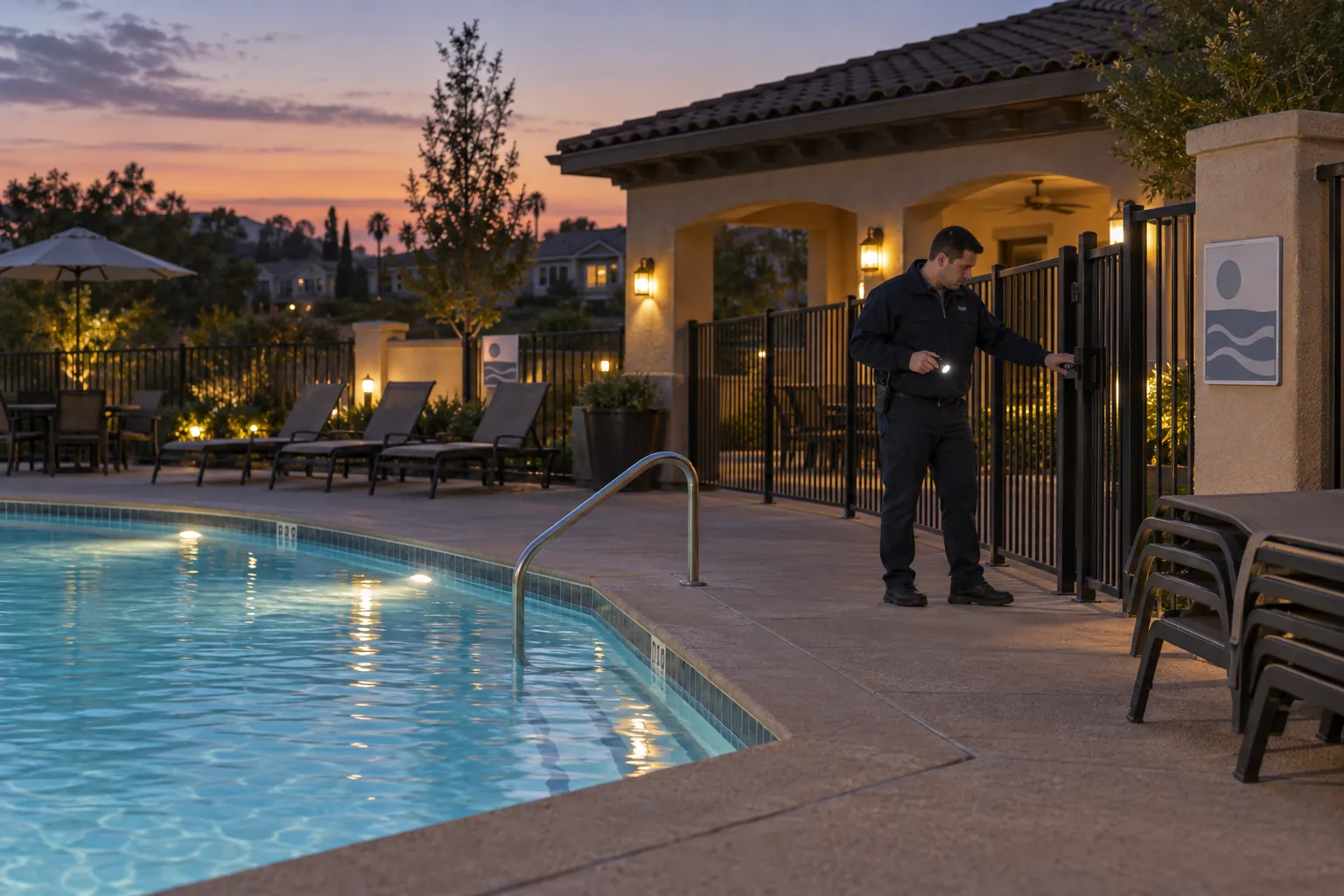
- amenities checked at closing time: the pool gate latched, the clubhouse locked and alarmed, fitness center doors secured and lights off where they should be;
- the mail kiosks and the package room checked;
- construction sites and vacant homes looked at from the street;
- exit-only gates watched for tailgating at the busiest times of the evening.
Vary the times within each window, so a patrol is not predictable, but keep the route complete. What matters is that each point is visited in its window and the result is written down at the point, not reconstructed at the end of the shift.
Good evidence of a patrol is plain: the checkpoint, the time, the officer's name, what they found, and a photo when something is wrong. A broken pool gate latch is a safety issue as well as a security one, and should reach the manager with a photo and the time. Our perimeter security checklist covers the physical points in more detail, and the key control guide covers the gatehouse key cabinet, the clubhouse keys and the master keys contractors ask for.
05
Who does what: the board, the manager and the contractor
Gated community security goes wrong most often in the gap between the people who decide and the people who deliver. Put each role in writing:
- The HOA board decides the level of service and the budget, adopts the access and parking rules, approves the post orders and receives the monthly report. It should not direct officers shift by shift.
- The community association manager (CAM) manages the contract, keeps the resident and vendor lists current, receives incident reports and maintenance issues from the gate, and chases the repairs.
- The security contractor employs, licenses, trains and supervises the officers, writes and keeps the post orders with the manager, fills every shift, and reports.
- The site supervisor or account manager checks the officers in person, reviews the daily activity reports and the patrol record, deals with complaints and makes sure open issues are passed on.
- The officer works to the post orders, records what was done and found when it happens, and hands over clearly.
Agree what the contractor reports each month: shifts covered against those contracted, patrols completed against those scheduled, incidents by type, gate and lighting faults found and how long they took to fix, complaints and their outcome. The figures that matter most to residents, such as whether the pool gate was checked each night and whether the broken streetlight was reported and fixed, come from the daily record, so the monthly report is only as good as that record.
06
Where the patrol record fails, and where SiteClara fits
The gatehouse has a binder of daily activity reports, each shift's patrols written up in the same neat hand an hour before the officer went home. The board asks whether the pool gate was checked the night a child got in, and the report says "all amenities secure" with no time against it. The broken light on the back street was mentioned to the day officer, who told the manager at the gate, who meant to call the electrician. When the contract comes up for renewal, nobody can show what the patrol actually did.
SiteClara records the patrol at the places it is done. A printed QR poster, with an optional NFC tag behind it, goes at each checkpoint: the pool gate, the clubhouse door, the back gate, the mail kiosk, a point on the perimeter. The officer scans the code or taps the tag on their own phone, with no app to install, sees the checks due at that point and marks each one done, or says what stopped them, such as a latch that would not catch. The time and the named person are recorded as it happens, with a photo when one is asked for. A problem found on the patrol is reported there and stays on the team's list of jobs until someone closes it, and one that needs the community manager can be escalated to them.
The contractor's supervisor sees what was due, done and missed, with the reason given, and each day can review the totals and photos, add a note and approve a report that goes to nominated contacts, such as the community manager or the board's security contact, at 8 a.m. the next morning, showing, for example, that 14 of 14 night checks were done and what is still open.
07
Questions people ask
Do gated communities have security guards?
Many do, at a staffed gatehouse, on a roving patrol or both, while others rely on a keypad or card-reader gate with no officer. Where someone is paid to guard the community, state licensing law usually applies: in Florida, section 493.6301, Florida Statutes, says that any individual who performs the services of a security officer shall have a Class D license, and a Class G license as well to carry a firearm.
What do you call a gate guard?
The law usually calls a gate guard a security officer or security guard. Section 493.6101, Florida Statutes, defines a security officer as any individual who, for consideration, guards persons or property, and California's BSIS security guard registration page uses the title security guard for someone employed by a licensed private patrol operator or private security employer to protect persons or property.
How do you become a gate guard?
You get the license or registration your state requires, usually after training and a background check. In California, the BSIS security guard registration page says an applicant must be at least 18, undergo a criminal history background check through the California Department of Justice and the FBI, and complete the Power to Arrest training before registration, then 32 hours of security officer skills training within six months and eight hours every year. In Florida, section 493.6303, Florida Statutes, requires at least 40 hours of professional training at a licensed school for a Class D license.
08
Further reading, and a list to take away
Read your own state's private security statute and regulator first. For the states above, that is Chapter 493, Florida Statutes, administered by the Florida Department of Agriculture and Consumer Services; the BSIS security guard registration page for California; and the Texas Department of Public Safety Private Security Program. OSHA's workplace violence page covers the risks to officers working alone at night. Your association's governing documents (the declaration or CC&Rs, bylaws and rules) set what the board may require of residents and visitors, and your local fire marshal decides how responders get through the gate.
Before you renew a gated community security contract, or take one on, check that:
- the contractor holds the company license your state requires, and every officer holds a current individual license or registration;
- in-house gate staff have been checked against your state's rules for proprietary officers;
- the post orders are current, signed as read, reviewed each year, and state what officers may not do;
- the visitor, vendor and delivery rules are written down and applied the same way on every shift;
- the gate log records only what the association needs, with a set retention period;
- emergency access through every gate has been agreed with the fire marshal and is tested on a schedule;
- the patrol has defined checkpoints and windows, and is recorded at each point as it happens;
- faults found on patrol reach the community manager the same shift, with a photo, and are tracked until fixed;
- the officer has a check-in routine and a way to summon help;
- the monthly report shows patrols completed against scheduled, not only incidents.
Sources
Every document this guide quotes or links to, in the order it first cites them.
- Chapter 493, Florida Statutes leg.state.fl.us
- Section 493.6301 leg.state.fl.us
- Section 493.6303 leg.state.fl.us
- Private Security Services Act leginfo.legislature.ca.gov
- Section 7583.6 leginfo.legislature.ca.gov
- Section 7574.01 leginfo.legislature.ca.gov
- Texas Department of Public Safety Private Security Program dps.texas.gov
- Section 316.006, Florida Statutes leg.state.fl.us
- Workplace violence osha.gov
- Section 493.6101, Florida Statutes leg.state.fl.us
- BSIS security guard registration page bsis.ca.gov
Related guides
 Security patrolsSecurity post orders: what they should say, and how to know they are followedSecurity post orders in the US: what they are, what state rules say, what to include, how to write, sign and review them, and how to check they are followed.
 Security patrolsPerimeter security checklist: how to inspect a fence line, its gates and the ground around itA perimeter security checklist for US sites: what a fence inspection covers, gates and barriers, how often to walk the line, and the record that shows it was done.
 Security patrolsTrespass notice: giving one properly, and keeping a record that holds upWhat a trespass notice is under US state law, who can give one, what a written notice should say, and how security officers record it so it holds up later.
 Security patrolsKey control: how to know who holds every key, and prove itA key control program for US buildings: the key register, issuing and returning keys, audits, lost keys and rekeying, and what OSHA, HIPAA and Texas law say.