Security patrols
Perimeter security checklist: how to inspect a fence line, its gates and the ground around it
A fence inspection is a walk along a site's fence line and gates to find damage, gaps and anything that makes the barrier easier to get over, under or through, and to record the condition of each stretch.
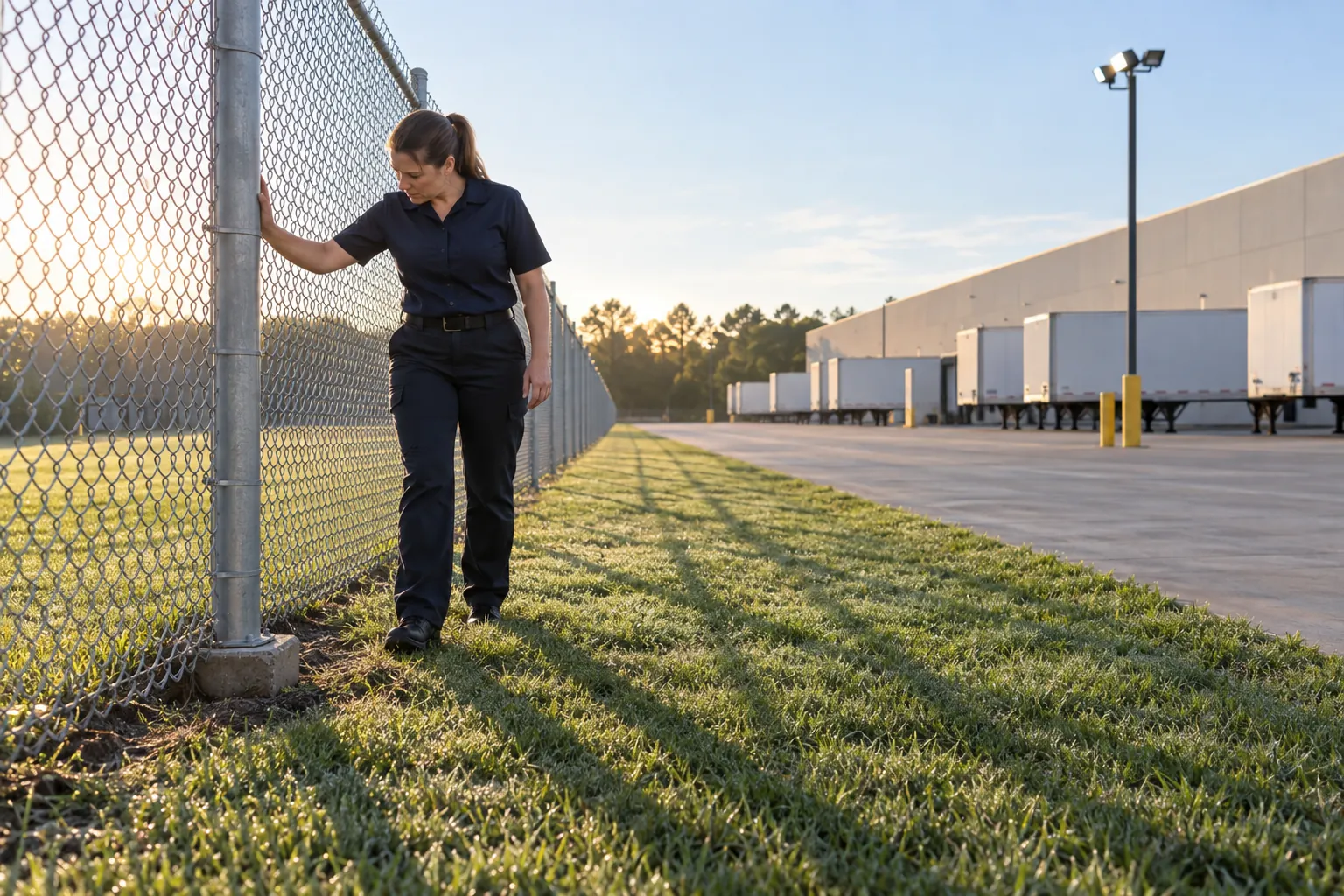
The perimeter is the first layer of a site's security and usually the least watched. A fence with a cut link behind the dumpster enclosure, a gate that no longer latches or a light that went out in the spring can stay that way for months if nobody walks the line. This guide sets out what a fence and perimeter inspection should cover on an American commercial site, school or campus, how often to do it, who owns it, and what a record of it should show.
01
What a perimeter check is for, and which guidance applies
A perimeter check confirms that the outer edge of a property still does its job: it marks where the site begins, it slows down anyone who should not be there, and it steers people and vehicles to the entrances where they can be seen. A fence inspection is the physical part of that check, walking the fence line and its gates and looking for damage, gaps and anything that makes the barrier easier to get over, under or through.
The Cybersecurity and Infrastructure Security Agency (CISA) describes this as the outermost of three layers. Its Security Planning Workbook (September 2023) calls security-in-depth "an industry-accepted concept in asset protection" that "helps to slow or dissuade potential criminals from gaining unauthorized access to your facility," and says the outer perimeter "could include the parking facility and lots, exterior common grounds, walkways, playgrounds, and a fence line or gate at the outer edge of your property." Among the physical security mitigations it lists are "installing bollards, barriers, fencing, or landscaping."
CISA's K-12 School Security Guide, 3rd edition, puts the same idea in terms any site can use. At the grounds perimeter, it says, "the main physical security objective is to detect threats, and delay them to the best extent possible." It suggests having "security personnel or school staff patrol the length of a fence or other perimeter barrier to detect threats away from clearly designated points of entry," and its summary table lists "general maintenance or groundskeeping" and "condition assessment" as dependencies of a perimeter barrier that is difficult to climb. A fence only delays anyone if it is intact, and only someone walking it will know.
No federal regulation requires an ordinary office, school or warehouse to inspect its fence on a set schedule. The obligation usually comes from somewhere else: the security services contract and its post orders, the lease or the property management agreement, an insurer's survey, the site's own security plan, or the rules of a regulated sector, which come first where they apply. One federal rule does touch the perimeter directly. Under the OSHA exit route standard, 29 CFR 1910.36(c)(1), "each exit discharge must lead directly outside or to a street, walkway, refuge area, public way, or open space with access to the outside." A fence or gate that turns the outside of an exit door into a locked yard deserves a hard look. OSHA covers private employers directly or through an approved state plan, so check which applies in your state; gates on fire department access are for the local fire code official.
A separate kind of fence inspection comes from the local building or zoning office. Most cities and counties limit a fence's height and placement in their zoning code, and a new or replacement fence may need a permit, depending on its height, materials and location, with an inspection once it is installed. A repair that changes the height, the material or the line of the fence should be checked with that office first.
02
What a perimeter security checklist should cover
Most perimeters are a mix of chain link, ornamental steel, wood, block walls, hedges and building walls, with pedestrian gates, vehicle gates and a parking lot or two. Whatever the materials, a good perimeter security checklist covers the same families of items.
- Fence fabric and panels: cut or unraveled chain link, bent or missing pickets on ornamental fencing, rotted or split boards on wood fences, panels pushed out of line, holes, and old repairs made with wire or zip ties that could be undone by hand.
- Posts, rails and fittings: leaning or loose posts, broken top rail, missing tension bands and ties, slack fabric, and rust at the base of posts where they meet the concrete.
- The bottom of the fence: gaps between the fence and the ground, washouts after heavy rain, dug-out spots, and drainage channels or culverts that pass under the fence line and could let a person through.
- The top of the fence: where the site uses barbed wire, razor wire or a top guard, whether it is intact and whether anything has been thrown over it, such as a carpet or a blanket.
- Climbing aids: pallets, dumpsters, carts, stacked materials, vehicles parked against the fence, and tree branches or structures that let someone step over it.
- The clear zone and vegetation: growth on or along the fence that hides a gap, blocks a camera's view or gives cover, and new worn paths in the grass that show where people are coming and going.
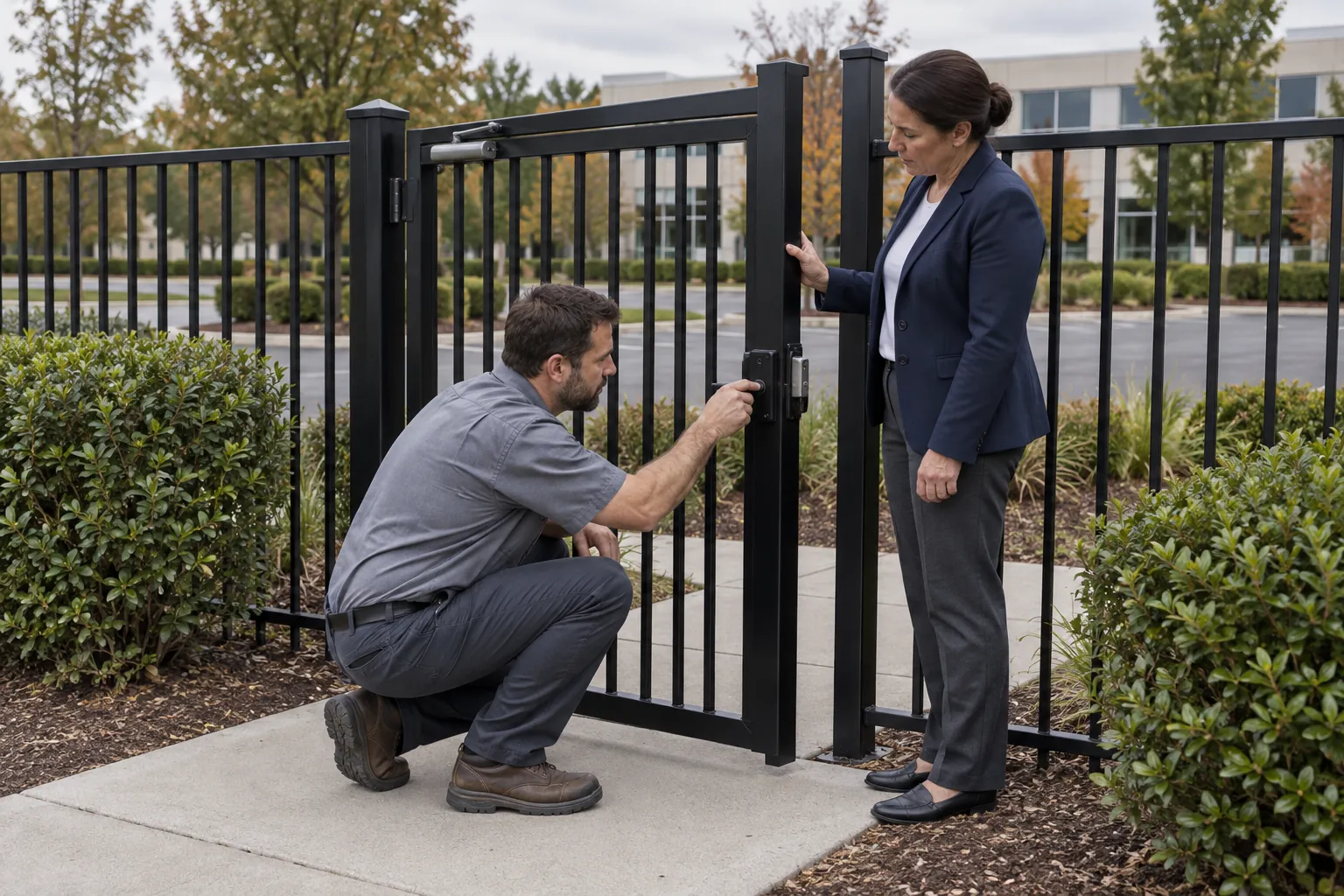
- Gates: hinges, latches, locks and chains, self-closing and self-latching hardware, gate operators, keypads and card readers, and whether each gate is in the state the post orders say it should be at that hour.
- Vehicle barriers: bollards, planters, arm barriers, wedge or rising barriers, and whether active barriers still operate.
- Lighting: fixtures along the fence line and at every gate, with any lamp out, any fixture damaged and any new dark spot noted. A full lighting survey is a separate job, usually done after dark.
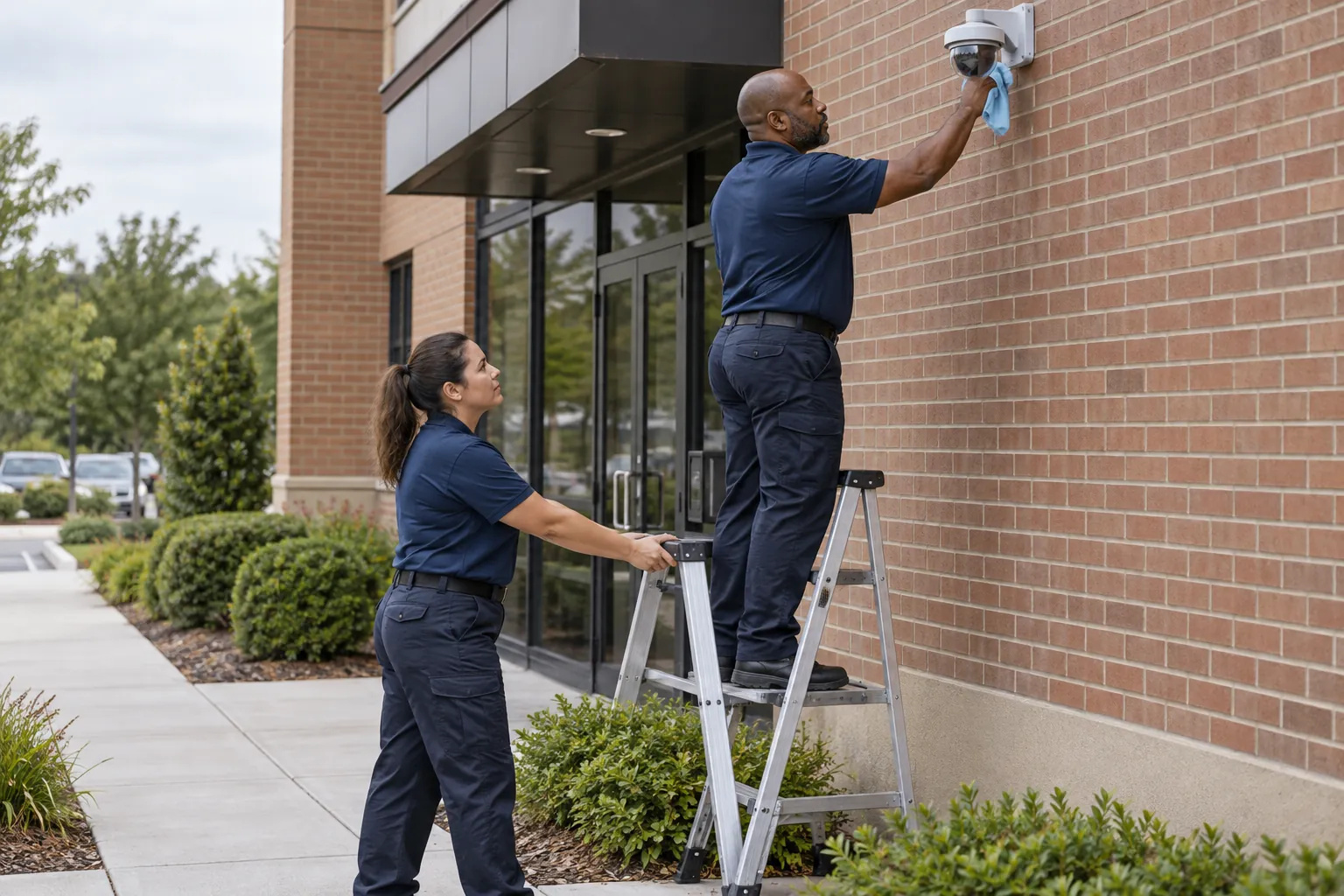
- Cameras and detection: cameras covering the fence and gates, whether they are still aimed where they should be and not blocked by growth, and any intrusion detection on the fence. See security camera checks for the system side.
- Signage: no trespassing, private property, and directional signs to the real entrances, present and readable.
- Signs of intrusion or tampering: cut padlocks, pried hinges, footprints, discarded tools, graffiti, litter and evidence of someone sleeping or gathering on the site.
Keep it specific. "Check the fence" produces a check mark; "segments 12 to 18 behind the dock: no gap at the drainage swale, pallets clear" produces a record someone can use.
03
How often to inspect the fence line, and who owns each check
Frequency should follow the risk and how the site is used. There is no national schedule for an ordinary commercial perimeter, so the plan belongs in the security plan or the post orders, where it can be agreed and reviewed. A common pattern on a staffed site looks like this:
- Every shift: gates checked at the times they should open and close, and the high-risk stretches (behind the building, next to the dumpster enclosure, along the parking lot, near the loading dock) walked or driven on patrol.
- Weekly: the whole fence line walked on foot in daylight, looking at the fabric, the posts, the bottom of the fence and the clear zone.
- Monthly: a closer inspection with the building engineer or groundskeeping, covering hardware, gate operators, bollards and barriers, vegetation growth and lighting at the fence.
- After anything unusual: a storm, a flood, a snowplow or vehicle strike, vandalism, a construction project that moved part of the fence, or a break-in anywhere on the site.
Seasons change the perimeter: summer growth closes the clear zone, and snow banks pushed against a fence make it a ramp. Put those in the calendar.
Write down who owns what. Security officers usually own the patrol and the gate checks. The building engineer or a contractor owns repairs and gate operator maintenance, groundskeeping the clear zone, and the facility or property manager the plan, the budget and how quickly a defect must be fixed. Where these are different companies, the contract should say who reports a fault, to whom, and how it is closed. A defect that belongs to nobody stays open.
04
Gates, vehicle barriers and the way out
Gates are the part of the perimeter most often left in the wrong state. A vehicle gate propped open for a delivery and never closed, a pedestrian gate with a broken closer, or a keypad with the code written on the post defeats the whole fence line. The checklist should name each gate, the state it should be in at each time of day, who may open it, and what the officer does if it is found wrong: close it, report it, and record both.
Be clear about what a gate or fence is designed to stop. CISA's Dams Sector Active and Passive Vehicle Barriers Guide (July 2026) says plainly that "normal fences are not effective in stopping moving vehicles" and that "most fence-type gates are not designed to stop a moving vehicle that attempts unauthorized entry." Where a site depends on bollards or active barriers, the same guide says active barriers "must be capable of operating continuously," and that part of choosing one is "remaining aware of manufacturer requirements for installation, operations, maintenance schedules, and procedures." A routine check that the barrier cycles, and a record of the manufacturer's maintenance, belong in the plan.
CISA's Vehicle Ramming Action Guide recommends that sites "define the perimeter and areas that require access control for pedestrians and vehicles" and "design a monitoring, surveillance, and inspection program that is consistent with venue operations and associated security requirements." A walking inspection will not judge a bollard's rating, but it will find one that has been hit, loosened or removed.
Temporary perimeters need the same care. CISA's Physical Security Considerations for Temporary Facilities fact sheet suggests securing non-public entrances or posting staff to monitor them, and confirming that parking areas have "appropriate lighting." Temporary fencing sags and gets unclipped; check it at every opening and after wind.
05
What good evidence of a perimeter inspection looks like
A perimeter check is only useful afterward if someone can see what was checked, where, when and by whom, and what happened to anything that was wrong. Good evidence has five parts.
- A map with numbered segments. Divide the fence line into short stretches between fixed points (gates, corners, light poles) and number them. "Segment 14, gap under the fence at the drainage swale" can be found again; "the back fence" cannot.
- A record for each check at the time it is done, with the person's name and the time, not a sheet completed at the end of the shift.
- Defects with a photo and a location, so the person who repairs it knows exactly where to go and the facility manager can see how serious it is without a site visit.
- A work order or job that stays open until it is fixed, with who owns it and when it was closed, and a recheck on the next round to confirm the repair.
- A view over time. The same stretch cut three times in a month is not three incidents; it is a weak point that needs a different answer, such as lighting, a camera, a relocated dumpster or a change to the fence itself.
The supervisor's review is where the evidence becomes useful. Each day or each week, the security supervisor or facility manager should look at which checks were due and done, which were missed and why, what defects are still open, and whether any gate was found in the wrong state. Anything found during the check that looks like criminal activity goes into the site's incident report process as well, and is reported to law enforcement where that is the site's policy.
06
Where perimeter records fail, and where SiteClara fits
The usual perimeter record is a line in the daily activity report: "perimeter check completed, no issues." It cannot show which stretch was walked, or when, and a gap under the fence mentioned to the building engineer in passing is forgotten by the next shift. After a break-in, nobody can say when that stretch was last seen intact.
SiteClara records the checks at the location. A printed QR poster, with an optional NFC tag behind it, goes at each checkpoint on the perimeter: each gate, the loading dock fence, the dumpster enclosure, the far corner of the parking lot, the drainage swale. Whoever walks the line, whether a security officer, the building engineer or a groundskeeper, scans the code or taps the tag on their own phone, with no app to install, sees the checks due at that point, such as "fence fabric and bottom intact" or "vehicle gate closed and locked," and marks each one done or says what stopped them. The time and the named person are recorded as it happens, with a photo when one is asked for. A defect found on the round, a cut link or a gate that will not latch, is reported there and goes onto the team's list of jobs until someone closes it, and the supervisor can escalate it to the building's management to answer.
The supervisor sees what was due, done and missed, and records the reason when a check was missed. Each day the supervisor reviews the checks and photos, adds a note and approves a report that goes to nominated management or client contacts at 8 a.m. the next morning, showing what was reported, what is still open and how the scheduled checks went.
07
Further reading, and a list to take away
CISA's Physical Security pages collect its guidance for facilities, including the Security Planning Workbook, the K-12 School Security Guide and the hostile vehicle mitigation resources. For the way out, read OSHA's exit route standards, 29 CFR 1910.36 and 1910.37, and ask the local fire code official about gates on access roads and exit paths.
Before you sign off on a perimeter security checklist, check that:
- the fence line is mapped and divided into numbered segments, with every gate named;
- the checklist covers fabric, posts, the bottom and top of the fence, climbing aids, the clear zone, gates, barriers, lighting, cameras and signage;
- each gate has a stated position for each time of day, and the officer knows what to do when it is wrong;
- the frequency is written in the post orders or the security plan: gates each shift, a full walk weekly, a closer inspection monthly and a check after every storm, strike or break-in;
- each check is recorded at the time, by a named person, with a photo when there is a defect;
- every defect becomes a job with an owner, and is rechecked after the repair;
- active barriers and gate operators are maintained to the manufacturer's schedule, with a record;
- no gate or fence blocks an exit discharge or fire department access without the right approval;
- someone reviews the results each day or week and looks for the same weak point coming back.
Sources
Every document this guide quotes or links to, in the order it first cites them.
- Security Planning Workbook cisa.gov
- K-12 School Security Guide, 3rd edition cisa.gov
- 29 CFR 1910.36 osha.gov
- Dams Sector Active and Passive Vehicle Barriers Guide cisa.gov
- Vehicle Ramming Action Guide cisa.gov
- 29 CFR 1910.37 osha.gov
- Physical Security Considerations for Temporary Facilities cisa.gov
- Physical Security cisa.gov
Related guides
 Security patrolsBuilding security checklist: what to check, when to check it, and how to show it was doneA building security checklist for US offices, schools and commercial buildings: doors, locks, lights, cameras, alarms and exits, when to check them and the record.
 Security patrolsLighting survey: how to check a property's security lighting after darkHow to run a security lighting survey at night: what to check, how to take foot-candle readings, how often, who owns the fixes, and a record that holds up.
 Security patrolsSecurity camera checks: a CCTV maintenance checklist that finds the dead camera firstA CCTV maintenance checklist for US buildings: daily, weekly and monthly camera checks, who owns each fix, privacy and audio rules, and a record that holds up.
 Security patrolsWarehouse security: the checks that protect the building, and the record that proves themWarehouse security for US distribution centers: perimeter, dock and yard checks, CTPAT and TAPA criteria, DEA storage rules, OSHA exits, and records that hold up.