Security patrols
Lost and found log: what to record, and what state law expects
A lost and found log is the record a building keeps of every item turned in: what it is, where and when it was found, who logged it, where it is stored, and how it left, whether returned to its owner, turned over to the police or disposed of under a written policy.
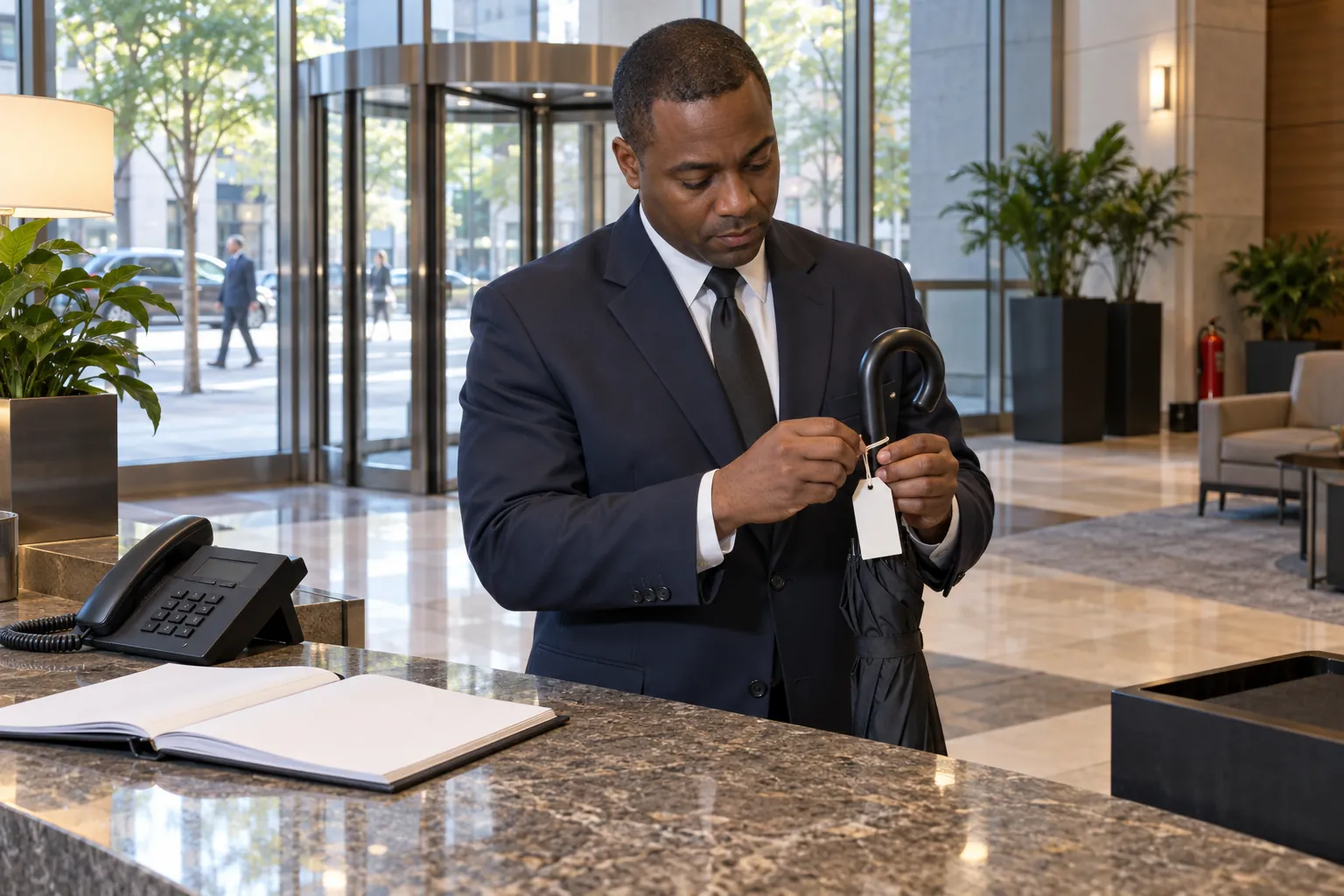
No federal rule requires one, but state finder laws decide what must happen to valuable items, and the log is how a front desk, a security post or a custodial team shows it followed them. This guide covers what to record, how three states handle found property, and how to run the log day to day.
01
What a lost and found log is, and the state laws behind it
A lost and found log is a numbered list of found items, one record per item, kept by whoever holds the building's lost property: the lobby security officer, the reception desk, the custodial office or the facility manager. Each entry follows the item from the moment it is handed in to the moment it leaves. Without it, every "I left my laptop here on Tuesday" becomes an argument.
There is no federal lost property law for ordinary buildings. Found property is state law, and states differ on the value that triggers a duty, the deadline, who must be told and who owns an item nobody claims. Three examples show the range.
California. Under California Civil Code section 2080, a person who finds a lost thing is not bound to take charge of it, but once they do they are "thenceforward a depositary for the owner", and any person or public or private entity that takes possession of found property must, within a reasonable time, inform the owner if known and return it. If the owner is unknown and the property is worth $100 or more, section 2080.1 requires the finder to turn it over within a reasonable time to the city police department, or the county sheriff outside city limits, with an affidavit stating when and where it was found and describing it. Under section 2080.3, if nobody proves ownership within 90 days, property reported at under $250 vests in the finder, and property of $250 or more is first advertised in a newspaper; property found by a public agency employee in the course of their work goes to public auction instead.
New York. New York Personal Property Law section 252 requires anyone who finds lost property worth $20 or more, or who comes into possession of it knowing it was found, to return it to the owner or report it and deposit it at a police station within ten days. Under subdivision 4, a finder who hands the item to "the person in possession of the premises where the property or instrument was found" is not prosecuted or liable for doing so, provided they had no reason to believe that person would not comply. This is how most items reach a building's front desk, and the building, now holding property it knows was found, must itself return it or deposit it with the police within ten days. Section 251 treats mislaid property as lost property. Section 253 sets how long the police hold an item, from three months for property under $100 to three years for property of $5,000 or more, and section 256 lets an employer assert the finder's rights where the finder was an employee under a duty to deliver the item to them, by filing written notice with the police before the item is released.
Florida. Florida Statutes section 705.102 requires any person who finds lost or abandoned property to report its description and location to a law enforcement officer, and makes it theft to keep it or to refuse to deliver it when required. Section 705.101 defines lost property to include property mislaid "on premises used at the time for business purposes", so an office lobby, a store or a campus building is squarely within it.
02
What a lost and found log should record
Whatever the format, a paper log book, a spreadsheet template or a form on a phone, every entry needs the same fields, recorded when the item is handed in:
- A log number, or item number, sequential, written on a tag or bag attached to the item so the shelf and the log always match.
- Date and time found, and the date and time it was logged if different.
- Exact location: building, floor and room or area, such as "third floor restroom, east core" rather than "third floor".
- Who found it: the employee's name, or for a visitor their name and contact details if they want to be told what happens to it. In a state where the finder may later have a claim, this matters.
- Who logged it: the officer, receptionist or custodian who took it in.
- A description precise enough to match a claim: type, color, make and distinguishing marks. Describe a wallet or bag from the outside, listing contents only as far as needed to identify it and count any cash.
- Estimated value band, because the state thresholds ($100 in California, $20 in New York) turn on value.
- Category: everyday item, high-value item, identification or payment card, keys, perishable, or hazardous.
- Where it is stored: the locked cabinet, the safe, or the police department it went to.
- Disposition: returned to the owner (name, how ownership was proved, signature, date and who released it), turned over to police (agency, date and any receipt or report number), released to the finder where the law allows, or disposed of under the written policy (date, method and who witnessed it).
Never leave a blank line or tear out a page in a paper log; a mistake is struck through and initialed. And close every entry with a disposition, so an item that has vanished from the shelf shows up as an open line nobody can explain.
Keep the log separate from the daily activity report. The officer's DAR should note that an item was found and logged, with the log number, but the lost and found log is the one place that item's whole history lives.
03
Handling found items by type
Most of what reaches a lost and found is ordinary: jackets, water bottles, umbrellas, chargers. A few categories need more care, and the log should flag them.
- Cash and high-value items. Wallets, phones, laptops, tablets, jewelry and cash are counted or described in front of a second person where possible, sealed in a numbered bag and locked in the safe or a cabinet with restricted keys. Do not try to unlock a phone or laptop; an owner looking for a phone often calls it, so keep it switched on and charged if you can do so without opening it.
- Identification and payment cards. Driver's licenses, passports, student IDs and credit cards are personal information. Restrict who sees them, do not photocopy them, and follow the local police department's practice or the issuer's instructions for returning them.
- Keys and access cards. A found building key or access badge is a security matter as well as a lost item: tell whoever runs key control the same day so a lost card can be deactivated.
- Perishables. Open food and drink are discarded at the end of the day and logged as disposed of, not stored.
- Hazardous items. Needles and syringes, weapons, ammunition and suspected drugs are not lost property to be carried to the desk. Staff should leave them in place, keep people away and call the security supervisor, who follows the site's procedure and calls the police where needed. Where custodial staff are covered by OSHA's Bloodborne Pathogens standard (29 CFR 1910.1030), the employer's exposure control plan governs, and the standard itself says broken glassware that may be contaminated "shall not be picked up directly with the hands" and that contaminated sharps go into closable, puncture-resistant containers.
04
Who does what, and how long items are kept
A lost and found works when everyone in the building knows the one place items go and nobody else keeps a private drawer of found things. Put it in writing, in the post orders for the security desk and in the custodial and front desk procedures.
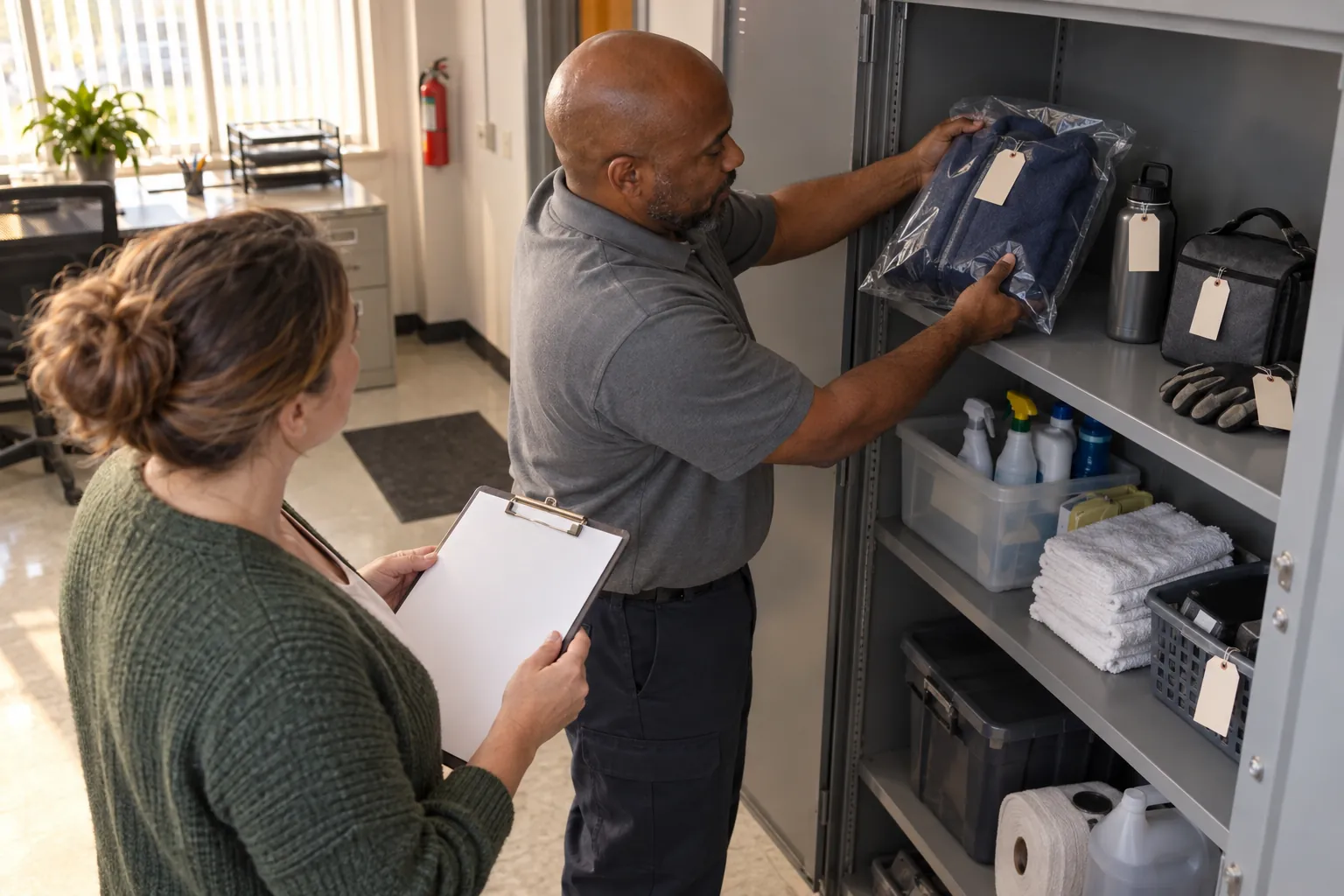
- Finding. Anyone who finds an item takes it to the designated point, usually the security desk or reception. Night custodians who find items on their rounds put them in a designated bag or drop box with a note of where and when, and the first person on duty in the morning logs them.
- Logging. The officer or receptionist logs the item at once, tags it with the log number and stores it by category.
- Trying to find the owner. A name on a badge or a label in a bag often makes the return easy. Note the effort on the entry.
- Handing over valuable items. Where state law requires found property above a value to go to the police within a set time, such as ten days in New York for property of $20 or more, or "within a reasonable time" in California for property of $100 or more, the log shows the date it went and to which department.
- Releasing to an owner. Ask the claimant to describe the item, where and when they lost it, before showing them anything. For high-value items check photo ID and have the claimant sign for it. Never let someone choose from a tray of phones.
- Disposal. Everyday items left unclaimed are donated, recycled or discarded after the period in the written policy, with the date and a witness recorded. The policy sets its own period per category; it cannot shorten a period the state law sets for items the police must hold.
- Review. The security supervisor or facility manager checks the shelf against the open entries on a set schedule and records the result.
Retention periods are a policy decision for the building owner, within the state law. A tenant whose coat was given away needs to see a policy that says how long coats are kept and a log line that shows the date it went.
Open items that need action at shift change, such as an owner coming to collect, go in the pass-down log.
05
What a good log looks like, and how it is checked
A lost and found log is good evidence when it was made at the time, is complete and matches the shelf. Check that:
- entries run in time order with sequential numbers and no gaps;
- every tagged item on the shelf matches an open entry, and every open entry matches an item;
- high-value entries show two names at intake and a signed release or a police receipt at the end;
- items the state law sends to the police went within its deadline;
- the periodic shelf checks are recorded with who did them and what they found.
Check it two ways. A regular count, weekly on a busy site, compares the shelf with the open entries and records anything missing. A less frequent review by someone outside the desk, such as the facility manager, samples closed entries: was the claim checked, did the cash match the count, was the police receipt filed?
The log also answers questions quickly. When a visitor calls about a laptop left in the second-floor conference room on Tuesday, the desk can search by date, location and description rather than rummaging through a box, and when someone says an item was taken rather than lost, the log shows who handled it.
06
Where the lost and found record fails, and where SiteClara fits
The usual failure is simple. A night custodian leaves a found item on the reception counter with no note, and it is logged the next morning, if at all, with a guess at where it came from. The shelf check in the post orders is initialed in a binder, sometimes days ahead. When an owner calls, nobody can say where or when it was found.
SiteClara records checks and reports at the place they happen. A printed QR poster, with an optional NFC tag behind it, goes at the security desk, beside the lost and found cabinet or at any point on the rounds. Staff scan the code or tap the tag on their own phone, with no app to install. A site can set up its own report form, for example with an option for a found item, so the finding is recorded at the location where it was made, with the time, the named person and a photo when one is asked for, and it goes onto the team's list of jobs until someone closes it. A scheduled check, such as "lost and found cabinet counted against the open log entries", is marked done or explained where it happens.
The supervisor sees what was due, done and missed, with the reason where one was given. Each day they review the totals and photos, add a note and approve a report that goes to nominated management or client contacts at 8 a.m. the next morning, showing what was reported, what is still open and how the scheduled checks went, for example 1 of 1 cabinet count completed.
07
Questions people ask
How do you handle lost and found in a hotel?
The same way as in any other building: one place found items go, a numbered log entry for each, and the state's found property law for anything valuable. In New York, a housekeeper may hand a found item to the hotel as the person in possession of the premises, and under New York Personal Property Law section 252 anyone who comes into possession of lost property worth $20 or more knowing it was found must, within ten days, return it to the owner or report it and deposit it at a police station. Where the housekeeper is an employee under a duty to deliver found items to the hotel, New York Personal Property Law section 256 lets the hotel as employer assert the finder's rights by filing written notice with the police before they deliver the item to the finder.
How long do hotels keep stuff in lost and found?
No federal rule sets a period, so it is the hotel's own written policy, within its state's found property law. In California, under California Civil Code section 2080.3, if no owner proves ownership within 90 days, property reported at under $250 vests in the finder. In New York, New York Personal Property Law section 253 sets how long the police hold a deposited item: three months under $100, six months from $100, one year from $500 and three years from $5,000.
08
Further reading, and a list to take away
Read your own state's found property statute before writing the policy. For the three states in this guide, that is California Civil Code sections 2080 to 2080.10, starting at California Civil Code section 2080; New York Personal Property Law sections 251 to 258, where the duty to report is New York Personal Property Law section 252; and Florida Statutes chapter 705 on the Florida Senate's site. Then ask the local police department or sheriff's office how it accepts found property, what paperwork it gives in return and whether it takes items such as IDs and keys.
Before you rely on a lost and found log, check that:
- there is one designated place for found items, named in the post orders and the custodial procedures;
- every item is logged when it is handed in, with a number tagged to the item;
- each entry records when, where, who found it, who logged it, a description and a value band;
- identification, keys, perishables and hazardous items each have their own handling rule;
- items the state law sends to the police go within its deadline, and the receipt is kept;
- owners describe the item before they see it, and sign for high-value returns;
- the retention and disposal policy is written, fits the state law and is applied every time;
- the shelf is counted against the open entries on a schedule, and the count is recorded.
Sources
Every document this guide quotes or links to, in the order it first cites them.
- California Civil Code section 2080 leginfo.legislature.ca.gov
- Section 2080.1 leginfo.legislature.ca.gov
- Section 2080.3 leginfo.legislature.ca.gov
- New York Personal Property Law section 252 nysenate.gov
- Section 251 nysenate.gov
- Section 253 nysenate.gov
- Section 256 nysenate.gov
- Florida Statutes section 705.102 flsenate.gov
- Section 705.101 flsenate.gov
- What is unclaimed property? unclaimed.org
- Bloodborne Pathogens standard (29 CFR 1910.1030) osha.gov
- Florida Statutes chapter 705 flsenate.gov
Related guides
 Security patrolsSecurity daily activity report: what to include, and how to write one that holds upThe security daily activity report (DAR): what to record, how to write entries that hold up, how it differs from an incident report, and how to review and keep it.
 Security patrolsSecurity pass-down log: what to hand over, and how to make the shift change stickThe security pass-down log: what the outgoing officer hands over, how to run the shift change, how to write entries that stay useful, and how to review and keep it.
 Security patrolsSecurity post orders: what they should say, and how to know they are followedSecurity post orders in the US: what they are, what state rules say, what to include, how to write, sign and review them, and how to check they are followed.
 Security patrolsKey control: how to know who holds every key, and prove itA key control program for US buildings: the key register, issuing and returning keys, audits, lost keys and rekeying, and what OSHA, HIPAA and Texas law say.