Security patrols
The New York Retail Worker Safety Act: the policy, the training and the everyday checks behind them
The New York Retail Worker Safety Act, Labor Law section 27-e, requires every employer with ten or more retail employees in New York State to adopt a written workplace violence prevention policy and provide employees with interactive training, and from January 1, 2027 requires employers with 500 or more retail employees to give each of them a silent response button, a form of panic button.
The policy and training requirements have applied since June 2, 2025. This guide covers who is covered (including the janitorial contractor), what the policy and training must contain, the buttons, the records the Department of Labor recommends, and how to make sure the store checks the policy relies on actually happen.
01
What the Retail Worker Safety Act and Labor Law 27-e require
The Retail Worker Safety Act is New York Labor Law section 27-e, Prevention of retail workplace violence. The enacting bill, Senate Bill S8358C, was signed by the governor on September 5, 2024 as Chapter 308 of the Laws of 2024. Before it took effect, the chapter amendment, Senate Bill S740, changed its start to "the two hundred seventieth day after it shall have become a law", which was June 2, 2025, and kept January 1, 2027 for subdivision 5, the silent response buttons.
The New York State Department of Labor's Retail Worker Safety page puts the duty in one sentence: the Act "requires all employers who employ 10 or more retail employees in New York State to implement strategies to reduce the risk of workplace violence to their employees and increase employee safety." In practice that means three things:
- A written retail workplace violence prevention policy.
- Interactive training at hire, then every year or every two years.
- Silent response buttons from January 1, 2027, for the largest employers.
The statute does not define workplace violence itself. The department's Retail Worker Safety Act Frequently Asked Questions describe it as "any act or threat of physical violence or aggressive behavior that occurs at the workplace or during a worker's regular duties", including a verbal or physical attempt or threat to injure an employee, an intentional display of force that gives an employee reason to fear bodily harm, intentional and wrongful physical contact that causes injury, and stalking that arises in the course of employment.
02
Who is covered, including the janitorial contractor
Section 27-e defines an employer as a person, business, corporation, partnership, limited liability company or association "employing at least ten retail employees". A retail employee is "an employee working at a retail store for an employer", and a retail store is "a store that sells consumer commodities at retail and which is not primarily engaged in the sale of food for consumption on the premises". Restaurants are out; the department's Retail Worker Safety guidance overview (P766) lists gas stations, convenience stores, big box stores, drug stores and factory outlets among what is in.
The department's FAQ settles three questions that come up in every company:
- The count is statewide, not per store. Five retail employees at one store and five at another make ten, and the law applies.
- Only retail employees count toward the ten. A business with seven retail employees and five in marketing and administration is not covered, although the department encourages every employer to reduce the risk of violence.
- Contractors working in stores are covered. Asked about a cleaning business whose employees clean retail stores but do not sell anything, the department answered: "Yes, employees working on-site at a retail store are covered by this Act. Those employers must comply with developing and delivering the retail workplace violence prevention policy and training."
That last answer matters to anyone who supplies people to stores. The FAQ was written about cleaners, but its reasoning is stated in general terms, so a janitorial company, a day porter service or a security contractor with employees posted at New York stores should assume it needs its own policy and its own training, not the store's. Get legal advice on your own contracts.
Where more than one employer works in the same store, each owes the duty to its own people. Agree in the contract and the post orders or scope of work how a threat reported to a night custodian reaches store management, and how the store's emergency procedures and devices are explained to contractor staff.
03
What the workplace violence prevention policy must contain
Subdivision 2 of section 27-e has the department publish a model policy, and requires every covered employer to adopt it or have its own policy that, in the words of the department's guidance overview, "equals or exceeds" the model. The department's Retail Workplace Violence Prevention Policy page says a policy of your own must include:
- A list of risk factors, including but not limited to working late night or early morning hours, exchanging money with the public, working alone or in small numbers, and uncontrolled access into the workplace.
- Methods to prevent workplace violence, including but not limited to systems for employees to report incidents.
- Information about federal and state laws concerning violence against retail workers, the remedies available to victims, and a statement that local laws may also apply.
- A statement that retaliation is against the law against workers who complain about workplace violence or about situations that may give rise to it.
The Model Retail Workplace Violence Prevention Policy is a fill-in document, with highlighted spaces for the business name, the person or office employees report to, and the store's own risks. Beyond six general work situations (the four above plus extensive interaction with the public and working at an isolated worksite), it lists store-specific factors: the sale of alcohol, a poorly lit store interior, "Poorly lit parking and/or surrounding areas", a history of robbery, violent incidents or other security problems, uncontrolled access into the store, high value merchandise, a large amount of cash on hand, and a lack of staff training on recognizing hostile and aggressive behavior.
To find each store's own risks, it suggests reviewing two years of safety, insurance and police records, asking workers, and evaluating "the physical store including building layouts, lighting, and communication and security systems for areas of risk". A model policy copied without that work tells nobody anything about the store they are standing in.
Distribution. Under subdivision 4, the employer must give each retail employee, "in writing in English and in the language identified by each employee" as their primary language, a notice containing the policy and the information presented at the training, at the time of hiring and at every annual training. The FAQ puts it plainly: the policy goes out when employees are first hired and once a year after that. The duty to translate applies where the department has published a translation of its model documents; at the time of writing those were Spanish, Simplified Chinese, Yiddish and Bengali (which the department labels Bangladeshi). Where an employee's primary language is not among them, the English version may be given.
04
The interactive training: what it covers and when
Subdivision 3 requires training "upon hire" and then annually, or once every two years for employers with fewer than 50 retail employees. The department's Retail Workplace Violence Prevention Training page adds that the training must be interactive, that employees must also get a written version of it, and that "Training must take place during paid work time." According to that page, the training must include information and instruction on:
- the requirements of the Retail Worker Safety Act;
- measures retail workers can take to protect themselves when faced with workplace violence;
- de-escalation tactics;
- active shooter events;
- emergency procedures, emergency exits and meeting places in the event of an emergency;
- how to use security alarms or buttons and other worksite-specific emergency devices;
- the responsibilities of supervisors and managers before, during and after emergency situations, including developing worksite-specific emergency procedures and training on areas of previous security problems.
Interactive does not mean in person. The FAQ says a training is interactive "if it requires an employee to provide input during the training and the employee receives a response to the input they provide", and that digital training can qualify. The department's own interactive model training is free, in English and Spanish.
The model training is not enough on its own. The department says it "does not include store-specific information" and that employers who use it should add a worksite list of emergency exits or a floor map, the meeting place, the emergency devices in use and how they work, the security devices such as personal response systems or panic alarms, other store-specific procedures, and "Any history of security problems at their store location and how they should be addressed."
That is where facility, security and janitorial teams come in: the exits in the training have to be actually clear, and the history of security problems has to be written down before anyone can teach it. A contractor training its own people should get the store's floor map and emergency procedures in writing.
05
Silent response buttons, records and enforcement
Silent response buttons from January 1, 2027. Under subdivision 5, every employer of 500 or more retail employees statewide must provide every retail employee with a silent response button. The department describes it as a button that must "request immediate assistance from a security officer, manager, or supervisor in case of emergency", and says the employer must also train employees to use it. The statute allows three forms: a device installed in an easily accessible location in the workplace, a wearable, or a mobile phone-based button. The FAQ adds that a phone or wearable button may only be installed on employer-provided equipment, and the statute says wearable and phone-based buttons "shall not be used to track employee locations except when the silent response button is triggered."
Whoever answers the button is part of the system. If it alerts a contract security officer, the post orders need to say what to do, and a button that rings at an empty podium is not assistance. Installed buttons need a routine test and a record of it, like any other alarm.
Records. The Act does not require an incident log. The FAQ says keeping a record of workplace violence incidents is not required, but "NYSDOL recommends you maintain a record of any workplace violence incident reports filed about your workplace" so that trends can be seen, and that a reporting system, while not required, is "a best practice and a recommended component of an effective workplace violence prevention program."
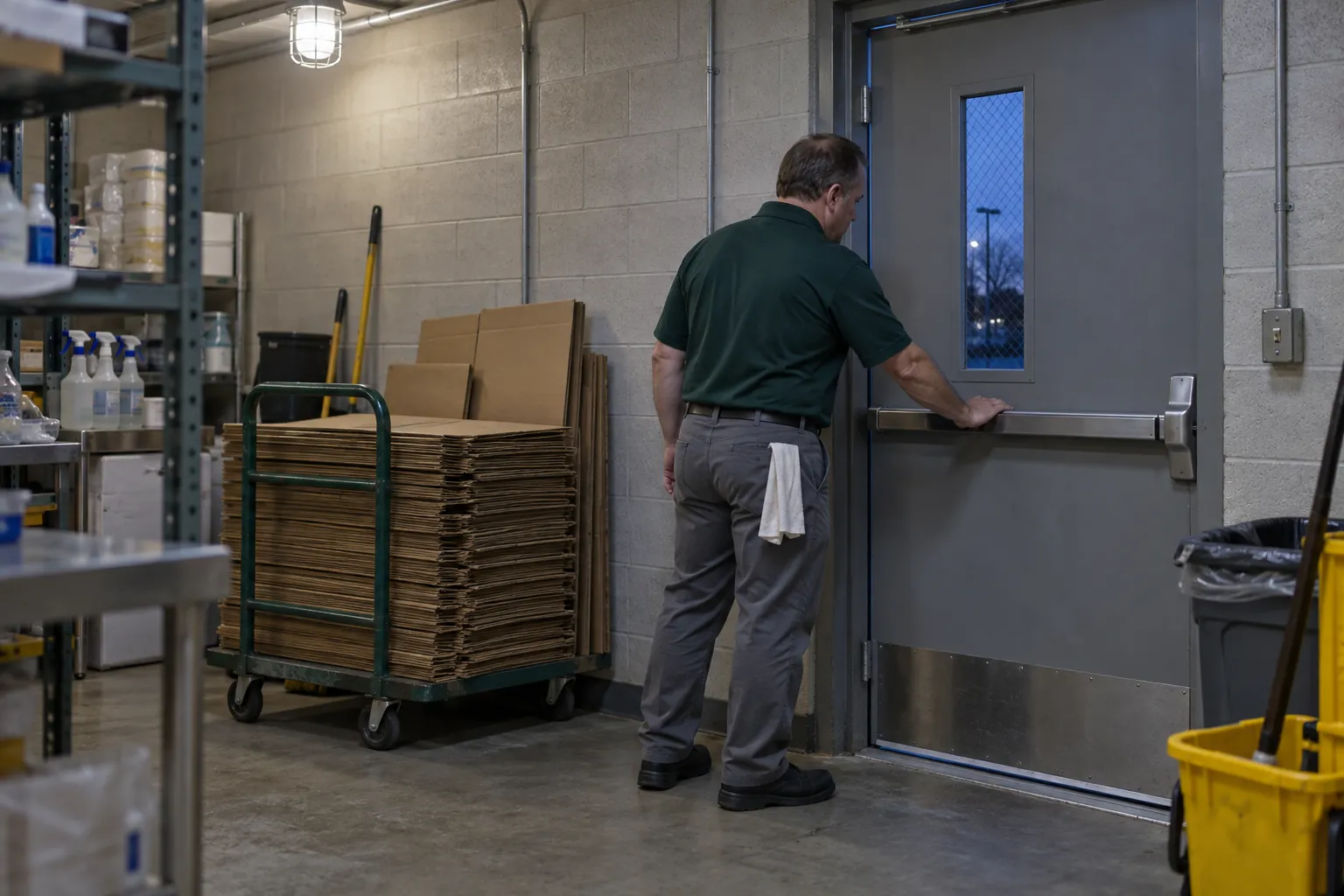
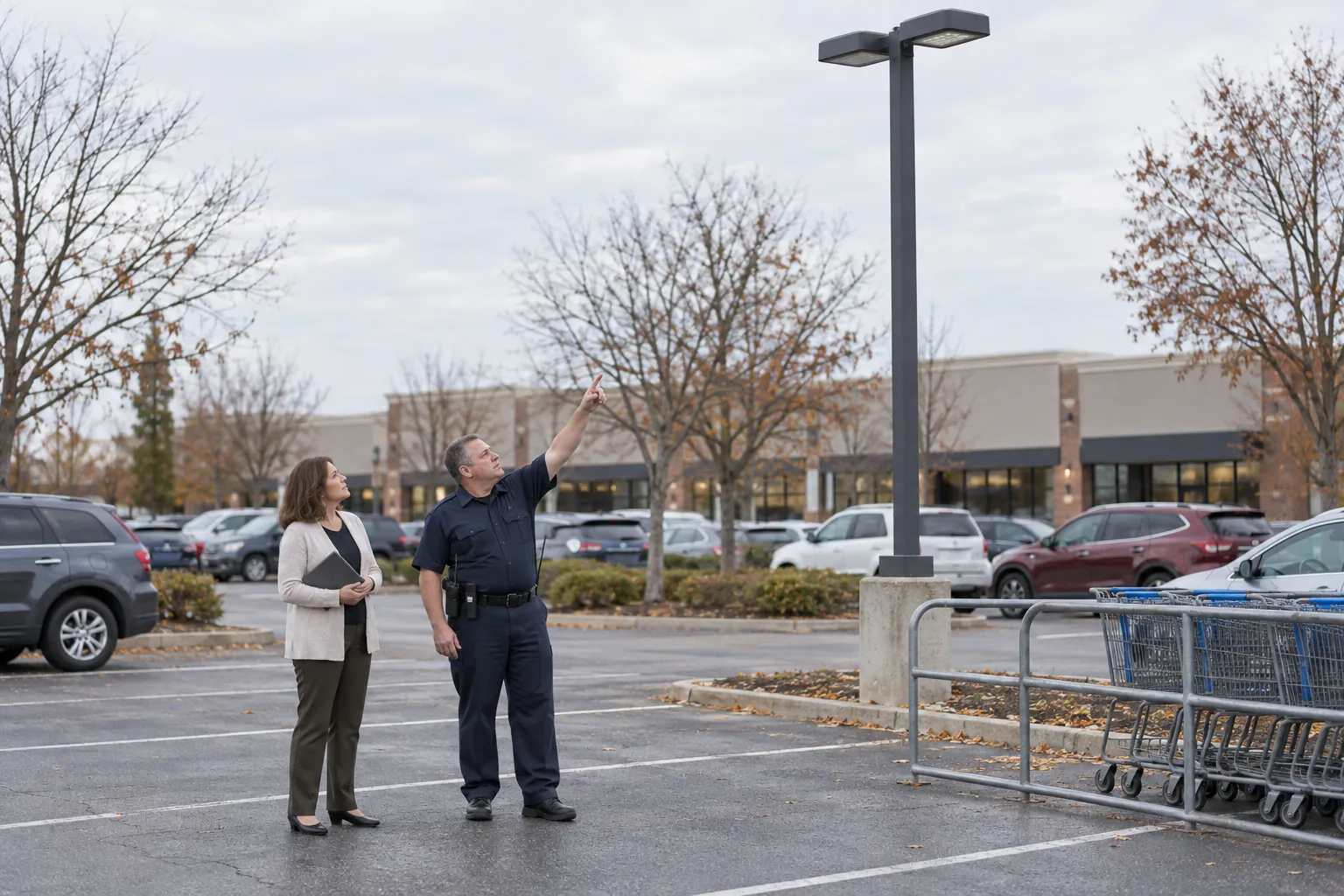
The physical side of prevention. The model policy's optional "Additional Methods" section is a short list of building checks: keep doors locked before and after business hours, lock delivery and garbage doors when they are not in use, report and replace broken locks, keep exit routes free of supplies and boxes, and maintain adequate lighting inside and outside the store, reporting any light that is burnt out or dimmed. Where the landlord is responsible, the employer asks the property owner to fix it. These are the everyday jobs of custodians, day porters, security officers and property management teams.
Enforcement. The department's guidance overview says an employee who believes there is a serious violation should first tell a supervisor in writing and give the employer a reasonable opportunity to correct the problem, unless they believe there is imminent danger and reasonably believe that reporting to a supervisor would not lead to corrective action. If the problem is not resolved, they can file a complaint with the Safety, Health and Essential Rights (SHER) Program at the Department of Labor, online, by email or by mail, and the department says complaints will be kept anonymous to the extent possible. Separately, New York Penal Law section 120.19, assault on a retail worker, makes it a class E felony to cause physical injury to a retail worker with intent to prevent them from doing their job.
06
Where the record fails, and what SiteClara does about it
The policy is on file, the training certificates are in the HR system, and the store is still unsafe at 10 p.m. The receiving door at the back is propped open with a pallet because the closer is broken. The parking lot light by the cart corral has been out for two weeks; the day porter mentioned it to a shift lead, who mentioned it to the store manager, who meant to call the landlord. The contractor's overnight custodian was shouted at by a man who came in through that door and told the security officer at pass-down; nothing was written down. When something worse happens, the store's history of security problems, the one the training is supposed to teach, exists only in people's memories.
SiteClara works on that everyday layer: the checks and reports in the building that the policy depends on. A printed QR poster goes at each location, such as a rear receiving door, a stockroom, an exit route, a restroom corridor or a parking lot light pole, with an optional NFC tag behind it. Staff scan the code or tap the tag on their own phone, with no app to install, and sign in with a link. They see the checks due at that location, such as door locked, closer working, exit route clear or lights working, and mark each one done, or say what stopped them. A problem, such as a broken lock or a light out, is reported there with a photo and goes onto the team's list of jobs until someone closes it.
The supervisor sees what is due, done and missed, and can record why a check was missed; a job that needs the building or property manager can be escalated to them to answer. Each day the supervisor reviews and approves a report that goes to nominated management or client contacts at 8 a.m. the next morning, showing what was reported, completed and still open, and how the scheduled checks went. When a store asks what happened to the rear door, the answer is a date, a name and a photo.
07
Questions people ask
Was the Retail Worker Safety Act amended?
Yes, before it took effect. The chapter amendment, Senate Bill S740, signed by the governor on February 14, 2025, replaced the original panic buttons, which would have alerted law enforcement, with silent response buttons that request help from a security officer, manager or supervisor. It also counted the 500 employees for the buttons statewide rather than nationwide, let employers with fewer than 50 retail employees provide training once every two years instead of annually, and moved the start date to June 2, 2025.
Does the Retail Worker Safety Act require panic buttons?
Only for the largest employers, and not until January 1, 2027. New York Labor Law section 27-e requires every employer with 500 or more retail employees in the state to provide every retail employee with a silent response button: a device installed in an easily accessible location in the workplace, a wearable, or a mobile phone-based button on employer-provided equipment. Wearable and phone-based buttons may not be used to track employee locations except when the button is triggered. Employers below 500 retail employees do not have to provide them.
How often is retail workplace violence prevention training required?
At hire, then once a year for employers with 50 or more retail employees and every two years for those with 49 or fewer. The Department of Labor's Retail Worker Safety Act Frequently Asked Questions say employers "must provide their retail employees with retail workplace violence prevention training when they are first hired", and the statute has the policy handed out again at every training.
What is the difference between Labor Law 27-b and 27-e?
They cover different employers. New York Labor Law section 27-b, Duty of public employers to develop and implement programs to prevent workplace violence, applies to the state, its political subdivisions, public authorities and other government agencies. Section 27-e, the Retail Worker Safety Act, applies to businesses employing at least ten retail employees at retail stores in New York.
Is the model workplace violence prevention policy available as a PDF?
Not as a PDF. The Department of Labor's Retail Workplace Violence Prevention Policy page offers the Model Retail Workplace Violence Prevention Policy as a Word document to fill in, in English, Spanish, Simplified Chinese, Yiddish and Bengali (which the department labels Bangladeshi). The page says employers must either adopt the model or establish their own policy that meets the minimum legal requirements of the law.
08
Where to read more, and a list to take away
Start with the statute itself, New York Labor Law section 27-e. The Department of Labor's Retail Worker Safety page links to the complaint route and to everything else: the policy page with the Model Retail Workplace Violence Prevention Policy and its translations, the training page with the interactive model training, the Retail Worker Safety Act FAQ, and the guidance overview (P766). For the federal background, read OSHA's workplace violence page.
Before the next annual training, retailers and the businesses that staff their stores can check their compliance against this list:
- you have counted retail employees across every New York store, and contractors have counted their own employees working on-site in stores;
- the policy names who employees report to and lists each store's own risk factors, not just the model's general ones;
- every employee received the policy at hire and in the last year, in English and in their primary language where the department has a translation;
- the training was interactive, on paid time, with a written copy, and added each store's exits, meeting place, devices and security history;
- if you have 500 or more retail employees statewide, silent response buttons, the people who answer them and the training on them will be in place by January 1, 2027;
- reports of threats and incidents are recorded where they can be reviewed for trends;
- rear and delivery doors, locks, exit routes and interior and parking lot lighting are checked on a schedule, and each fault found has an owner and a date;
- store, landlord and contractors have agreed how a report made to one reaches the others.
Sources
Every document this guide quotes or links to, in the order it first cites them.
- New York Labor Law section 27-e, Prevention of retail workplace violence nysenate.gov
- Enacting bill, Senate Bill S8358C nysenate.gov
- Chapter amendment, Senate Bill S740 nysenate.gov
- Retail Worker Safety page dol.ny.gov
- Retail Worker Safety Act Frequently Asked Questions dol.ny.gov
- Workplace violence page osha.gov
- Workplace violence enforcement page osha.gov
- Retail Worker Safety guidance overview (P766) dol.ny.gov
- Retail Workplace Violence Prevention Policy page dol.ny.gov
- Model Retail Workplace Violence Prevention Policy dol.ny.gov
- Retail Workplace Violence Prevention Training page dol.ny.gov
- New York Penal Law section 120.19, assault on a retail worker nysenate.gov
- New York Labor Law section 27-b, Duty of public employers to develop and implement programs to prevent workplace violence nysenate.gov
Related guides
 Security patrolsCalifornia SB 553: the workplace violence prevention plan, the log and the checks behind themCalifornia's SB 553 in practice: who Labor Code 6401.9 covers, what the plan must contain, the violent incident log, hazard inspections, training and records.
 Security patrolsSecurity incident report: what to write, and how to make it hold upHow a US security officer writes an incident report: what to include, state rules on report writing and reporting to regulators, and how to make it hold up later.
 Security patrolsPanic button testing: how to know the alarm will bring helpHow to test panic buttons in US buildings: what state laws and standards say, fixed and wearable devices, placing the alarm on test, how often, and the record.
 Security patrolsLighting survey: how to check a property's security lighting after darkHow to run a security lighting survey at night: what to check, how to take foot-candle readings, how often, who owns the fixes, and a record that holds up.