Security patrols
Panic button testing: how to know the alarm will bring help
Panic button testing means pressing each fixed or wearable panic button with the alarm account placed on test, then confirming that the right signal, from the right location, reached the monitoring center or security console.
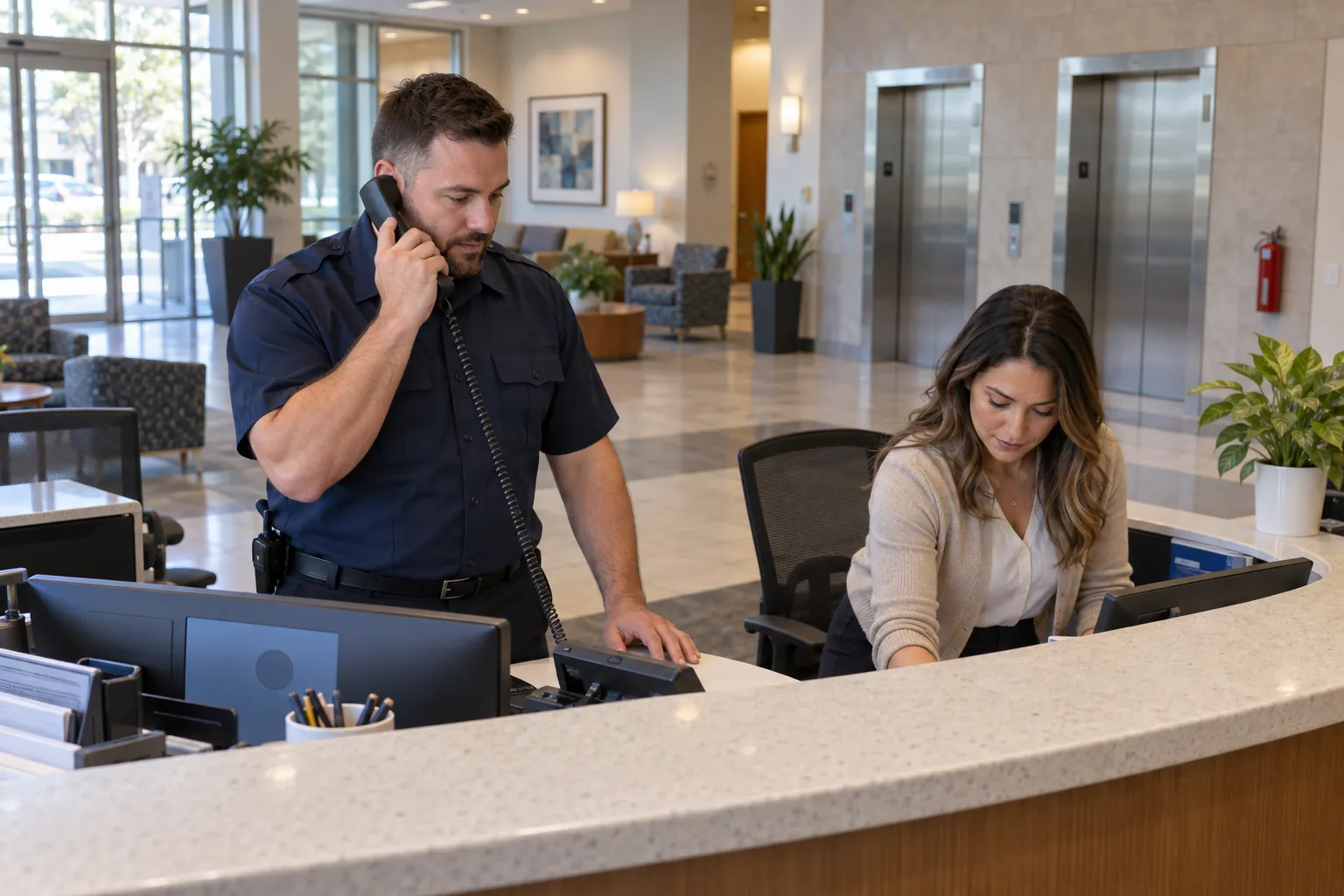
A panic button is pressed once in earnest, usually by someone who is frightened and has no time to try again. Whether help arrives at that moment depends on things nobody sees on the day: the battery in the pendant, the zone list at the monitoring center, the button under the reception desk that a new filing cabinet now blocks. The only way to know is to test, and the only way to show you tested is a record. This guide covers what US laws and standards say about panic buttons, what a test should prove, how to run one without sending the police by mistake, how often to test, who does what, and how to keep a record that holds up.
01
What US laws and standards say about panic buttons
No federal law requires an ordinary US workplace to have a panic button, and none sets a schedule for testing one. The duty comes from several directions: federal workplace violence guidance, state laws for schools and hotels, banking rules, installation standards and the alarm contract. Which applies depends on the building, the state and the sector.
Federal guidance. OSHA has no panic button standard, but its guidance treats them as a recognized control. The Guidelines for Preventing Workplace Violence for Healthcare and Social Service Workers (OSHA 3148, 2016) lists panic buttons among the engineering controls and says that "security/silenced alarm systems should be regularly maintained and managers and staff should fully understand the range and limitations of the system." Its checklist asks whether security devices, alarms included, are "tested on a regular basis and repaired promptly when necessary." The Recommendations for Workplace Violence Prevention Programs in Late-Night Retail Establishments (OSHA 3153, 2009) recommends "arranging for a reliable response system when an alarm is triggered." Both are advisory, but they show what good practice looks like.
Schools. Several states now require silent panic alarms in public schools, often under the name Alyssa's Law. In Florida, Florida Statutes section 1006.07 (2026 edition) requires each public school, including charter schools, to implement a mobile panic alert system, "known as 'Alyssa's Alert,'" that must "integrate with local public safety answering point infrastructure to transmit 911 calls and mobile activations" (subsection (4)(c)). The same section tells schools to "establish a schedule to test the functionality and coverage capacity of all emergency communication systems and determine if adequate signal strength is available in all areas of the school's campus" (subsection (4)(e)). In Texas, Senate Bill 838 (88th Legislature), adding Education Code section 37.117, requires each school district and open-enrollment charter school to provide every classroom with "silent panic alert technology that allows for immediate contact with district or school emergency services and emergency services agencies, law enforcement agencies, health departments, and fire departments," beginning with the 2025-2026 school year.
Hotels. New Jersey's hotel panic device law, P.L. 2019, Chapter 123, covers hotels with 100 or more guest rooms and employees assigned to work alone in a guest room, such as housekeeping and room service. The New Jersey Department of Labor's summary of the panic device law defines the device as "a two-way radio or other electronic device an employee can wear or keep in their pocket that allows them to summon immediate on-scene assistance," and says hotel employers "must maintain, repair, or replace the panic devices and the systems that are needed to operate the devices." The Department recommends that training cover "how to maintain and test the panic device to ensure it's working." Other states and cities have their own hotel worker rules, so check the one where the property sits.
Banks and California. Federal bank security rules set by each bank's regulator apply here. For the banks the FDIC supervises, 12 CFR 326.3 (Security program) requires an alarm system or other device for promptly notifying law enforcement of a robbery or burglary, and a program that provides for "selecting, testing, operating and maintaining appropriate security devices." California's Labor Code section 6401.9, in force since July 1, 2024, requires a covered employer's plan to include "effective procedures to respond to actual or potential workplace violence emergencies," among them "effective means to alert employees of the presence, location, and nature of workplace violence emergencies" (subsection (c)(2)(G)(i)). It does not require a panic button, but where the plan relies on one, testing is how you show it is effective. See California workplace violence prevention.
Installation standards. UL 681, Installation and Classification of Burglar and Holdup Alarm Systems (edition 15, revised September 2025) covers the "installation of holdup alarm initiating devices used to send holdup or duress signals to an off premises location." The NFPA publishes NFPA 731, Standard for the Installation of Premises Security Systems. A standard binds a building only where a law, insurer or contract adopts it; both are paid documents, so ask your alarm contractor which edition they work to.
02
What panic button testing has to prove
A panic button is a chain: the button or pendant, the panel or app it talks to, the path to whoever receives the signal, what they see, and the person who comes. A test that proves only the first link, a light blinking on a pendant, proves very little about whether the system is functioning. Most US buildings have some mix of these:
- Fixed holdup or duress buttons, hardwired or wireless, at a reception desk, teller line, pharmacy counter, nurse station or school front office.
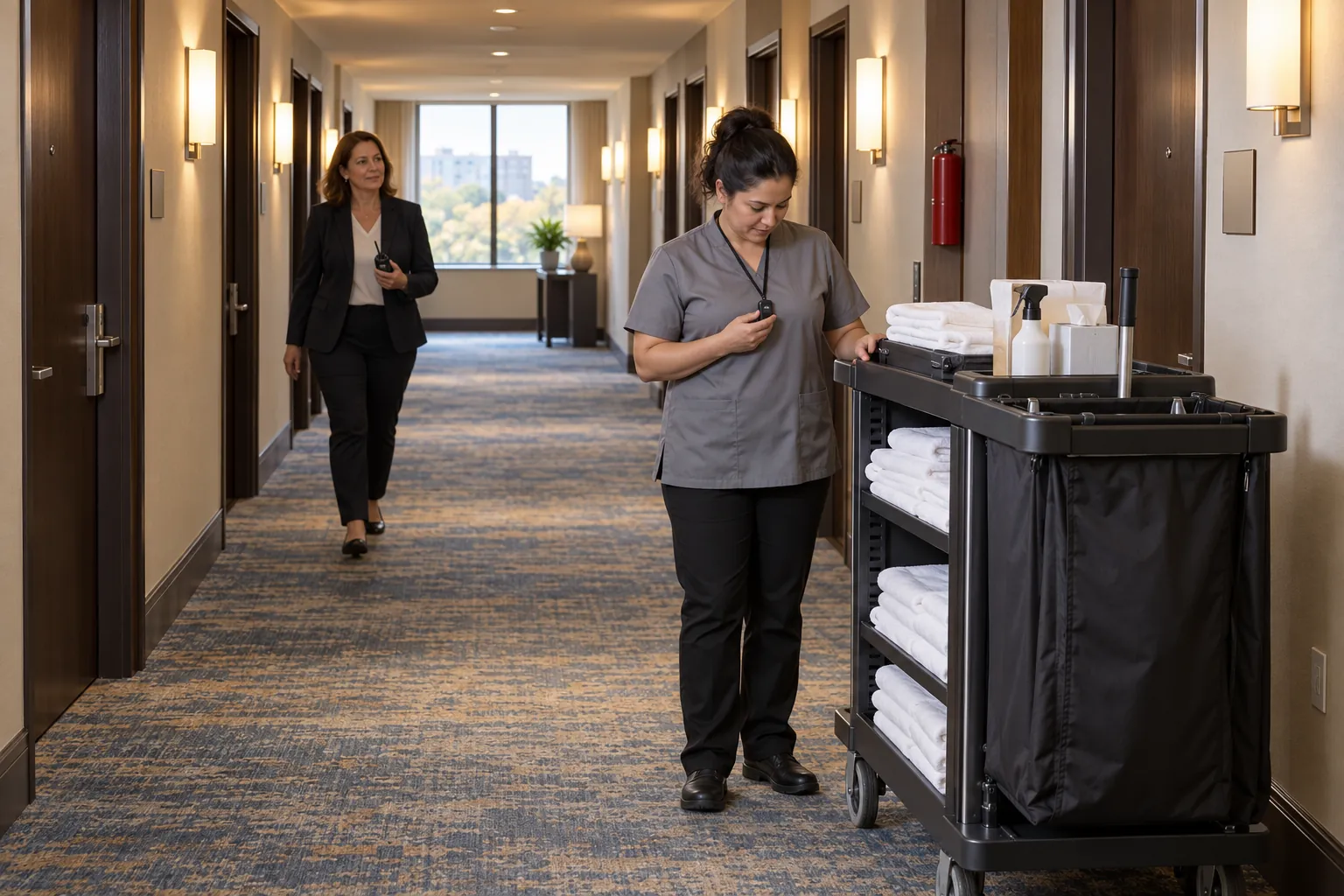
- Wearables: pendants and badge buttons worn by room attendants, behavioral health staff, custodians and officers working alone.
- Mobile panic alerts: an app or badge that sends an alert, sometimes a 911 call, with the user's location, as many school systems now do.
- Radios and duress codes: a two-way radio's emergency key, or a keypad code that sends a silent signal while appearing to disarm.
For each device, a complete test answers six questions:
- Does it activate? The button can be reached and pressed the way it would be used, the pendant's battery is good, and nothing blocks or covers a fixed button.
- Does the signal arrive? The monitoring center, the security console, the dispatch software or the supervisors' phones receive it, every time, from every part of the building. Florida's wording, "coverage capacity" and "adequate signal strength" in all areas, is a good test for any wireless system: stairwells, basements, elevators and the far end of the parking lot are where signals drop.
- Is it the right signal? The receiver sees a holdup or panic signal, not a burglary or a trouble signal, and it is silent where it is meant to be silent.
- Does it say where? The zone description or the location shown matches the actual room and floor. Zone lists go stale when offices move, rooms are renumbered or a floor is renovated.
- Does the right person respond? The call list, the dispatch instructions and the in-house response plan name people who still work there, on the shifts that exist today.
- How long does help take? Occasionally, and as a planned drill, time the response from activation to someone arriving at the door.
Routine tests cover the first four questions. The last two need a planned drill with the people who will respond.
03
How to test a panic button without sending the police
The commonest testing failure is a test nobody told the monitoring center about, dispatched as real. It wastes a police response, can bring a fee or fine under a local false alarm ordinance, and teaches everyone that alarms from that address are usually tests. A good routine runs in this order:
- Plan the window. Pick a quiet time and the devices to test. Where alerts go straight to 911, use the system's test mode and any procedure agreed with the local public safety answering point; never send a live 911 activation as a test unless that has been agreed.
- Place the account on test. Call the monitoring center or use its portal, give the passcode, and ask for the zones to be placed on test for a set period. Tell your own console and anyone else who receives the alert.
- Press each device as a user would. Test a wearable from where it is used: a guest room at the end of a corridor, a stairwell, the basement laundry.
- Confirm what arrived. For each signal, get the time, zone, description and signal type from the monitoring center or the console screen, and compare it with what you pressed and where. A wrong description is a failed test even though the button worked.
- Check nothing sounded. A silent alarm that sets off a sounder, or a light a visitor can see, is a fault.
- Take the account off test. Confirm every zone is back in service and note the time. A test window left open is a real alarm nobody acts on.
- Record it and raise any fault. Note each device, the result, who tested and who confirmed receipt. A failure goes to the alarm contractor as a work order, and the device is out of service until it is fixed and retested.
Wearables need two extra checks: a daily one, charged and checked in at the start of the shift, and a location one, confirming that the floor or room the system reports is where you actually are.
04
How often to test panic buttons
No federal rule sets a testing frequency for panic buttons in an ordinary building. The schedule comes from the manufacturer's instructions, the alarm contractor's service agreement, the insurer, a bank's security program, a school district's policy or a state law where one applies, and from the risk. Where none of those says more, this pattern is a sensible starting point to adjust:
- Every shift, for wearables: signed out charged and working, signed back in. The console check belongs in the security guard shift checklist.
- Monthly: an activation test of each fixed button, or on a large campus a rotating share so every device is tested each quarter, confirmed at the receiving end.
- Quarterly: a walk of wireless coverage, stairwells and basements included, and a check of the zone and call lists against the building as it is now.
- Twice a year: a timed response drill. In schools it can sit alongside the school safety drills.
- Every year: the alarm contractor's service visit, with batteries replaced as the manufacturer directs.
- After any change: a new monitoring company, panel, communicator, app version or renovation, or a device moved. Test before relying on it.
Test more often where the risk is higher: cash handling at night, emergency departments, behavioral health units, staff alone in guest rooms, and anywhere a past test found a fault. A system that supervises itself reports some faults on its own, but it checks the device and the path, not the zone description or the people who respond.
05
Who does what, and what good evidence looks like
Panic button testing fails most often in the gaps between organizations: the owner buys the system, a contractor services it, a monitoring center receives the signals, officers run the routine, and a department uses the devices. Write down who owns each part:
- The owner or facility manager keeps the device register, sets the schedule and sees faults fixed.
- The security team runs the tests and wearable checks, with the steps and the monitoring center's number in the post orders.
- The alarm contractor services the system, updates the zone list and repairs faults.
- The monitoring center holds the zone descriptions and call list and confirms test signals.
- The department using the devices reports a lost or failing device the same day.
Good evidence starts with a device register: each device's identifier, type, location, the zone it reports as, the signal path, and who carries it if it is worn. Each test then records the date and time, the device, the person who pressed it, the person or center that confirmed receipt, what was received, whether the location was right, and the time the account went back in service. A fault carries its work order, the date it was fixed and the date it was retested.
Keep test records apart from real activations. A real alarm is an incident, with its own security incident report and, in some states, its own statutory records. Keep the register private: a list of hidden holdup buttons is exactly what a robber would want.
06
Where the testing record fails, and what SiteClara does about it
Most panic button programs are strong on paper and thin in practice. The sheet in the security office is signed for the month before the test is done. The monthly test covers only the three buttons nearest the console. A room attendant mentions a dead pendant to whoever is at the linen room, and it goes no further. The contractor's portal shows the signals, but nobody on site looks, so a button that has not reported in months goes unnoticed until the day it is needed.
SiteClara records routine checks at the place they are done. A printed QR poster, with an optional NFC tag behind it, sits at each location where a check is scheduled. Staff scan or tap with their own phone, with no app to install, see the checks due there, and mark each one done or explain what stopped them. The time and the named person are recorded as it happens, with a photo when one is asked for, and a reported problem, such as a pendant that failed its test, goes onto the team's list of jobs until someone closes it.
The supervisor sees what is due, done and missed, and records the reason a check was missed. Each day they review the checks and photos, add a note, and approve a report that goes to nominated managers or client contacts at 8 a.m. the next morning, showing what was completed, what is still open, and how the scheduled checks went.
For panic buttons, place the poster somewhere only staff go, such as inside the security office or the housekeeping office, and name locations neutrally, never "hidden button under desk." A poster beside a concealed button marks where it is.
07
Questions people ask
What is the purpose of a panic button?
A panic button lets someone call for help at once, without reaching a phone or leaving where they are. The New Jersey Department of Labor's summary of the panic device law describes a device an employee can wear or keep in a pocket that allows them to "summon immediate on-scene assistance from a security officer, manager, supervisor, or other appropriate hotel staff member."
Are panic buttons connected to the police?
Some are and some are not; it depends on the system and the law behind it. Under Florida Statutes section 1006.07, a school's Alyssa's Alert system "must integrate with local public safety answering point infrastructure to transmit 911 calls and mobile activations," and Texas Senate Bill 838 requires classroom technology that allows immediate contact with law enforcement agencies among others. New Jersey's hotel panic devices summon hotel staff on site instead, and many commercial holdup buttons signal a monitoring center that then calls the police, so a test has to confirm where your own signal goes.
08
Further reading, and a list to take away
OSHA's Guidelines for Preventing Workplace Violence for Healthcare and Social Service Workers and Recommendations for Workplace Violence Prevention Programs in Late-Night Retail Establishments both end with checklists that ask about panic buttons and alarm testing, useful for an annual review. For schools and hotels, read your own state's law; Florida Statutes section 1006.07, Texas Senate Bill 838 and the New Jersey Department of Labor's summary of the panic device law are examples.
Before you rely on a panic button, check that:
- every device is on a private register with its location, zone description and signal path;
- you know which state law, banking rule, insurer or contract applies;
- the schedule is written down, owned and in the post orders;
- every test is placed on test and taken off, with both times recorded;
- each test confirms signal type and location at the receiving end;
- wearables are checked every shift and coverage walked quarterly;
- response is drilled and timed at least twice a year;
- faults become work orders, and staff know what replaces a device until it is retested.
Sources
Every document this guide quotes or links to, in the order it first cites them.
- Guidelines for Preventing Workplace Violence for Healthcare and Social Service Workers osha.gov
- Recommendations for Workplace Violence Prevention Programs in Late-Night Retail Establishments osha.gov
- Florida Statutes section 1006.07 leg.state.fl.us
- Senate Bill 838 (88th Legislature), adding Education Code section 37.117 capitol.texas.gov
- New Jersey Department of Labor's summary of the panic device law nj.gov
- 12 CFR 326.3 (Security program) ecfr.gov
- Labor Code section 6401.9 leginfo.legislature.ca.gov
- UL 681, Installation and Classification of Burglar and Holdup Alarm Systems shopulstandards.com
- NFPA 731, Standard for the Installation of Premises Security Systems nfpa.org
Related guides
 Security patrolsSecurity post orders: what they should say, and how to know they are followedSecurity post orders in the US: what they are, what state rules say, what to include, how to write, sign and review them, and how to check they are followed.
 Security patrolsSchool security checklist: what to check at a K-12 school, when, and by whomA school security checklist for US K-12 campuses, built on CISA's layered approach: perimeter, grounds, building and interior, who checks what, when, and the record.
 Security patrolsHospital security officer duties, and how to show the work was doneHospital security officer duties in the US: the CMS, OSHA, Joint Commission and California rules behind them, patrols, training, limits and records.
 Security patrolsSecurity camera checks: a CCTV maintenance checklist that finds the dead camera firstA CCTV maintenance checklist for US buildings: daily, weekly and monthly camera checks, who owns each fix, privacy and audio rules, and a record that holds up.