Security patrols
Lighting survey: how to check a property's security lighting after dark
A lighting survey is a systematic check of a property's lighting, its fixtures, controls and light levels, and a security lighting survey does it after dark across the parking lots, walkways, entrances, loading docks and places people wait.
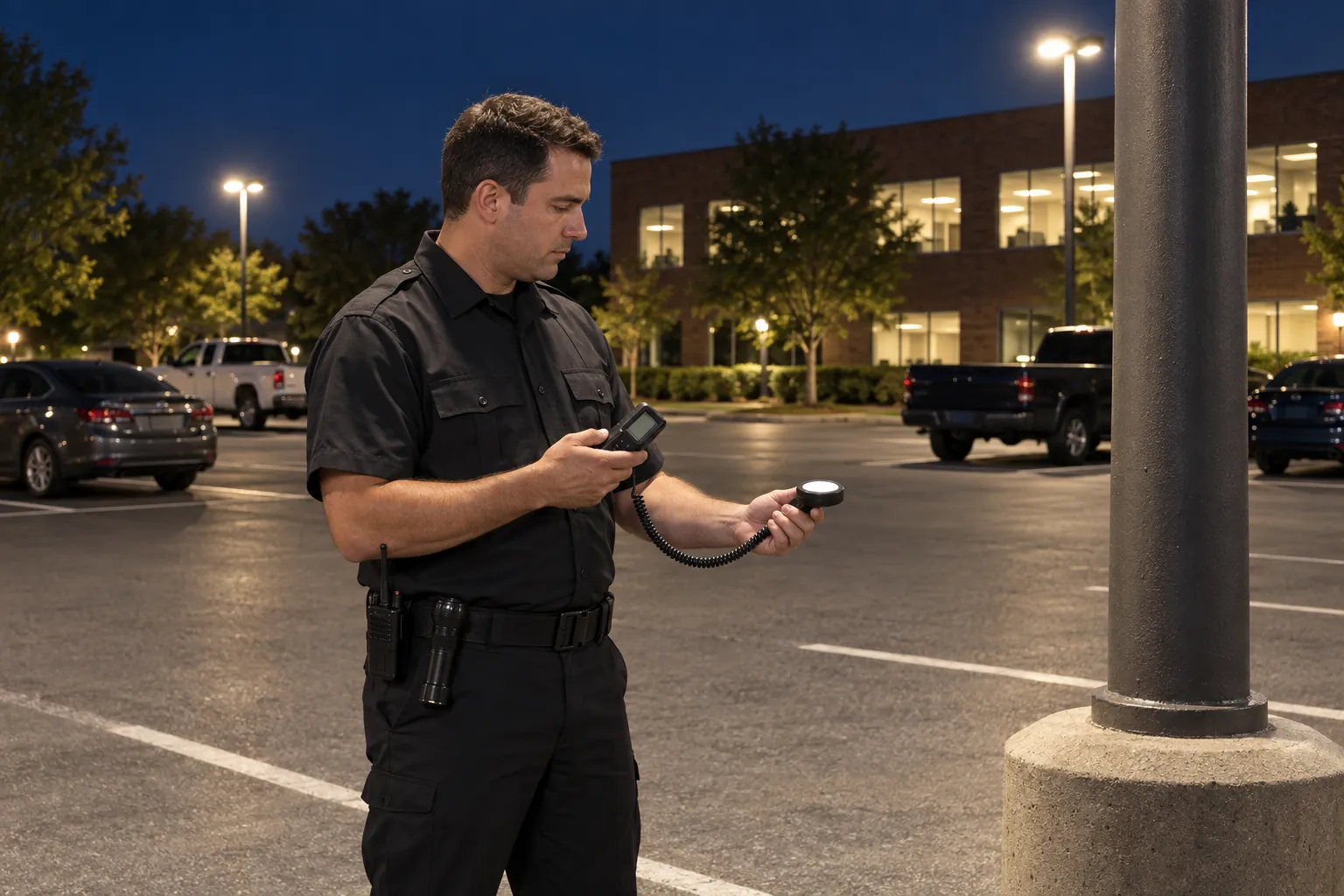
It finds the burned-out pole head, the wall pack hidden by a tree, the photocell that switches on an hour late and the dark stretch between two fixtures. Done with a light meter and a map, it also gives you readings you can compare from one survey to the next. This guide covers what the rules say in the United States, what a survey should cover, how to take the readings, how often to do it, and how to keep a record that shows it happened.
01
What a lighting survey is, and which rules apply
A security lighting survey, sometimes called a night lighting audit, checks that exterior lighting lets people see where they are walking, recognize a face, and lets cameras and officers see what is happening. A designer calculates what new fixtures should achieve; a survey finds out what the installed lighting delivers tonight, after years of dirt, aging and tree growth.
The same name is used for an energy lighting survey, which inventories the existing lights to find cost and energy savings from LED lighting, more energy efficient fixtures or better controls. This guide is about the security survey, though a night walk often turns up the same opportunities, such as lights burning all night in empty spaces.
No single federal rule sets exterior light levels for an ordinary commercial property. What applies comes in four kinds.
- Specific state laws for specific businesses. Florida's Florida Statutes section 812.173, Convenience business security, requires every convenience business, as the law defines it, to have "a lighted parking lot illuminated at an intensity of at least 2 foot-candles per square foot at 18 inches above the surface." California's California Financial Code section 13041 sets minimums during the hours of darkness at an automated teller machine: "a minimum of 10 candlefoot power at the face of the automated teller machine and extending in an unobstructed direction outward five feet," two candlefoot power within 50 feet, and two candlefoot power in the part of the defined parking area within 60 feet of the machine.
- Premises liability. Most of the law on a property owner's duty toward visitors is state law, much of it decided by courts rather than written in statutes, and it differs from state to state. California's California Civil Code section 1714 states the general principle: everyone is responsible for an injury caused to another "by his or her want of ordinary care or skill in the management of his or her property or person." Florida's Florida Statutes section 768.0705, Limitation on premises liability, shows how the two meet: a convenience business that "substantially implements" the security measures in sections 812.173 and 812.174, lighting included, gains "a presumption against liability" for criminal acts by third parties on the premises.
- Workplace safety. For general industry, OSHA's 29 CFR 1910.37, Maintenance, safeguards, and operational features for exit routes, says "each exit route must be adequately lighted so that an employee with normal vision can see along the exit route," and that each exit sign must be illuminated to at least five foot-candles (54 lux). On construction sites, 29 CFR 1926.56, Illumination, sets minimum foot-candle levels in its Table D-3 for construction areas, ramps, runways, corridors, offices, shops and storage areas. OSHA's State Plans page lists the 22 State Plans (21 states and Puerto Rico) that cover private employers, so check which rules apply in yours.
- Local codes and lighting standards. Many cities and counties set parking lot lighting in their zoning or development code, often with limits on glare and light spill. The Illuminating Engineering Society (IES) publishes the recommended practices designers work from, including RP-20 for parking facilities and G-1 on security lighting. They are paid documents, not law until a code or contract adopts them.
Whatever the position in your state, the survey is how an owner or provider shows the lighting was looked at and the faults put right.
02
What a security lighting survey covers
Start with a site map and walk every part of the property people use after dark. A security lighting survey checklist usually covers:
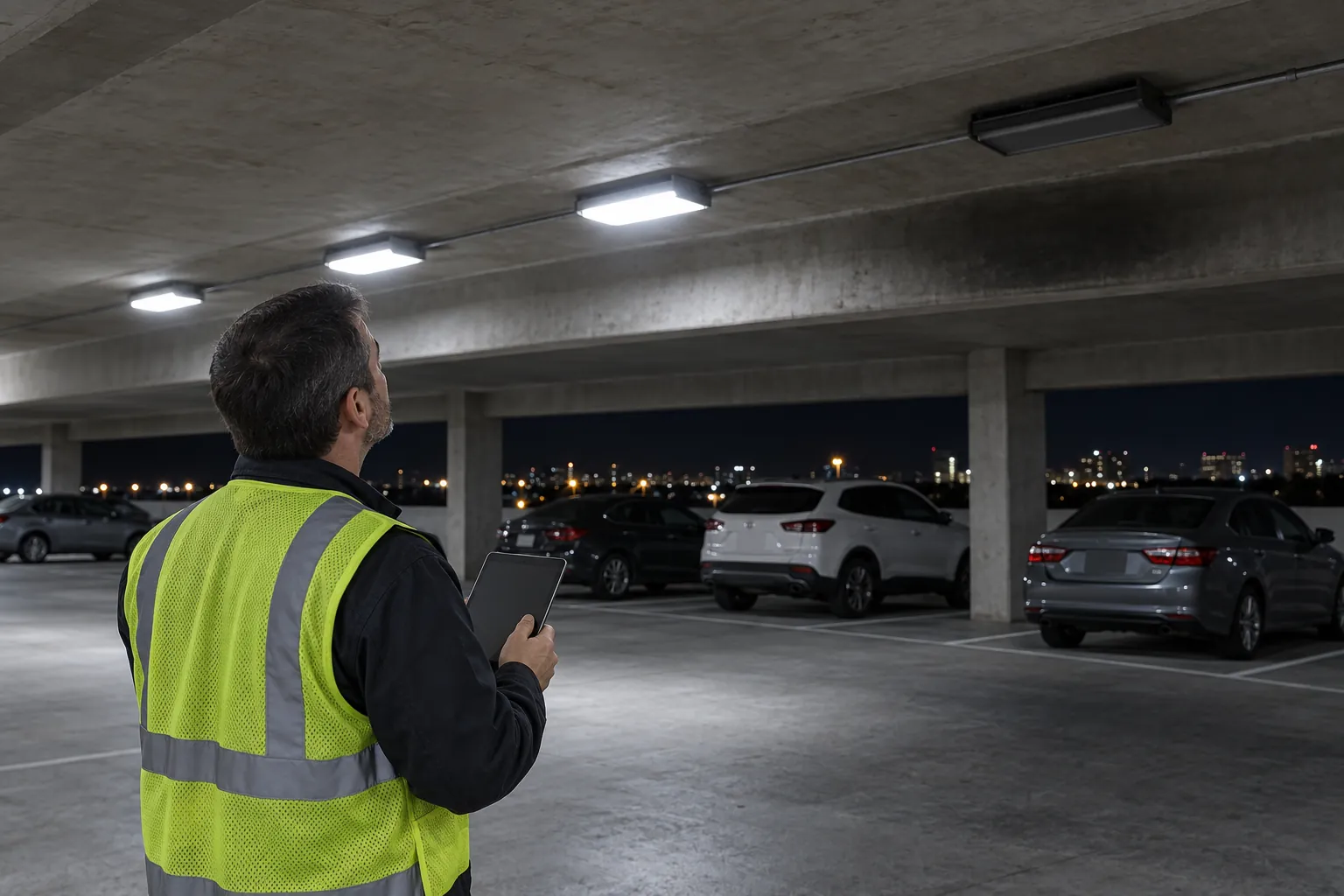
- Parking lots and garages: every pole head and ceiling fixture, garage stairwells and elevator lobbies, and the route from the car to the door. The parking lot inspection guide covers pavement and ADA items.
- Entrances and exits: main and staff entrances, and the route from every fire exit to the public way.
- Walkways: sidewalks, paths, steps and ramps, where a trip hazard in shadow matters as much as crime.
- Loading docks, dumpster enclosures and service yards: the places staff go alone at night.
- Waiting places: bus stops on the property, ride-share pickup points, ATMs, benches and smoking areas.
- The perimeter: fence lines, gates and the backs of buildings, alongside the perimeter security checklist.
- Camera fields of view: whether each exterior camera has enough light, without glare, to show what it is there to show. The security camera checks guide covers the cameras themselves.
- Signs: illuminated exit signs, address numbers and wayfinding that people need to read at night.
At each place, the surveyor looks for the same things:
- Outages: fixtures out, cycling on and off, or flickering.
- Dark spots: gaps between fixtures, corners the light never reaches, and shadows cast by walls, vehicles, signs or landscaping.
- Obstructions: tree canopy grown over a pole head, shrubs in front of a wall pack, a new sign or banner blocking a fixture.
- Glare: fixtures aimed into the eyes of drivers, pedestrians or cameras, which can make it harder to see rather than easier.
- Controls: photocells and timers that switch lights on too late or off too early, after a power outage or a change to daylight saving time.
- Damage: broken lenses, loose heads, missing hand-hole covers and exposed wiring, which go to an electrician, not the surveyor.
- Light spill onto neighbors' windows, which may breach a local ordinance.
The Center for Problem-Oriented Policing's guide Improving Street Lighting to Reduce Crime in Residential Areas makes a point every surveyor should remember: glare and high light levels that make it harder to see can increase fear, while uniform lighting that eliminates both glare and dark shadows can make people feel more secure. More light is not always better light.
03
Taking the readings: meters, grid points and heights
A walk-through with notes finds outages and obstructions. Readings with a light meter tell you whether the lighting that is working is enough. Exterior light is usually measured in the United States in foot-candles (fc); one foot-candle is about 10.76 lux. Where a statute or a design sets a number, you need readings to show you meet it.
A practical method for a property team:
- Use a meter that reads low levels. Exterior security lighting is often a fraction of a foot-candle to a few foot-candles, so choose an illuminance meter with a resolution of at least 0.1 fc. Keep a note of its make, model and calibration date.
- Survey in full darkness, at least an hour after sunset, with the lights at their normal night setting.
- Fix the measuring points. Mark numbered points on the site map: under each pole, midway between poles, at the darkest spot, at each entrance and waiting place. Use the same points every time.
- Measure at a consistent height. Horizontal readings are taken with the sensor level and facing up, at grade or at a stated height. If a statute names a height, use it: Florida's convenience business law measures at 18 inches above the surface. Write the height on the form.
- Add vertical readings where faces matter. At entrances, ATMs and camera positions, a reading with the sensor held upright, facing the direction people approach from, says more about whether a face can be seen than a reading at the ground.
- Keep your own shadow off the sensor, hold the meter at arm's length, and let it settle before you note the figure.
- Work out the spread, not just the average. The lowest reading in an area matters as much as the average. Many designers compare the average or maximum reading with the minimum (a uniformity ratio): a high ratio means bright pools with dark gaps between them.
04
How often to survey, and who does what
Lighting fails a fixture at a time, invisibly in daylight, so an annual survey alone misses months of outages. Check at three levels:
- Every night, or every patrol: a quick look for outages on the security officer's first round after dark, written into the post orders. The officer does not measure anything; they note each fixture out by its pole or fixture number and report it.
- Monthly: a full walk of the property after dark by the facility manager, building engineer or security supervisor, with the site map, checking every fixture, the controls and the obstructions.
- Once or twice a year, and after changes: a measured survey with a light meter at the fixed points, repeated after a relamping, an LED retrofit, new landscaping, construction or an incident.
Where a state statute sets a minimum, as Florida's does for convenience businesses and California's does around ATMs, the measured survey is the evidence that you meet it, so its frequency should be set with that in mind. Ask your insurer or counsel how often they expect it.
Decide in advance who owns each part:
- The property owner or manager owns the lighting and the budget for fixing it, and decides the standard it should meet.
- The facility manager or building engineer keeps the site map, the fixture numbers and the survey schedule, raises work orders and chases the electrical contractor.
- The security provider reports what its officers see on patrol, and can carry out the monthly walk if its contract says so. If lighting checks are part of the security contract, name them in the scope and the post orders.
- A licensed electrician or the lighting vendor does every repair. Nobody else opens a fixture or a pole.
05
What a lighting survey report should show, and fixing what it finds
A survey report does not need to be long, but it needs to be specific enough that the contractor goes to the right pole and the next surveyor can compare. A good one shows:
- When: the date, the start and end time, and the conditions (clear, rain, fog, snow cover).
- Who: the name of the person who walked it, and anyone who helped.
- How: the meter used, its calibration date and the measuring height.
- Where: the site map with numbered points and fixture numbers.
- What was found: each reading against its point, each fault against its fixture, with a photo where it helps.
- What was done: the work order for each fault and the date it was fixed.
- What stays open: faults waiting for parts, a tree trim, a dark area that needs a new fixture.
Treat faults in order of risk. A dark entrance, garage stairwell or route from the lot to the door is urgent: raise the work order that night and, until it is fixed, consider temporary lighting or closing that area. A dark area that has never been lit properly is a design question for the owner, not a repair.
A fault is not fixed until someone has seen the light working after dark. After an LED retrofit, re-measure at the same points: new fixtures can leave gaps the old ones filled.
Keep the reports. After an incident, the questions will be what the lighting was like that night, when it was last checked and what was done about the faults found; dated surveys and work orders answer them. The Center for Problem-Oriented Policing's guide Thefts of and from Cars in Parking Facilities lists poor lighting among the conditions that make parking lots vulnerable, and notes that high-quality lighting improves natural surveillance.
06
Where the lighting record fails, and what SiteClara does about it
Lighting records fail in familiar ways. The officer notices the pole out by the dumpster enclosure and mentions it at pass-down, and it stays out for three weeks because nobody raised a work order. The monthly night walk is on the list but nothing shows it happened. After an incident, nobody can say when the lights in that corner were last checked.
SiteClara works on those gaps. A printed QR poster at a location, with an optional NFC tag behind it, lets staff scan or tap with their own phone, with no app to install. For lighting, that might be a poster at the security booth, the garage stair lobby, the loading dock and the staff entrance. Staff see the checks due there, such as the first round after dark or the monthly lighting walk, and mark each one done or say what stopped them, with a photo when one is asked for. A fault found on the round, such as a fixture out or a wall pack hidden by a tree, is reported with a photo and stays on the team's list of jobs until someone closes it.
The supervisor sees what was due, done and missed, and records the reason a check was missed. A job the team cannot fix itself, such as a pole that needs the electrical contractor or a new fixture that needs the owner's money, can be escalated to the building manager to answer. Each day the supervisor reviews and approves a report that goes to nominated management or client contacts at 8 a.m. the next morning, showing what was reported, what was completed and what is still open.
07
Questions people ask
What is lux in lighting?
Lux (lx) is the SI unit of illuminance, the amount of light falling on a surface: one lux is one lumen per square meter, as Table 3 of the NIST Guide to the SI, Chapter 4 sets out. In the United States, light levels are more often given in foot-candles, and the NIST Guide to the SI, Appendix B.9 gives the conversion: one foot-candle equals about 10.76 lux.
How do you check a lighting level?
You check a lighting level with a light meter held at the surface you care about. OSHA's letter of interpretation Requirements for minimum illumination at construction sites (May 8, 1991) says the existing illumination level at a work surface "is best measured with a light meter reading in lumens per square foot which are equal to foot-candles." For a survey, take the readings at fixed, numbered points, at a stated height and in full darkness, so one survey can be compared with the next.
What is adequate lighting in the workplace?
OSHA does not set one light level for every workplace; its standards set lighting for particular cases, such as exit routes and construction sites. Its letter of interpretation OSHA accepts employers' use of the ANSI/IES-RP-7-1991 (June 17, 1996) points employers to the industrial lighting consensus standard, recommending "that employers use this standard as guidelines to determine sufficient lighting required to provide for the safety and health of employees in workplaces." On construction sites, 29 CFR 1926.56, Illumination, sets minimum foot-candles by area or operation. A workplace lighting assessment checks the lighting against the level set for each area and the tasks done there.
08
Where to read more, and a checklist to take away
The Florida and California sections, OSHA's standards and the Center for Problem-Oriented Policing guides linked above are free to read on their owners' sites; the IES sells its recommended practices. Your city or county's zoning or development code will say whether it sets parking lot lighting levels or limits light spill.
Before you rely on your lighting surveys, check that:
- you know whether a state statute, local code, lease or insurer sets a lighting level for this property;
- there is a site map with every fixture numbered and fixed measuring points marked;
- officers check for outages on the first round after dark and report each by fixture number that night;
- someone walks the whole property after dark every month;
- a measured survey is done at least once a year and after any lighting, landscaping or building change;
- readings are taken at a stated height, in full darkness, with vertical readings at entrances;
- every fault has a work order, a fix date and a check after dark that it works;
- dark areas that need a new fixture go to the owner as a decision, not a repair;
- the reports are kept, dated and named, so you can show what the lighting was like on any night.
Sources
Every document this guide quotes or links to, in the order it first cites them.
- Florida Statutes section 812.173, Convenience business security leg.state.fl.us
- California Financial Code section 13041 leginfo.legislature.ca.gov
- California Civil Code section 1714 leginfo.legislature.ca.gov
- Florida Statutes section 768.0705, Limitation on premises liability leg.state.fl.us
- 29 CFR 1910.37, Maintenance, safeguards, and operational features for exit routes osha.gov
- 29 CFR 1926.56, Illumination osha.gov
- State Plans osha.gov
- Improving Street Lighting to Reduce Crime in Residential Areas popcenter.asu.edu
- Thefts of and from Cars in Parking Facilities popcenter.asu.edu
- NIST Guide to the SI, Chapter 4 nist.gov
- NIST Guide to the SI, Appendix B.9 nist.gov
- Requirements for minimum illumination at construction sites osha.gov
- OSHA accepts employers' use of the ANSI/IES-RP-7-1991 osha.gov
Related guides
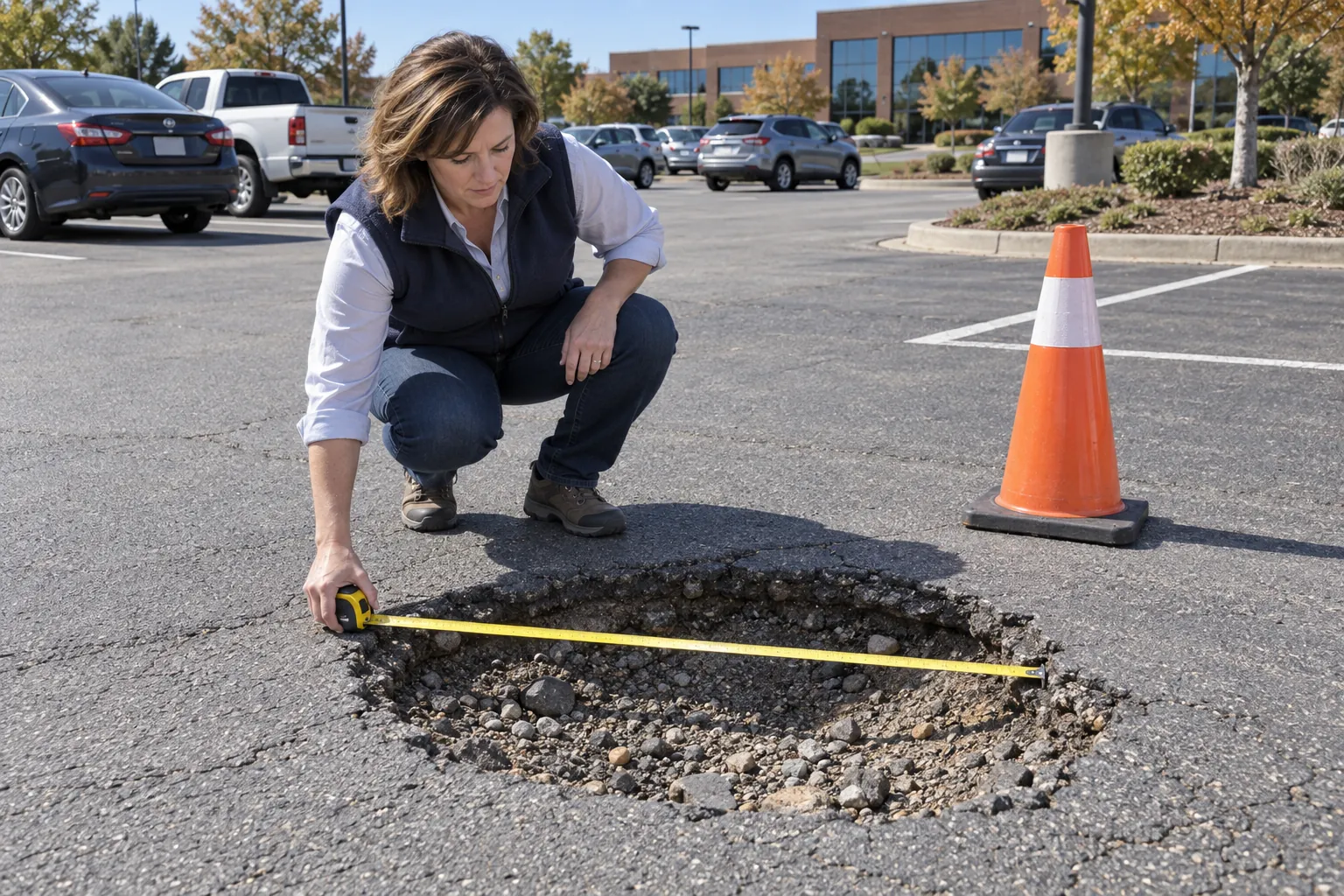 Premises and facilities managementParking lot inspection checklist: what to check, how often, and what to recordA parking lot inspection checklist for commercial property: pavement, striping, ADA spaces, lighting and drainage, how often to check, and a record that holds up.
 Security patrolsPerimeter security checklist: how to inspect a fence line, its gates and the ground around itA perimeter security checklist for US sites: what a fence inspection covers, gates and barriers, how often to walk the line, and the record that shows it was done.
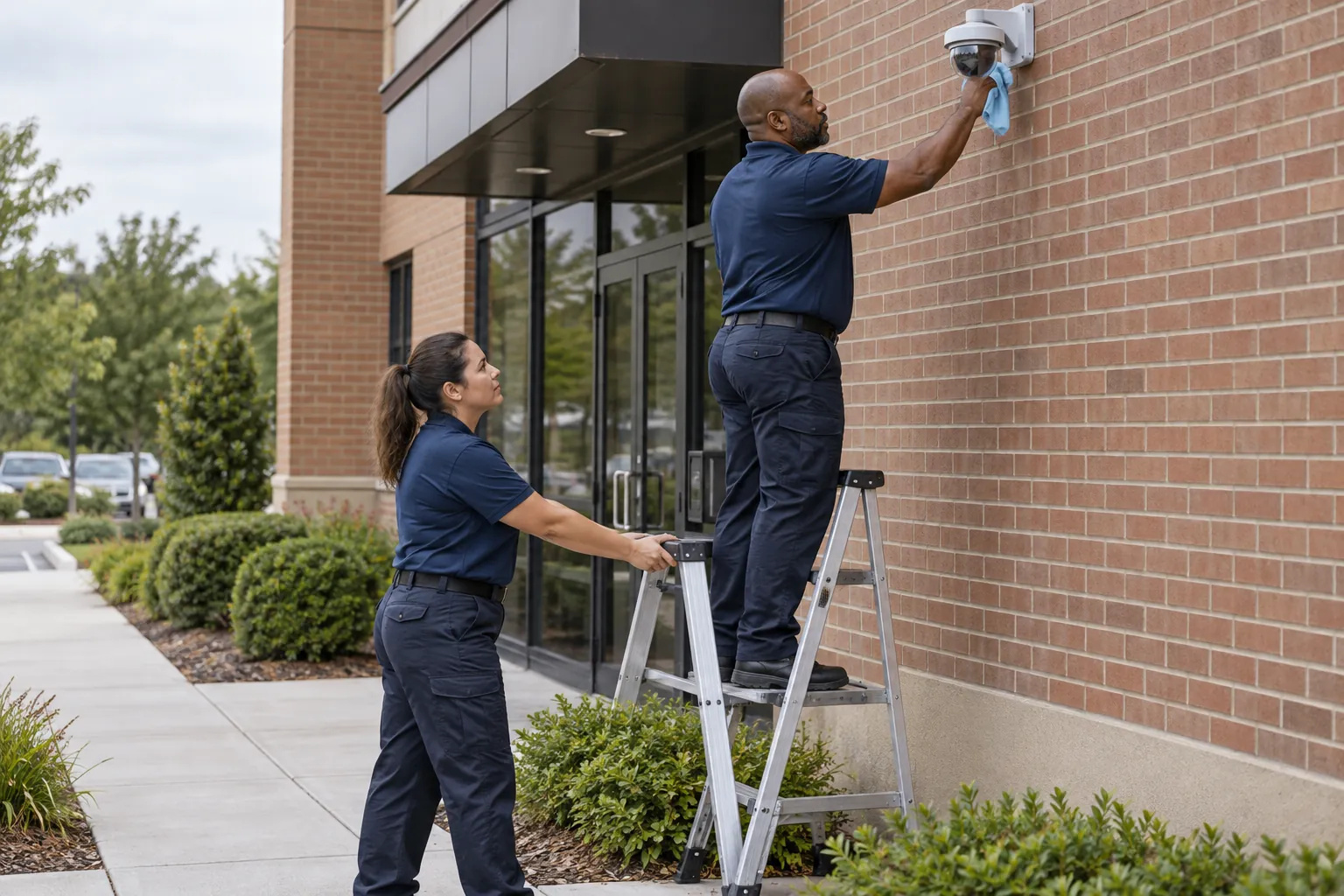 Security patrolsSecurity camera checks: a CCTV maintenance checklist that finds the dead camera firstA CCTV maintenance checklist for US buildings: daily, weekly and monthly camera checks, who owns each fix, privacy and audio rules, and a record that holds up.
 Security patrolsBuilding security checklist: what to check, when to check it, and how to show it was doneA building security checklist for US offices, schools and commercial buildings: doors, locks, lights, cameras, alarms and exits, when to check them and the record.