Security patrols
The security guard contract: what a security services agreement should say
A security guard contract is a legally binding service agreement in which a licensed security company agrees to supply officers to protect a client's people and property, and sets out the posts, hours, duties, performance standards, price and who carries the risk when something goes wrong.

Most disputes over contract security come back to a vague answer on one of those points. This guide covers what a security services agreement in the United States should say, the state licensing laws that sit underneath it, and how to write the staffing, reporting, insurance and exit terms so both sides can see whether the service was delivered.
01
What a security guard contract is, and which law governs it
A security guard contract (also called a security services agreement or guard service agreement) is a commercial contract between a client and a contract security company. The company supplies licensed officers to protect people and property at the client's premises: a lobby post, a roving patrol, a parking structure or an overnight fire watch. The client pays for hours or posts; the company employs, trains, supervises and insures the officers.
No federal statute prescribes what a guard contract for an ordinary commercial building must say. The contract is governed by state contract law, and the company by the state's private security licensing statute, which decides who may lawfully sell guard services at all. Three large states show the pattern:
- California. The Private Security Services Act in the Business and Professions Code regulates the private patrol operator. Business and Professions Code section 7582.1 defines one as a person who, "for any consideration whatsoever," agrees to furnish or furnishes "a watchman, guard, patrolperson, or other person to protect persons or property." Under section 7582.3, nobody may engage in that business without a license unless specifically exempted, and a violation is a misdemeanor. The Bureau of Security and Investigative Services (BSIS) issues the licenses.
- Florida. Chapter 493 of the Florida Statutes defines a security agency in section 493.6101 as any person who, for consideration, advertises as providing or is engaged in the business of furnishing security services. Section 493.6301 requires the agency to hold a Class "B" license and each individual security officer a Class "D" license, with a Class "G" license for anyone who bears a firearm.
- New York. The Security Guard Act, in Article 7-A of the General Business Law, sets registration and training for the officers themselves. General Business Law section 89-g says that "no security guard company shall knowingly employ a person as a security guard" unless the company has verified a valid registration card or filed the application for one. The Department of State licenses the companies and registers the guards.
Before you negotiate anything else, find the licensing statute for the state where the building is, and read its definitions: they decide whether the service you are buying is covered.
02
What a security services agreement should cover
A guard contract that works in practice has most of these parts, usually as a short set of general terms and a site schedule for each property:
- Parties, premises and licenses: the legal names, the addresses, and the company's state license number, with a duty to tell the client if it lapses.
- Scope of services: each post by location and hours (for example, a lobby post from 6 a.m. to 6 p.m. weekdays), each patrol with its route and frequency, and whether officers are armed or unarmed.
- Post orders: who writes them, who approves them, how they change, and a requirement that every officer reads and acknowledges them before standing a post. See the guide to security post orders.
- Staffing and qualifications: the license or registration and training each officer must hold, supervision, and the client's right to ask for an officer's removal from the site.
- Reporting: daily activity reports, incident reports with a deadline, a pass-down log and a regular performance review.
- Billing and price changes: bill rates by officer type, overtime and holiday rates, who pays for overtime the company caused, how invoices are backed by time records, and how rates move with wage laws.
- Insurance and indemnity: the policies, limits, additional insured status and who indemnifies whom.
- Use of force and authority: what officers may and may not do, and how the company reports any physical altercation or weapon discharge.
- Term, termination and transition: the length of the contract, the renewal notice date, termination for cause and for convenience, and how keys, access cards, post orders and records are handed over.
The site schedule matters more than the general terms. "Security services as required" cannot be enforced against either side; "one unarmed officer at the lobby desk around the clock, with a patrol of the parking lot and loading dock every two hours from 10 p.m. to 6 a.m." can.
03
Licensing, registration and training: what to check and require
The client does not hold the license, but it can pay for hiring an unlicensed operator: an uninsured incident, or an officer who should never have been on the post. Write the checks into the contract and do them before the start date.
Check the company's license yourself. Most state regulators publish a lookup. In California, BSIS points to the Department of Consumer Affairs DCA License Search; in New York, the Department of State's security guard pages link to its licensee search and online security guard registry. Keep a copy of the result on file, and put the expiration date on your calendar.
Require proof that each officer is registered. In Florida, section 493.6118 makes it a ground for disciplinary action for a licensee to employ or contract with "any unlicensed or improperly licensed person or agency" when the status "was known or could have been ascertained by reasonable inquiry." A subcontracting clause should require the client's written consent and the same license checks for any subcontractor.
Know the state's training floor. The contract can ask for more, but it should never ask for less than the law:
- In California, Business and Professions Code section 7583.6 requires a course in the power to arrest and the appropriate use of force before registration, "not less than 32 hours of training in security officer skills within six months" of the initial registration (16 of them within 30 days), and eight hours of review or practice every year.
- In New York, General Business Law section 89-n sets an eight-hour pre-assignment course, an on-the-job course of 16 to 40 hours within ninety working days of employment, and an eight-hour annual in-service course, each given by an approved school or company.
- Armed officers need whatever separate firearm license or permit the state requires (Florida's Class "G", for example), and the contract should require it to be current for every armed officer on the post.
Ask for records, not assurances. California's section 7583.2 already requires a private patrol operator to keep current records of each employee and of their completed training, and to report in writing any firearm discharge or physical altercation with a member of the public while on duty. A contract can reasonably ask for the parts that concern its site: the officers approved for the post, their registration numbers and expiration dates, and site training completed.
Site-specific training is the client's to define: the alarm panel or fire alarm annunciator, key and access card control, elevator entrapment, evacuation routes and who to call. Put it in the site schedule and require it before an officer works the post alone.
04
Posts, hours, relief and reporting: writing what the service is
Posts and coverage. List each post, its hours and whether it may be left unattended. Say who covers a post during meal and rest breaks under the state's wage and hour rules, how quickly the company fills a post when an officer calls out, and what credit the client gets for an unfilled hour.
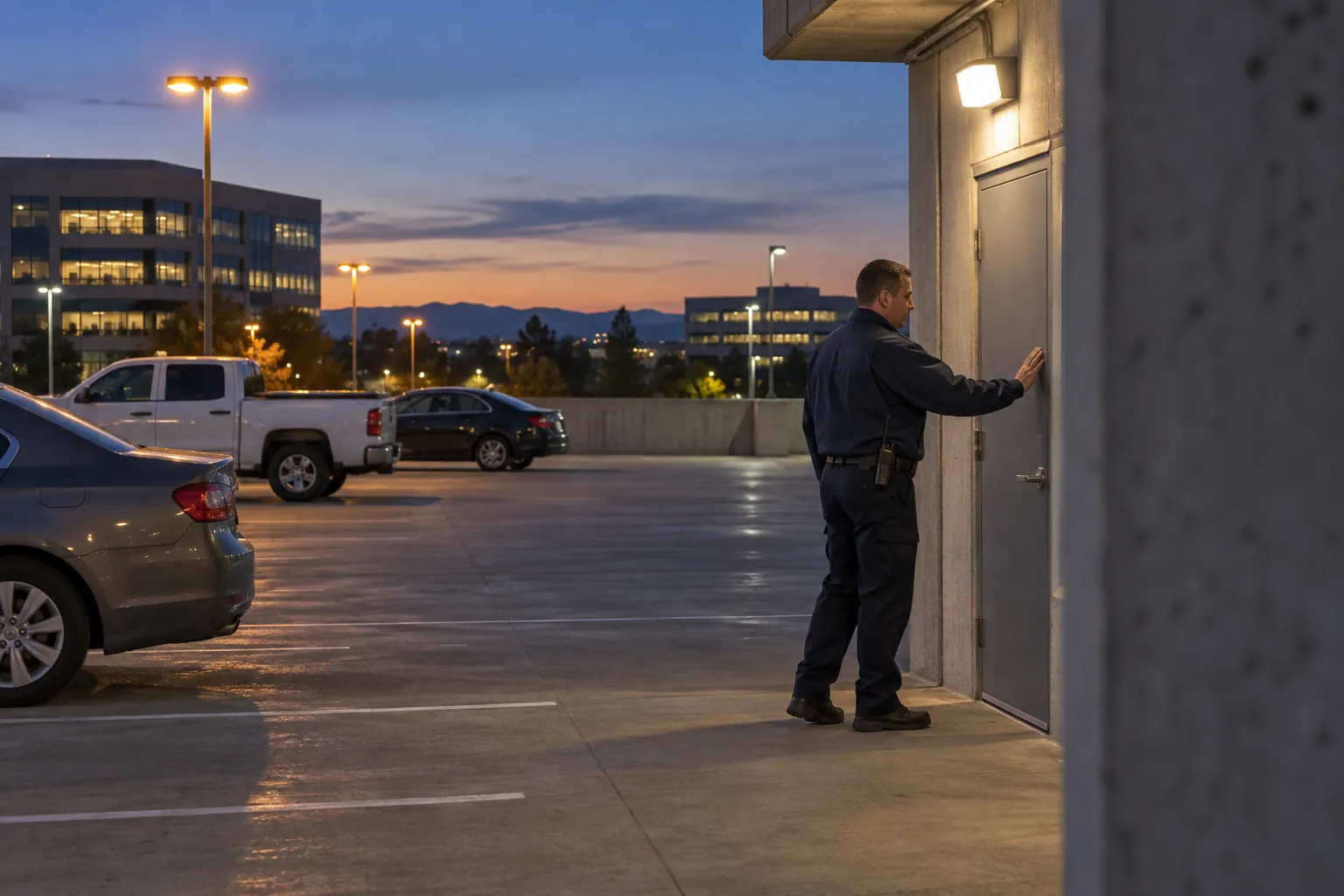
Patrols. State the route, the checkpoints, the frequency and what is checked at each point: doors locked, lighting working, fire exits clear. A frequency without a list of points cannot be measured.
Supervision. Say how often a field supervisor visits, whether unannounced, and how the visits are recorded.
Reports. Require a daily activity report for each shift, an incident report for defined events within a set time, with a call to the client for anything serious, and a pass-down log at each shift change. See the guide to the security daily activity report.
Performance measures. Agree on a short set of measures and review them monthly or quarterly: posts filled on time, patrols completed against those scheduled, reports delivered on time, incidents reported within the deadline, and client complaints. The guide to security KPIs covers how to define them so they cannot be gamed.
Public contracts. A federal service contract over $2,500, including one for guard services, is covered by the McNamara-O'Hara Service Contract Act, which requires contractors and subcontractors to pay service employees "no less than the wage rates and fringe benefits found prevailing in the locality" set by the Department of Labor's wage determination; the Department of Labor's Service Contract Act pages explain it. The price change clause should say how any such wage rule passes through.
05
Insurance, use of force, safety, term and exit
Insurance. State licensing laws set a floor, not a target. California's section 7583.39 requires a private patrol operator to file and keep on file with the bureau an insurance policy as a condition of the license, and section 7583.40 defines that policy as commercial general liability insurance with "minimum limits of insurance of one million dollars ($1,000,000) for any one loss or occurrence." Florida's section 493.6110 requires a Class "B" agency to carry a combined single-limit policy of "at least $300,000." What your building needs is for your risk manager or insurer to say: typically general liability with the client as additional insured, workers' compensation, commercial auto coverage for patrol vehicles and, depending on the service, umbrella and crime policies. Ask for certificates before the start date and at each renewal.
Indemnity. Each side usually indemnifies the other for its own negligence. Read the clause against the insurance: an indemnity the company's policy does not cover is a promise with nothing behind it. Have counsel in the state check the clause.
Authority and use of force. What a private officer may lawfully do is set by state law. The contract and post orders should say what officers do: observe and report, ask someone to leave, call the police, and when (if ever) they may physically intervene. Require any use of force to be reported to the client promptly. See the guide to the difference between armed and unarmed security before adding weapons to the scope.
Safety of the officers. The security company is the officers' employer and carries the employer's duty under section 5(a)(1) of the Occupational Safety and Health Act, the General Duty Clause, to furnish a place of employment "free from recognized hazards that are causing or are likely to cause death or serious physical harm." OSHA's workplace violence page notes that "there are currently no specific OSHA standards for workplace violence." The client controls the building, though, and OSHA's Multi-Employer Citation Policy (CPL 02-00-124, 1999) describes creating, exposing, correcting and controlling employers on a shared worksite. Say who fixes a hazard on a patrol route, such as a dead light in a parking structure. In a state plan state, such as California, the state's own rules apply; see the guide to California's workplace violence prevention plan.
Term and exit. Put any automatic renewal notice date on the calendar. Include termination for cause with a cure period and termination for convenience on stated notice, so a failing contract need not be proved in court before it ends. Many guard contracts restrict hiring the company's officers or charge a conversion fee; read that clause, because at a changeover the officers who know the building are often worth keeping. Require the outgoing company to hand back every key, access card, the post orders, open incident files and the site records on the last day, against a signed list.
06
Where the record fails, and where SiteClara fits
Most guard contracts are not lost on the bill rate. They are lost on a slow run of doubts: a loading dock door found unlocked in the morning, a monthly review where the daily activity reports say "patrols completed, all secure" every night and nobody can tell which doors were checked, when, or by whom. The contract promised a patrol every two hours; the evidence is a sentence. The same gap hurts the security company: a crew that walked every round on time has nothing better to show than one that did not.
SiteClara is built to close that gap. A printed QR code poster at each checkpoint the post orders name, with an optional NFC tag behind it, lets officers scan or tap with their own phone, with no app to install, to see the checks due at that point and mark them done, or say what stopped them, such as a locked gate. The named officer and the time are recorded as it happens, with a photo when one is asked for. A problem found on the round, such as a door that will not latch or a light out in the parking structure, is reported there and goes on the team's list of jobs until someone closes it, and a job that needs the building's manager can be escalated to them to answer.
The security supervisor sees what was due, done and missed, with the reason where one was given, and approves a daily report that goes to nominated managers or client contacts the next morning: what was reported, completed and still open, and how the scheduled checks went. That gives the contract's performance review something to work from.
07
Questions people ask
How do you win security guard contracts?
First hold the license the state requires to sell guard services: in California, for example, Business and Professions Code section 7582.3 makes it a misdemeanor to run a private patrol business without one. To bid on federal contracts, a company also needs an entity registration in SAM.gov; the SAM.gov Entity Registration page says that "a registration allows you to bid on government contracts and apply for federal assistance."
How much does a security guard get paid?
The Bureau of Labor Statistics' Occupational Outlook Handbook entry for security guards and gambling surveillance officers reports that the median annual wage for security guards was $38,020 in May 2025. Pay on a federal guard services contract follows the Department of Labor's wage determination under the Service Contract Act, as the Department of Labor's Service Contract Act pages explain, and federal and state minimum wage laws set the floor on other contracts.
08
Further reading, and a list to take away
Start with the licensing statute and regulator for the state where the building is: in California, the Bureau of Security and Investigative Services; in Florida, Chapter 493 of the Florida Statutes; in New York, the Department of State's security guard pages. Have counsel in the state review the indemnity, insurance and termination terms.
Before you sign a security guard contract, check that it:
- names the parties and the premises, and states the company's license number, which you have checked with the state regulator;
- lists each post and patrol with its hours, route, checkpoints and frequency, and says whether officers are armed;
- requires every officer to hold a current state registration or license and the state's training, plus site-specific training, before standing a post alone;
- says who approves the post orders, and sets out reports, deadlines and a regular performance review;
- prices overtime and extra coverage, and says how rates move with wage laws;
- requires insurance at the limits your insurer advises, and an indemnity the insurance supports;
- limits use of force to what the post orders allow, and requires prompt reporting of any incident;
- controls subcontracting, and provides termination for cause and for convenience with a clean handover.
Sources
Every document this guide quotes or links to, in the order it first cites them.
- Business and Professions Code section 7582.1 leginfo.legislature.ca.gov
- Section 7582.3 leginfo.legislature.ca.gov
- Section 493.6101 leg.state.fl.us
- Section 493.6301 leg.state.fl.us
- General Business Law section 89-g nysenate.gov
- DCA License Search search.dca.ca.gov
- Security guard pages dos.ny.gov
- Section 493.6118 leg.state.fl.us
- Business and Professions Code section 7583.6 leginfo.legislature.ca.gov
- General Business Law section 89-n nysenate.gov
- Section 7583.2 leginfo.legislature.ca.gov
- Department of Labor's Service Contract Act pages dol.gov
- Section 7583.39 leginfo.legislature.ca.gov
- Section 7583.40 leginfo.legislature.ca.gov
- Section 493.6110 leg.state.fl.us
- Occupational Safety and Health Act osha.gov
- Workplace violence page osha.gov
- Multi-Employer Citation Policy osha.gov
- SAM.gov Entity Registration page sam.gov
- Occupational Outlook Handbook entry for security guards and gambling surveillance officers bls.gov
- Bureau of Security and Investigative Services bsis.ca.gov
Related guides
 Security patrolsSecurity post orders: what they should say, and how to know they are followedSecurity post orders in the US: what they are, what state rules say, what to include, how to write, sign and review them, and how to check they are followed.
 Security patrolsSecurity guard RFP: how to write one, and how to choose the right bidHow to write a security guard RFP in the US: the scope and post schedule, what bidders must submit, how to compare pricing and score proposals fairly.
 Security patrolsSecurity KPIs: what to measure, and how to know the figures are trueThe security KPIs worth measuring on a guard services contract, how to define and verify them, the licensing and training measures, and how green figures mislead.
 Security patrolsSecurity daily activity report: what to include, and how to write one that holds upThe security daily activity report (DAR): what to record, how to write entries that hold up, how it differs from an incident report, and how to review and keep it.