Security patrols
Armed vs unarmed security: what each requires, and how to choose
An armed security guard usually needs a state firearm permit or license on top of the basic guard registration, while an unarmed security guard holds the basic registration and works without a firearm.

Whether a post should be armed is one of the first questions a client asks a security company, and one of the hardest to answer well. An armed officer is not simply an unarmed officer with a gun: the state license, the training, the screening, the records and the liability when something goes wrong are all different. This guide sets out what US state law requires of armed and unarmed security officers, the questions that decide which a site needs, and how either kind of post is written down and checked.
01
What separates an armed security officer from an unarmed one
There is no federal license for private security officers. Each state decides who may work as a guard and on what terms, and nearly every state that licenses guards treats carrying a firearm as a separate, higher authority on top of the basic registration. The Bureau of Labor Statistics puts it plainly in its Occupational Outlook Handbook entry for security guards: some guards carry firearms, guards who carry weapons usually must be licensed by the appropriate government authority, training is more rigorous for armed guards because they need weapons training, and positions for armed guards have more stringent background checks and entry requirements than those for unarmed guards.
An unarmed security officer holds the state's basic guard registration or license and works without a firearm. Depending on the state and the employer, unarmed guards may still carry a radio, a flashlight, handcuffs, a baton or a chemical spray, and some states set a training rule of their own for the baton or the spray. An armed security officer holds the same basic registration plus a firearm permit or license, has passed a firearms course and a range qualification, and must keep requalifying to stay armed.
Four large states show how the second layer works:
- California. The Bureau of Security and Investigative Services (BSIS) issues the guard registration, and its security guard registration fact sheet treats the exposed firearms permit as a separate credential, with separate courses required to carry a baton or tear gas. Under Business and Professions Code section 7583.23, the Bureau issues a firearms permit only to a licensee, qualified manager or registered guard who is at least 21, has completed a Bureau-certified firearms course and written examination within the previous six months, and has been investigated; a registered guard must also show appropriate judgment, restraint and self-control for carrying and using a firearm.
- Florida. An unarmed officer needs a Class "D" license, which under section 493.6303, Florida Statutes, requires at least 40 hours of professional training. Section 493.6115 adds that any licensee who bears a firearm must also hold a Class "G" license, and that no employee may carry a weapon or firearm unless their duties require it. Chapter 493 sets 28 hours of range and classroom training for the Class "G" license, 8 of them in-person range training, and at least 4 hours of firearms requalification training in each year of the license.
- New York. The Department of State's security guard training requirements are the same 8-hour pre-assignment course, 16-hour on-the-job training and 8-hour annual in-service course for both kinds of guard. An armed guard adds a 47-hour firearms course, which needs a valid New York State pistol permit and a security guard registration to enroll, and an 8-hour annual firearms course every calendar year, and applies for an armed guard registration upgrade.
- Texas. The Department of Public Safety licenses noncommissioned and commissioned security officers. Its training and continuing education page requires the Level II course of every noncommissioned officer, and the Level III course, at least 45 hours with a test that includes a course of fire, of every commissioned officer. Firearm proficiency must be shown within 90 days of the application date.
Elsewhere the names change, but the pattern holds: read the state's private security statute before a contract promises an armed officer. The rules above are the versions published in September 2026, and they change: California's firearms permit section, for one, was last amended with effect from January 2025.
02
What changes when a post is armed
The firearm is the visible difference. The rest lands on the officer, the company and the client:
- The officer. An older minimum age in some states (21 for a California firearms permit), a deeper background check, a firearms course and range qualification before the first armed shift, and regular requalification after it. An officer whose firearm permit lapses is, for that day, an unarmed officer, whatever the schedule says.
- The company. California's Business and Professions Code section 7583.2 is a good example of what follows: a licensee must keep an accurate and current record of all firearms and other deadly weapons in its possession or carried by employees on duty, report a missing weapon to law enforcement within seven days, confirm an employee is proficient with each weapon before letting them carry it, and deliver a written report to the director within seven business days of any firearm discharge or physical altercation with a member of the public while on duty.
- The post. Where the weapon is stored between shifts, how it is handed over, whether the officer may leave the post with it, and who is allowed to relieve them. An unarmed officer cannot cover an armed post without leaving it, in effect, unarmed.
- The client. A more expensive post, a contract that says who owns the firearms policy, and a closer interest in who is standing in the lobby. The client's insurer may have a view on liability too, and is worth asking before deciding.
Unarmed does not mean unequipped or untrained. Most of what any officer does – access control, patrols, alarm response, visitor help, reporting – is the same armed or not, and in states such as California an unarmed officer still needs a course for a baton or tear gas.
03
How to decide whether a site needs armed security
State licensing laws say what an armed officer must hold. For most businesses – an ordinary office, retail store, warehouse, campus or apartment building – they do not say when a site must have one. That decision is usually the owner's or the client's, made with their security provider, and sometimes settled by a contract, an insurer or the rules of a regulated sector. The useful way to make it is the same way any security measure is chosen: start from the risk, not from the weapon.
OSHA's workplace violence page notes that there is currently no specific OSHA standard for workplace violence, and it lists the factors that raise the risk: exchanging money with the public, working alone or in isolated areas, working where alcohol is served, and working late at night or in high-crime areas. Those factors are a reasonable place to begin the assessment for any site. The questions that usually decide the answer are these:
- What is being protected? Cash, pharmaceuticals, firearms, high-value retail goods or critical equipment attract different threats from an office lobby. Protecting people and protecting property may point to different answers.
- What has actually happened here? Incident history, police calls and the pattern of trespass or theft on the site and nearby, from records rather than impressions.
- What will the officer be asked to do? A post that is mostly visitor management, customer service and fire watch rarely needs a firearm; a post expected to face armed robbery or to protect a cash movement may.
- How fast will help arrive? A remote site with long police response times is a different case from a downtown building with a patrol car minutes away.
- Who else is there? Schools, hospitals, shelters, houses of worship and busy public spaces raise the stakes of any use of force, and of an officer who is visibly armed.
- What else would reduce the risk? Lighting, locks, access control, cameras, cash handling procedures, a second unarmed officer or a mobile patrol may do more for less. An armed officer is one countermeasure among many.
- Can the provider support it? Enough licensed armed officers for every shift, including relief and sick-leave coverage, supervisors who understand the firearms policy, and training kept current.
For federal buildings there is a published benchmark. The Interagency Security Committee's best practice, Armed Contract Security Officers in Federal Facilities (2019 edition), describes the armed officer as a countermeasure to deter, detect, delay, deny and diminish threats, and recommends minimum criteria for the officers who do it: a minimum of 64 hours of weapons and use of force training, covering defensive tactics, handcuffs, non-lethal weapons and firearms, firearms qualification every six months, annual refresher training, and written use of force guidance at every post. It applies to facilities occupied by federal employees for non-military activities and binds no private client, but it is a useful yardstick for what a serious armed program involves.
04
Writing the post: orders, force and supervision
The decision only holds if the post orders carry it. Post orders are the operational instructions for one post, and for an armed or unarmed post they should say, in plain words:
- whether the post is armed or unarmed, and what license and permit the officer must hold to stand it;
- what equipment is issued, and for an armed post, the firearm, the ammunition and the holster, how they are issued, where they are stored and how they are handed over at shift change;
- what the officer does in each likely incident – trespass, theft, a medical emergency, a fire alarm, an aggressive visitor – and at what point they stop and call the police instead;
- the use of force policy that applies, and who to report to after any use of force;
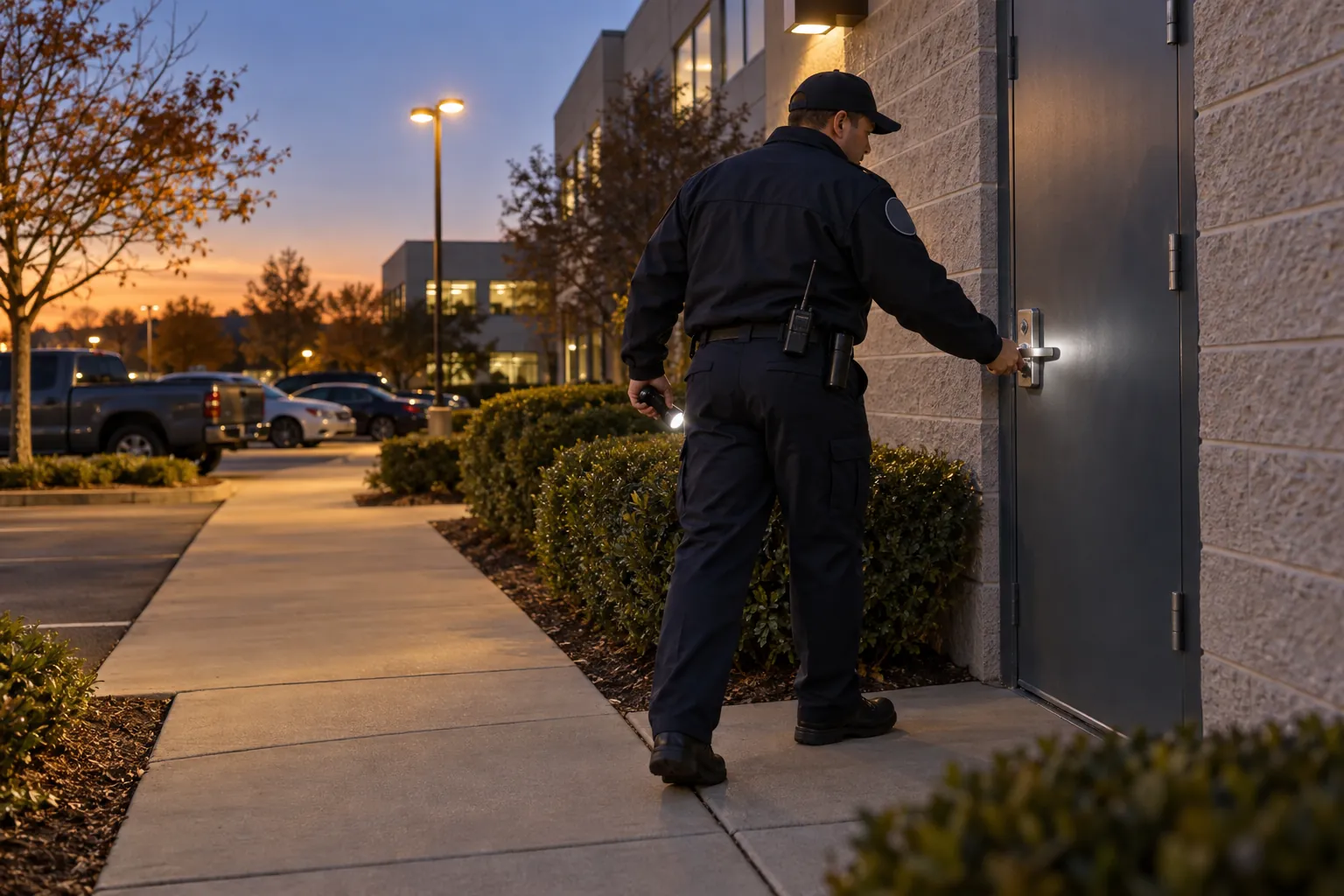
- the patrol routes, checkpoints and times, and what counts as a completed round;
- the reports the officer writes and who reads them: the daily activity report, incident reports, the pass-down log and, where there is one, the weapons log.
An unarmed post needs its limits spelled out just as clearly. "Observe and report" is a sound instruction only if the post orders say what to report, to whom and how fast, and what the officer is not expected to do.
Supervision closes the loop. A security supervisor on an armed contract checks that every officer's firearm permit and requalification are current before the schedule is published, not after an incident; that the weapons record matches what is on post; and that use of force reports are written the same shift.
05
What good records look like for either kind of post
Whether the security is working is answered by the records, not by the choice of armed or unarmed. For any post, good evidence is the patrol that can be shown to have been walked, the checkpoint that was checked at the time it was due, the incident reported the same day with what was done about it, and the fault found on a round that reached the person who could fix it.
For an armed post, add the records that follow the firearm:
- a current copy of each officer's firearm permit or license and their latest qualification certificate, checked against the state's license lookup where it has one;
- the weapons record: which firearm, which officer, issued and returned when;
- firearm discharge and use of force reports, with the regulator notified where state law requires it, as California's section 7583.2 does;
- training records for the firearms course, requalification and any intermediate weapons.
Records are only evidence if they were made at the time. A patrol log completed at the end of the shift, or a weapons record written up once a week, tells a client what the officer wanted to be true. The strongest records are made at the checkpoint, by the named officer, with the time taken by the system, and reviewed the next morning.
06
Where the record fails, and where SiteClara fits
The armed or unarmed decision tends to get a meeting, a contract clause and a price. The routine of the post gets far less attention, and that is where things usually go wrong: a round nobody can prove was walked, a fire door found propped open and mentioned in the daily activity report but never passed to maintenance, a checkpoint marked "all secure" at 5 a.m. for the whole night. None of that depends on whether the officer carries a firearm.
SiteClara gives the routine a record. A printed QR poster, with an optional NFC tag behind it, sits at each checkpoint on the patrol: a gate, a loading dock, a stairwell door, a parking garage level. The officer scans the code or taps the tag on their own phone, with no app to install, and marks the scheduled check done, or says what stopped them, such as a locked gate. The time and the named officer are recorded as it happens, with a photo when one helps. A hazard or fault found on the round is reported there and goes onto the team's list of jobs until someone closes it.
The security supervisor sees what is due, done and missed, and can record why a check was missed; a job that needs the building manager can be escalated to them to answer. At the end of the day the supervisor reviews the totals and photos, adds a note and approves the daily report, which goes to nominated management or client contacts at 8 a.m. the next morning, showing what was reported, what is still open and how the scheduled checks went.
07
Questions people ask
What disqualifies you from armed security?
It depends on the state, but the screening is stricter than for unarmed work. The Bureau of Labor Statistics' Occupational Outlook Handbook entry for security guards says most states require rigorous hiring and screening programs for armed guards, including background, criminal record and fingerprint checks. In California, Business and Professions Code section 7583.23 requires a firearms permit applicant to be at least 21, and the Bureau issues the permit only once it has determined that the applicant carrying and using a firearm presents no apparent threat to public safety. In Florida, section 493.6115, Florida Statutes, requires a temporary Class "G" applicant to be certified mentally and emotionally stable, for example by a validated written psychological test taken within the previous 12 months, and to pass a review of mental health and substance abuse data and a criminal history record check.
Do armed guards make more than unarmed?
Official figures do not say. The Bureau of Labor Statistics' Occupational Outlook Handbook entry for security guards gives one median annual wage for all security guards, $38,020 in May 2025, and does not report armed and unarmed pay separately, so any comparison of armed vs unarmed security pay comes from job listings or private surveys rather than federal statistics.
How hard is it to get into armed security?
Harder than unarmed work, and how much harder depends on the state. In New York, the Department of State's security guard training requirements add a 47-hour firearms course, open only to someone who already holds a valid New York State pistol permit and a security guard registration, and then an 8-hour firearms course in every calendar year the armed registration is held. In Texas, the Department of Public Safety's training and continuing education page requires every commissioned security officer to pass the Level III course, at least 45 hours with a test that includes a course of fire, and to demonstrate firearm proficiency within 90 days of the application date.
08
Further reading, and a list to take away
Start with the private security statute and licensing board for the state where the post is: in California the Bureau of Security and Investigative Services and the Business and Professions Code, in Florida the Department of Agriculture and Consumer Services and Chapter 493 of the Florida Statutes, in New York the Department of State, and in Texas the Department of Public Safety's private security section. BSIS publishes its security guard training requirements, including the 8-hour annual continuing training and an Annual Firearms Requalification elective course, and the Bureau of Labor Statistics describes the job and how armed and unarmed roles differ. For a benchmark of a full armed program, read the Interagency Security Committee's best practice for armed contract security officers; for the wider risk picture, OSHA's workplace violence page.
Before a post is armed, or before an armed post is made unarmed, check that:
- the reason is written down, from an assessment of what is protected, what has happened and who is present;
- other measures – lighting, access control, cameras, procedures, a second officer – have been considered;
- the provider can staff every shift, including relief, with officers holding current armed licenses or permits for this state;
- the post orders say armed or unarmed, what is carried, where it is stored and how it is handed over;
- the use of force policy is written, at the post, and understood;
- the weapons record, requalification dates and incident reporting duties are assigned to a named person;
- the patrol routes and checkpoints are defined, and there is a record made at the time that they were walked;
- the arrangement is reviewed when the site, the incidents or the tenants change.
Sources
Every document this guide quotes or links to, in the order it first cites them.
- Occupational Outlook Handbook entry for security guards bls.gov
- Security guard registration fact sheet bsis.ca.gov
- Business and Professions Code section 7583.23 leginfo.legislature.ca.gov
- Section 493.6303, Florida Statutes flsenate.gov
- Section 493.6115 flsenate.gov
- Chapter 493 leg.state.fl.us
- Security guard training requirements dos.ny.gov
- Training and continuing education page dps.texas.gov
- Business and Professions Code section 7583.2 leginfo.legislature.ca.gov
- Workplace violence page osha.gov
- Armed Contract Security Officers in Federal Facilities cisa.gov
- Security guard training requirements bsis.ca.gov
Related guides
 Security patrolsSecurity guard duties and responsibilities: what the job involves, and how it is checkedSecurity guard duties in the US: state licensing and training, patrols, access control, reports, the limits of the role, and how post duties are set and checked.
 Security patrolsSecurity post orders: what they should say, and how to know they are followedSecurity post orders in the US: what they are, what state rules say, what to include, how to write, sign and review them, and how to check they are followed.
 Security patrolsUse of force report: what a security officer writes, and who reads itHow a US security officer writes a use of force report: which state rules require one, what to include, how to write it in time order, and how it is reviewed.
 Security patrolsThe security guard contract: what a security services agreement should sayWhat a US security guard contract should cover: state licensing checks, post orders, staffing, reporting, insurance, use of force and a clean exit.