Security patrols
Use of force report: what a security officer writes, and who reads it
A use of force report is the written account an officer completes after using physical or deadly force on someone while on duty, setting out step by step what force was used, why it was used and what happened to the person.
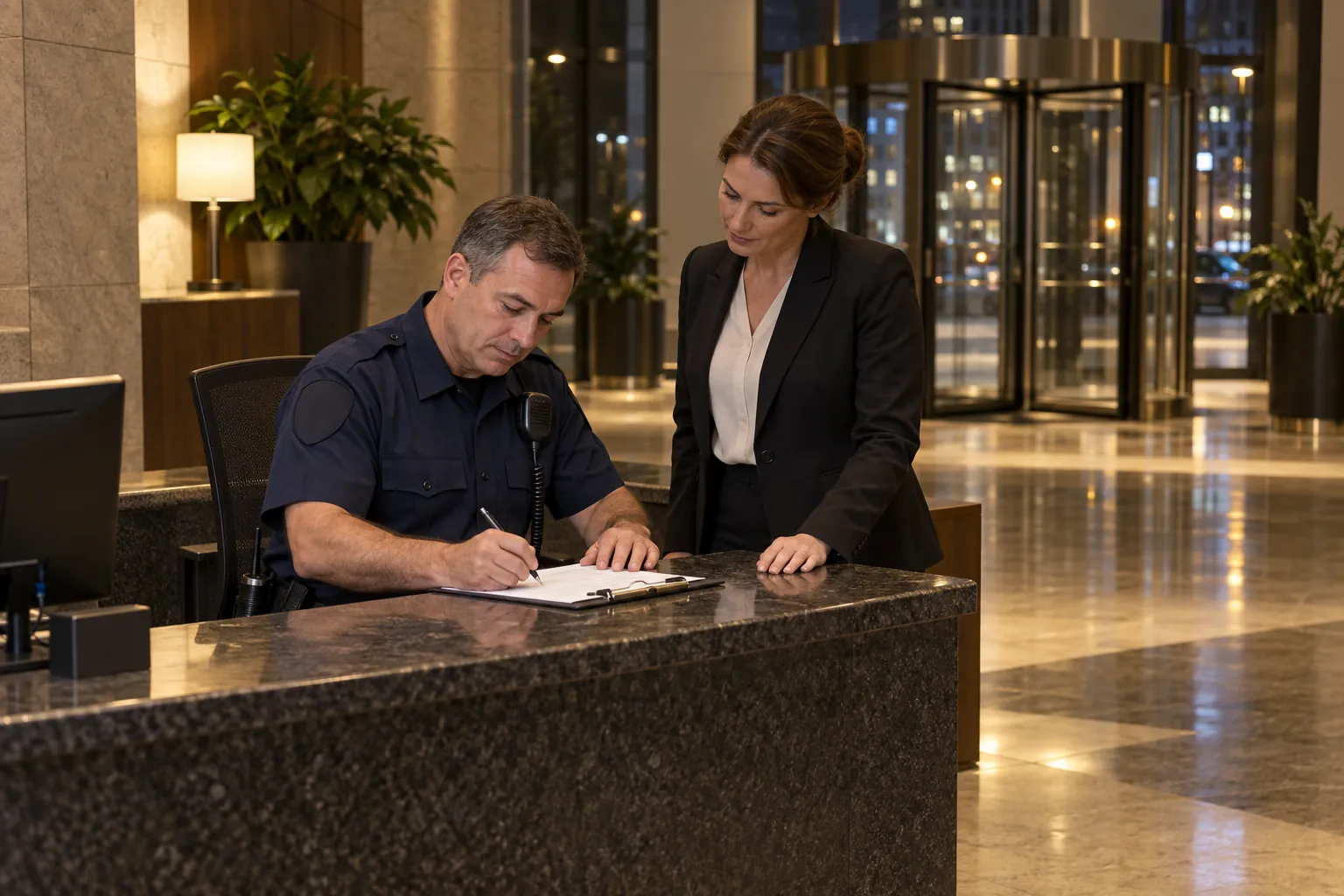
When a security officer puts hands on someone, detains them, draws a weapon or fires one, it is the account everyone else will judge the officer by: the supervisor, the client, the police, an insurer, sometimes a state licensing board or a court. This guide covers what a use of force report is in private security in the United States, which state rules require one, what it should contain, how to write it so it holds up, and how it should be reviewed once it is filed.
01
What a use of force report is, and which rules require one
A use of force report is the written account of any occasion on which an officer used physical force, or a weapon, on another person while on duty: an escort that turned into a struggle, a detention, handcuffing, a takedown, pepper spray or a baton where the officer is licensed to carry one, a firearm drawn or discharged. It is written by each officer involved, as soon as the situation is safe, and it sits alongside the security incident report for the event. The incident report says what happened on the post; the use of force report explains, step by step, why force was used, what force it was, and what happened to the person it was used on.
There is no federal standard for use of force reporting in private security. Rules written for policing govern government officers, not contract or in-house guards. A private officer usually acts with the same authority as any other member of the public. In California, for example, Penal Code section 837 sets out when "a private person may arrest another", and Penal Code section 847 requires a private person who has made an arrest to take the person before a magistrate or deliver them to a peace officer without unnecessary delay. The report is where the officer shows they stayed inside that authority.
What does regulate the report is state security licensing law, and it differs from state to state:
- California. Business and Professions Code section 7583.2 (as amended by AB 2515, effective January 1, 2023) makes it a violation for a licensed private patrol operator to fail to deliver to "the director", which section 7574.01 defines as the Director of Consumer Affairs, "a written report describing the circumstances surrounding the discharge of any firearm, or physical altercation with a member of the public while on duty" by a licensee or employee, within seven business days. For altercations, the report is required only where the altercation results in the arrest of a security guard, a police report filed by a member of the public, a member of the public needing first aid or other medical attention, the guard's discharge, suspension or reprimand, or "any physical use of force or violence on any person while on duty". The report must include "a description of any injuries or damages incurred, the identity of all participants, and whether a police investigation was conducted." It is not required when officers are asked by hospital staff to help restrain a patient for medical or mental health reasons.
- Florida. Under Florida Statutes section 493.6115, whenever a Class "G" licensee discharges their firearm in the course of their duties, the licensee and the agency that employs them must, within 5 working days, submit to the Department of Agriculture and Consumer Services "an explanation describing the nature of the incident, the necessity for using the firearm, and a copy of any report prepared by a law enforcement agency."
- Other states license officers through their own boards and set their own reporting duties, if any. Check the law of the state where the post is, not where the company is headquartered.
Where no statute requires a report, the company's policy and the client's post orders should.
02
What counts as a use of force
The policy should draw the line low and write it down, so that an officer on the night shift does not have to decide alone whether a push counted. A typical policy for a commercial building, campus, hospital or retail post asks for a use of force report whenever an officer:
- used physical contact to control someone, beyond a guiding touch that met no resistance: holding an arm against resistance, pushing, pulling someone away from another person, a takedown;
- detained or arrested someone, or physically prevented them from leaving;
- applied handcuffs or another restraint;
- used or displayed a weapon the officer is licensed and authorized by the company to carry, such as a baton, pepper spray or a firearm, including drawing a firearm without firing it;
- discharged a firearm for any reason other than authorized training on a range;
- was assaulted and defended themselves, even if the officer used no more than it took to get free;
- was involved in any contact after which someone was injured, complained of injury or asked for medical attention.
Every officer who used force writes their own report, and every officer who saw it writes a witness statement. When in doubt, write it: a missing report on a hand on an arm, when the person later complains of a shoulder injury, leaves the company with no account of what happened.
03
What a use of force report should contain
Whatever form the company uses, a use of force report should let a reader who was not there see the whole event in order and judge whether each step was reasonable. It should carry:
- The date, time and exact location: building, floor, entrance, parking level or aisle, and separately the time the report was written.
- Why the officer was there and what started it: the call, the alarm, the patrol, the request from staff, and what the officer saw or was told on arrival.
- The person's behavior, in observable terms: what they said, what they did with their hands and body, any weapon or object, how their behavior changed over time.
- What the officer tried before force: verbal instructions, warnings, distance, time, calling for backup or police. De-escalation that was tried and failed belongs in the report as much as the force that followed.
- The force used, exactly: which hold, where on the body, how long, which weapon if any, how many times, and when it stopped. "Subject was restrained" is not enough.
- Why that force, at that moment: what the officer perceived and what they were trying to prevent, in their own words.
- Injuries and medical care, to everyone involved, described plainly: who gave first aid, whether EMS was called, who was taken to a hospital.
- Everyone involved: the person, other officers, witnesses and staff, with contact details, or a physical description where a name is not known.
- Police involvement: when police were called and arrived, the responding officer's name and badge number, the case number, and to whom any detained person was handed over.
- Evidence: photographs of injuries and the scene, which cameras cover the area and whether footage was preserved, body-worn camera recordings where the company uses them, and any items taken and who now holds them.
- Notifications: supervisor, client contact, and any regulator report the company must make.
- The officer's name, license or guard card number where the state issues one, and signature, and the reviewing supervisor's name and date.
California's list for the director's report, injuries and damages, the identity of all participants and whether police investigated, is a useful floor in any state.
04
How to write it so it holds up
A use of force report is read by people looking for the weak point. The ones that hold up share a few habits:
- Write it before the end of the shift. Memory fades and hardens quickly. A report written the next week reads like a reconstruction, because it is one.
- Write in time order, in the first person. "At 9:14 p.m. I asked him to leave the lobby. He said no and stepped toward me with his fists closed." Each step with its time.
- Describe, do not label. "Aggressive", "combative" and "non-compliant" are conclusions. Say what the person did that led you to that conclusion: the words, the distance, the hands.
- Write your own account. Officers should not write a joint report or copy each other's. Two accounts that differ on small points are normal; two accounts with identical sentences suggest they were agreed.
- Include what did not happen. If no weapon was drawn, or the person was checked and had no injury, say so.
- Never rewrite a submitted report. If something was missed or wrong, add a dated addendum saying what changed and why. A quietly edited report is worse than an honest correction.
- Keep opinions about the person out of it. Their appearance, race, religion or background have no place in the report unless they are part of a description needed to identify them.
Training matters here, and some states say so. In California, Business and Professions Code section 7583.6 requires every applicant for a guard registration to complete a course in "the exercise of the power to arrest and the appropriate use of force". Section 7583.7 lists the topics the appropriate use of force training must cover, among them legal standards for use of force, the duty to intercede, objectively reasonable force, supervisory responsibilities, use of force review and analysis, and de-escalation. The bureau's security guard training requirements describe a 3-hour Power to Arrest course, a 5-hour Appropriate Use of Force course and a 4-hour Observation & Documentation course that covers report writing.
05
Review, notification and what happens next
The company's procedure should say who reviews the report and how quickly. A sound process:
- The officer tells the supervisor at once, before writing, so that medical care, police and camera footage are dealt with while they still can be.
- The security supervisor checks the scene and the people: injuries photographed, footage preserved before it is overwritten, witnesses identified.
- Reports are submitted before the officers go off duty, with witness statements attached.
- A manager reviews the use of force: was it within policy, within the officer's legal authority and proportionate to what the officer faced; was de-escalation tried; does the account match the footage. California's training topics call this "use of force review and analysis"; whatever it is called, the outcome should be written down.
- The client is told as the contract requires, usually the same day.
- Regulator deadlines are met. In California, seven business days to the director for a qualifying altercation or any firearm discharge; in Florida, 5 working days for a Class "G" licensee's firearm discharge. Put the deadline in the case file on the day.
- Follow-up is recorded: retraining, a change to the post orders, a door or camera repaired, a trespass warning issued, or no action and why.
Two other records can be triggered by the same event. If an officer is hurt, the employer's OSHA recordkeeping duties apply, and under 29 CFR 1904.39 a work-related fatality must be reported to OSHA within eight hours, and an in-patient hospitalization, amputation or loss of an eye within twenty-four hours; see the OSHA 300 log guide for the rest.
In California, Labor Code section 6401.9 requires most employers to "record information in a violent incident log for every workplace violence incident", with personal identifying information left out, and to keep the log for at least five years. An assault on an officer will often be such an incident for the security company as employer, and the client may need to log it too. The use of force report is the detailed, named account; the violent incident log is a separate, anonymized record, and the California workplace violence prevention guide covers what it holds.
Keep reports, footage references and reviews together, with restricted access and a set retention period: they name people, describe injuries and may become evidence.
06
Where the record around a use of force fails, and where SiteClara fits
The use of force report is usually written, because a supervisor asks for it. The weak records are the ones around it: whether that door was checked earlier in the night, whether the parking level lights worked, whether last week's fault was fixed. The daily activity report says "all patrols completed, all secure" every two hours, and the answer is an assurance rather than a record.
SiteClara is a way to record that routine part. A printed QR poster, with an optional NFC tag behind it, goes at each checkpoint that matters: an entrance, a stairwell door, a loading dock, a parking level. The officer scans the code or taps the tag on their own phone, with no app to install, sees the checks due at that point and marks them done, or says what stopped them. The time and the named officer are recorded as it happens, with a photo when one is asked for. A problem found on the round, such as a door that will not latch or a light out, is reported there and goes onto the team's list of jobs until someone closes it.
The security supervisor sees what was due, done and missed, with the reason where one was given, and a job that needs the building manager can be escalated to them to answer. Each day the supervisor reviews the totals and photos, adds a note and approves a report that goes to nominated management or client contacts at 8 a.m. the next morning.
07
Questions people ask
What qualifies as use of force?
For police, the National Institute of Justice's The Use-of-Force Continuum treats officer presence and verbal commands as the levels where no physical force is used, and empty-hand control, less-lethal methods and lethal force as the levels where it is. For a licensed security officer in California, Business and Professions Code section 7583.2 makes a report to the director due for "any physical use of force or violence on any person while on duty", as well as for any firearm discharge. Company policy should set its own line at least that low.
What are the three types of use of force?
There is no official list of three. The National Institute of Justice's The Use-of-Force Continuum gives an example for law enforcement with five levels: officer presence, verbalization, empty-hand control, less-lethal methods and lethal force. A security company's policy should name the levels its own officers may use, which depends on what they are licensed and authorized to carry.
How do you write a good use of force report?
Write it before the end of the shift, in time order and in the first person, describing what the person did rather than labeling them, and saying exactly what force was used and why. In California, Business and Professions Code section 7583.2 requires the report to the director to include "a description of any injuries or damages incurred, the identity of all participants, and whether a police investigation was conducted." The bureau's security guard training requirements include report writing in the 4-hour Observation & Documentation course.
08
Further reading, and a list to take away
Start with the security licensing board in the state where the post is: in California, Business and Professions Code sections 7583.2 to 7583.7 and the bureau's training requirements; in Florida, Chapter 493 of the Florida Statutes. OSHA's 29 CFR Part 1904 covers an officer who is hurt, and California employers should read Labor Code section 6401.9.
Before the next shift, check that:
- the use of force policy says what counts as force, in plain words, and sets a low threshold for writing a report;
- every officer knows each officer involved writes their own report, and witnesses write statements;
- the form asks for the person's behavior, what was tried first, the force used exactly, the reason, injuries, police involvement and evidence;
- reports are written before the end of the shift and corrected only by dated addendum;
- a named manager reviews every use of force and records the outcome;
- state reporting deadlines, such as California's seven business days, are tracked from the day of the incident;
- camera footage is preserved before it is overwritten;
- officers' training in arrest, use of force and report writing is current for the state where they work;
- reports are stored securely, with restricted access and a set retention period.
Sources
Every document this guide quotes or links to, in the order it first cites them.
- Penal Code section 837 leginfo.legislature.ca.gov
- Penal Code section 847 leginfo.legislature.ca.gov
- Business and Professions Code section 7583.2 leginfo.legislature.ca.gov
- Section 7574.01 leginfo.legislature.ca.gov
- Florida Statutes section 493.6115 leg.state.fl.us
- Business and Professions Code section 7583.6 leginfo.legislature.ca.gov
- Section 7583.7 leginfo.legislature.ca.gov
- Security guard training requirements bsis.ca.gov
- 29 CFR 1904.39 osha.gov
- Labor Code section 6401.9 leginfo.legislature.ca.gov
- The Use-of-Force Continuum nij.ojp.gov
Related guides
 Security patrolsSecurity incident report: what to write, and how to make it hold upHow a US security officer writes an incident report: what to include, state rules on report writing and reporting to regulators, and how to make it hold up later.
 Security patrolsSecurity post orders: what they should say, and how to know they are followedSecurity post orders in the US: what they are, what state rules say, what to include, how to write, sign and review them, and how to check they are followed.
 Security patrolsSecurity supervisor duties: running the shift, and knowing the posts are coveredSecurity supervisor duties in the US: running the shift, post inspections, training and license checks, incidents, emergencies, and proving the work was done.
 Security patrolsSecurity daily activity report: what to include, and how to write one that holds upThe security daily activity report (DAR): what to record, how to write entries that hold up, how it differs from an incident report, and how to review and keep it.