Security patrols
Security supervisor duties: running the shift, and knowing the posts are covered
A security supervisor's duties are to run the shift's security operations: keeping every post covered by a licensed, trained officer, briefing and supervising the team, inspecting posts and patrols, handling incidents and emergencies, reviewing reports and keeping the client informed.
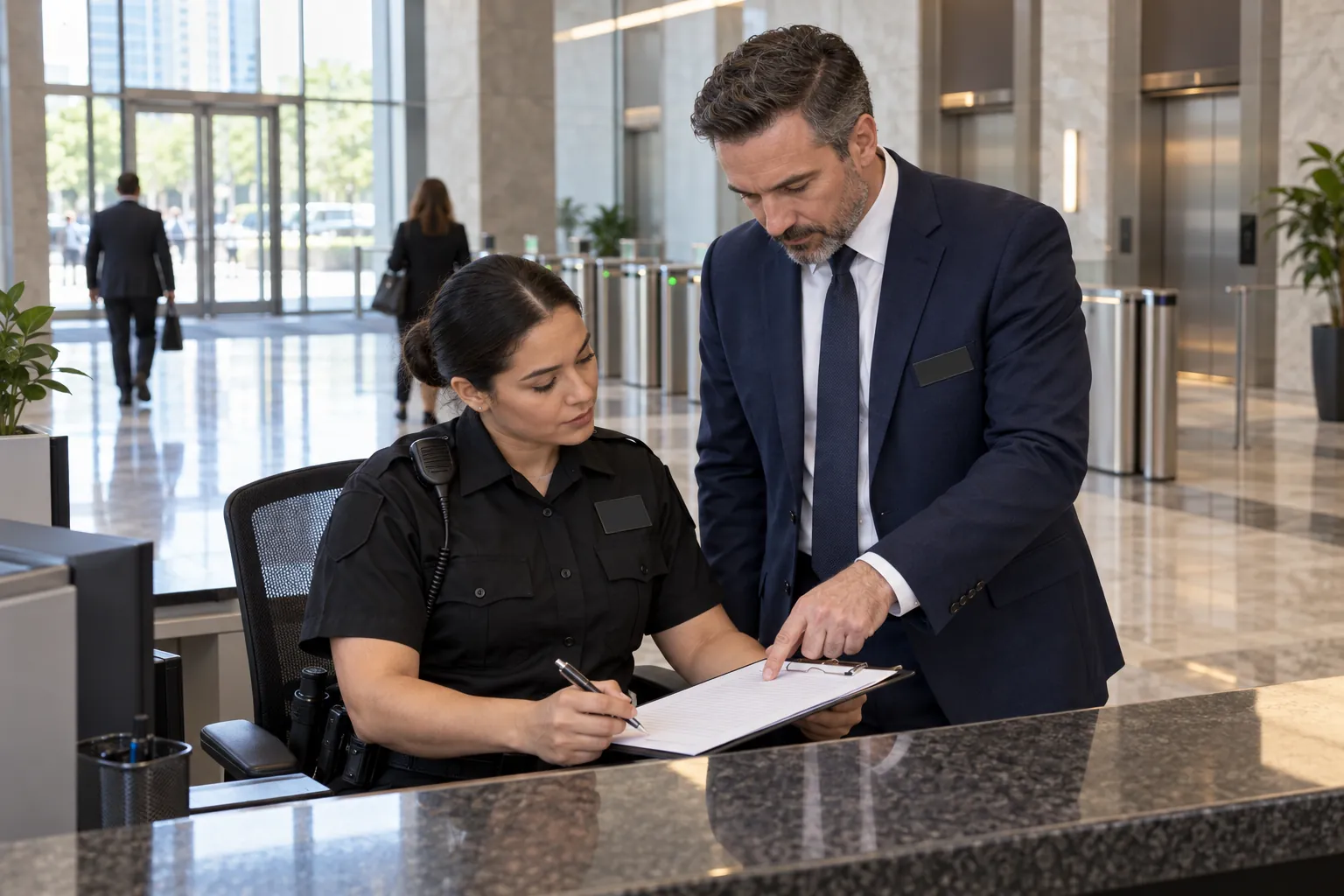
The supervisor is the person between the officers on post and the account manager or client who pays for them, and the job is to make sure every officer knows the post orders, that patrols and checks actually happen, that incidents are handled and written up, and that the client hears about problems before they become complaints. This guide sets out the duties, what US training and licensing rules put on the supervisor's desk, and how a supervisor can show the shift went as planned.
01
What a security supervisor is
The federal occupational classification calls the job First-Line Supervisors of Security Workers and defines it in one line: supervisors "directly supervise and coordinate activities of security workers and security guards." The O*NET summary for First-Line Supervisors of Security Workers (33-1091.00), published with the U.S. Department of Labor, lists the titles people actually hold: security supervisor, security shift supervisor, security guard supervisor, shift supervisor, security lieutenant and security chief, among others.
In practice there are two common versions of the role. At a contract security company, a site or shift supervisor runs the officers at one large post, or a mobile or field supervisor drives between several smaller ones, and answers to an account or operations manager. In a proprietary (in-house) program, the supervisor is employed by the organization whose hospital, campus, office tower or warehouse is being protected, and answers to its security director or facility manager. Either way the supervisor is usually a working one, patrolling and answering alarms as well as supervising.
No federal law sets out a security supervisor's duties. Security is licensed by the states, and a supervisor who works a post normally needs the same state guard registration or license as the officers, often with more on top where the supervisor is also armed. The duties come from four places:
- State licensing law, which sets training hours and deadlines that someone has to track.
- The contract and the post orders, which set the posts, hours, patrols and reporting the client is paying for. See security post orders.
- Workplace safety law, chiefly the OSHA standards and, in some states, state rules on workplace violence.
- Industry guidance, such as ASIS International's Private Security Officer Selection and Training Guideline (ASIS PSO-2019), a paid, voluntary guideline for proprietary and contract security that many companies use to shape their selection and training programs.
02
The core duties of a security supervisor
Grouped by what they are for, the duties of a security supervisor are these:
- Staffing the posts. Assigning officers to posts and patrols, making sure every post is covered at shift change, and finding cover when someone calls out. Coverage is the first thing a client notices when it fails.
- Briefing the shift. Passing on what the last shift found, any changes to the post orders, expected deliveries, contractors or events, and anything from the client. The pass-down log is the written half of this.
- Inspecting posts and patrols. Visiting each post during the shift, checking the officer is alert, in uniform, carrying their credentials and following the orders, and checking that patrol rounds are being walked, not just written up.
- Handling incidents. Responding to alarms, altercations, trespassers and medical calls, deciding when to call police or the fire department, and making sure each incident is written up promptly and accurately.
- Reviewing reports. Reading every officer's daily activity report and incident report before they go to the client, and sending back any that are vague, late or wrong.
- Training and coaching. Delivering or arranging site training, on-the-job training and refreshers, explaining company policy, and correcting problems on the spot.
- Checking equipment. Radios, keys and key cards, cameras, alarm panels, flashlights, any patrol vehicle and the other assets the officers are responsible for; logging keys and cards out and back in; reporting faults.
- Talking to the client. Being the point of contact on site for the property manager or facility manager, passing on hazards and maintenance issues officers find, and answering questions before they become complaints.
- Administration. Timesheets and schedules for the company's own systems, supply orders such as uniforms and badges, and, higher up, budgets and procedures.
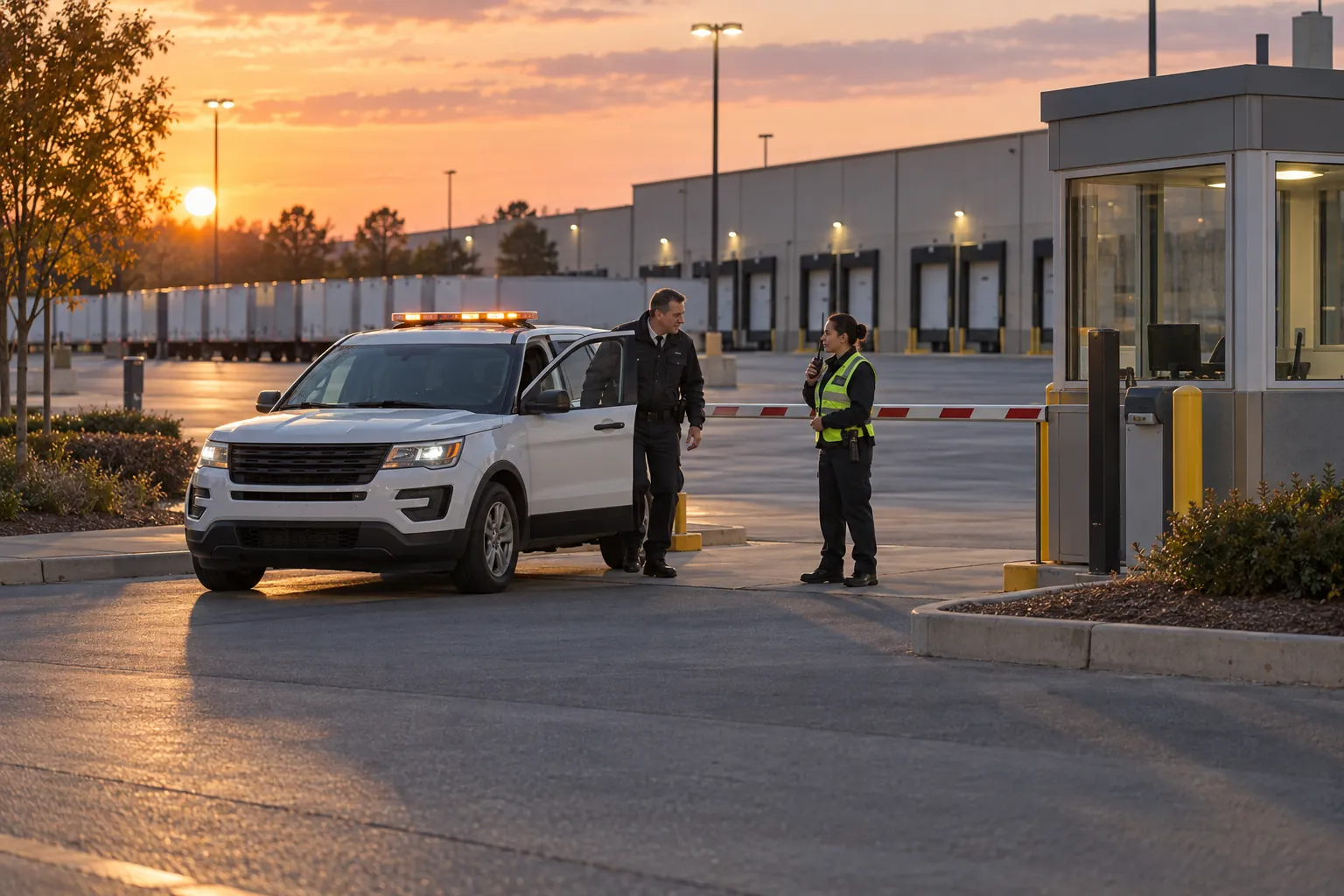
The weight shifts with the post. A lobby post in an office tower is mostly access control and visitor management; a distribution center is gates, trailers, the perimeter and the loading docks; a hospital adds patient-related calls and close work with clinical staff; a mobile supervisor spends much of the shift driving between posts. The post orders say what the duties look like at each site.
03
Licenses, training deadlines and records
Because guards are licensed state by state, keeping security personnel in compliance, by checking that every officer on the schedule is legal to work that post, is one of the supervisor's quieter but more important duties. Two large states show the kind of deadlines involved.
In California, Business and Professions Code section 7583.6 requires each applicant to complete a course in the power to arrest and the appropriate use of force, then "not less than 32 hours of training in security officer skills within six months from the date an initial registration is issued," 16 of them within 30 days, and eight hours of review or practice every year. The same section requires the employer to keep "at the principal place of business or branch office a record for each of its registrant employees verifying completion of the trainings required by this section" for as long as the guard is employed. The BSIS security guard fact sheet adds that a guard must have a valid, current registration card on their person while on duty.
In New York, the Department of State's security guard training requirements are an 8-hour pre-assignment course before applying, a 16-hour on-the-job training course "relevant to the duties of guards, requirements of the work site, and the needs of the employer" within 90 days of employment, and an 8-hour annual in-service course each calendar year.
Other states have their own boards, license classes and hour counts, and a few regulate guards lightly or only at the city or county level. Whatever the state, the supervisor usually ends up doing the same things:
- Check the officer's registration or license, armed or unarmed, before their first shift at the post, and see it on them when inspecting.
- Know each officer's training deadlines, especially the ones that fall in the first weeks, and do not let them lapse unnoticed.
- Deliver or sign off the site-specific part of on-the-job training: the post orders, the patrol route, the alarm panel, the emergency procedures.
- Send completion records to whoever keeps them for the company, so the file the state expects actually exists.
- Take an officer off a post they are not licensed or trained for, even when it leaves a gap to fill.
The company, not the supervisor personally, is usually the licensee responsible for these records, but a lapsed card is usually found at the post, not in the office.
04
Post inspections: how a supervisor checks the work
O*NET describes the core of the supervisory task as monitoring "the behavior of security employees to ensure adherence to quality standards, deadlines, or procedures." On a security contract that mostly means post inspections, and they work best when they are routine rather than a reaction to a complaint.
A good post inspection is short, unannounced as to its exact time, and the same every time, so results can be compared. A typical inspection covers:
- the officer is on post, alert, in the correct uniform and carrying their registration or license card;
- the officer can explain the post orders for the post, including who to call in an emergency and their part in the evacuation plan;
- the daily activity report is being kept as the shift goes, not saved for the end;
- patrol rounds and scheduled checks due so far this shift have been done, at the checkpoints the orders name;
- keys, radios and equipment are all present and working;
- any hazard, maintenance fault or security weakness the officer has found has been reported to the right person;
- anything the client has asked about has been answered.
Write the inspection down: the time, the post, the officer, what was checked and anything corrected. A supervisor who visits a post and leaves no record has, as far as the client can tell, not visited.
The hardest thing to check is the patrol. An officer on a roving post can write "patrol completed, all secure" on every line of the DAR without visiting half the checkpoints, and a single inspection cannot prove otherwise. Supervisors combine methods: walking part of the route behind the officer, reviewing camera footage of doors on the route, and reading the patrol record for the times each checkpoint was visited. The record only helps if it is made at the checkpoint, at the time.
Reviewing reports is the other half of checking. Read each DAR and incident report for what happened, when, where and who was involved, in plain words; send it back if it says "all secure" and nothing else across eight hours, or if an incident in the DAR has no incident report. The supervisor's review is also where a fault found on patrol should be turned into a work order for the property manager or building engineer, rather than left in a report nobody acts on.
05
Incidents, emergencies and workplace violence
In an emergency the supervisor usually runs the security response on site until police, fire or EMS take over: calling 911 when the post orders say to, meeting responders, controlling access and helping with evacuation.
Where an OSHA standard requires an emergency action plan, 29 CFR 1910.38, Emergency action plans, sets its minimum contents, including "procedures for reporting a fire or other emergency," procedures for evacuation and exit route assignments, and "procedures to account for all employees after evacuation." It also requires the employer to "designate and train employees to assist in a safe and orderly evacuation of other employees." Security officers are often among those employees, whether the plan is the client's or the security company's own. The supervisor should know which plan applies at each post, what the officers' part in it is, and that every officer has been told.
Workplace violence is part of the job. OSHA defines it as "any act or threat of physical violence, harassment, intimidation, or other threatening behavior that occurs at the work site," and its workplace violence page states that "there are currently no specific OSHA standards for workplace violence." Some states have gone further. In California, Labor Code section 6401.9, operative from July 1, 2024 for most employers, requires a written workplace violence prevention plan and a violent incident log recording "the date, time, and location of the incident," the type of violence, a detailed description and the response, among other things, kept for at least five years. Officers and supervisors are often first on the scene, so their incident reports are frequently where the employer's log entries come from.
Which workplace safety rules apply depends on the state. Federal OSHA covers most private employers, but OSHA's State Plans page explains that 22 State Plans cover both private sector and state and local government workers, and seven cover only state and local government workers. Check whether the post is in a State Plan state before assuming the federal standard is the one that applies.
After any incident, the supervisor's job is to make sure that:
- the incident report is written by the officers involved, promptly and in their own words, and reviewed;
- the client is told, in the way and within the time the contract or post orders set;
- anything the employer must record, such as a violent incident log entry or an injury, reaches the person who keeps that record;
- the post orders are changed if the incident showed they were wrong or silent;
- the next shift hears about it through the pass-down log and the briefing.
06
Where the record fails, and where SiteClara fits
A supervisor is judged on things that are hard to prove. The client asks whether the back gate was checked at 2 a.m. and the DAR says "patrol completed." A leaking pipe an officer found three nights running never reached maintenance because it was noted in a report and nobody turned it into a work order. The supervisor inspected four posts but the only evidence is their own word. When the record is thin, the conversation with the client is about trust rather than facts.
SiteClara gives the routine part of the shift a record. A printed QR poster, with an optional NFC tag behind it, sits at each checkpoint the post orders name: a gate, an emergency exit, a mechanical room, a parking garage level. The officer scans the code or taps the tag on their own phone, with no app to install, and marks the scheduled check done, or says what stopped them, such as a locked door. The time and the named officer are recorded as it happens, with a photo when one is asked for. A hazard or maintenance issue found on the round is reported there and goes onto the team's list of jobs until someone closes it.
The security supervisor sees what is due, done and missed at each site, grouped by building and floor, and can record why a check was missed from the company's own list of reasons with a few words. A job that needs the building manager can be escalated to them to answer. Each day the supervisor reviews the totals and photos, adds a note and approves the daily report, which goes to nominated management or client contacts at 8 a.m. the next morning, showing what was reported, what is still open and how the scheduled checks went.
07
Questions people ask
What are the duties of a security supervisor?
The federal classification sums the job up as to "directly supervise and coordinate activities of security workers and security guards." The tasks the O*NET summary for First-Line Supervisors of Security Workers (33-1091.00) lists include "Monitor the behavior of security employees to ensure adherence to quality standards, deadlines, or procedures," "Investigate disturbances on the premises, such as security alarms, altercations, and suspicious activity," and "Recruit, interview, and hire security personnel." The same list has supervisors patrolling the premises, authorizing entry and writing reports of what they observed on patrol, so most supervisors do the officers' work as well as overseeing it.
What skills does a security supervisor need?
The O*NET summary for First-Line Supervisors of Security Workers (33-1091.00) lists active listening, critical thinking, reading comprehension, speaking, monitoring and writing among the skills the role needs. The knowledge areas it lists are public safety and security, administration and management, customer and personal service, law and government, and personnel and human resources.
How much does a security supervisor make?
The O*NET summary for First-Line Supervisors of Security Workers (33-1091.00) gives national median wages for 2025 of $26.90 an hour, or $55,940 a year, from Bureau of Labor Statistics wage data. It puts employment in the occupation at 71,900 in 2024, with average projected growth of 3% to 4% from 2024 to 2034.
08
Further reading, and a list to take away
O*NET's summary for First-Line Supervisors of Security Workers lists the tasks the role involves across the country. Each state's licensing board publishes its own license classes and training rules: in California the Bureau of Security and Investigative Services and Business and Professions Code section 7583.6, in New York the Department of State, and elsewhere the board named in the state's private security statute. OSHA publishes the emergency action plan standard, its workplace violence guidance and its State Plans page; California employers should also read Labor Code section 6401.9.
On each shift, a security supervisor should be able to say that:
- every post is covered by an officer with a current state registration or license for that work, armed or unarmed;
- no officer on the schedule is past a training deadline, and new officers' site training is signed off;
- the shift was briefed, and the pass-down log from the last shift was read;
- every post was inspected at least once, and each inspection was written down;
- the patrol rounds and scheduled checks were done at the checkpoints, with a reason recorded for any that were not;
- every incident has a report, reviewed, and the client was told as the contract requires;
- hazards and faults found on patrol reached the property manager or building engineer as work orders;
- keys, cards, radios and equipment are accounted for;
- the DARs were reviewed before they went to the client.
Sources
Every document this guide quotes or links to, in the order it first cites them.
- O*NET summary for First-Line Supervisors of Security Workers (33-1091.00) onetonline.org
- Business and Professions Code section 7583.6 leginfo.legislature.ca.gov
- BSIS security guard fact sheet bsis.ca.gov
- Security guard training requirements dos.ny.gov
- 29 CFR 1910.38, Emergency action plans osha.gov
- Workplace violence page osha.gov
- Labor Code section 6401.9 leginfo.legislature.ca.gov
- State Plans page osha.gov
Related guides
 Security patrolsSecurity guard duties and responsibilities: what the job involves, and how it is checkedSecurity guard duties in the US: state licensing and training, patrols, access control, reports, the limits of the role, and how post duties are set and checked.
 Security patrolsSecurity post orders: what they should say, and how to know they are followedSecurity post orders in the US: what they are, what state rules say, what to include, how to write, sign and review them, and how to check they are followed.
 Security patrolsSecurity daily activity report: what to include, and how to write one that holds upThe security daily activity report (DAR): what to record, how to write entries that hold up, how it differs from an incident report, and how to review and keep it.
 Security patrolsSecurity pass-down log: what to hand over, and how to make the shift change stickThe security pass-down log: what the outgoing officer hands over, how to run the shift change, how to write entries that stay useful, and how to review and keep it.