Premises and facilities management
The OSHA 300 log: what to record, when, and how to keep it honest
The OSHA 300 log (OSHA Form 300) is the running record of recordable work-related injuries and illnesses that most U.S. employers with more than ten employees must maintain for each establishment, one line per case, under OSHA's recordkeeping requirements in 29 CFR Part 1904.

It feeds the 300A annual summary posted every February, and for many employers the electronic submission due by March 2. This guide covers who keeps one, what makes a case recordable, how to fill it in, the year-end deadlines, and how the reports it depends on actually reach the person who keeps it.
01
What the OSHA 300 log is, and who has to keep one
The OSHA 300 log, formally the Log of Work-Related Injuries and Illnesses (OSHA Form 300), is one of three forms required by OSHA's recordkeeping rule, 29 CFR Part 1904. Under 29 CFR 1904.29, employers "must use OSHA 300, 300-A, and 301 forms, or equivalent forms, for recordable injuries and illnesses." The 300 log lists every recordable case at an establishment, one line each. The Form 301 Injury and Illness Incident Report gives the detail of each case. The Form 300A Summary of Work-Related Injuries and Illnesses totals the year and is the only one of the three that is posted on the wall.
Not every employer has to keep the log. The small employer exemption in 29 CFR 1904.1 reads: "If your company had 10 or fewer employees at all times during the last calendar year, you do not need to keep OSHA injury and illness records." The count is for the whole company at its peak, not one site.
There is also an industry exemption. Establishments classified in the industries listed in Appendix A to Subpart B of Part 1904 are partially exempt from routine recordkeeping. The list includes NAICS 5616, Investigation and Security Services, and elementary and secondary schools (6111). It does not include NAICS 5617, Services to Buildings and Dwellings, which covers janitorial and building maintenance contractors, so they generally must keep the log. Check your own NAICS code against the current list.
Federal OSHA is not the whole picture. Per OSHA's State Plans page, 22 State Plans cover both private sector and state and local government workers, and seven cover only state and local government workers. Employers in those states should check their State Plan's own rule. A public school district or city facilities department is covered only where a State Plan reaches public employers.
02
What goes on the log: the recording criteria
A case goes on the log when it is work-related, is a new case, and meets the general recording criteria. The criteria are set out in 29 CFR 1904.7: an injury or illness is recordable "if it results in any of the following: death, days away from work, restricted work or transfer to another job, medical treatment beyond first aid, or loss of consciousness." A significant diagnosed injury or illness is also recordable, even without those outcomes: the rule names cancer, chronic irreversible disease, a fractured or cracked bone, and a punctured eardrum.
The line people argue about is first aid. Section 1904.7(b)(5)(ii) gives a closed list: non-prescription medication at non-prescription strength, tetanus shots, cleaning and covering surface wounds, hot or cold therapy, non-rigid supports such as elastic wraps, temporary immobilization for transport, drilling a fingernail or toenail to relieve pressure or draining a blister, eye patches, removing foreign bodies from the eye by irrigation or a cotton swab, removing splinters or foreign material from other areas by simple means, finger guards, massage, and fluids for heat stress. Anything not on the list, such as stitches or a rigid means of support, is medical treatment. Under 1904.7(b)(5)(i), visits "solely for observation or counseling" and diagnostic procedures such as x-rays are not medical treatment.
Work-relatedness is presumed. 29 CFR 1904.5 says "Work-relatedness is presumed for injuries and illnesses resulting from events or exposures occurring in the work environment, unless an exception in §1904.5(b)(2) specifically applies." The exceptions include eating or drinking for personal consumption, personal grooming, a motor vehicle accident in a company parking lot while commuting, the common cold or flu, and voluntary wellness activities.
Some cases have their own rules. Under 29 CFR 1904.8, you "must record all work-related needlestick injuries and cuts from sharp objects that are contaminated with another person's blood or other potentially infectious material." For a custodian emptying restroom sharps containers, that applies whether or not treatment follows. Medical removal, hearing loss and tuberculosis have their own sections, 1904.9 to 1904.11.
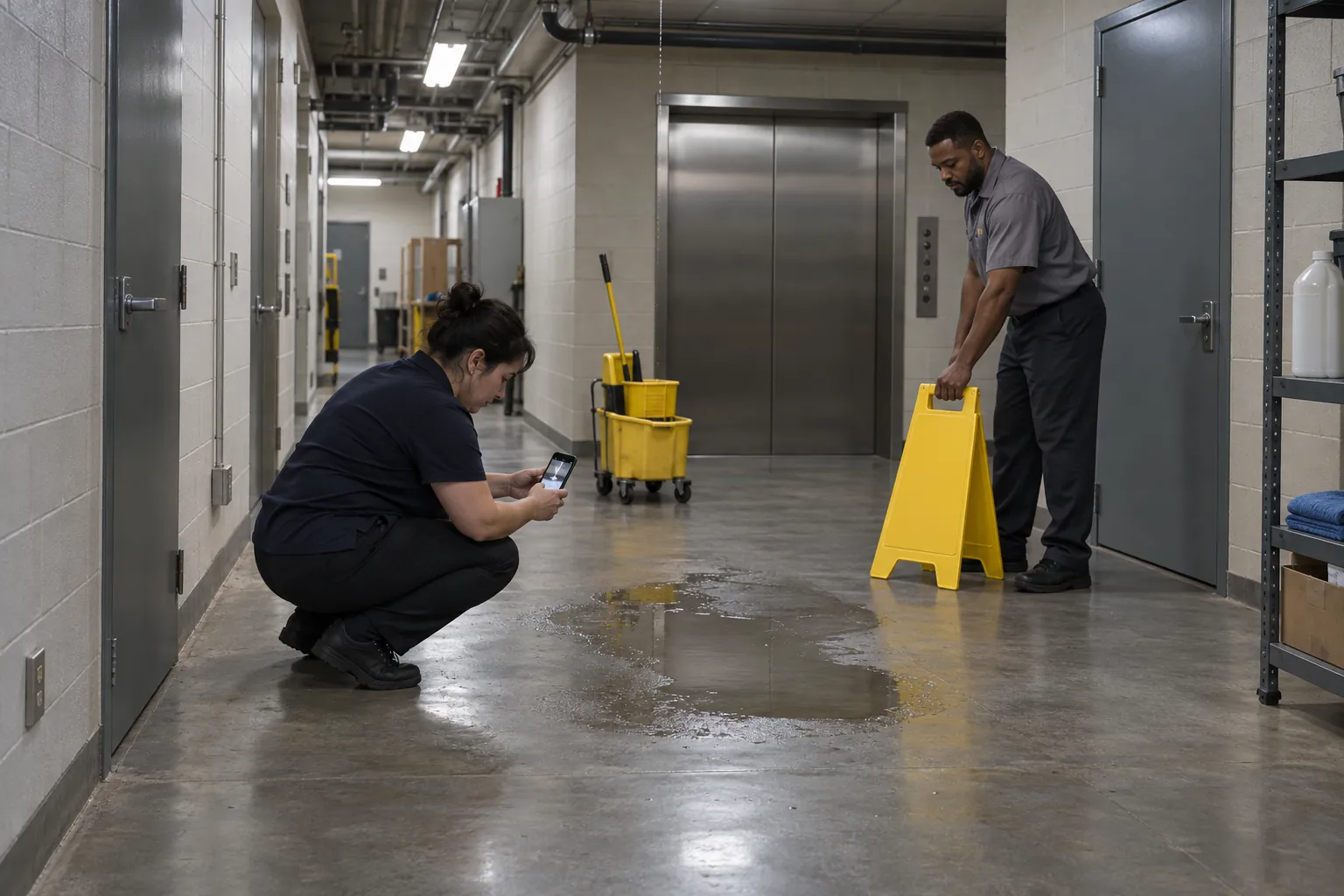
In building services the recordable cases are familiar: a slip on a wet floor that ends in a fracture, a back strain from lifting trash that leads to restricted duty, a cut from glass in a trash bag that needs stitches. Many more incidents stop at first aid and stay off the log.
03
Filling in the 300 log and the 301 report
Section 1904.29(b)(3) sets the clock: "You must enter each recordable injury or illness on the OSHA 300 Log and 301 Incident Report within seven (7) calendar days of receiving information" that a recordable case has occurred. The clock runs from when the employer hears of it.
The 300 log itself (OSHA's Form 300, Rev. 04/2004) takes one line per case, across these columns:
- (A) to (C): the case number, the employee's name and job title.
- (D) to (F): the date of injury or onset of illness, where the event occurred, and a description of the injury or illness, the parts of the body affected, and the object or substance that directly caused it.
- (G) to (J): one check only, for the most serious outcome: death, days away from work, job transfer or restriction, or other recordable case.
- (K) and (L): the number of days away from work and days on job transfer or restriction.
- (M): whether it was an injury, or an illness by type: skin disorder, respiratory condition, poisoning, hearing loss, or all other illnesses.
Count days from the day after the injury, in calendar days, including weekends and holidays the employee could not have worked. You may stop counting at 180 days, and if a case turns out more serious than first recorded, revise the entry.
Some cases are privacy concern cases under 1904.29(b)(7), among them a sexual assault, mental illness, HIV, hepatitis or tuberculosis, a contaminated needlestick, and any other illness where the employee asks for their name to be left off. For these you write "privacy case" in place of the name and keep a separate, confidential list of case numbers and names.
Every case on the log also needs a Form 301 or an equivalent. A workers' compensation or insurance form can serve if it carries the same information, and a computer system is acceptable if it can produce the forms when they are needed.
Two questions trip up multi-site and contract employers. First, 29 CFR 1904.30 requires "a separate OSHA 300 Log for each establishment that is expected to be in operation for one year or longer," and the definitions in 29 CFR 1904.46 describe an establishment as "a single physical location where business is conducted or where services or industrial operations are performed," with a main or branch office standing in where work is not done at one fixed place. A contractor with custodians spread across client buildings has to decide which of its own establishments each employee belongs to. Second, 29 CFR 1904.31 says whose log a temporary worker belongs on: the employer who supervises them "on a day-to-day basis" records their injuries. A contract janitor supervised by the contractor goes on the contractor's log, not the building owner's.
04
The year-end: the 300A summary, posting, submission and retention
At the end of each calendar year, 29 CFR 1904.32 requires the employer to "review the OSHA 300 Log to verify that the entries are complete and accurate, and correct any deficiencies identified," then complete the 300A. The 300A totals the log's columns and adds the average number of employees and total hours worked. Form 300A itself says that all establishments covered by Part 1904 "must complete this Summary page, even if no work-related injuries or illnesses occurred during the year"; under 1904.32(b)(2), if you had no recordable cases, you enter zeros for each column total.
A company executive certifies it: an owner (of a sole proprietorship or partnership), an officer of the corporation, the highest-ranking official at the establishment, or that official's immediate supervisor.
- By February 1: post the certified 300A "in a conspicuous place or places where notices to employees are customarily posted," and keep it up until April 30. You post the summary, never the log.
- By March 2: submit electronically through OSHA's Injury Tracking Application (ITA), if your establishment is covered by 29 CFR 1904.41. Establishments with 250 or more employees submit the 300A; those with 20 to 249 employees in an industry in Appendix A to Subpart E submit the 300A; and those with 100 or more employees in an industry in Appendix B also submit the information from the 300 and 301.
- For five years: under 1904.33, keep the 300 log, the privacy case list, the 300A and the 301s "for five (5) years following the end of the calendar year that these records cover," updating them if a case changes.
Access has deadlines too. Under 29 CFR 1904.35, when an employee, former employee or their personal representative asks for a copy of the 300 log, you must provide it "by the end of the next business day," free the first time, and the same for an employee's own 301. Under 29 CFR 1904.40, when an authorized government representative asks for your Part 1904 records, "you must provide copies of the records within four (4) business hours."
05
Getting reports to the log: the working record behind it
The 300 log is only as good as the reports that reach it. Section 1904.35(b)(1) requires every employer to "establish a reasonable procedure for employees to report work-related injuries and illnesses promptly and accurately," to tell employees how to use it, and to tell them they have the right to report. It adds: "You must not discharge or in any manner discriminate against any employee for reporting a work-related injury or illness."
Severe injuries run on a much shorter clock than the log. Under 29 CFR 1904.39, an employer must report a work-related fatality to OSHA "within eight (8) hours," and an in-patient hospitalization, amputation or loss of an eye "within twenty-four (24) hours." Reports go by phone to 1-800-321-OSHA (6742), to the nearest Area Office, or through the online reporting application on OSHA's website.
In building services the injured person is often alone, at night, in someone else's building. A good reporting route:
- It starts where the work is. A custodian at 11 p.m. reports from the floor, not the next morning.
- It captures the facts the 300 and 301 need: who, when, exactly where, what happened, and what treatment followed.
- It reaches a named person who decides within the seven days whether the case is recordable and knows the eight- and 24-hour duties.
- It follows the hazard. A wet floor without a sign, a broken step or an overflowing sharps container needs fixing, not just recording.
In a building shared by several employers, each keeps its own log for its own employees; the property manager, the janitorial contractor and the security contractor will each have one. A custodian who slips on a roof leak goes on the contractor's log, but the leak is the property manager's to fix, and neither log will say so.
06
Where the record fails, and what SiteClara does about it
Injury logs fail upstream. An officer twists an ankle on a dark stairwell on a Saturday night and mentions it to whoever relieves them; by Tuesday it has become days away from work, nobody wrote down where it happened, and the seven days are nearly gone. A leak caused three near slips before a fracture, each reported to whoever was passing. At year-end the log is rebuilt from emails and claims.
SiteClara works upstream, on routine checks and reports in the building. A printed QR poster goes at each location, such as a restroom, a stairwell or a loading dock, with an optional NFC tag behind it. Staff scan the code or tap the tag on their own phone, with no app to install, and sign in with a link. They see the checks due at that location and mark each one done, or say what stopped them. A problem, such as a leak, a trip hazard or a full sharps container, is reported there with a photo and goes onto the team's list of jobs until someone closes it.
The supervisor sees what is due, done and missed, and can record why a check was missed; a job that needs the building manager can be escalated to them to answer. Each day the supervisor reviews and approves a report that goes to nominated management or client contacts at 8 a.m. the next morning, showing what was reported, completed and still open, and how the scheduled checks went. After an injury, that record shows whether the hazard was reported and what was done.
07
Questions people ask
How do I get an OSHA 300 log form?
Download it from OSHA's Injury & Illness Recordkeeping Forms page, which has the 300, the OSHA Form 300A and the 301 as fillable PDFs in English and Spanish. OSHA advises saving the file to your computer before adding data, and the page says equivalent forms "may be maintained in any file format (e.g. Excel, CSV)" provided the requirements of 1904.29(b)(4) and 1904.32(b)(2)(iii) are met.
When is the OSHA 300 log submitted?
Most employers never send the 300 log itself to OSHA; they keep it on file. Under 29 CFR 1904.41, only establishments with 100 or more employees in an industry listed in Appendix B must also submit information from the 300 and 301, and all submissions are due "by March 2 of the year after the calendar year covered by the form(s)." Employee names in column B need not be included.
Are OSHA 300 logs public, and can I look up a company's log?
The log is not a public document. Under 29 CFR 1904.35, Employee involvement, employees, former employees, their personal representatives and their authorized employee representatives have the right to a copy, with names left on except in privacy concern cases. Under 29 CFR 1904.29(b)(10), an employer who voluntarily shows the forms to anyone else "must remove or hide the employees' names and other personally identifying information," with narrow exceptions. What the public can search is the data establishments submit through the ITA, which OSHA publishes on its Establishment-Specific Injury and Illness Data page: 300A summary data by establishment, and available 300 and 301 case details.
Who is exempt from keeping the OSHA 300 log?
Two groups. Under 29 CFR 1904.1, Partial exemption for employers with 10 or fewer employees, a company that had ten or fewer employees at all times during the last calendar year does not need to keep the records. Under 29 CFR 1904.2, Partial exemption for establishments in certain industries, an establishment classified in an industry in Appendix A to Subpart B does not need to keep them unless the government asks; the exemption applies establishment by establishment, not to the whole company. Neither exemption removes the duty to report a fatality, in-patient hospitalization, amputation or loss of an eye under 1904.39.
08
Where to read more, and a list to take away
Start with OSHA's regulation pages for 29 CFR 1904.7, General recording criteria, 29 CFR 1904.29, Forms and 29 CFR 1904.32, Annual summary. The Injury & Illness Recordkeeping Forms page has the 300, 300A and 301 as fillable PDFs in English, with instructions, and in Spanish (forms only). The Injury Tracking Application (ITA) Information page explains the electronic submission. In a State Plan state, read your state's rule as well; OSHA's State Plans page lists which states run one and whom they cover.
Before the next February 1, check that:
- you know whether the company is over the ten-employee line and whether its NAICS code is on the partially exempt list;
- there is a separate 300 log for each establishment expected to operate for a year or more, and every employee is assigned to one;
- employees know how to report an injury, know they have the right to, and have been told that retaliation is prohibited;
- a named person decides within seven calendar days whether each case is recordable, and completes the 300 line and the 301;
- supervisors on every shift know the eight-hour and 24-hour reporting duties and the number to call;
- the log has been reviewed and corrected, the 300A completed with hours and average employees, and certified by a qualifying executive;
- the 300A is posted from February 1 to April 30, and submitted through the ITA by March 2 if you are covered;
- five years of logs, summaries and 301s can be produced within four business hours, and updated if a case changes.
Sources
Every document this guide quotes or links to, in the order it first cites them.
- 29 CFR 1904.29 osha.gov
- 29 CFR 1904.1 osha.gov
- Appendix A to Subpart B of Part 1904 osha.gov
- State Plans osha.gov
- 29 CFR 1904.7 osha.gov
- 29 CFR 1904.5 osha.gov
- 29 CFR 1904.8 osha.gov
- 29 CFR 1904.30 osha.gov
- The definitions in 29 CFR 1904.46 osha.gov
- 29 CFR 1904.31 osha.gov
- 29 CFR 1904.32 osha.gov
- Injury Tracking Application (ITA) osha.gov
- 29 CFR 1904.41 osha.gov
- 29 CFR 1904.35 osha.gov
- 29 CFR 1904.40 osha.gov
- Injury & Illness Recordkeeping Forms osha.gov
- 29 CFR 1904.39 osha.gov
- Establishment-Specific Injury and Illness Data osha.gov
- 29 CFR 1904.2, Partial exemption for establishments in certain industries osha.gov
Related guides
 Premises and facilities managementThe workplace incident report: what to write, when, and who needs to see itHow to write a workplace incident report: what to include, the OSHA 301 and its seven-day rule, the 8- and 24-hour calls to OSHA, and what happens next.
 Premises and facilities managementNear miss reporting: catching the close calls before they become injuriesWhat counts as a near miss, what OSHA recommends, what a near miss report should capture, and how to follow it up so people keep reporting in your buildings.
 Premises and facilities managementAccident investigation: finding out why it happened, not who to blameHow to investigate a workplace accident in a U.S. building: OSHA's four steps, the scene, interviews, root causes, corrective actions and the records that matter.
 Premises and facilities managementThe OSHA inspection process: what happens, and what to have readyHow an OSHA inspection works under 29 CFR 1903: why OSHA comes, the walkaround, citations and penalties, the 15 working days, and proving abatement.