Fire and water checks
Fire drills and evacuation drills in Australia: the duty, the drill and the record
A fire drill, also called an evacuation drill, is a planned practice in which everyone in a building leaves by the emergency exits to the assembly area when the fire alarm sounds, so that the warning, the wardens, the exits and the headcount are tested before a real emergency.

It is the only time most people in a building actually walk the route they would take in an emergency, and done well it leaves a short list of things to fix. Done badly, it is a fire alarm test with a coffee break outside. This guide covers where the duty to hold drills comes from in Australia, how often to run them, how to plan and debrief one, and what the record should show.
01
Where the duty to hold fire drills comes from
There is no single national fire drill law in Australia. The duty comes from two directions: work health and safety law, which requires an emergency plan that is tested, and state fire safety law, which in some states sets the frequency of evacuation practice and the record outright.
Under the model work health and safety laws, a person conducting a business or undertaking (PCBU) must have an emergency plan for each workplace. The Commonwealth's version, the Work Health and Safety Regulations 2011 (Cth), sets this out in regulation 43, and the states and territories that have adopted the model laws carry the same regulation in their own WHS regulations. It says the PCBU "must ensure that an emergency plan is prepared for the workplace" that provides for emergency procedures, including "evacuation procedures", and also for:
- "testing of the emergency procedures, including the frequency of testing";
- "information, training and instruction to relevant workers in relation to implementing the emergency procedures".
The PCBU must also "maintain the emergency plan for the workplace so that it remains effective", having regard to the nature of the work and the hazards, the size and location of the workplace, and "the number and composition of the workers and other persons at the workplace". The regulation does not set a number of drills a year. It leaves the frequency to the plan, which is why an evacuation drill schedule has to be written down and followed rather than assumed.
Victoria is the exception to the model laws. It still has its own Occupational Health and Safety Act 2004 (Vic) and its own regulations, so a Victorian workplace works from those general duties rather than from a WHS regulation 43. In practice, Victorian employers plan and practise evacuations in the same way, usually following the Australian Standard.
That standard is AS 3745-2010 Planning for emergencies in facilities, published by Standards Australia. It is the document most workplaces, shopping centres, schools and commercial buildings use to organise the emergency plan, the emergency control organisation of wardens and the evacuation exercises. It is a paid standard, so this guide does not quote it; check the current edition and its requirements with Standards Australia or your fire safety adviser.
Queensland goes further than any general duty. Under the Building Fire Safety Regulation 2008 (Qld), section 44, the occupier of a building must ensure that an evacuation of the building is carried out "by an appropriate number of persons", "in an appropriate way" and "at intervals of not more than 1 year". Section 43 sets the same yearly interval for budget accommodation buildings, and section 46 requires a written evacuation practice record.
02
What an evacuation drill covers in practice
A fire drill is not the same as a fire alarm test. The routine test of the alarm system, its smoke detectors and its manual call points belongs to the maintenance regime (see fire alarm testing). A drill tests people: whether they hear the warning, know what it means, use the right exits, reach the assembly area and are accounted for. A useful evacuation drill covers:
- The warning: whether the alert and evacuation tones, or the public address message, can be heard in every part of the building, including plant rooms, toilets, lifts, car parks and outdoor areas.
- The wardens: whether the chief warden and floor or area wardens take up their roles, sweep their areas, close doors behind them and report in. See fire warden duties.
- The routes: whether exits, stairs and paths of travel are clear, fire doors close, exit signs are visible, and people follow the routes on the evacuation diagram rather than the way they came in.
- The assembly area: whether it is big enough, safe from traffic and the building, and known to everyone, including contractors and visitors.
- The headcount: whether the sign-in book, visitor list or contractor register can actually be used to account for people on the footpath.
- People who need help: whether each person with a personal emergency evacuation plan (PEEP) is assisted as the plan says, and whether mobility-impaired visitors are found.
- The call to emergency services: whether the person responsible knows how and when to ring Triple Zero (000), and what to tell the fire brigade on arrival.
- The all clear: who gives it, how, and whether anyone re-enters before it is given.
Not every drill has to test everything. A practical pattern is one full evacuation a year, with smaller exercises in between, such as a single floor, a warden walk-through or a desktop exercise for the emergency control organisation. What matters is that, over the year, each part of the emergency procedures is actually tested.
03
How often to run fire drills
Outside Queensland, the frequency of evacuation drills is set by the emergency plan, having regard to the workplace. As a working rule, plan at least one evacuation exercise a year, and more often where the risk or the turnover of people is higher. Consider more frequent drills where:
- people change often: casual staff, shift workers, contractors, students or short-stay residents;
- occupants are vulnerable or need help to evacuate, as in aged care, childcare, healthcare and schools;
- the building is large, high-rise or complex, with several tenancies and several warden teams;
- the last drill found real problems, such as an inaudible alarm, a blocked exit or a failed headcount;
- the building, fit-out, alarm system or emergency procedures have changed.
In Queensland, the Building Fire Safety Regulation 2008 sets the floor. Evacuation practice is required at intervals of not more than one year, with "an appropriate number of persons" and "in an appropriate way", meaning what is appropriate for implementing the building's fire and evacuation plan given the number, mobility and other characteristics of the people likely to need evacuating. The regulation's own examples show the flexibility: a hospital simulates the evacuation of an intensive care unit rather than moving patients, and an apartment block's managing agent picks a time when most residents are home.
Queensland also sets instruction intervals that sit alongside the drill. The occupier must give general evacuation instructions to each person working in the building at intervals of not more than one year, and to a new starter "no later than 2 days after the person starts working in the building" (section 35). First-response evacuation instructions, covering the manual alarm and firefighting equipment, are due at least every two years, and within a month of starting (section 36). Evacuation coordination instructions go to the people who carry out the evacuation coordination procedures, the wardens in practice, at least once a year (section 38).
04
Planning and running a fire drill that tests something
A drill everybody expects, at the same time each year, tests little. Plan it as an exercise with a purpose:
- Set the objective. Pick two or three things to test, taken from the last drill's findings or the risks in the plan: the alarm in the new fit-out, the headcount for the night shift, the assistance for a worker with a PEEP.
- Choose the scenario. A fire in a known location, with one exit declared blocked, makes wardens and occupants think. A drill with every exit open tests only the walk.
- Tell who needs to know. The alarm monitoring company, so the brigade is not called unnecessarily; building management, security and neighbouring tenancies; anyone with a medical or care reason to be warned. Occupants need not know the time, unless the plan or the setting says otherwise, as in some care settings.
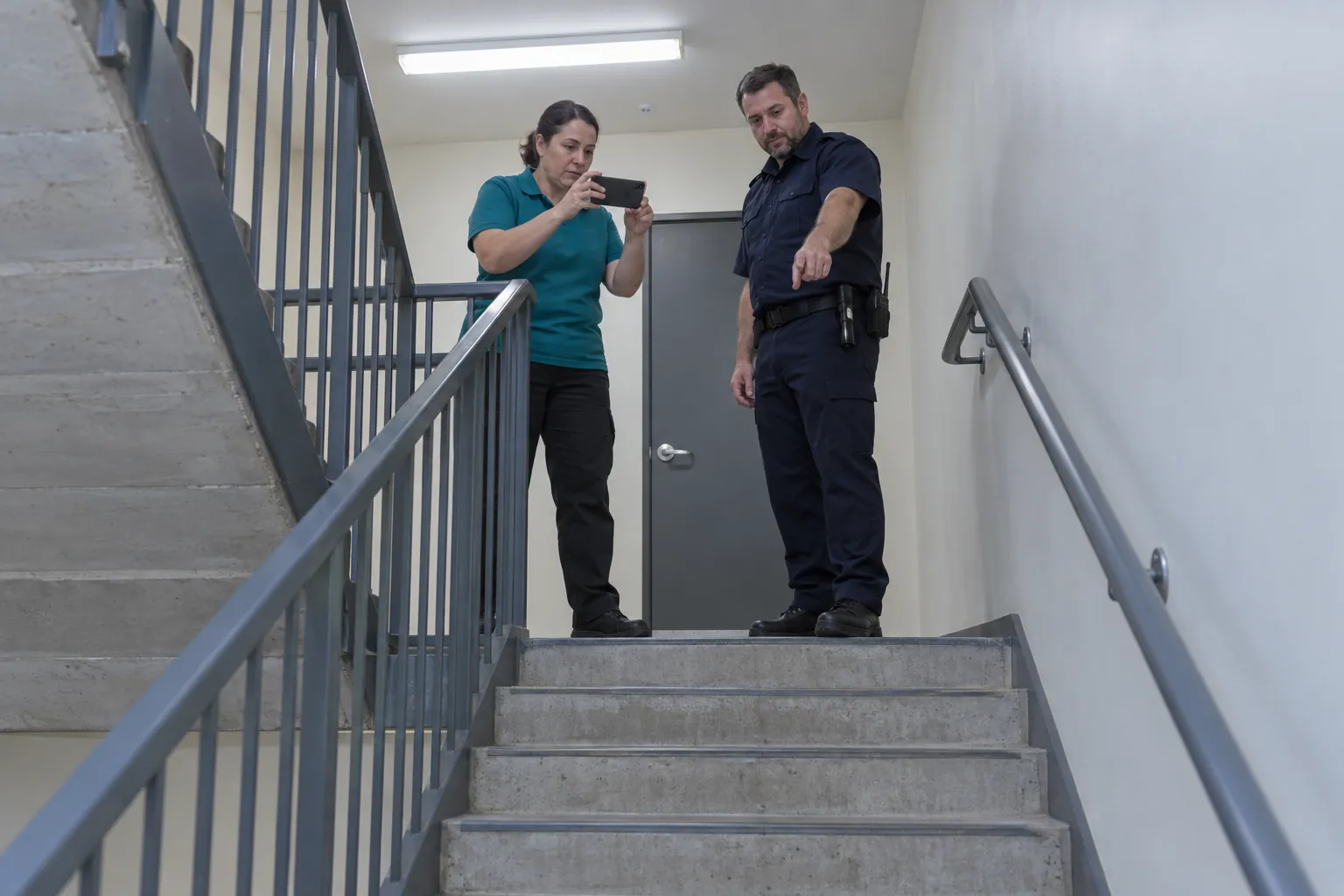
- Brief the observers. Place an observer at each key point, such as a stair door, the assembly area and a lift lobby, with a short sheet of what to watch and a watch or phone to note the times.
- Run it. Start the alarm, let the wardens run their procedure, and time the evacuation from alarm to the last person at the assembly area and the chief warden's all-clear report.
- Account for people. Test the headcount method against the sign-in book, visitor list and contractor register, and note anyone who could not be accounted for.
- Give the all clear, then return people to the building in an orderly way, and reset the alarm system and doors.
Include the people who are usually left out: cleaners and security officers on an evening shift, contractors working in plant rooms, tenants on other floors, visitors at reception, and anyone in a car park. A cleaning or security provider whose staff are on site outside business hours should know the building's emergency procedures, take part in drills that fall in their hours, and have their own after-hours drill if nobody else is in the building.
05
The debrief and the fire drill record
The debrief is where a drill earns its keep. Hold it straight after, while the details are fresh, with the chief warden, the wardens and the observers. Ask what worked, what did not, and what surprised anyone, then agree actions with an owner and a date.
In Queensland the record is prescribed. Under section 46 of the Building Fire Safety Regulation 2008, the occupier must keep an evacuation practice record of each evacuation that states:
- "the date of the evacuation";
- "the times when the evacuation started and ended";
- "any action to be taken as a result of the evacuation, including, for example, carrying out a review of the building's fire and evacuation plan or giving additional fire and evacuation instructions".
The same regulation makes the evacuation practice record a "prescribed document", alongside the fire and evacuation instruction record and the record of maintenance. Section 72 requires an occupier other than a public authority to keep a prescribed document for at least two years after it was made (or, for a document with entries for more than one day, two years after the last entry), and a former occupier must hand prescribed documents over to the new occupier no later than one month after leaving. Section 71 requires a copy to be kept in the building and a copy in a secure place in other premises, and allows an electronic copy if the information is readily accessible where it is kept.
Elsewhere the law does not prescribe the form of the record, but regulation 43 still requires the plan to provide for testing and its frequency, and a PCBU needs evidence that the testing happened. A good fire drill record, in any state, shows:
- the date, the start and end times, and the scenario;
- which areas, floors and tenancies took part, and roughly how many people;
- who acted as chief warden and wardens, and who observed;
- how long the evacuation took, and whether everyone was accounted for;
- what went wrong, what action is to be taken, who owns it and by when;
- when each action was closed, and whether the emergency plan or the instructions were changed as a result.
The last line matters most. A drill that finds an inaudible alarm in the car park and produces no change has tested nothing. The record should show the finding moving to a fix, and the next drill confirming it.
06
Where fire drill records fail, and what SiteClara does about it
Fire drill records rarely fail on the day. They fail afterwards. The debrief notes sit in the chief warden's notebook. The action to fix the blocked exit on level three is emailed to building management and never confirmed as done. The follow-up checks that should come out of a drill, such as clear exits, closed fire doors and an unobstructed assembly area, are ticked on a sheet on the back of the plant room door, sometimes weeks in advance.
SiteClara records the checks at the place they are done. A printed QR poster, with an optional NFC tag behind it, sits at each location where a check is scheduled, such as an exit door, a stair landing or the assembly point. The warden, cleaner or security officer doing the check scans or taps with their own phone, with no app to install, sees the checks due at that location and marks each one done, or explains what stopped them. The time and the named person are recorded as it happens, with a photo when one is asked for. A problem found there, such as a propped fire door or stock stacked in an exit path, goes onto the team's list of jobs until someone closes it.
The supervisor sees what was due, what was done and what was missed at each location, and records the reason for anything missed. Each day they review the record, add a note and approve a report that goes to nominated managers the next morning, so the building manager or the client can see that the actions from the last drill were followed through, location by location, rather than taking it on trust.
07
Questions people ask
How many times should you do a fire drill?
In most of Australia the law leaves the number to the emergency plan. Regulation 43 of the model WHS regulations, for example in the Work Health and Safety Regulation 2011 (Qld), requires the plan to provide for "testing of the emergency procedures, including the frequency of testing", having regard to the work, the hazards, the size and location of the workplace and the people there. Queensland also sets a floor for buildings: section 44 of the Building Fire Safety Regulation 2008 (Qld) requires an evacuation "at intervals of not more than 1 year".
How many minutes is a fire drill?
No Australian law sets a number of minutes for a fire drill; it takes as long as the building takes to clear and account for everyone. What Queensland does require is the timing on the record: section 46 of the Building Fire Safety Regulation 2008 (Qld) says the evacuation practice record must state "the times when the evacuation started and ended", along with the date and any action to be taken as a result.
08
Further reading, and a list to take away
For the duty, read regulation 43 in the Work Health and Safety Regulations 2011 (Cth) or the same regulation in your state or territory's WHS regulations; in Victoria, the Occupational Health and Safety Act 2004 (Vic). For Queensland, read the Building Fire Safety Regulation 2008 (Qld) and the Queensland Fire Department's page for building occupiers, owners, lessees and bodies corporate, which explains the occupier's duties under the Fire Services Act 1990 (Qld) and offers a fire safety management tool. For the structure of the plan, the wardens and the exercises, AS 3745-2010 Planning for emergencies in facilities is available from Standards Australia.
Before your next fire drill, check that:
- the emergency plan says how often each part of the emergency procedures is tested, and the last test is within that interval (in Queensland, within a year);
- the drill has two or three stated objectives, taken from the last drill's findings;
- the monitoring company, building management, security and neighbouring tenancies know it is happening;
- the chief warden and wardens are current, briefed and cover every floor and shift, including after hours;
- cleaners, security officers, contractors and visitors are included in the drill and the headcount;
- each person with a PEEP has been considered in the scenario;
- observers will time the evacuation and note what they see;
- the debrief produces actions with owners and dates;
- the record shows the date, the start and end times, and the actions, and is kept as your state requires (in Queensland, two years for an occupier other than a public authority);
- the actions from the last drill are closed, and you can show when.
Sources
Every document this guide quotes or links to, in the order it first cites them.
- Work Health and Safety Regulations 2011 (Cth) legislation.gov.au
- Occupational Health and Safety Act 2004 (Vic) legislation.vic.gov.au
- Building Fire Safety Regulation 2008 (Qld) legislation.qld.gov.au
- Work Health and Safety Regulation 2011 (Qld) legislation.qld.gov.au
- Building occupiers, owners, lessees and bodies corporate fire.qld.gov.au
- Fire Services Act 1990 (Qld) legislation.qld.gov.au
Related guides
 Fire and water checksAS 3745: planning for emergencies in a facility, and keeping the plan trueWhat AS 3745-2010 asks of an Australian facility, how it sits beside the WHS duty to have an emergency plan, who runs it, and what a record should show.
 Fire and water checksFire warden duties: what the chief warden and floor wardens do, day to day and when the alarm soundsWhat a chief warden and floor wardens do in an Australian workplace: the law behind the role, the routine checks, the job in an evacuation, and the records to keep.
 Fire and water checksEvacuation diagrams: what they must show, where they go, and how to keep them rightWhat an evacuation diagram must show, where it is displayed and which way it faces, how often it is reviewed, and the law in Queensland, Tasmania and under WHS.
 Fire and water checksFire alarm testing in commercial buildings: who tests what, and what the record must showFire alarm testing in Australian commercial buildings: AS 1851 routine service, state maintenance law, what the building team checks, records and false alarms.