Fire and water checks
Fire warden duties: what the chief warden and floor wardens do, day to day and when the alarm sounds
A chief warden is the person who leads a building's emergency control organisation: they take charge when the alarm sounds, direct the floor and area wardens, make sure the fire brigade has been called and hand over to the emergency services when they arrive.
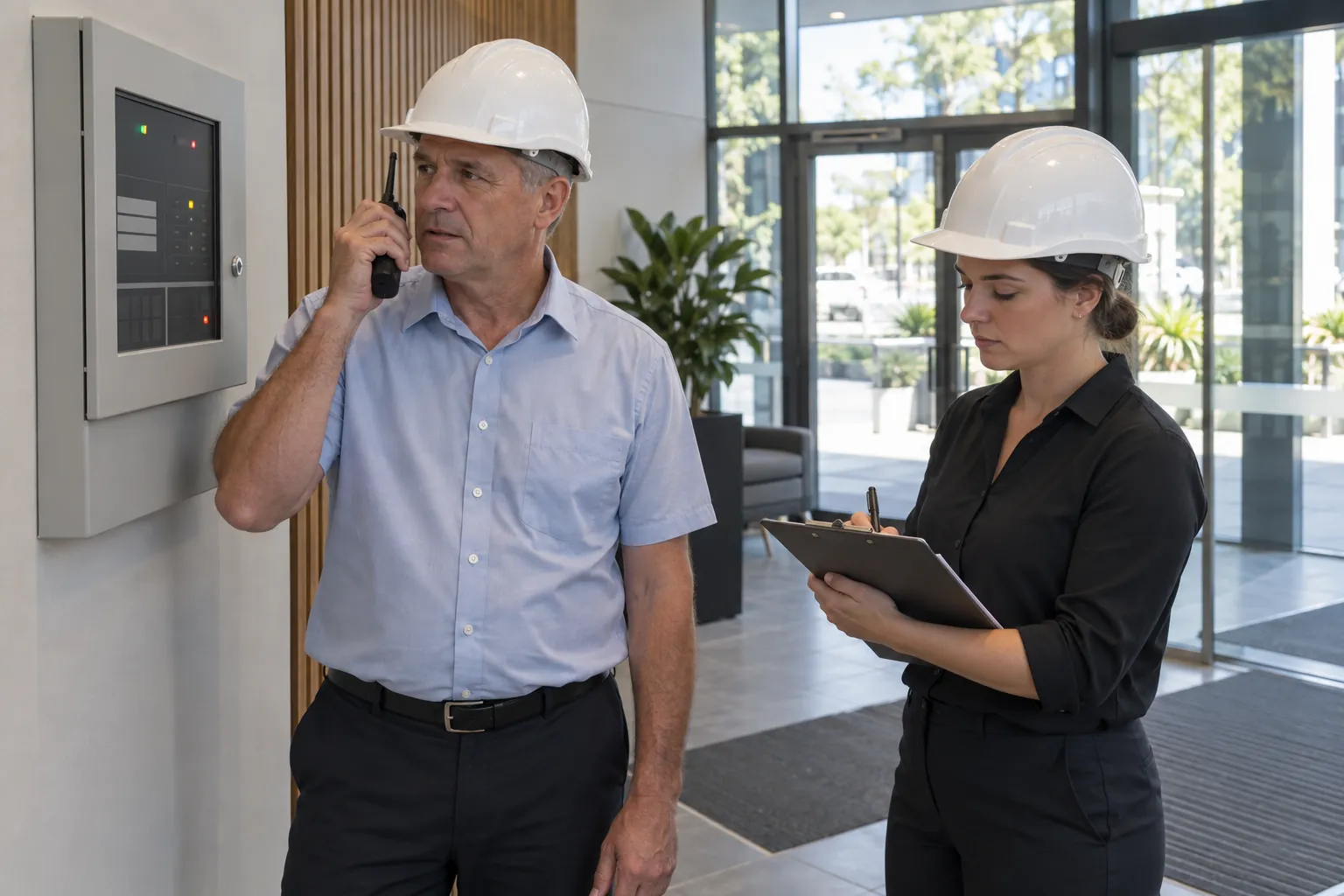
In most Australian workplaces the fire warden is someone with another job: a receptionist, a team leader, a building manager, sometimes a security officer on the night shift. The helmet or cap sits under a desk for months at a time. The role matters on two kinds of day: the ordinary one, when a warden notices the blocked exit or the propped fire door, and the rare one, when the alarm sounds and the chief warden has to know who is still inside. This guide covers where the duty comes from, who does what in the emergency control organisation, the routine checks, the job in an evacuation, and the records worth keeping.
01
Where the fire warden role comes from
No Australian law makes "chief warden" a job title for every workplace. The role comes from three layers: work health and safety law, which requires an emergency plan; the Australian Standard most facilities use to write it; and, in some states, building fire safety law that names the people who run an evacuation.
Work health and safety law. In the states and territories with the harmonised work health and safety (WHS) laws, the person conducting a business or undertaking (PCBU) at a workplace must have an emergency plan. In Queensland, for example, section 43 of the Work Health and Safety Regulation 2011 (Qld) says the PCBU "must ensure that an emergency plan is prepared for the workplace", providing for emergency procedures including "evacuation procedures" and "effective communication between the person authorised by the person conducting the business or undertaking to coordinate the emergency response and all persons at the workplace". That authorised person is, in most buildings, the chief warden. The plan must also provide for "information, training and instruction to relevant workers in relation to implementing the emergency procedures": the wardens are the relevant workers.
Victoria keeps its own Occupational Health and Safety Act 2004. WorkSafe Victoria's Compliance code: Workplace facilities and the working environment (December 2023) says the information, instruction and training employers must give under section 21 of the Act "needs to include emergency response procedures, including to employees with designated roles, such as fire/emergency evacuation wardens where appropriate", and that the emergency management plan "needs to identify and list key emergency personnel (eg fire wardens, first aid staff with photos, contact details)".
The standard. AS 3745-2010 Planning for emergencies in facilities, published by Standards Australia and amended in 2014 and 2018, is where the familiar words come from: the emergency planning committee, the emergency control organisation (ECO), the chief warden, floor and area wardens. Standards Australia lists it as pending revision. It is a paid document, so this guide describes the roles as they are commonly used; the Victorian code says employers "also need to comply with relevant Australian standards such as AS 3745".
Building fire safety law. Queensland is the clearest example. The Building Fire Safety Regulation 2008 (Qld) requires a written fire and evacuation plan that states the building's evacuation coordination procedures, and requires the occupier to instruct "the persons responsible for carrying out the evacuation coordination procedures" at intervals of not more than one year. Those responsible persons are the chief warden and the wardens by another name. Our guide to Queensland building fire safety covers the regulation in full.
02
Who is who in the emergency control organisation
The emergency control organisation is the set of people who act when something happens. Its size depends on the building, but in an Australian office, school, shopping centre or factory it usually has these roles:
- Chief warden: takes charge when the alarm sounds, decides on the response in line with the plan, directs the wardens, makes sure the fire brigade has been called, meets the brigade and any other emergency services on arrival and hands over. Between emergencies, the chief warden keeps the warden list current and runs the debrief after a drill.
- Deputy chief warden: steps in when the chief warden is away, on leave or on another shift, and otherwise supports them. A chief warden with no deputy is a single point of failure.
- Communications officer: in larger buildings, stays with the chief warden at the fire panel or warden intercommunication point, logs what happens and passes messages.
- Floor or area wardens: run the evacuation of one floor or area, direct people to the exits, check their area is clear and report to the chief warden.
- Wardens: help the floor warden, sweep rooms and toilets, and stay with people who need help.
WHS law does not set a number of wardens per floor or per head of staff. Section 43 of the Queensland regulation, like its equivalents elsewhere, says the PCBU must have regard to "the nature of the work", "the nature of the hazards", "the size and location of the workplace" and "the number and composition of the workers and other persons at the workplace". The number of wardens should follow from those, with cover for leave, sickness, part-time hours and every shift the building is occupied. A floor with one warden who works three days a week is, for two days, a floor with none. Chief wardens are best chosen for leadership and knowledge of the building rather than seniority: someone who is on site most days, can stay calm and be heard, and knows the plan, the fire panel and the team.
Multi-tenanted buildings need the organisation joined up. Usually the building appoints the chief warden and each tenant provides floor wardens for its own space, trained in the building's procedures. After hours the only people present may be contract cleaners, a patrolling security officer or a caretaker, so the plan should say who acts as warden then.
03
The routine checks: what a warden looks at between emergencies
Most of a warden's year is spent noticing things. A short walk of their area, at a frequency the plan sets, catches what would slow an evacuation. Queensland's fire service publishes a Fire Safety Management Tool for Building Occupiers, Owners, Lessees and Bodies Corporate with Advisory Notes that is a useful model anywhere in the country. Among its questions are "Are evacuation routes clear of obstructions?", "Are final exits clear of obstructions for two metres?", "Are the doors along the evacuation route unlocked and unobstructed?" and "Are the fire/smoke doors unobstructed and undamaged?". A warden's walk covers the same ground:
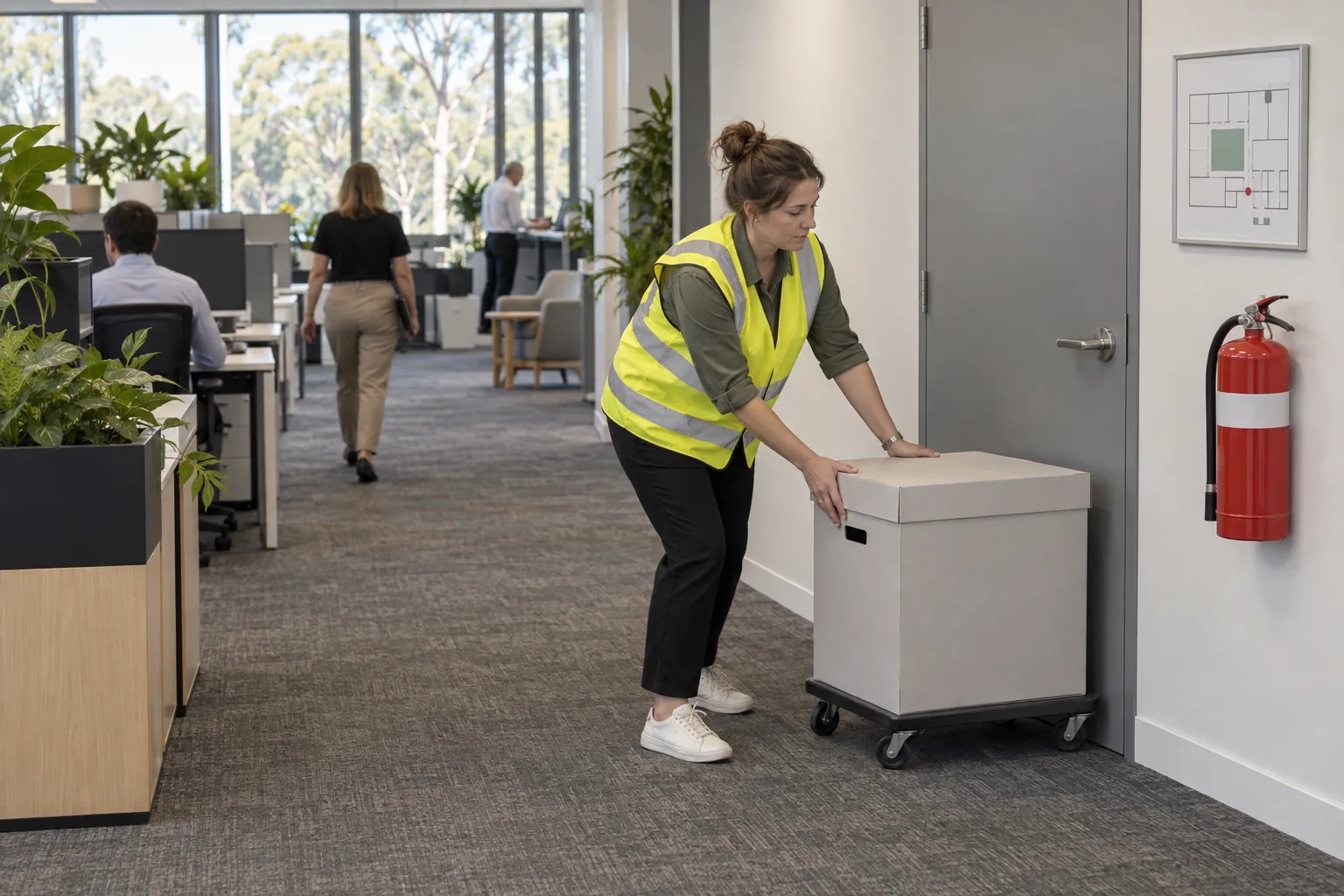
- Exit paths: corridors, aisles and stairs clear of boxes, trolleys, furniture and stock. The Victorian code says aisles and passageways "need to be kept free of furniture or other obstructions at all times".
- Exit doors: unlocked when the building is occupied, opening without a key and clear on both sides.
- Fire and smoke doors: closed, not wedged or held open with a bin, closing fully onto the latch, and undamaged. See our fire door inspection guide.
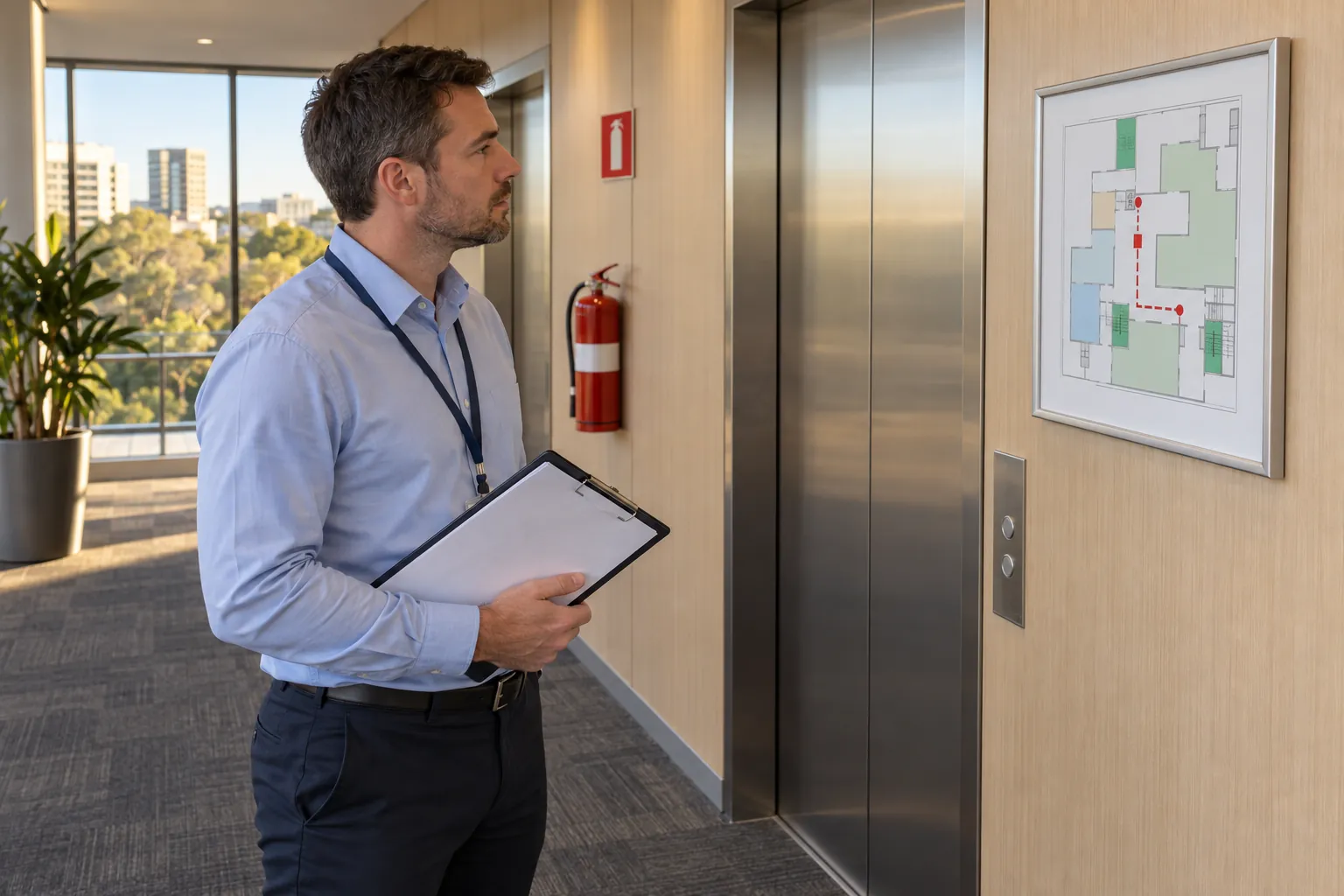
- Evacuation diagrams: in place, securely fixed and facing the right way after any fit-out or furniture move. See our evacuation diagram guide.
- Exit signs and emergency lighting: undamaged and visible, not hidden by displays.
- Extinguishers, hose reels and manual call points: present, not blocked, not obviously damaged or discharged.
- The fire indicator panel, where a warden is asked to check it: showing normal, with no isolations or faults. The same tool asks whether the system is operating "with no isolations or faults indicating".
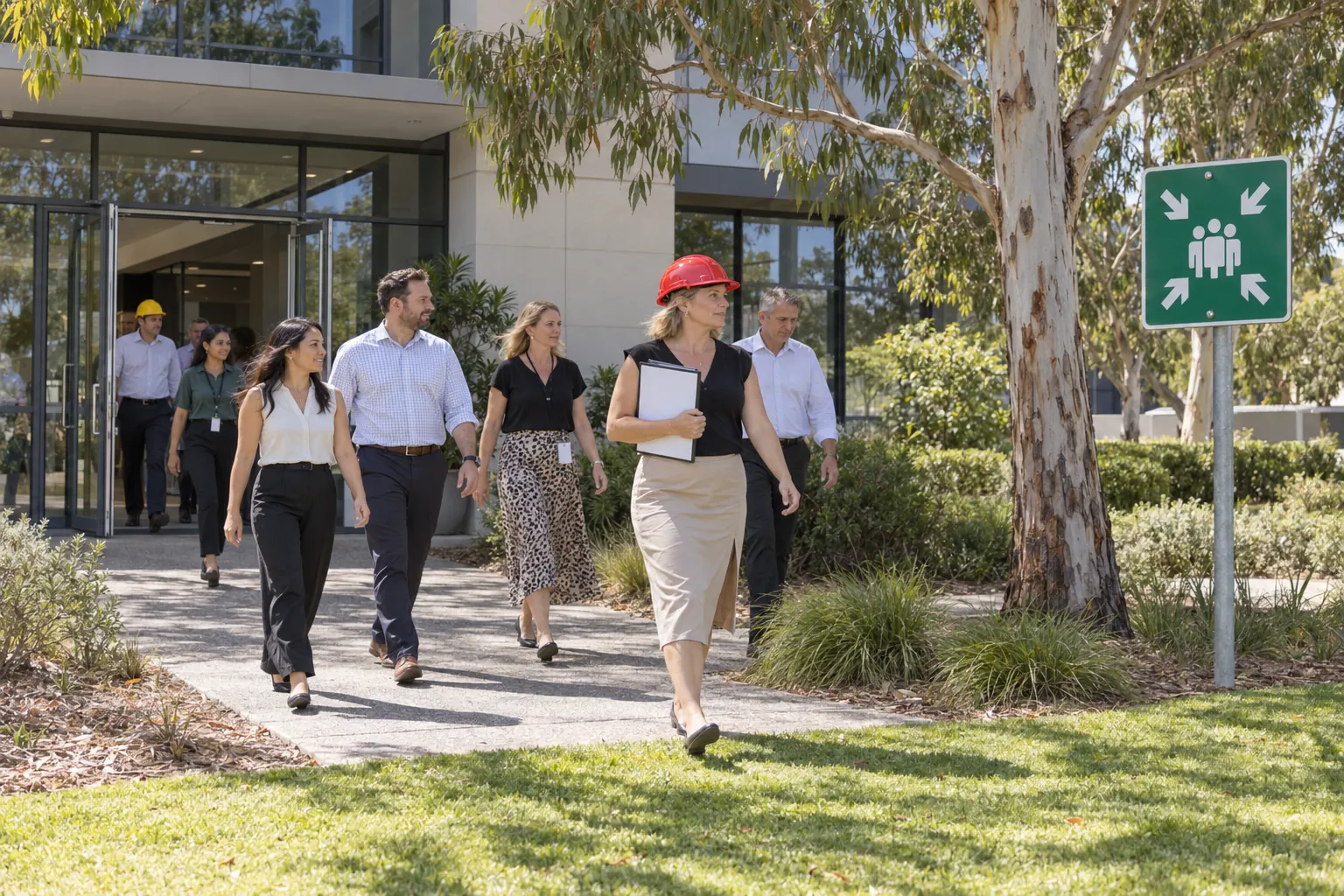
- The assembly area: reachable, and not taken over by parked cars, skips or a builder's compound.
The warden's walk is a look, not a service. Routine servicing of fire protection systems and equipment is done by a competent contractor to AS 1851, under whatever state fire safety maintenance regime applies to the building. The warden's job is to notice when something is wrong between those visits and to make sure it is reported to someone who will fix it.
04
The chief warden and wardens in an evacuation
The detail belongs in the building's emergency plan, and the wardens should know it before the day. Queensland's regulation sets out what the evacuation coordination procedures are for, and it is a good outline of the chief warden's job anywhere. Section 17 lists procedures for alerting and communicating with people in the building, alerting the fire service "including using manually operated fire alarms", arranging the evacuation of "persons with special needs, members of the public and other persons in the building" to the assembly area, "checking whether all persons have been evacuated from the building", meeting the fire officers at the place stated in the plan, and telling them "the number of persons evacuated" and "the number and identity of any persons not accounted for".
In practice, the chief warden's sequence usually runs:
- Go to the control point named in the plan, usually the fire indicator panel, and put on the helmet or vest so people can see who is in charge.
- Find out what and where: which zone is in alarm, and what the floor wardens are reporting.
- Make sure the brigade has been called. A monitored alarm may call automatically, but the plan should say who confirms it with triple zero (000).
- Decide and direct: evacuate the affected floor, the floors around it or the whole building, in line with the plan, using the public address or warden intercommunication points where fitted.
- Collect the floor reports: area clear, areas not checked, anyone who needs help and where they are.
- Meet the brigade and hand over: the zone, the reports, anyone unaccounted for, and anyone waiting in a refuge or stairwell.
- Hold people at the assembly area until the brigade or the chief warden says it is safe to go back in.
A floor or area warden, meanwhile, tells people nearby to leave by the nearest safe exit, directs them away from lifts unless the plan says otherwise, sweeps their area on the way out without delaying their own escape, closes doors behind them, stays with anyone who needs help as their personal emergency evacuation plan says, and reports to the chief warden. Use an extinguisher only if trained to, with the alarm raised and a clear way out; many plans simply say get out.
05
Training, and what the records should show
Wardens need to be trained in their own building's procedures, not just in fire behaviour and extinguishers. The Victorian code says employers need to ensure that "employees, managers and supervisors are taught and trained in the emergency processes and hold regular practice runs for relevant emergency procedures". AS 3745 sets its own requirements for warden training; read them in the current text, not a course brochure. The most useful training is practical: wardens walk their own routes, find the fire panel and the assembly area, and practise the skills they would use in responding to an alarm, such as sweeping an area and reporting it clear.
Queensland sets timings in law. Under the Building Fire Safety Regulation 2008, the occupier must give the evacuation coordination instructions to the responsible persons "at intervals of not more than 1 year" (section 38), as changed "no later than 1 month after" a material change to a procedure, and to a new person "within 1 month before the person becomes responsible" (section 39). In a high occupancy building, which includes many workplaces where 30 or more workers are normally employed, the occupier must appoint a fire safety adviser holding a current building fire safety qualification (section 34), who gives or arranges the instructions (section 41). Section 45 requires a fire and evacuation instruction record stating "the name of each person who was given the instructions", "the name of the person who gave the instructions", "the date the instructions were given" and "a brief description of the instructions given".
Whatever the state, a good record lets the PCBU, a fire safety adviser or an inspector see that the roles are filled, the people in them trained, and the routine checks done. That means keeping:
- a current warden list, by floor or area, with a deputy for each role and contact details, dated when it last changed;
- the training each warden has had, when, and from whom;
- the routine checks: date, time, area, the warden's name and what was found, including the propped door and the boxes in the stairwell, not only ticks;
- what happened to each problem found: who it was reported to, and when it was fixed;
- checks that were missed, and why, such as the warden being on leave with nobody covering;
- each evacuation drill and real event, with the chief warden's debrief and the actions that came out of it.
06
Where the warden record fails, and what SiteClara does about it
The warden's routine check usually lives on a sheet in a folder at reception. It is easy to fill in for the week in one go, easy to miss when the floor warden is on leave, and slow to follow up: the propped fire door noted on Tuesday is still propped on Friday, because the sheet sends the problem to nobody.
SiteClara records the check at the place it is done. A printed QR poster, with an NFC tag behind it if staff prefer to tap, sits at each location on the warden's route: a stair landing, a final exit, the fire indicator panel, the assembly area. The warden, or the cleaner or security officer covering after hours, scans or taps with their own phone, with no app to install, sees the checks due at that location and marks each one done, or explains what stopped them. The time and the named person are recorded as it happens, with a photo when one is asked for.
A problem found on the walk, such as a blocked exit or a door that will not close, is reported there with a photo and goes onto the team's list of jobs until someone closes it. The supervisor sees which checks were due, done and missed at each location, records the reason for anything missed, and can escalate a job to the building manager. Each day the supervisor reviews and approves a report that goes to nominated managers or the client the next morning, so the chief warden and the building manager can see the routine was kept, location by location.
07
Questions people ask
What is a chief warden?
The chief warden is the person who takes charge of a building's response when the alarm sounds. The title comes from AS 3745 rather than the law, but the law describes the job: section 43 of the Work Health and Safety Regulation 2011 (Qld) requires the emergency plan to provide for "effective communication between the person authorised by the person conducting the business or undertaking to coordinate the emergency response and all persons at the workplace", and that authorised person is usually the chief warden. In Queensland, section 17 of the Building Fire Safety Regulation 2008 (Qld) lists what the evacuation coordination procedures cover, among them "checking whether all persons have been evacuated from the building", meeting the fire officers, and telling them "the number of persons evacuated" and "the number and identity of any persons not accounted for".
What is the role of a warden?
A warden is a worker given a designated role in the emergency plan and trained to carry out its procedures on their own floor or in their own area. WorkSafe Victoria's Compliance code: Workplace facilities and the working environment says the information, instruction and training employers must give "needs to include emergency response procedures, including to employees with designated roles, such as fire/emergency evacuation wardens where appropriate", and that the emergency plan "needs to identify and list key emergency personnel (eg fire wardens, first aid staff with photos, contact details)". In an evacuation a warden directs people to the nearest safe exit, checks their area is clear and reports to the chief warden; between emergencies, they notice the blocked exit or the propped fire door and report it.
08
Further reading, and a list to take away
Start with the emergency plan duty in your own state or territory's WHS regulation, or in Victoria the Occupational Health and Safety Act 2004 and WorkSafe Victoria's compliance code. In Queensland, read the Building Fire Safety Regulation 2008 and the fire service's Fire Safety Management Tool with Advisory Notes. For the emergency control organisation, the reference is AS 3745-2010 with its amendments; our guide to AS 3745 emergency planning covers how the plan is written, tested and reviewed.
For your wardens, make sure that:
- the emergency plan names a chief warden and a deputy, and says who takes the role after hours and at weekends;
- every floor or area has enough wardens for the people in it, with cover for leave and every shift;
- each warden has been trained in this building's procedures, and the training is recorded;
- the routine check fits a short walk, is done at the frequency the plan sets, and is walked, not signed in advance;
- problems found go to someone who will fix them, and the record shows when they were fixed;
- drills are held and debriefed, and the chief warden's actions are followed through;
- contractors on site after hours, such as cleaners and security officers, know their part in the plan.
Sources
Every document this guide quotes or links to, in the order it first cites them.
- Section 43 of the Work Health and Safety Regulation 2011 (Qld) legislation.qld.gov.au
- Compliance code: Workplace facilities and the working environment worksafe.vic.gov.au
- AS 3745-2010 Planning for emergencies in facilities store.standards.org.au
- Building Fire Safety Regulation 2008 (Qld) legislation.qld.gov.au
- Fire Safety Management Tool for Building Occupiers, Owners, Lessees and Bodies Corporate with Advisory Notes fire.qld.gov.au
- Compliance code: Workplace facilities and the working environment content-v2.api.worksafe.vic.gov.au
Related guides
 Fire and water checksAS 3745: planning for emergencies in a facility, and keeping the plan trueWhat AS 3745-2010 asks of an Australian facility, how it sits beside the WHS duty to have an emergency plan, who runs it, and what a record should show.
 Fire and water checksFire drills and evacuation drills in Australia: the duty, the drill and the recordRunning a fire drill or evacuation drill in an Australian workplace: the WHS duty, Queensland's yearly rule, planning the exercise, the debrief and the record.
 Fire and water checksEvacuation diagrams: what they must show, where they go, and how to keep them rightWhat an evacuation diagram must show, where it is displayed and which way it faces, how often it is reviewed, and the law in Queensland, Tasmania and under WHS.
 Fire and water checksWorkplace fire safety checklist: the checks, who does them and the records they leaveA workplace fire safety checklist for Australia: the emergency plan duty, state fire safety rules, daily to annual checks, who does each, and what records show.