Fire and water checks
Fire alarm testing in commercial buildings: who tests what, and what the record must show
Fire alarm testing in an Australian commercial building is the routine service of its fire detection and alarm system by a competent fire services contractor to AS 1851, at monthly, six-monthly, yearly and five-yearly intervals, as state or territory maintenance law requires.
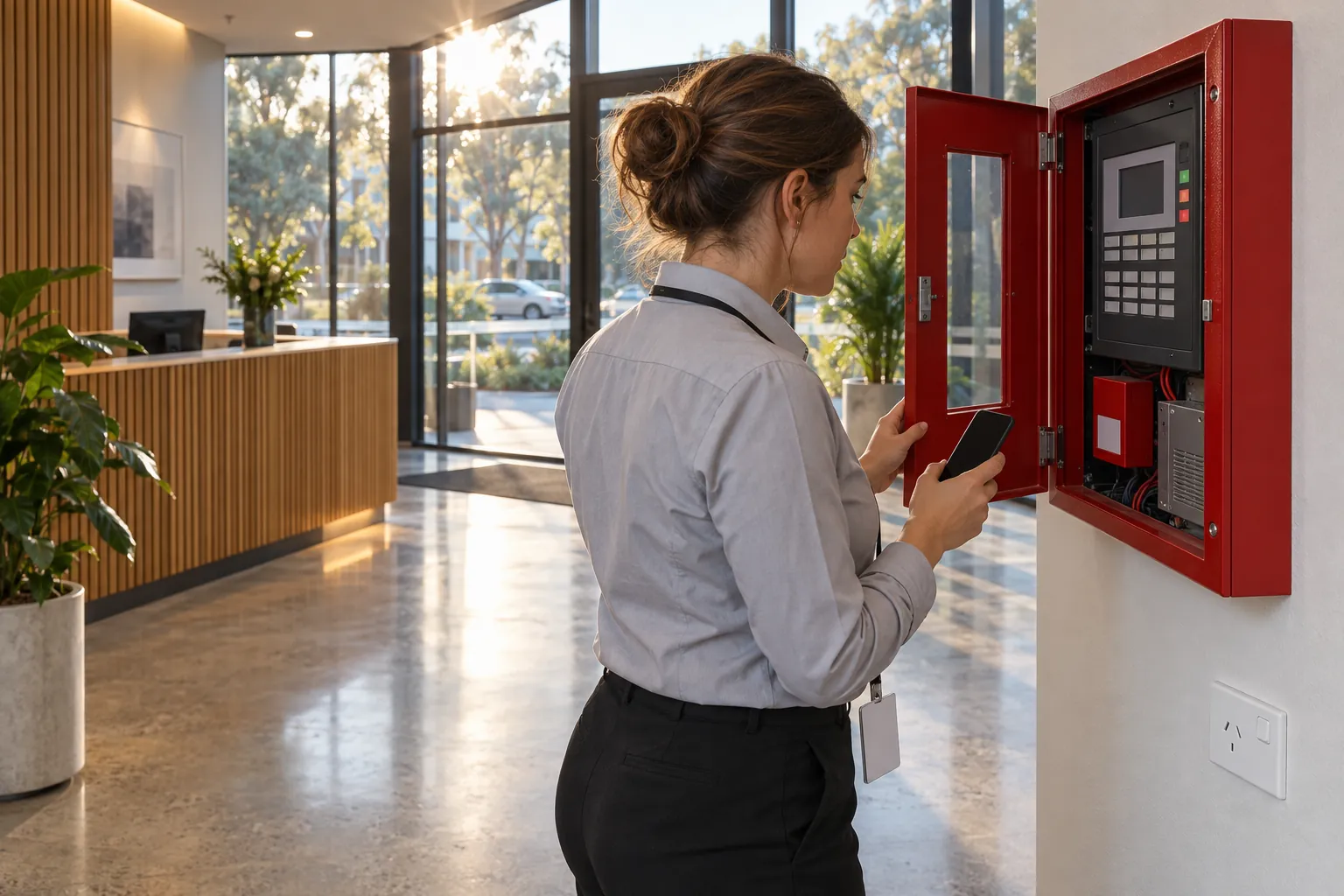
Search for fire alarm testing and most of what comes back is about the smoke alarm on a hallway ceiling at home, a single device tested with its own button. A commercial building is a different matter: a system with a panel, detectors, manual call points and often a direct link to the fire brigade. This guide covers who tests what, how often, what the building team does between visits, and what the records must show.
01
Where the duty to test a fire alarm comes from
No national rule says "test the fire alarm every month". Fire safety maintenance is state and territory law, and each state calls up the same standard in its own way.
The standard is AS 1851-2012 Routine service of fire protection systems and equipment, published by Standards Australia on 3 December 2012 and amended in November 2016. Standards Australia describes it as setting out "requirements for inspection, testing, preventive maintenance and survey of fire protection systems and equipment", and lists it as pending revision. Section 6 covers fire detection and alarm systems. Design and installation sit in AS 1670.1:2024.
How the standard becomes a legal requirement depends on where the building is:
- Victoria: under Part 15 of the Building Regulations 2018 (Vic), the owner must ensure each essential safety measure "is maintained in a state which enables the essential safety measure to fulfil its purpose" (regulation 226). Schedule 8 lists automatic fire detection and alarm systems and occupant warning systems among the essential safety measures.
- New South Wales: the owner issues an annual fire safety statement covering every essential fire safety measure in the building, under the Environmental Planning and Assessment (Development Certification and Fire Safety) Regulation 2021. NSW Planning's guidance on fire safety certification says the statement confirms that "an accredited practitioner (fire safety) has assessed, inspected and verified the performance of each fire safety measure".
- Queensland: section 54 of the Building Fire Safety Regulation 2008 (Qld) requires the occupier to ensure each prescribed fire safety installation is maintained "by an appropriately qualified person" and inspected and tested at intervals in compliance with the Queensland Development Code, part MP6.1.
- South Australia: the Metropolitan Fire Service's page on the maintenance of fire safety systems points to regular maintenance in line with AS 1851 and Ministerial Building Standard 002, with the owner lodging a Form 3 maintenance verification each year.
Workplace law adds a second thread. Regulation 43 of the model WHS Regulations, as adopted in the states and territories that use the model law, requires a person conducting a business or undertaking (a PCBU) to have an emergency plan that provides for emergency procedures and for "testing of the emergency procedures, including the frequency of testing" (for example, section 43 of the Work Health and Safety Regulation 2011 (Qld)). Victoria has its own OHS Act 2004 and regulations.
02
What fire alarm testing covers in a commercial building
A home smoke alarm is a single device, mains-powered or running on its own battery, and in Victoria older homes and some other residential buildings have their own installation rule (regulation 145 of the Building Regulations 2018). A fire detection and alarm system installed in a commercial building is a network, and testing it means proving each part works and that the parts work together. It usually includes:
- The fire indicator panel (FIP), which shows the zone in alarm and any faults and isolations.
- Automatic detectors: point smoke and heat detectors, and in some buildings beam or aspirating smoke detection.
- Manual call points, the red break-glass alarms beside exits and on escape routes.
- Occupant warning: sounders and visual alarms, or in larger buildings an emergency warning and intercommunication system (EWIS) with voice messages and warden phones.
- The link to the fire brigade or a monitoring service, where the system is monitored.
- Interfaces with other systems: air handling, held-open fire doors, lift recall and sprinkler flow switches.
AS 1851 brings these together in Section 6. Its preface says the 2005 edition's sections on fire detection, alarms, sound systems and intercom systems "have been combined in a new Section 6". The general section adds a systems interface test, which checks that the alarm starts everything it is meant to start. Faults often sit between trades, so it needs an owner.
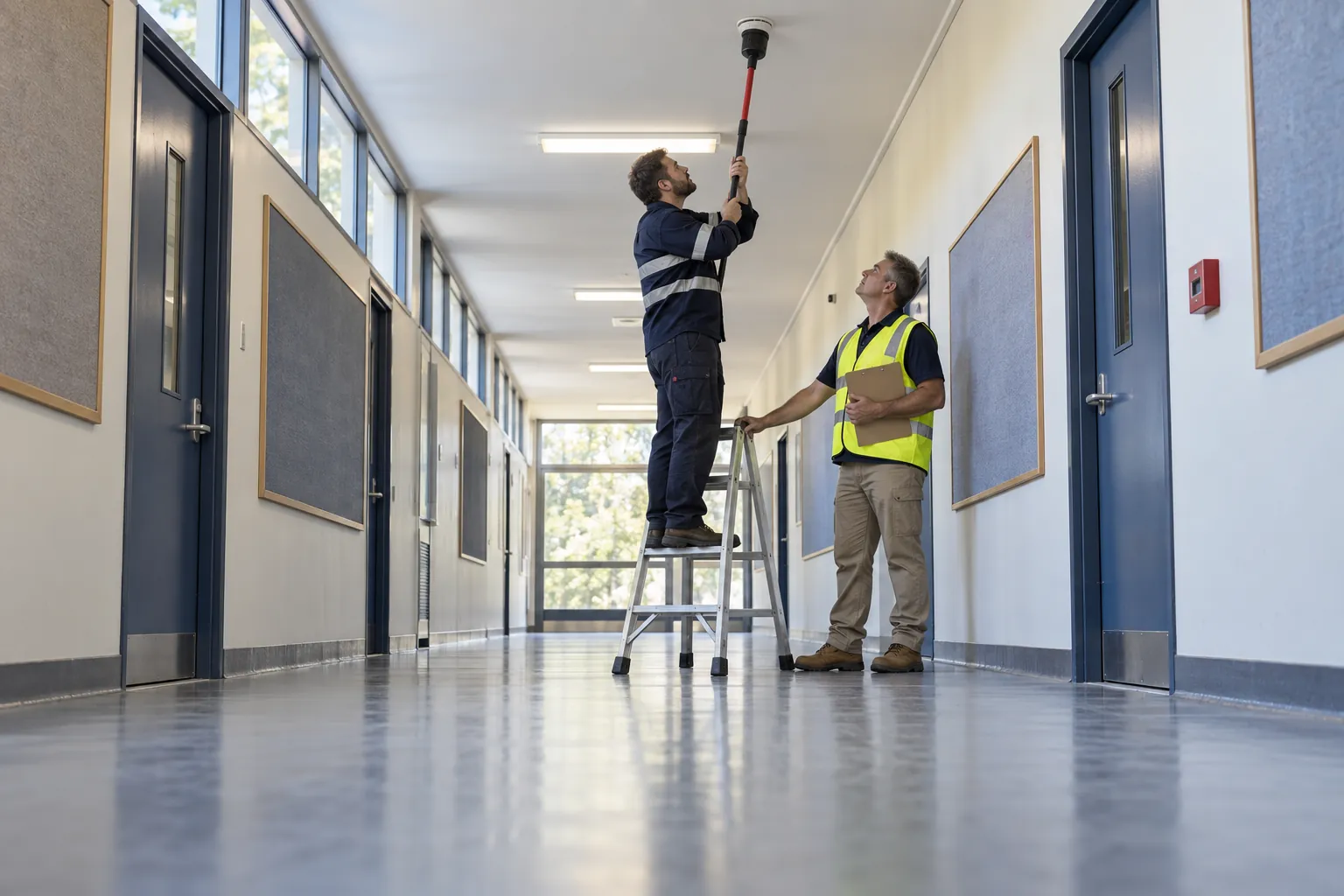
In Australia, routine service is carried out by a competent person under AS 1851, not by site staff, and on a system monitored by the fire brigade, operating a call point or a detector without first arranging an isolation will call the brigade out. Building staff should not test devices themselves unless the building's own procedure says they may, and says how.
03
How often, and who does it
The routine service intervals come from AS 1851, from the building's own maintenance documents, or both. In Victoria, an occupancy permit or maintenance determination can specify "the frequency and type of inspection, testing and maintenance required" for each essential safety measure. In Queensland the intervals follow QDC MP6.1. Start with the building's documents, then the standard.
The contractor's visits follow the Section 6 intervals, and any emergency warning or intercom system has its own schedules there too:
- Monthly: the most frequent routine service of the fire detection and alarm system.
- Six-monthly: required for the fire detection and alarm system only where it forms part of a special hazard system (for example, local control stations, visual warning devices and actuators); ask the contractor whether it applies to your building.
- Yearly: the fullest annual routine for the system, with the yearly condition report.
- Five-yearly: the longer-interval activities the standard sets for the fire detection and alarm system.
The exact activities at each interval are in the standard, which is a paid document; ask the contractor to show you the schedule they are working to, not a summary of it. AS 1851 also has a clause on the frequency and tolerances of routine service intervals. A monthly service done six weeks late is out of tolerance and should be reported as such, not written up as the month's service.
The standard has a clause on competent persons, and the state law adds its own tests. Queensland requires an "appropriately qualified person"; NSW requires an accredited practitioner (fire safety) to assess each measure for the annual fire safety statement. Ask who will attend and what licence or accreditation they hold before the first visit.
04
What the building team does between visits
A contractor may be on site once a month. In between, the building manager, caretaker, security officer or cleaning supervisor is often the first to see a problem. Their checks are observations, not tests. A practical routine:
- Look at the panel each day. It should show normal. Any fault, alarm or isolation shown is recorded and reported to whoever holds the fire services contract, the same day.
- Keep an isolation register. Every zone or device isolated for trades, cleaning or hot work is written down with who asked for it, when it started, and when it was restored.
- Walk the building with the system in mind. Manual call points visible and unobstructed; detectors not covered, painted over or bagged after a job; no new partitions, shelving or stock blocking sounders or call points.
- Watch for trade and cleaning activity. Dust, steam, aerosols and heat set off detectors. Contractors arrange any isolation through the building manager first.
- Record every alarm. Genuine or not, each activation is logged with the time, the zone, the cause found and who attended.
Fire Rescue Victoria's guidance on false alarms says that "Trade activities can regularly generate dust, heat and fumes which may activate smoke detectors", says that appointing someone to manage the fire alarm system, such as a site engineer, building manager or fire warden, "has proved to assist in reducing preventable false alarms", and advises training for that person in "correct testing procedures" and "correct isolation procedures". It also warns that, depending on its length and purpose, "an isolation may amount to a disconnection in which case a building permit is required."
In Victoria, resetting a fire indicator panel without a reasonable excuse is an offence, as is damaging or interfering with the panel or the equipment that sends the alarm signal, which FRV says includes "isolating, disabling, disconnecting or modifying your monitored automatic alarm system". The penalty is 60 penalty units. Resetting the panel will not stop the brigade responding; follow the emergency plan instead.
FRV charges for preventable false alarms at a published rate of $675 per truck per 15 minutes, and a submission explaining the circumstances must be made within 14 days of the notification. FRV says it will not charge where there is a reasonable excuse and the alarm was not preventable or foreseeable. A dated record of isolations, briefings and the cause of each activation is what a submission is built from.
05
What the records must show
AS 1851's general section deals with routine service records: logbooks, tags and labels, a summary record and how long records are kept. Its reporting clauses cover defects, non-conformances and out of tolerance activities, and the yearly condition report. The owner or occupier should hold a copy, not only the contractor.
The state rules say what those records must contain and how quickly they must be produced:
- Queensland: section 55 of the Building Fire Safety Regulation 2008 requires the occupier to keep a record of maintenance stating, among other things, a description of the installation, the name and licence number of the person who did the work, the date, a brief description of what was done, and the results, including "whether or not the person carrying out the maintenance considered the installation was in proper working order" and the details of any repair needed or made. Records and occupier statements are kept for two years, and each occupier statement goes to the commissioner within 10 business days of falling due.
- Victoria: regulation 225 requires the owner to make available at the building, within 24 hours of a request by the municipal building surveyor or the chief officer, the annual essential safety measures reports from the last 10 years, the maintenance schedules and determinations, and "the records of all inspections, testing and maintenance (including repairs)" of each essential safety measure. FRV's guidance adds that "A hard-copy maintenance log book must be kept on site and be available to the fire services 24 hours a day."
- New South Wales: the annual fire safety statement lists every essential fire safety measure and is issued by or on behalf of the owner, following assessment by an accredited practitioner (fire safety).
Defects are where records most often go quiet. Queensland requires the occupier to ensure a repair or other corrective action shown in the record of maintenance is completed within one month, unless there is a reasonable excuse, and a contractor who finds a critical defect must give the occupier a critical defect notice within 24 hours. Elsewhere the same discipline helps: a named person, a date for the repair and a closing entry.
The building's own working records cover the days between visits: the daily panel check, the isolation register and the alarm log, each dated and naming the person.
06
Where the record fails, and what SiteClara does about it
The contractor's logbook is usually in order. The gaps are in the building team's part: a daily panel check initialled for the whole week on Friday, an isolation for a fit-out left on for a fortnight because nobody recorded who asked for it, a fault light a night security officer mentioned to whoever was on the desk, and a false alarm with no note of the cause when the charge arrives. Across several buildings, a facility manager often cannot tell which sites looked at their panel this week without ringing round.
SiteClara records those checks where they happen. A printed QR poster, with an optional NFC tag behind it, sits at the fire indicator panel or at another location where a check is scheduled. Staff scan the code or tap the tag on their own phone, with no app to install, see the checks due at that location, such as today's panel check, and mark each one done or say what stopped them. A problem, such as a fault showing on the panel or a detector left bagged after a job, is reported there with a photo and stays on the team's list of jobs until someone closes it.
The supervisor sees what is due, done and missed, and records the reason a check was missed. A job that needs the building manager can be escalated to them to answer. Each day the supervisor reviews and approves a report that goes to nominated contacts, such as the owner's facility manager, at 8am the next morning, showing what was reported, what was completed, what is still open, and how the scheduled checks went.
07
Questions people ask
How often is fire alarm testing required?
It depends on the building's documents and its state. AS 1851 sets monthly, yearly and five-yearly routine service for a fire detection and alarm system, with six-monthly service where it forms part of a special hazard system. In New South Wales, NSW Planning's page on fire safety certification says "Annual fire safety statements must be issued each year", while supplementary fire safety statements for critical fire safety measures are issued "at more regular intervals", as the building's fire safety schedule specifies.
What qualifications do you need to test fire alarms?
It depends on the state and the task. In New South Wales, NSW Planning's page on fire safety certification says the government approved the Fire Protection Association Australia (FPAA) accreditation scheme in July 2020, and "Only practitioners accredited by the FPAA can perform the functions of an accredited practitioner (fire safety) where those functions are covered by the scheme." Queensland requires an "appropriately qualified person". Ask the contractor what licence or accreditation the technician who attends holds.
How often should smoke alarms be tested in Australia?
Every month, for smoke alarms in homes. Fire Rescue Victoria's page on smoke alarms says to test them monthly: "Press and hold the test button until the smoke alarm beeps three times." It also advises cleaning each alarm at least once a year and replacing 9-volt batteries every year. Landlords have duties too: the Queensland Fire Department's page on smoke alarms says "Within 30 days before the start of a tenancy, the lessor/landlord must test and clean each smoke alarm in the home." A commercial building's detectors are serviced under AS 1851 instead.
How do you tell if a smoke alarm needs to be replaced?
By its age. Fire Rescue Victoria's page on smoke alarms says to replace a smoke alarm every ten years, ideally with hard-wired, interconnected smoke alarms or with alarms that have tamper-proof chambers and 10-year long-life batteries.
08
Further reading, and a list to take away
Standards Australia sells AS 1851-2012 Routine service of fire protection systems and equipment and AS 1670.1:2024, the design and installation standard for fire detection and alarm systems. For the law in your state, read Part 15 and Schedule 8 of the Building Regulations 2018 (Vic), NSW Planning's page on fire safety certification, sections 54 to 55A of the Building Fire Safety Regulation 2008 (Qld) with the Queensland Fire Department's page for building occupiers, owners, lessees and bodies corporate, or the MFS page on the maintenance of fire safety systems in South Australia. Fire Rescue Victoria's page on false alarms is useful in any state. Your state or territory fire service can tell you its own false alarm charging rules.
Before the next contractor visit, check that:
- the building's list of fire safety measures includes the detection, warning and brigade link, and the contract covers each one;
- the contract names the edition of AS 1851 and the intervals the building's documents set;
- the contractor's monthly, six-monthly and yearly records are held by the owner or occupier, not only by the contractor;
- late services are reported as out of tolerance, not recorded as on time;
- someone looks at the panel each day and reports any fault or isolation the same day;
- every isolation is recorded with who asked, when it started and when it was restored;
- every alarm, genuine or false, is logged with its cause and who attended;
- each defect has a named person, a repair date and a closing entry after it is fixed;
- staff know not to reset the panel, and know who is appointed to manage the system.
Sources
Every document this guide quotes or links to, in the order it first cites them.
- AS 1851-2012 Routine service of fire protection systems and equipment store.standards.org.au
- AS 1670.1:2024 store.standards.org.au
- Building Regulations 2018 (Vic) legislation.vic.gov.au
- Fire safety certification planning.nsw.gov.au
- Building Fire Safety Regulation 2008 (Qld) legislation.qld.gov.au
- Maintenance of fire safety systems mfs.sa.gov.au
- Work Health and Safety Regulation 2011 (Qld) legislation.qld.gov.au
- False alarms frv.vic.gov.au
- Smoke alarms frv.vic.gov.au
- Smoke alarms fire.qld.gov.au
- Building occupiers, owners, lessees and bodies corporate fire.qld.gov.au
Related guides
 Fire and water checksAS 1851 routine service: what it asks of owners, fire contractors and building teamsWhat AS 1851-2012 routine service covers, how intervals and competent persons work, what the records must show, and how Victoria's regulations call it up.
 Fire and water checksEssential safety measures in Victoria: the duties, the annual report and the recordsWhat essential safety measures are under Victoria's Building Regulations 2018, who maintains them, the annual ESM report, the records to keep and the checks between.
 Fire and water checksFire drills and evacuation drills in Australia: the duty, the drill and the recordRunning a fire drill or evacuation drill in an Australian workplace: the WHS duty, Queensland's yearly rule, planning the exercise, the debrief and the record.
 Fire and water checksFire warden duties: what the chief warden and floor wardens do, day to day and when the alarm soundsWhat a chief warden and floor wardens do in an Australian workplace: the law behind the role, the routine checks, the job in an evacuation, and the records to keep.