Premises and facilities management
Near miss reporting in Australia: what WHS law asks, and how to make it work
A near miss is an unplanned event at work that could have injured someone, made someone ill or damaged property, but did not.
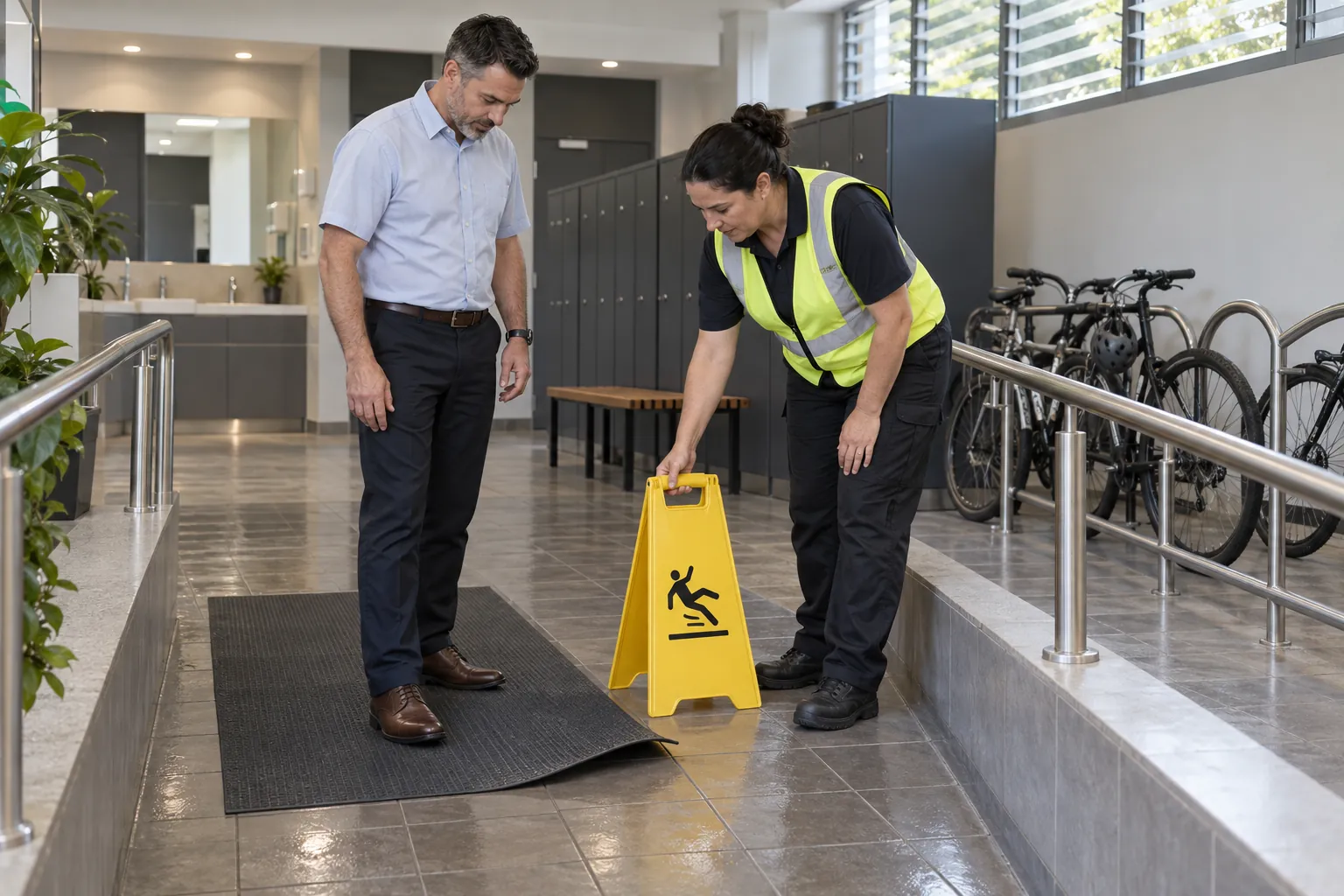
It is the incident that did not quite happen: the slip that ended in a stumble, the carton that fell from a high shelf onto an empty aisle, the tingle from a cleaning machine's lead. Nobody was hurt, so nothing has to be done, and that is exactly why the same hazard is still there next week. This guide covers what a near miss is under Australian work health and safety law, when one is a notifiable dangerous incident, what a useful report holds, and how to make sure a report ends in a fix.
01
What a near miss is, and what WHS law says about it
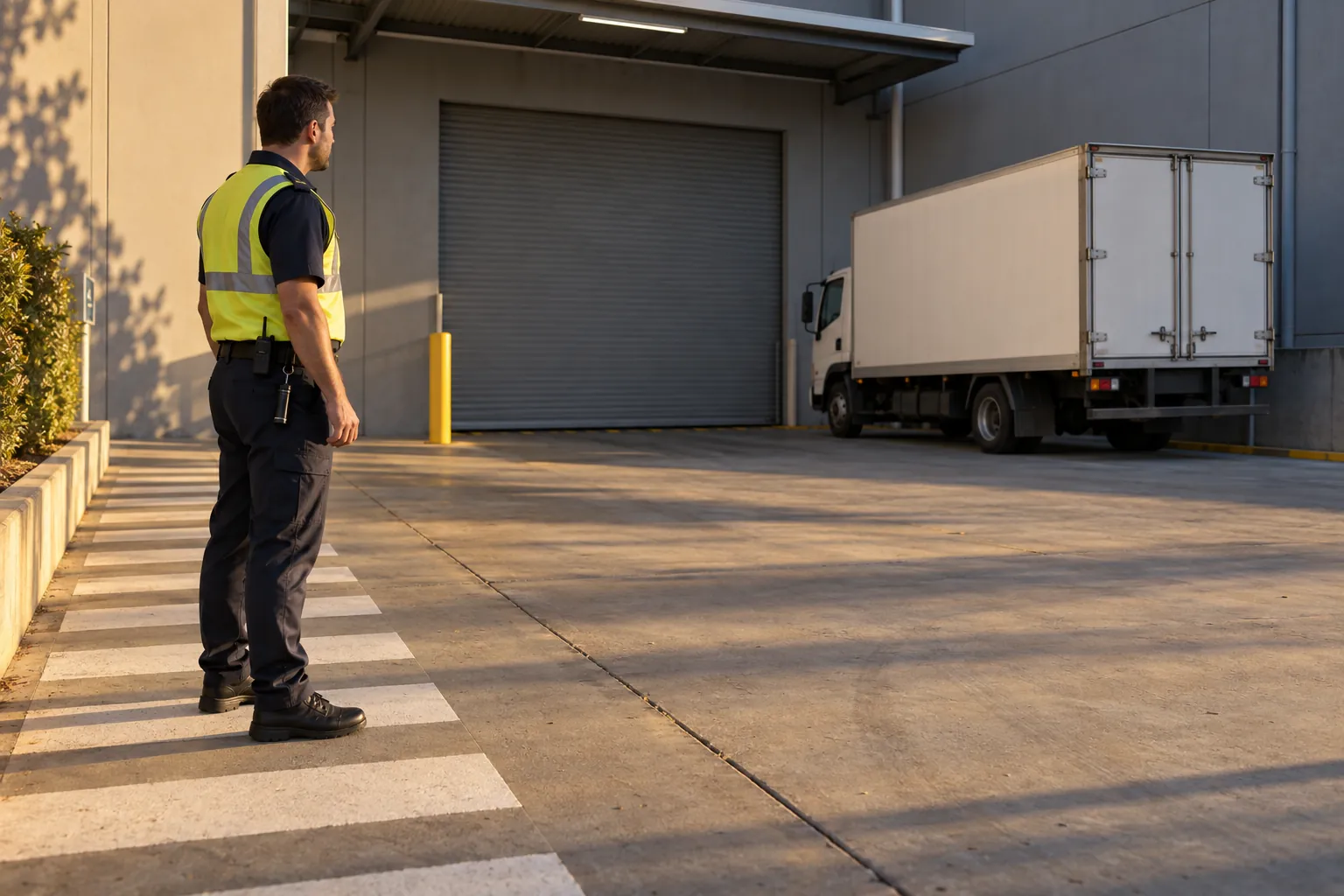
A near miss is also called a close call or a near hit, and the point is the same whatever the name: the harm was avoided by luck or timing, not by a control that worked. In a building that might be a contract cleaner losing footing on a freshly mopped ramp, a pallet jack rolling off a loading dock with nobody behind it, or a delivery van reversing past a pedestrian in the car park with half a metre to spare.
The phrase itself does not appear in the Work Health and Safety Act 2011 (Cth), the Commonwealth's version of the model WHS Act, or in its Work Health and Safety Regulations 2011. The Act works with two other ideas. Section 35 defines a notifiable incident as a death, a serious injury or illness, or a dangerous incident. Section 37 defines a dangerous incident as an incident "that exposes a worker or any other person to a serious risk to a person's health or safety emanating from an immediate or imminent exposure to" a listed event, such as an uncontrolled spill or leak of a substance, an uncontrolled fire, electric shock, or "the fall or release from a height of any plant, substance or thing".
So a near miss sits in one of two places. Some near misses are dangerous incidents, and the regulator must be told immediately even though nobody was hurt. Most are not notifiable, but they still reveal a hazard, and the general duties still apply: regulation 34 of the WHS Regulations requires a duty holder to "identify reasonably foreseeable hazards that could give rise to risks to health and safety", and a near miss is about the clearest evidence of a foreseeable hazard there is.
02
What counts as a near miss in a building
Facility managers, building managers and cleaning and security contractors see the same near misses again and again. Typical examples:
- Slips and trips: a stumble on a wet floor in an end of trip facility, a trip on a lifted carpet tile in a corridor, a missed step on a poorly lit fire stair.
- Falling objects: stock or archive boxes sliding off high shelving in a store room, a ceiling tile dropping in a plant room, a tool dropped from a ladder near people passing below.
- Electrical: a shock or tingle from a floor scrubber, vacuum or kettle, a scorched power point, a lead run through a doorway and crushed.
- Chemicals: a cleaning chemical decanted into an unlabelled bottle, a spill in the cleaners' store, two products mixed in a mop bucket.
- Vehicles and plant: a forklift or pallet jack near miss at a loading dock, a car taking the ramp too fast past a pedestrian in the car park, a boom gate coming down on a person walking through.
- Doors, lifts and escalators: a lift that stopped out of level, an automatic door closing on someone, an escalator in a shopping centre that jolted.
- After hours: a guard on a lock-up patrol finding an open riser or an unlocked roof hatch.
It helps to keep four words apart, because they lead to different actions:
- Hazard: something that could cause harm, such as the lifted carpet tile. Nobody has been affected yet.
- Near miss: an event where the hazard nearly caused harm, such as the trip on that tile with no fall.
- Incident: an event that caused injury, illness or damage.
- Notifiable incident: a death, a serious injury or illness, or a dangerous incident as the Act defines them, which must go to the regulator.
A good reporting system takes all four through the same door. The person who triages the report can sort out which it is.
03
When a near miss must be notified, and who does it
Where a near miss is a dangerous incident, section 38 of the WHS Act applies. The person conducting a business or undertaking (PCBU) "must ensure that the regulator is notified immediately after becoming aware" of it, "by the fastest possible means", by telephone or in writing. If the notice is given by telephone, the PCBU must give the details the regulator asks for and, if required, a written notice within 48 hours of that requirement being made.
Section 38(7) requires the PCBU to "keep a record of each notifiable incident for at least 5 years from the day that notice of the incident is given to the regulator". That record, and the notice given in the way the regulator sets, is the statutory record. Your internal near miss report is not a substitute for it.
Section 39 requires the person with management or control of the workplace to ensure, so far as is reasonably practicable, that the site of a notifiable incident "is not disturbed until an inspector arrives at the site or any earlier time that an inspector directs". The site includes the plant, substance, structure or thing involved. The exceptions include helping an injured person and any action "essential to make the site safe or to minimise the risk of a further notifiable incident". For a building team, that means taping off the scene and leaving it, not tidying up.
The regulator is the one for your state or territory. SafeWork NSW's Incident notification page says that "some types of work-related dangerous incidents must be notified even if no-one is injured", and takes notifications on 13 10 50, 24 hours a day. WorkSafe Victoria's Report an incident page asks for a call on 13 23 60 immediately and a written report within 48 hours, and says the record must be kept "for at least five years".
Buildings usually have several PCBUs at once: the owner or owners corporation, the facility management company, the cleaning contractor, the security contractor, the tenants. Section 46 of the Act says that where more than one person has a duty in relation to the same matter, each must "consult, co-operate and co-ordinate activities" with the others. In practice, agree in writing, before anything happens, who notifies the regulator for which kinds of incident, who preserves the site, and how each contractor's near miss reports reach the building manager or facility manager, and the building manager's reach the contractor.
04
What a good near miss report holds
A near miss report is only useful if someone can act on it without going back to ask. The essentials:
- Where, precisely: the building, the level and the place, such as "level 2 end of trip facility, shower 3", not "upstairs".
- When it happened, and when it was reported.
- Who reported it, so they can be asked a question and told the outcome.
- What happened, in the reporter's own words, and what could have happened.
- What was done straight away to make it safe: a wet floor sign, a barrier, the machine tagged out of service.
- A photo, when it shows the hazard better than words do, taken without people's faces where possible.
- Whether it might be notifiable, so the person triaging it checks against section 37 at once.
Speed matters more than polish. A report made on the spot, before the shift ends, is far more accurate than one written from memory at the end of the week, and the hazard can be made safe the same day.
People report when reporting is safe and when something happens as a result. Under section 28 of the Act, workers must take reasonable care for their own and others' health and safety and co-operate with any reasonable safety policy or procedure that has been notified to them, so a clear near miss procedure is something a PCBU can ask workers to follow. But a procedure that leads to blame, or to nothing, will stop being used. Thank the reporter, keep the report about the hazard rather than the person, and tell them what was done.
Consultation is part of the duty, not an extra. Section 47 requires a PCBU to consult, so far as is reasonably practicable, with workers who are or are likely to be directly affected by a work health or safety matter, and section 49 says consultation is required "when identifying hazards and assessing risks" and when deciding how to eliminate or minimise them. Where there is a health and safety representative (HSR), section 70 requires the PCBU to allow the HSR access to information it holds about hazards at the workplace affecting the work group.
05
From report to fix: who does what
A simple sequence keeps the thread between report and repair:
- Make safe: whoever finds the hazard makes it safe if they can do so without risk, and reports it.
- Triage: the supervisor or building manager reads it the same day, checks whether it is notifiable, and decides the priority.
- Assign: the fix goes to one named person or company, such as the maintenance contractor, the cleaning supervisor or the tenant, with a date.
- Fix: the hazard is eliminated where reasonably practicable; otherwise, under regulation 36, substitution, isolation or engineering controls come before administrative controls and personal protective equipment.
- Check and close: someone other than the person who did the fix confirms it is done, ideally at the location, and closes the report.
- Tell the reporter what was done.
The WHS Regulations back up the last part of the loop. Regulation 37 requires a control measure to remain effective, including being "installed, set up and used correctly", and regulation 38 requires a duty holder to review and as necessary revise a control measure when, among other things, "a new relevant hazard or risk is identified" or the control does not control the risk it was put in to control. A near miss is often the first sign of either: the anti-slip matting that has curled, the chemical labelling that nobody follows. When a near miss points at a control that should have worked, review the control, not just the spot.
Look across the reports as well as at each one. A monthly review at the WHS committee or the contract meeting should ask where near misses keep happening, which are still open and why, and which control measures need changing. The same stretch of car park, the same shower, the same stairwell appearing three times is a finding in its own right.
In strata buildings, be clear about common property. A near miss in a lobby, lift or car park of a strata or body corporate building is usually for the owners corporation to fix through its strata manager or building manager, even when it is a tenant's cleaner or a contractor's guard who reports it. Agree the route in advance so the report does not sit with whoever happened to hear it.
06
Where near miss reporting fails, and what SiteClara does about it
Near miss reporting rarely fails for want of a form. It fails because the form is somewhere else, because the report is made to whoever was passing, and because nobody can later show whether the fix happened. A cleaner mentions the tingle from the scrubber to the building manager at the lift, and a month later nobody can say who was told, which machine it was, or whether it was tagged out. The WHS committee sees a count, not a list of hazards with owners and dates.
SiteClara records work and reports at the location. A printed QR poster, with an optional NFC tag behind it, sits at each place where checks are scheduled, such as an end of trip facility, a loading dock, a plant room or a fire stair. Staff scan or tap on their own phone, with no app to install, and can report a problem there, with a photo when one helps. The report carries the location, the time and the named person, and goes onto the team's list of open jobs until someone closes it. The same tag is where the scheduled checks at that location are marked done, or explained when something stopped them.
The supervisor sees the open jobs and the day's checks, adds a note and approves a daily report that goes to nominated management or client contacts the next morning, showing what was reported, what was completed and what is still open. For a near miss, that turns "I told someone" into a dated report at a known location, and "it was fixed" into a closed job with a time and a name.
07
Questions people ask
What is considered a near miss?
Any unplanned event at work that could have caused injury, illness or damage but did not. The model WHS Act does not use the phrase, but WorkSafe Victoria's page on notifiable incidents under the Occupational Health and Safety Act 2004 gives "a near miss" as its example of an incident that exposes "a person to a serious risk to the person's health and safety". Near misses that are not notifiable still count: SafeWork NSW's Code of Practice How to manage work health and safety risks tells duty holders to ask workers about "any near misses or incidents that have not been reported" and to analyse records of near misses to identify hazards.
What is the difference between a near miss and an accident?
Harm. An accident, or an incident in WHS terms, injures someone, makes them ill or damages property; a near miss does not. The law looks at the risk as well as the result, though: section 35 of the Work Health and Safety Act 2011 makes a dangerous incident notifiable alongside a death and a serious injury or illness, so a near miss that fits section 37 needs the same immediate notice to the regulator as a serious accident.
What is a good near miss example?
A carton falling from high shelving into an aisle that was empty a moment before. It is also a dangerous incident under section 37 of the Work Health and Safety Act 2011, which lists "the fall or release from a height of any plant, substance or thing", together with events such as "an uncontrolled escape, spillage or leakage of a substance" and "electric shock". A trip on a lifted carpet tile with no fall is a near miss too, but not notifiable: it goes on the list of hazards to fix.
08
Where to read more, and a list to take away
The Work Health and Safety Act 2011 on the Federal Register of Legislation sets out notifiable and dangerous incidents in Part 3 (sections 35 to 39) and consultation in Part 5. The Work Health and Safety Regulations 2011 set out the duty to identify hazards and to maintain and review control measures (regulations 34 to 38). Each state and territory that has adopted the model laws has its own Act and Regulations on its own legislation site, and its own regulator. Safe Work Australia publishes the model Codes of Practice, including How to manage work health and safety risks.
For notification, read your regulator's own page: SafeWork NSW's Incident notification, and in Victoria, WorkSafe Victoria's Report an incident and Notifiable incidents under the Occupational Health and Safety Act 2004.
Before you rely on your near miss reporting, check that:
- everyone who works in the building, contractors included, knows how to report a near miss and can do it in a minute or two;
- reports are made at the time, with the exact location and a photo where it helps;
- someone reads each report the same day and checks it against the definition of a dangerous incident;
- it is written down who notifies the regulator and who preserves the site, for each PCBU in the building;
- the procedure matches your jurisdiction, and Victoria's OHS Act where the site is in Victoria;
- every report ends with a named owner, a date and a confirmed fix;
- the reporter is told what was done;
- near misses are reviewed together each month, and repeat locations lead to a review of the control measure;
- your HSR and WHS committee can see the reports.
Sources
Every document this guide quotes or links to, in the order it first cites them.
- Work Health and Safety Act 2011 legislation.gov.au
- Work Health and Safety Regulations 2011 legislation.gov.au
- Notifiable incidents under the Occupational Health and Safety Act 2004 worksafe.vic.gov.au
- Incident notification safework.nsw.gov.au
- Report an incident worksafe.vic.gov.au
- How to manage work health and safety risks safework.nsw.gov.au
Related guides
 Premises and facilities managementHazard report forms and hazard reporting: what WHS law asks, and how to close the loopHazard reporting under Australian WHS law: the duty to identify hazards, what a hazard report form should hold, who acts on it, and how to show the fix was made.
 Premises and facilities managementWork incident reports: what Australian WHS law asks, and what a good report holdsWhat a work incident report should hold under Australian WHS law, when an incident is notifiable, the register of injuries, and how to follow a report through.
 Premises and facilities managementWorkplace inspection checklist: what WHS law asks, what to walk, and what to do nextWorkplace inspections under Australian WHS law: the duties behind them, what the checklist covers, how often, recording findings, and HSRs' right to inspect.
 Premises and facilities managementWorkplace housekeeping: what WHS law asks, and a routine that holds between inspectionsWorkplace housekeeping under Australian WHS law: regulation 40, what the codes of practice ask, who keeps which areas tidy, how often, and what a good record shows.