Premises and facilities management
Workplace inspection checklist: what WHS law asks, what to walk, and what to do next
A workplace inspection checklist is a list, area by area, of the hazards and safety controls to check on a planned walk through the premises, so that problems such as a fire exit blocked by pallets, an extension lead run under a carpet tile, an empty soap dispenser in the amenities or a car park light that has been out for a week are found and fixed before they hurt someone.
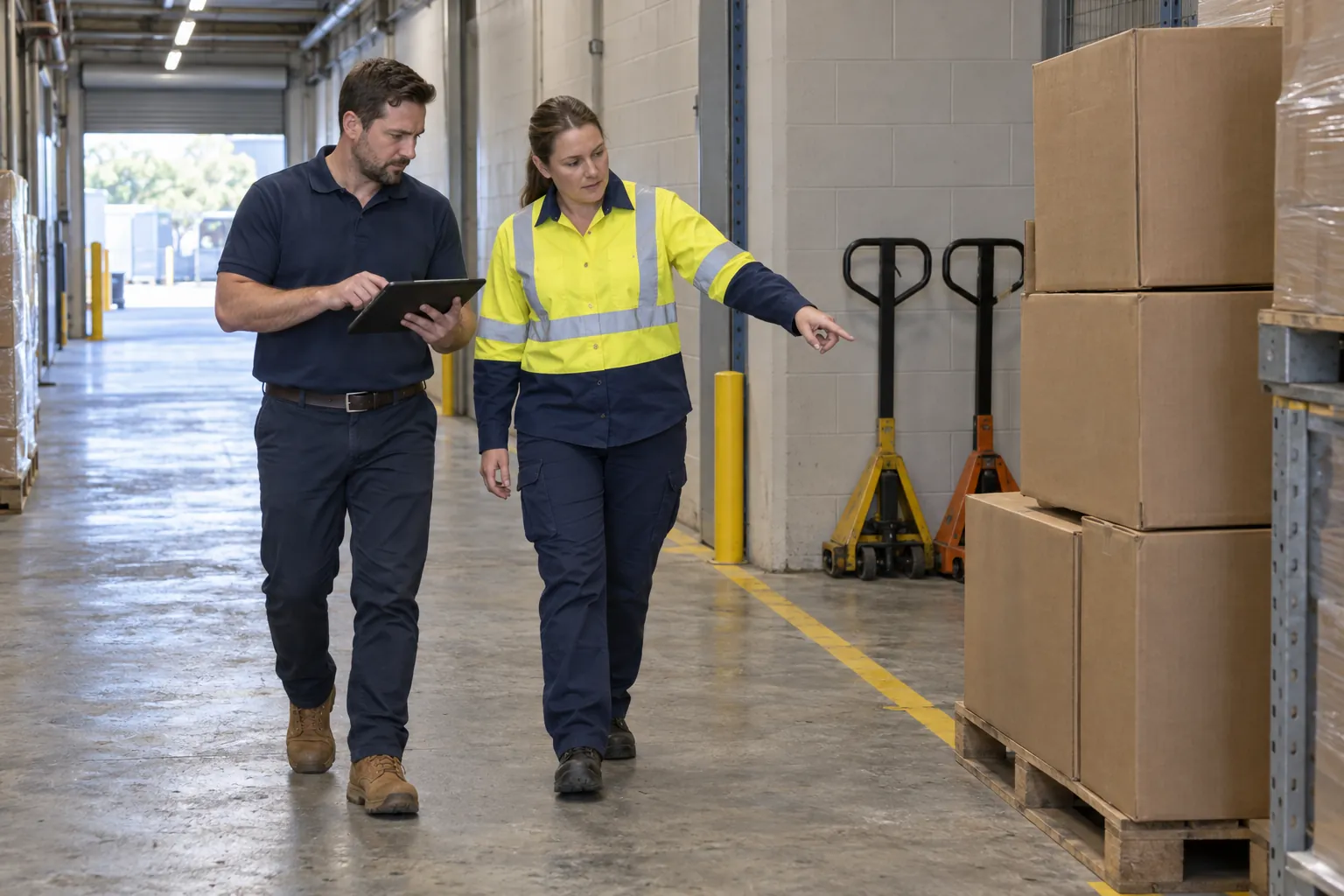
This guide covers the duties in Australian work health and safety law that an inspection serves, what a WHS inspection checklist should cover in an office, shopping centre, school or strata building, how often to inspect and who should do it, how to record findings and close them out, and the right of health and safety representatives to inspect for themselves.
01
The WHS duties behind a workplace inspection
No Australian law prescribes a workplace inspection checklist or how often to inspect. It sets the duties an inspection is the practical way to meet. Under section 19 of the Commonwealth Work Health and Safety Act 2011, which follows the model WHS Act and keeps its section numbers, a person conducting a business or undertaking (PCBU) must ensure, so far as is reasonably practicable, the health and safety of its workers and of others affected by the work. Section 19(3) lists what that includes, among it "that the health of workers and the conditions at the workplace are monitored for the purpose of preventing illness or injury".
The Commonwealth Work Health and Safety Regulations 2011, which follow the model Regulations, turn that into a risk management process. The wording below is from Queensland's Work Health and Safety Regulation 2011, which follows the model regulations and keeps their numbers:
- Regulation 34: "A duty holder, in managing risks to health and safety, must identify reasonably foreseeable hazards that could give rise to risks to health and safety."
- Regulations 35 and 36: eliminate the risk so far as is reasonably practicable, and if that is not possible, minimise it using the hierarchy of control measures, with administrative controls and personal protective equipment last.
- Regulation 37: a control measure must be maintained so that it remains effective, including "fit for purpose", suitable for the work, and "installed, set up and used correctly".
- Regulation 38: control measures must be reviewed and, as necessary, revised, including when a control "does not control the risk it was implemented to control" and when "a new relevant hazard or risk is identified".
An inspection serves all four: it finds hazards, checks that existing controls are still working, and shows when one needs reviewing.
The approved code of practice How to manage work health and safety risks (the SafeWork NSW edition of August 2019, based on the Safe Work Australia model code dated May 2018) puts it plainly under "Inspect the workplace": "regularly walking around the workplace and observing how things are done can help you predict what could or might go wrong." It adds: "You may use a checklist designed to suit your workplace to help you find and make a note of hazards."
In a building shared by several businesses, more than one duty holder is involved. Section 20 of the model Act puts a duty on the person with management or control of a workplace to ensure that "the workplace, the means of entering and exiting the workplace and anything arising from the workplace are without risks to the health and safety of any person", and section 46 requires every duty holder with a duty in relation to the same matter to "consult, cooperate and coordinate activities" with the others. "Any person" includes visitors, customers, contractors and other building users, not only workers. In practice the building manager, the tenants and the contractors each inspect what they control, and agree who fixes what.
02
What a workplace inspection checklist covers
A general WHS inspection checklist for an office, shopping centre, school, warehouse or the common property of a strata building usually covers the areas below. The code of practice asks you to look at "how people actually work, how plant and equipment are used, what chemicals are around and what they are used for, what safe or unsafe work practices exist as well as the general state of housekeeping". Tailor it to the activity.
An inspection is not the same as a safety audit. A safety audit checklist tests whether the system works: whether risks are assessed, controls reviewed, workers consulted and records kept. An inspection checklist looks at the physical conditions and work practices in each area on the day.
- Entry, exit and movement: regulation 40 requires, so far as is reasonably practicable, that the layout of the workplace allows people "to enter and exit and to move about without risk to health and safety, both under normal working conditions and in an emergency". Walkways and stairs clear, handrails firm.
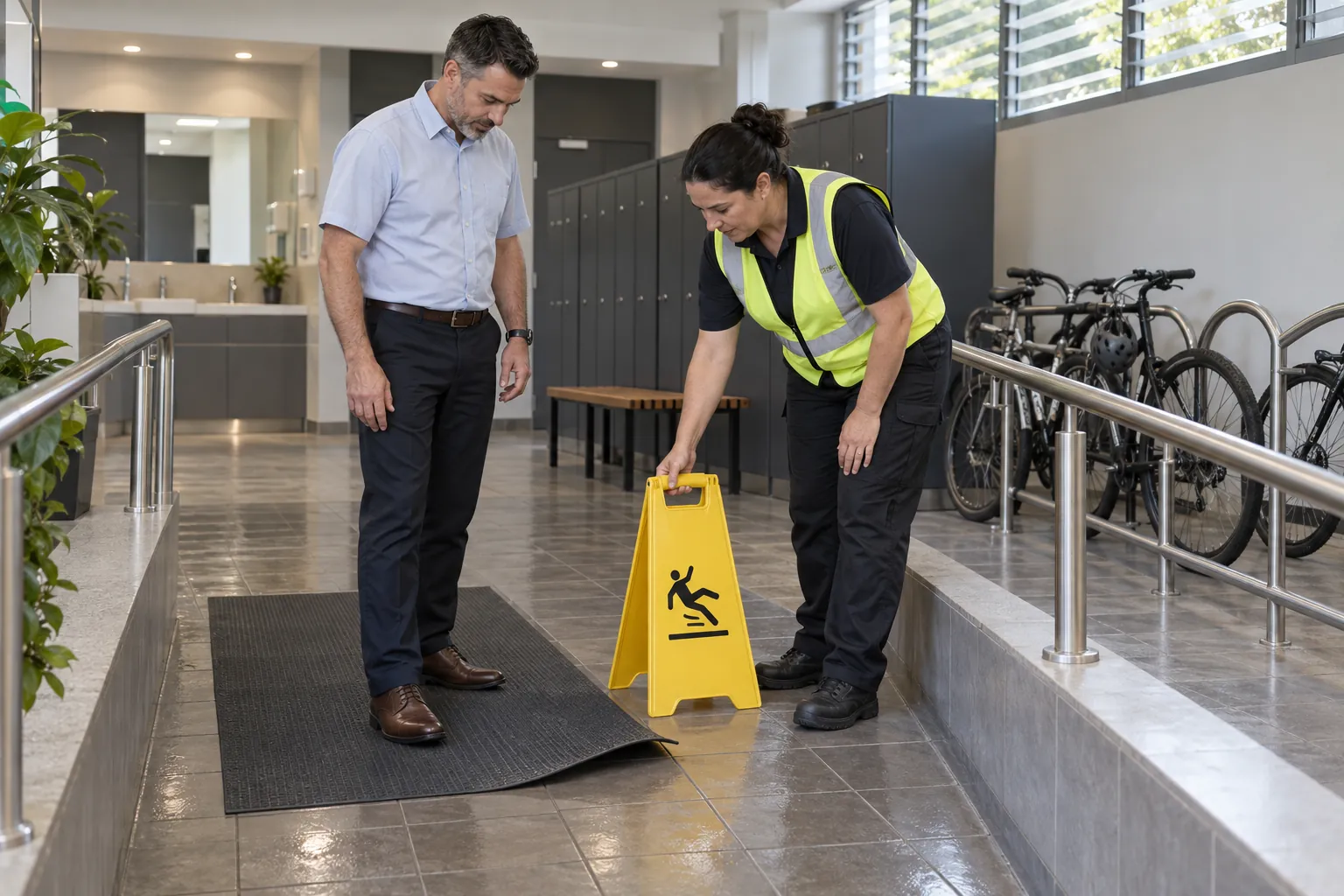
- Floors and surfaces: regulation 40 again, floors "designed, installed and maintained" to allow work without risk. Lifted tiles, spills, wet entrances, and workplace housekeeping in store rooms and plant rooms.
- Lighting, ventilation and temperature: lighting good enough to work, to move about and for "safe evacuation in an emergency"; ventilation working; heat managed in summer.
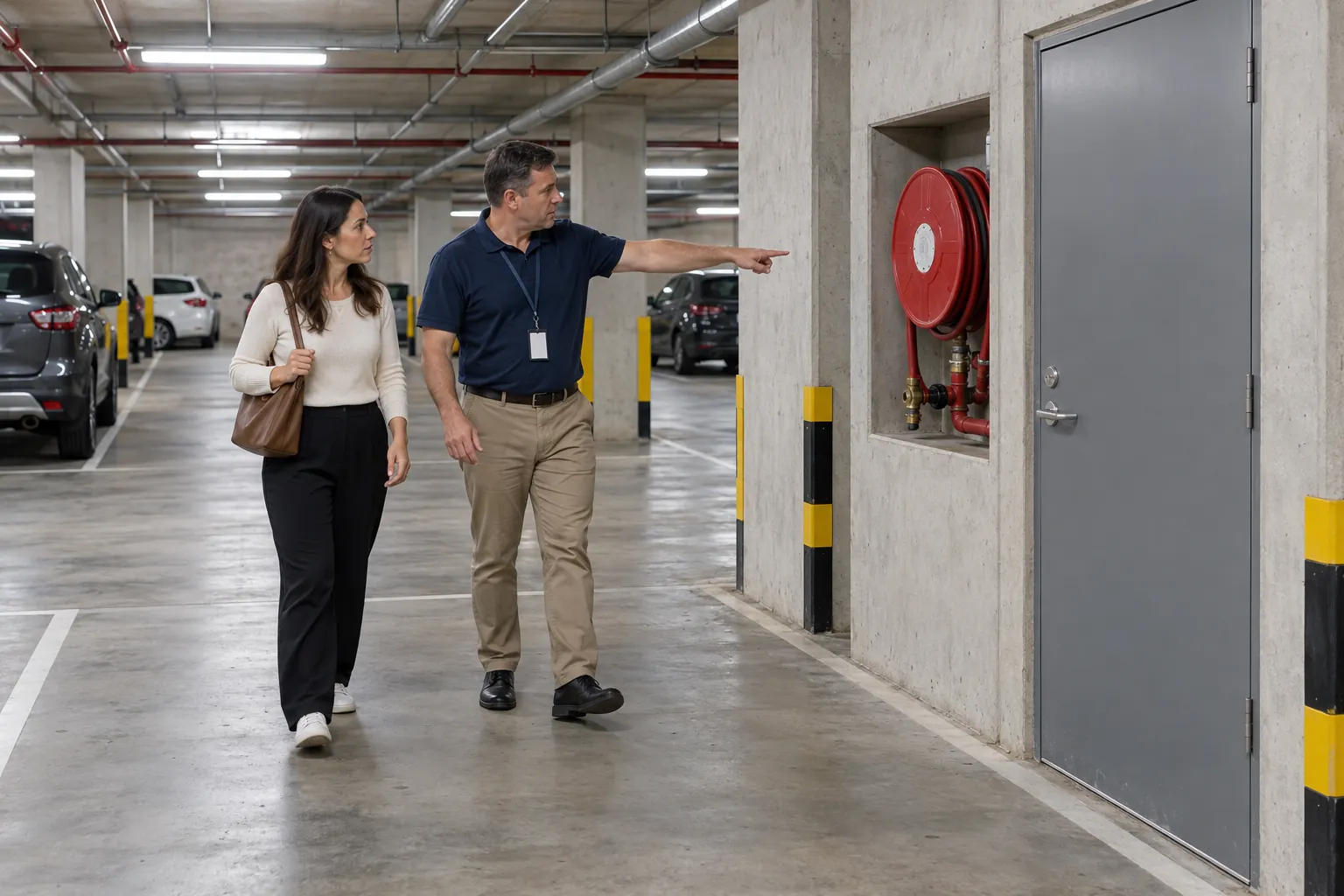
- Emergency preparedness: exits clear, exit signs lit, fire doors not propped open, extinguishers and hose reels accessible, and the emergency plan required by regulation 43 known on site. The detailed servicing of fire safety measures is a separate regime; see AS 1851 routine service.
- First aid: regulation 42 requires first aid equipment for the workplace, access to it for each worker, and enough trained first aiders or access to them. Kits stocked and in date, first aiders named.
- Amenities: regulation 41 requires adequate facilities, including toilets, drinking water, washing and eating facilities, maintained so as to be "in good working order" and "clean, safe and accessible". Soap and paper stocked, the kitchenette clean, end of trip facilities in order.
- Electrical: damaged leads or power points, piggy-backed power boards, switchboards used as storage.
- Hazardous chemicals: stored and labelled correctly, safety data sheets available, the right PPE on hand.
- Plant and equipment: guards in place, faulty items tagged out, ladders sound.
- Falls and falling objects: edges and roof access protected, shelving stable.
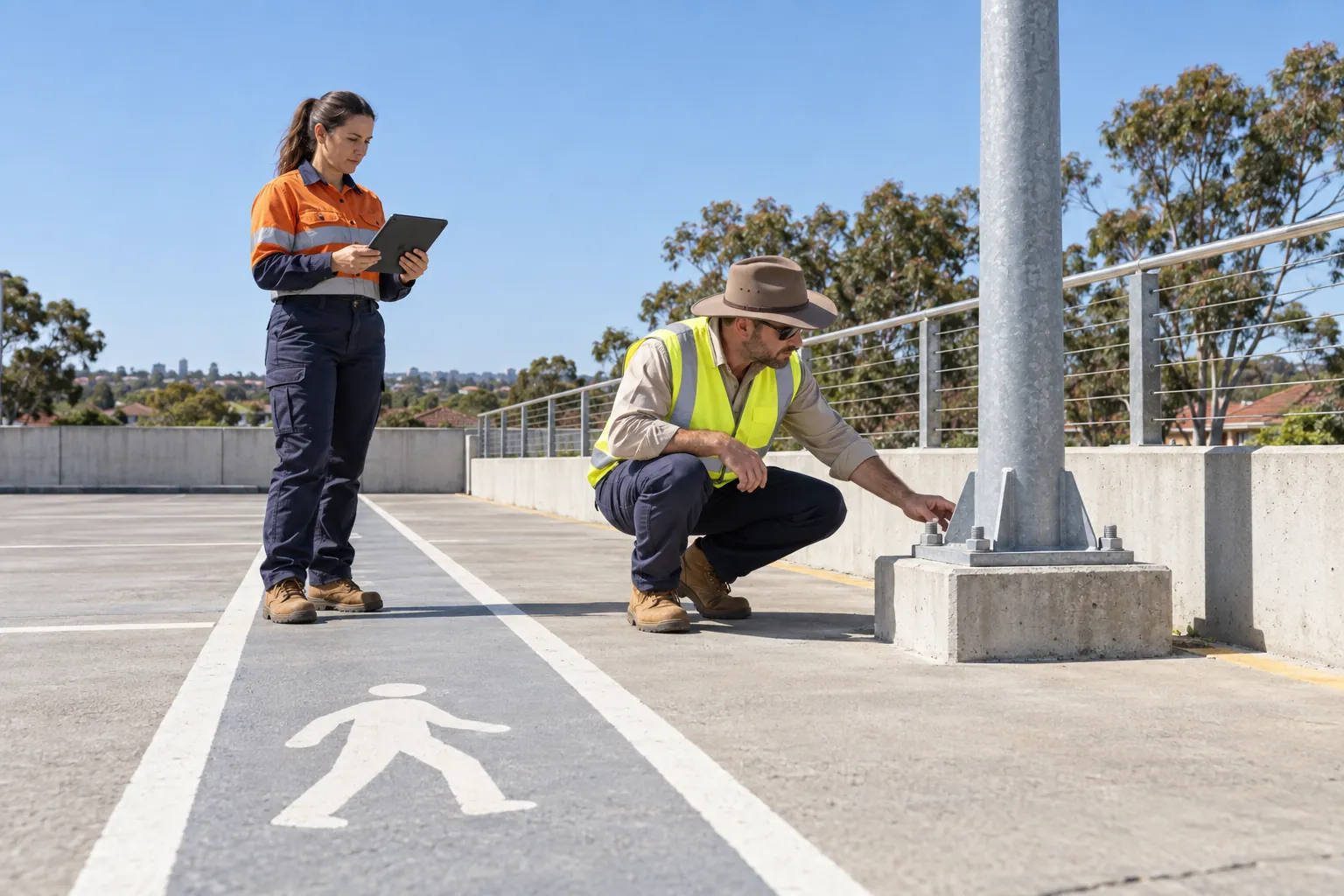
- Traffic: separate pedestrian routes and clear markings in car parks and loading docks.
- Contractors and visitors: signed in, inducted and barricaded where needed.
The code also reminds you that "Hazards are not always obvious", and fatigue or stress will not show up on a walk. A checklist sits alongside consultation and incident records, not in place of them.
03
How often to inspect, and who should do it
Because the law does not set a frequency, decide one from the risk, write it down and keep to it. As a guide:
- Higher-risk areas, such as workshops, commercial kitchens, loading docks, plant rooms and construction work, often need a weekly walk, and a pre-start check of specific equipment each shift.
- Lower-risk areas, such as offices, retail floors and the common property of a residential building, are often inspected monthly or quarterly, with a fuller review once a year.
- Before a change: regulation 38 requires a review of control measures "before a change at the workplace that is likely to give rise to a new or different risk", such as a fit-out, a new tenant, a new process or a change in how a space is used.
- After an incident or near miss: to find the cause and check other areas for the same hazard. See near miss reporting.
The code says control measures for high risks "should be reviewed more frequently".
The person inspecting should know the workplace and what good looks like, and be trained to recognise hazards. That might be the building or facility manager, a supervisor, a WHS adviser or a trained worker from the area. For specialist items such as electrical installations, lifts, cooling towers and fire safety measures, the general inspection notes what is visibly wrong and the competent person inspects in detail.
Vary who inspects: a manager who walks the same floor every month stops seeing the lead across the doorway. In a multi-tenanted building, agree which parts the building manager inspects (common areas, car parks, plant, fire stairs, external areas) and which each tenant covers, so no area falls between the two.
04
Recording findings, and closing them out
The code of practice says: "As you walk around, you may spot straightforward problems and action should be taken on these immediately, for example cleaning up a spill." Where there is immediate or significant danger, "move those persons to a safer location first and attend to the hazard urgently". Everything else needs a record that someone is chased to close. A good inspection record, on paper or digital, holds:
- The inspection: the date and time, the area or floor covered, and who inspected.
- Each finding: what the hazard is, exactly where ("level 3 east fire stair, landing below level 4", not "the stairs"), and a photo where it helps.
- What was done on the spot: spill cleaned, lead removed, area coned off, equipment tagged out, or nothing.
- A risk rating, so the most serious items are dealt with first.
- The control: what will be done, chosen with the hierarchy of controls in mind; a sign or a cone is rarely the final fix.
- An owner and a date: a named person, and a date by which it will be done.
- Close-out: when it was done, by whom, and who checked it at the location.
Record what was in order as well. The code suggests you "make a list of the hazards you find, including the ones you know are already being dealt with, to ensure that nothing is missed", and says the list "can be kept and updated next time you do an inspection". Before each inspection, read the last one and its open actions, so the walk checks that earlier fixes held.
Review the findings together every few months. The same finding month after month, such as a slippery entrance every wet day, points to a cause the inspection will not fix on its own. That calls for the review regulation 38 requires.
05
Involving workers and health and safety representatives
Section 49 of the model Act requires consultation with workers "when identifying hazards and assessing risks to health and safety arising from the work", when making decisions about ways to eliminate or minimise those risks, and when making decisions about the procedures for "monitoring the conditions at any workplace" under the PCBU's management or control. An inspection program is one of those procedures.
Where workers have elected a health and safety representative (HSR), the HSR has their own right to inspect. Under section 68(2)(a) of the model Act (quoted here from Queensland's Work Health and Safety Act 2011), an HSR may inspect the workplace or any part of it where a worker in the work group works:
- "at any time after giving reasonable notice to the person conducting the business or undertaking at that workplace"; and
- "at any time, without notice, in the event of an incident, or any situation involving a serious risk to the health or safety of a person emanating from an immediate or imminent exposure to a hazard".
In Victoria, section 58 of the OHS Act gives an HSR a similar right to inspect after reasonable notice, and "immediately in the event of an incident or any situation involving an immediate risk", and to take photographs.
Beyond the legal minimum, involving workers makes inspections better:
- invite the HSR, or a worker from the area, to join each inspection and to sign it off;
- ask the people who work there about near misses that were never reported, as the code suggests;
- include the cleaners, security officers and maintenance staff who walk the whole building every day, whoever employs them;
- make it easy to fill in a hazard report form between inspections, so problems are not saved up for the next walk.
06
Where the inspection record fails, and what SiteClara does about it
Workplace inspection records tend to fail in the same two ways. The inspection happens, but its findings sit in a spreadsheet or a filed form where nobody is chased to close them. And the hazards seen between inspections, by the cleaners, security officers and building staff who walk the site every day, are mentioned to whoever was passing and never written down.
SiteClara helps with the second, and with the routine checks that sit alongside a formal inspection. A printed QR poster, with an optional NFC tag behind it, sits at each location where checks are scheduled, such as a fire stair, a plant room, a car park level, an amenities block or a loading dock. Staff scan or tap on their own phone, with no app to install, see the checks due there, and mark each one done or explain what stopped them. They can also report a problem at that location, with a photo when one helps. The report carries the location, the time and the named person, and goes onto the team's list of open jobs until someone closes it.
The supervisor sees what is due, done and missed, and the open jobs grouped by building and floor. Each day they add a note and approve a report that goes to nominated management or client contacts the next morning, showing what was reported, what was completed and what is still open.
07
Questions people ask
What should be included in a workplace safety inspection checklist?
Whatever the hazards of your own workplace are: the code of practice How to manage work health and safety risks says "You may use a checklist designed to suit your workplace to help you find and make a note of hazards." Under "Inspect the workplace" it asks you to look at "how people actually work, how plant and equipment are used, what chemicals are around and what they are used for, what safe or unsafe work practices exist as well as the general state of housekeeping", whether the work environment allows work without risk ("space for unobstructed movement, adequate ventilation, lighting"), how suitable and well maintained tools and equipment are, and whether any changes have occurred that may affect health and safety. It also says to list the hazards you find, "including the ones you know are already being dealt with".
What are the 7 common workplace hazards?
There is no official list of seven. Table 1 of the code of practice How to manage work health and safety risks gives ten examples of common hazards: manual tasks, gravity (falling objects, falls, slips and trips), psychosocial hazards, electricity, machinery and equipment, hazardous chemicals, extreme temperatures, noise, radiation and biological hazards such as micro-organisms.
What are the 7 steps of the inspection process?
No Australian law or code of practice sets seven steps. The code of practice How to manage work health and safety risks describes risk management in four steps: identify hazards, assess risks if necessary, control risks, and review hazards and control measures "to ensure they are working as planned". Inspecting the workplace is one way to identify hazards, and the code says to act at once on straightforward problems, and to move people to safety where there is immediate or significant danger, then adds: "Follow up on why the situation occurred to identify additional hazards and risks."
08
Where to read more, and a list to take away
The Commonwealth Work Health and Safety Act 2011, which follows the model Act and keeps its numbers, sets out the primary duty in section 19, the duty of a person with management or control of a workplace in section 20, consultation in Part 5 and HSRs' powers in section 68. The Commonwealth Work Health and Safety Regulations 2011, which follow the model Regulations, set out risk management in Part 3.1 and general workplace facilities, first aid and emergency plans in Part 3.2.
Read the code of practice How to manage work health and safety risks, chapters 2, 5 and 6 on finding hazards, reviewing controls and keeping records. In Victoria, start with the Occupational Health and Safety Act 2004 and WorkSafe Victoria's guidance.
Before your next workplace inspection, check that:
- the checklist is built from your own hazards and activities, area by area, not copied whole from someone else's;
- the frequency for each area is written down, and followed;
- in a shared building, it is agreed who inspects the common areas and who inspects each tenancy;
- every finding has a location, a photo where it helps, an owner and a date;
- actions are tracked to close-out and checked at the location;
- the HSR and workers from the area are invited, and hear what was done;
- hazards reported between inspections are recorded, not just mentioned;
- repeat findings lead to a review of the control measure, and of the risk assessment;
- the procedure matches your jurisdiction, and Victoria's OHS Act where the site is in Victoria.
Sources
Every document this guide quotes or links to, in the order it first cites them.
- Work Health and Safety Act 2011 legislation.gov.au
- Work Health and Safety Regulations 2011 legislation.gov.au
- Work Health and Safety Regulation 2011 legislation.qld.gov.au
- How to manage work health and safety risks safework.nsw.gov.au
- Occupational Health and Safety Act 2004 legislation.vic.gov.au
- Work Health and Safety Act 2011 legislation.qld.gov.au
Related guides
 Premises and facilities managementHazard report forms and hazard reporting: what WHS law asks, and how to close the loopHazard reporting under Australian WHS law: the duty to identify hazards, what a hazard report form should hold, who acts on it, and how to show the fix was made.
 Premises and facilities managementWorkplace housekeeping: what WHS law asks, and a routine that holds between inspectionsWorkplace housekeeping under Australian WHS law: regulation 40, what the codes of practice ask, who keeps which areas tidy, how often, and what a good record shows.
 Premises and facilities managementBuilding compliance checklist: the duties that come with an Australian buildingA building compliance checklist for Australian commercial buildings: WHS duties, fire safety maintenance by state, asbestos, plant, water, access and the records.
 Premises and facilities managementNear miss reporting in Australia: what WHS law asks, and how to make it workWhat a near miss is under Australian WHS law, when one is a notifiable dangerous incident, what a good report holds, and how to make sure the hazard is fixed.