Premises and facilities management
Work incident reports: what Australian WHS law asks, and what a good report holds
A work incident report is the written record of an injury, illness, dangerous incident or damage at work, setting out who was involved, exactly where and when it happened, what was done straight away and what will change.
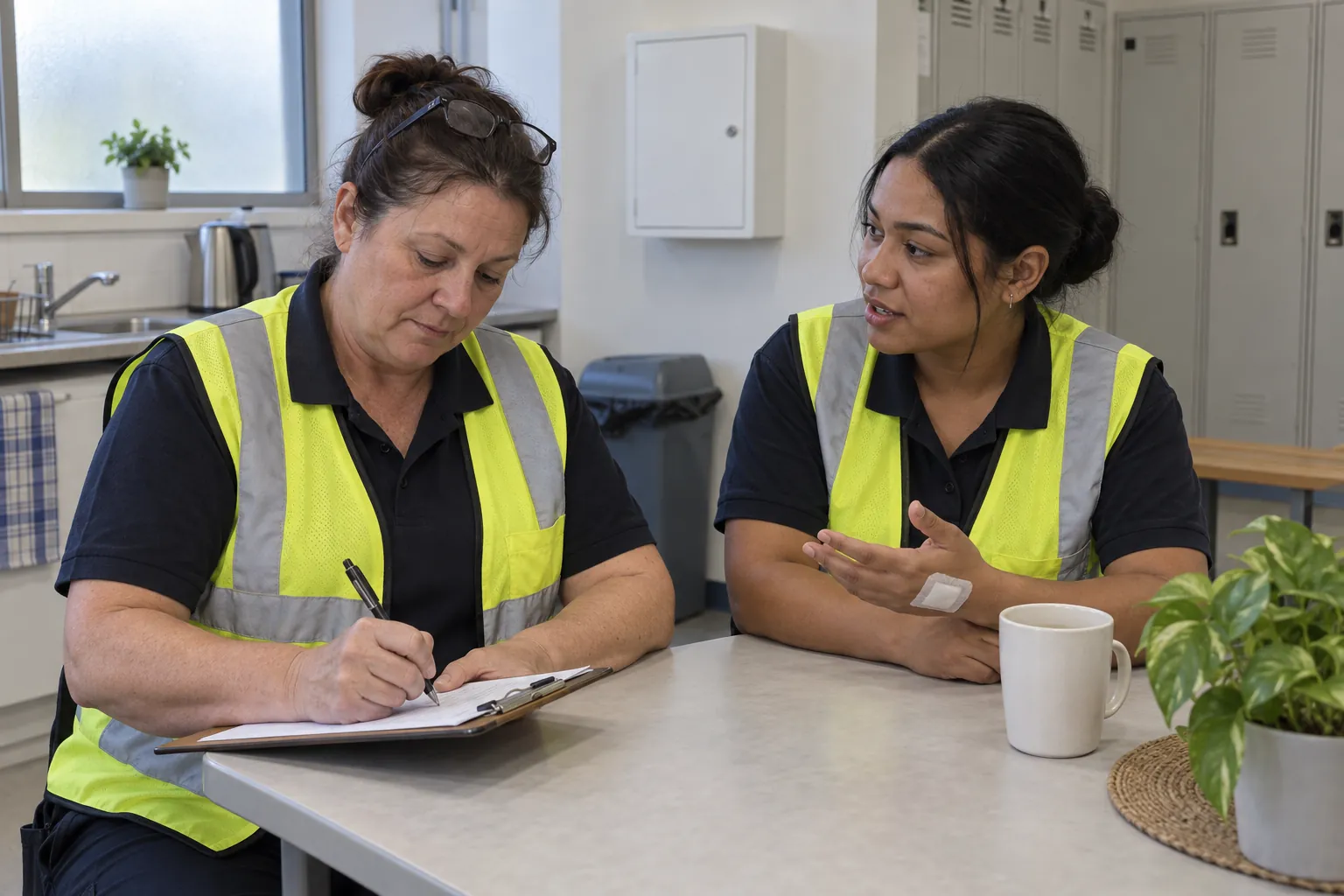
A cleaner slips on a wet ramp at the loading dock and grazes a wrist. A guard on a lock-up patrol is cut by a broken pane in a fire stair door. A contractor's ladder kicks out in a plant room. Each needs a work incident report, and some need a call to the regulator before anything else happens. This guide covers what Australian work health and safety law asks for after an incident, the three records that usually follow, what a useful report holds, and how to make sure it ends in a fix rather than a filed form.
01
What a work incident report is, and what WHS law asks for
A work incident report is the written account of something at work that hurt someone, made someone ill or damaged property. It is usually the first record made, and every later step relies on it: the insurer, the regulator, the investigation and the fix.
Australian work health and safety law does not prescribe a single incident report form. What it does is set legal duties that make a report necessary. The Work Health and Safety Act 2011 (Qld), Queensland's version of the model WHS Act, is a good example. Section 35 defines a notifiable incident as "the death of a person", "a serious injury or illness of a person" or "a dangerous incident". Section 38 requires the person conducting a business or undertaking (the PCBU) to ensure the regulator is notified "immediately after becoming aware" of one, and section 38(7) requires the PCBU to "keep a record of each notifiable incident for at least 5 years from the day that notice of the incident is given to the regulator".
Most incidents in a building are not notifiable, but a graze or a strained back still points to a hazard. The Work Health and Safety Regulation 2011 (Qld) requires a duty holder to "identify reasonably foreseeable hazards that could give rise to risks to health and safety" (section 34) and to review a control measure when it "does not control the risk it was implemented to control" (section 38). An incident report is how the business learns of both. Near misses, where nobody was hurt this time, belong in the same reporting system for the same reason.
Workers have a part too: section 28 of the Act requires a worker to "co-operate with any reasonable policy or procedure" on health and safety "that has been notified to workers", so a written reporting procedure explained at induction is one a PCBU can expect its cleaners and guards to follow.
02
What to report in a building, and the three records that follow
In an office tower, a shopping centre, a school or a strata building, cleaning, security and facilities teams report the same kinds of incident again and again:
- Slips, trips and falls: a wet floor in an end of trip facility, a missed step on a fire stair, a fall from a step ladder.
- Manual handling: a strained back from a full bin or from pulling a floor scrubber up a ramp.
- Cuts and sharps: broken glass in a bin bag, a needlestick injury in a public toilet or car park.
- Chemicals and electrical: a splash to the eye while decanting a product, a shock from a vacuum lead.
- Aggression: a guard or concierge threatened or assaulted on a patrol or at lock-up.
- Property and plant: a boom gate striking a car, a lift stopping between floors with people inside.
Each starts with an internal incident report, and it can lead to two further records the law requires. Keep the three apart, because each has a different owner and purpose:
- The incident report: your organisation's own account of what happened, what was done and what will change. No statute fixes its form, but it is the evidence that you are identifying hazards and reviewing controls.
- The register of injuries: a workers compensation record of every work-related injury or illness. SafeWork NSW's page on the mandatory injury register says "You are legally required to keep a register of workplace injuries and illnesses sustained by workers or visitors", and that injuries must be recorded "regardless of whether there has been a claim made to your insurer". In Victoria, WorkSafe Victoria publishes a register of injuries template and says "Every workplace should have a register of injuries".
- The notifiable incident record: the notice given to the regulator for a death, serious injury or illness or dangerous incident, kept for at least five years under section 38(7) of the Queensland Act and its equivalent in the other model-law jurisdictions, and for at least five years in Victoria, where WorkSafe Victoria asks for a copy of the written notification to be kept.
A worker's injury usually means an incident report and a register entry; a serious one adds the notification. A dangerous incident with nobody hurt is notified and reported, but may never reach the register.
03
When an incident must go to the regulator
Under section 36 of the Queensland Act, a serious injury or illness is one requiring immediate treatment as an in-patient in a hospital, or immediate treatment for a listed injury such as an amputation, "a serious head injury", "a serious eye injury", "a serious burn", "a spinal injury" or "serious lacerations". It also covers "medical treatment within 48 hours of exposure to a substance", which matters for cleaners handling chemicals.
Section 37 defines a dangerous incident as one exposing a person to "a serious risk to a person's health or safety emanating from an immediate or imminent exposure to" a listed event, including "an uncontrolled escape, spillage or leakage of a substance", "electric shock" and "the fall or release from a height of any plant, substance or thing".
The notice must be given "by the fastest possible means", by telephone or in writing, with a written notice "within 48 hours" if the regulator asks for one (section 38). The regulators' own pages set out how:
- SafeWork NSW's Incident notification page says to report a serious injury or illness, a death or a dangerous incident "immediately on 13 10 50", 24 hours a day, and that "some types of work-related dangerous incidents must be notified even if no-one is injured". It gives the maximum penalty in NSW for failing to notify as "$50,000 for a body corporate and $10,000 for an individual".
- WorkSafe Victoria's Report an incident page asks for a call on 13 23 60 immediately, a written report within 48 hours and a copy kept "for at least five years". If you are unsure whether an incident is notifiable, WorkSafe Victoria's page on notifiable incidents under the Occupational Health and Safety Act 2004 says "you should report it to WorkSafe anyway".
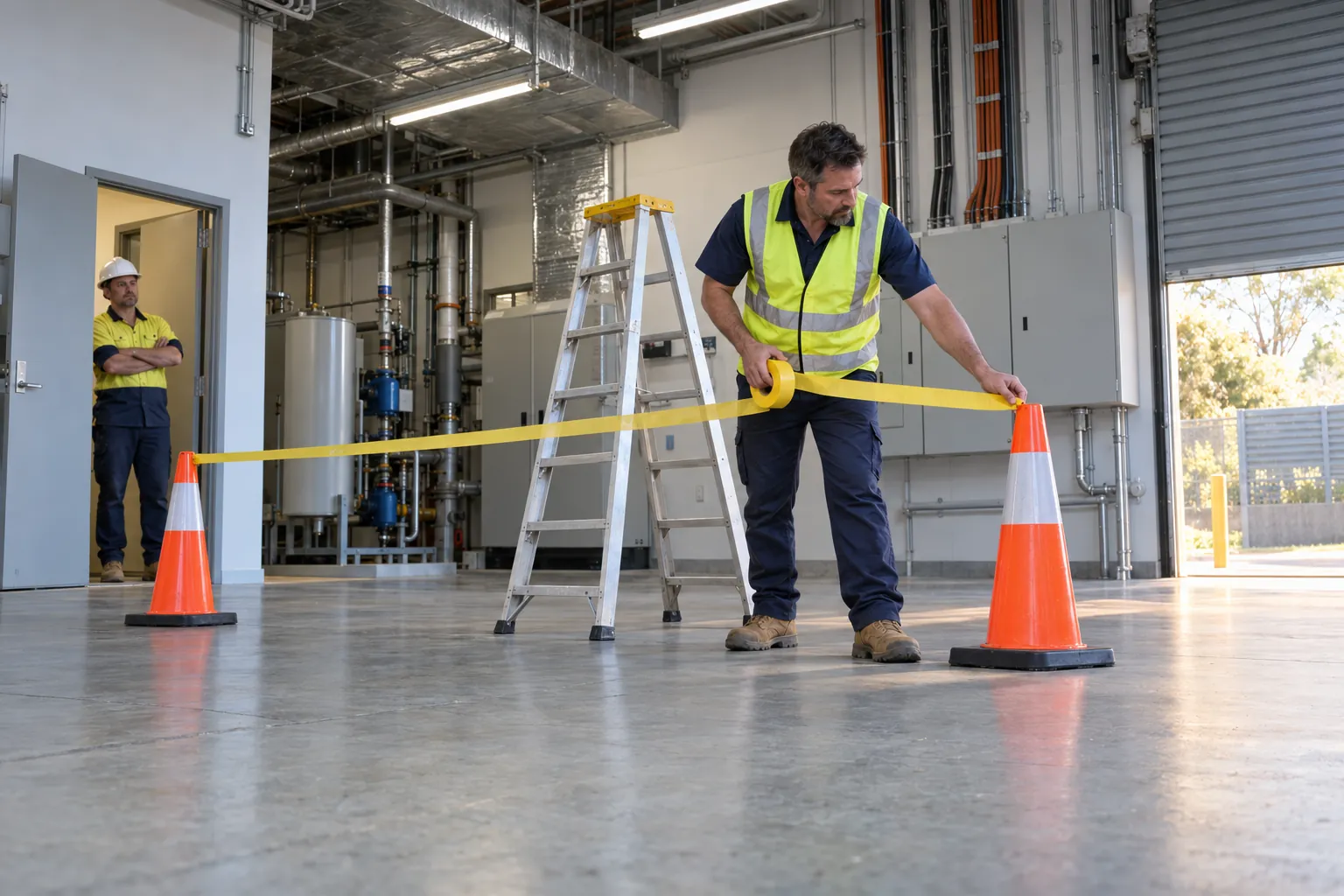
Section 39 requires the person with management or control of the workplace to ensure, so far as is reasonably practicable, that the site "is not disturbed until an inspector arrives at the site or any earlier time that an inspector directs", apart from helping an injured person or action "essential to make the site safe". For a cleaning or security team, that usually means taping off the area to preserve the scene rather than mopping up the spill or putting the ladder away, unless doing so is essential to make the site safe.
A building often has several PCBUs at once: the owners corporation, the facility manager, the cleaning and security contractors, the tenants. Section 46 requires each to "consult, cooperate and coordinate activities" with the others who have a duty in the same matter, and WorkSafe Victoria notes that "More than one employer may have a duty to notify WorkSafe of an incident." Agree in advance who makes the notifications, who preserves the scene and how each contractor's reports reach the building manager.
04
What a good work incident report holds
A useful incident report can be acted on by someone who was not there, without a follow-up phone call. SafeWork NSW's page on investigating and reporting incidents lists what the regulator will ask for when a notifiable incident is reported, and it is a sound template for every internal report: "an overview of what happened, including date, time and location", information about anyone injured and "their relationship to you (worker, site visitor, volunteer, contractor, member of the public)", information about the injury and treatment, "immediate action taken to make the site safe" and "further safety action taken, or actions that will be taken, to prevent the incident happening again".
In practice, that means:
- Exactly where: "basement 2 car park, ramp to loading dock", not "downstairs".
- When it happened, and when it was reported.
- Who was involved, the names of any witnesses and who is reporting, so they can be asked a question later.
- What happened, in plain words, including the task being done.
- The injury or damage, and the first aid or treatment given.
- What was done straight away: the area coned off, the machine tagged out.
- A photo where it helps, once any injured person has been looked after.
- Whether it might be notifiable, so a supervisor checks the same day.
Where the person was a worker and was injured, the register of injuries needs its own details. SafeWork NSW lists them: the worker's name, address, age, occupation and industry, "the time and date of injury", "the nature of the injury" and "the cause of the injury". It "may be kept in writing or be electronic", and workers must be able to access it.
Report on the spot, not from memory at the end of the week, and keep the report about the event, not the person. SafeWork NSW also reminds employers that they "have 48 hours after becoming aware a worker has received a workplace injury to notify your insurer", and that the insurer must be told "even if you are unsure whether workers compensation will be required". A report that sits in a bag until Friday makes that deadline hard to meet.
05
After the report: investigation, controls and follow-up
SafeWork NSW is direct about what happens next: "investigate why the incident occurred. Document the investigation, the outcome, all work changes or risk controls put in place as a result, and how you have communicated these changes to your workers." It offers a record of action taken template for those notes.
A simple sequence keeps the thread between the report and the fix:
- Care and make safe: first aid, then the area made safe. For a notifiable incident, call the regulator and leave the scene.
- Triage the same day: check whether it is notifiable, enter a worker's injury in the register and tell the insurer.
- Find the cause: ask why the task, the place or the equipment allowed it, not only who was there.
- Decide the control: under sections 35 and 36 of the Queensland Regulation, eliminate the risk where reasonably practicable; otherwise substitution, isolation or engineering controls come before administrative controls and personal protective equipment.
- Assign it to one named person or company, with a date.
- Check and close at the location, with a date and a name, and tell the person who reported it.
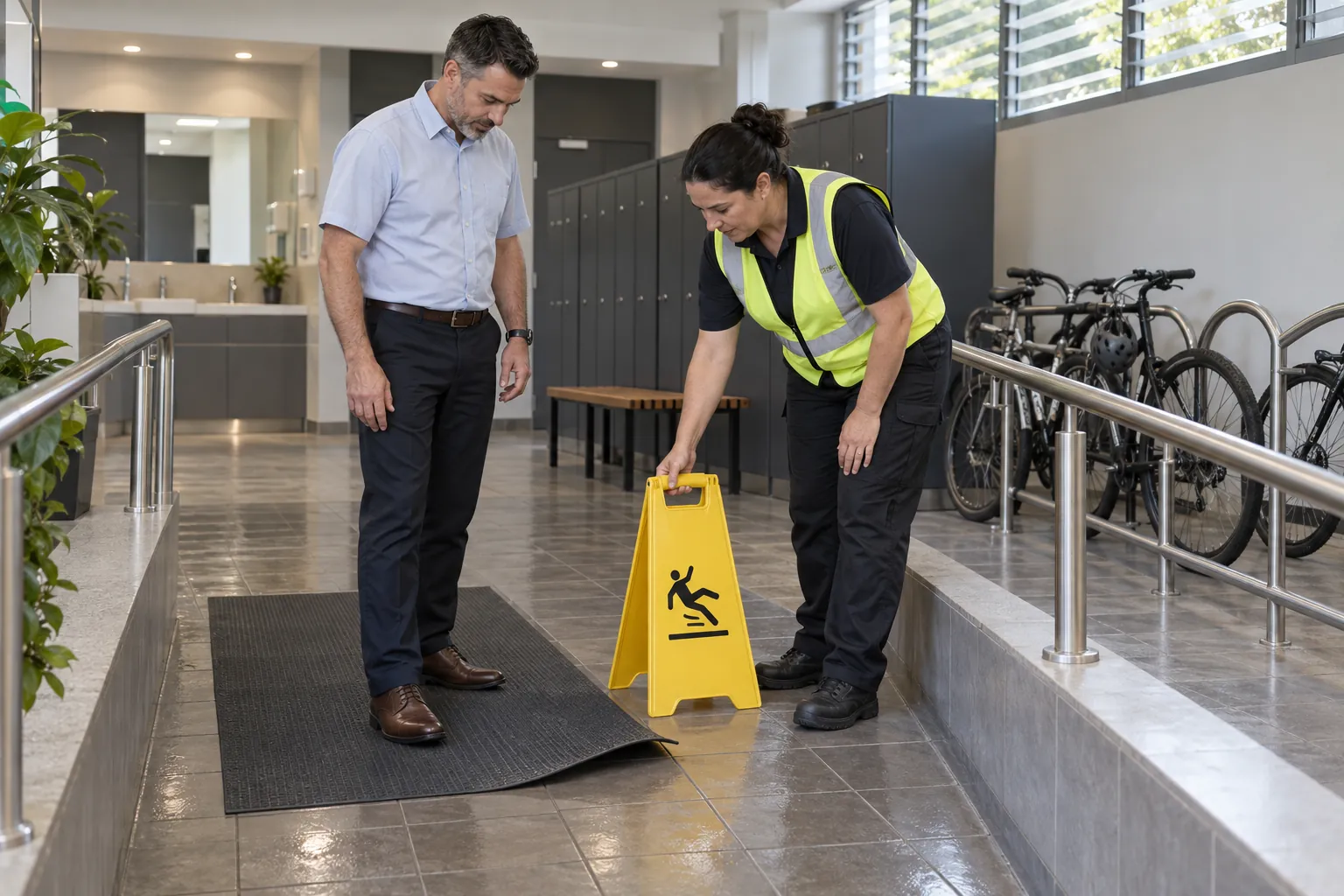
Section 38 of the Queensland Regulation gives "a notifiable incident occurs because of the risk" as an example of a control measure that must be reviewed and, as necessary, revised. The same logic applies to lesser incidents: curled anti-slip matting, a wet floor sign left in the store, a full sharps container are controls that failed in practice.
Consultation is part of the duty. Section 49 of the Act requires consultation with affected workers "when identifying hazards and assessing risks" and when deciding how to eliminate or minimise them, so show the reports to your health and safety representative or WHS committee. In Victoria, WorkSafe Victoria says a notifiable incident record must be made available to people including the health and safety representative and "members of any health and safety committee established by the employer".
Look across reports as well as at each one: three from the same car park ramp is a finding in itself. In a strata or body corporate building, the fix on common property usually belongs to the owners corporation through its strata manager or building manager, even when a contractor's worker was hurt, so agree the route before it is needed.
06
Where the incident record fails, and what SiteClara does about it
Incident reporting rarely fails for want of a form. It fails because the form is in the site office and the incident was on level 9, because the report is written from memory at the end of the week, and because nobody can later show whether the fix happened. The guard mentions the broken door pane to the building manager at the lift; a month later nobody knows which stair it was or whether it was boarded up.
SiteClara records work and reports at the location. A printed QR poster, with an optional NFC tag behind it, sits at each place where checks are scheduled, such as a loading dock or a plant room. Staff scan or tap on their own phone, with no app to install, and can report a problem there, with a photo when one helps. The report carries the location, the time and the named person, and stays on the team's list of open jobs until someone closes it.
The supervisor sees the open jobs and the day's checks, adds a note and approves a daily report that goes to nominated management or client contacts the next morning, showing what was reported, what was completed and what is still open. For an incident, that turns "I told someone" into a dated report at a known place, and "it was fixed" into a closed job with a time and a name.
07
Questions people ask
How do I write a workplace incident report?
Write it as soon as the injured person has been looked after, in plain words, while witnesses are still to hand. SafeWork NSW's page on investigating and reporting incidents lists what it asks for when an incident is notified, and the same headings suit an internal report: "an overview of what happened, including date, time and location", who was injured and their relationship to you, the injury and treatment, "immediate action taken to make the site safe" and "further safety action taken, or actions that will be taken, to prevent the incident happening again".
What is a reportable incident at work?
In WHS law the incidents that must go to the regulator are called notifiable incidents. SafeWork NSW's Incident notification page lists three kinds: "the death of a person", "a serious injury or illness of a person" and a dangerous incident, noting that "some types of work-related dangerous incidents must be notified even if no-one is injured". Any other incident still goes in your own incident report, and a worker's injury in the register of injuries.
How do I report a workplace incident?
Inside the business, follow your written procedure and tell your supervisor straight away. To the regulator, a notifiable incident is reported by phone first: SafeWork NSW's Incident notification page says "you must report it to us immediately on 13 10 50", and WorkSafe Victoria's Report an incident page says to "Notify WorkSafe immediately by calling 13 23 60". Other states and territories have their own regulator and number.
How long do you have to do an incident report at work?
No law sets a deadline for your internal report, but the statutory clocks are short. A notifiable incident must be reported to the regulator immediately; in Victoria, WorkSafe Victoria's Report an incident page adds "Report the incident in writing within 48 hours". For a worker's injury in NSW, SafeWork NSW's page on investigating and reporting incidents says "You must also notify your insurer within 48 hours", so complete the report the same day.
08
Where to read more, and a list to take away
For the law, read your own state or territory's Act and Regulations. In the Work Health and Safety Act 2011 (Qld), notifiable incidents are Part 3 (sections 35 to 39); in the Work Health and Safety Regulation 2011 (Qld), hazards and control measures are sections 34 to 38.
For the practical steps, read the regulator's own pages: SafeWork NSW's Incident notification, Investigating and reporting incidents and Mandatory injury register; and WorkSafe Victoria's Report an incident, Notifiable incidents under the Occupational Health and Safety Act 2004 and Register of injuries template.
Before you rely on your incident reporting, check that:
- everyone in the building, contractors included, can report an incident on the spot in a few minutes;
- the procedure is written down, explained at induction and matches your jurisdiction, Victoria included;
- supervisors and team leaders know what a serious injury or illness and a dangerous incident are, and the regulator's number;
- each PCBU in the building knows who notifies the regulator and who preserves the scene;
- every worker injury goes in the register of injuries, and the insurer is told within your jurisdiction's deadline (48 hours in NSW);
- every report ends with a cause, a named owner, a date and a fix confirmed at the location;
- reports are reviewed together each month, and repeat locations lead to a review of the control;
- your health and safety representative and WHS committee can see the reports.
Sources
Every document this guide quotes or links to, in the order it first cites them.
- Work Health and Safety Act 2011 (Qld) legislation.qld.gov.au
- Work Health and Safety Regulation 2011 (Qld) legislation.qld.gov.au
- Notifiable incidents under the Occupational Health and Safety Act 2004 worksafe.vic.gov.au
- Mandatory injury register safework.nsw.gov.au
- Register of injuries template worksafe.vic.gov.au
- Incident notification safework.nsw.gov.au
- Report an incident worksafe.vic.gov.au
- Investigating and reporting incidents safework.nsw.gov.au
Related guides
 Premises and facilities managementNear miss reporting in Australia: what WHS law asks, and how to make it workWhat a near miss is under Australian WHS law, when one is a notifiable dangerous incident, what a good report holds, and how to make sure the hazard is fixed.
 Premises and facilities managementHazard report forms and hazard reporting: what WHS law asks, and how to close the loopHazard reporting under Australian WHS law: the duty to identify hazards, what a hazard report form should hold, who acts on it, and how to show the fix was made.
 Premises and facilities managementFirst aid kit checklist: what an Australian workplace kit holds, and how to keep it completeWhat a workplace first aid kit should hold under Australian WHS law and the codes, how many kits and where, how often to check them, and who restocks them.
 Premises and facilities managementWorkplace inspection checklist: what WHS law asks, what to walk, and what to do nextWorkplace inspections under Australian WHS law: the duties behind them, what the checklist covers, how often, recording findings, and HSRs' right to inspect.