Premises and facilities management
First aid kit checklist: what an Australian workplace kit holds, and how to keep it complete
A first aid kit checklist for an Australian workplace lists what each kit should hold, from gloves, dressings, bandages and saline to a resuscitation face shield, and the checks that keep it complete: after each use and on a set schedule, signed and dated.

Most kits are fully stocked on the day they are bought. After that, an adhesive strip goes here, a cold pack there, the gloves are borrowed for a spill, and a year later the kit that looks fine on the wall is missing half of what a first aider would reach for. This guide sets out what Australian work health and safety law asks of a PCBU, what the codes of practice say a kit should contain, how many kits a building needs, how often to check them, and how to keep a record of the checks that someone could rely on.
01
What Australian WHS law asks of a first aid kit
No Australian law prints a list of what must be in a first aid kit. The duty is to provide first aid equipment that suits the workplace, and the detail sits in codes of practice. Where the model work health and safety laws apply, the duty is regulation 42, "Duty to provide first aid": regulation 42 of the Commonwealth's Work Health and Safety Regulations 2011, section 42 of Queensland's Work Health and Safety Regulation 2011, and provision 42 of the Work Health and Safety Regulation 2017 (NSW).
The Queensland text says a person conducting a business or undertaking (PCBU) at a workplace "must ensure" the provision of first aid equipment for the workplace, that each worker has access to the equipment, and access to facilities for administering first aid. The PCBU must also ensure that enough workers are trained in first aid, or that workers can reach enough other trained people. Each duty carries a maximum penalty of 60 penalty units in Queensland.
The regulation does not say how many kits, what goes in them or how often to check them. It tells the PCBU what to weigh: "the nature of the work being carried out at the workplace", "the nature of the hazards at the workplace", "the size and location of the workplace", and "the number and composition of the workers and other persons at the workplace".
The practical detail is in the Code of Practice: First aid in the workplace. Safe Work Australia publishes the model code and each harmonised jurisdiction approves its own version under section 274 of its WHS Act. This guide quotes SafeWork NSW's Code of Practice: First aid in the workplace (January 2020), which is based on the national model code. A code is not law in itself, but it says codes "are admissible in court proceedings" and that courts "may rely on the code in determining what is reasonably practicable". Another method is allowed if it gives an equivalent or higher standard.
02
What goes in a workplace first aid kit
The NSW code says a kit "should provide basic equipment for administering first aid for injuries" including cuts, scratches, punctures, grazes and splinters, sprains and strains, minor burns, major bleeding wounds, broken bones, eye injuries and shock.
Both codes start from a basic kit for most workplaces and ask the PCBU to add to it where a risk assessment shows the need. The NSW code's Appendix E lists the recommended contents of a typical kit. As a checklist, with its quantities:
- First aid instructions, including a CPR flow chart (1); notebook and pen (1)
- Resuscitation face mask or face shield (1)
- Disposable nitrile examination gloves (5 pairs)
- Sterile gauze pieces, 7.5 x 7.5 cm, three per pack (5 packs)
- Saline, 15 ml (8); single wound cleaning wipes, 1% Cetrimide BP (10)
- Adhesive dressing strips, packet of 50 (1)
- Single-use splinter probes (10) and tweezers or forceps (1)
- Antiseptic liquid or spray, 50 ml (1)
- Non-adherent wound pads: 5 x 5 cm (6), 7.5 x 10 cm (3), 10 x 10 cm (1)
- Conforming cotton bandages, 5 cm (3) and 7.5 cm (3); crepe bandage, 10 cm (1)
- Scissors (1); hypoallergenic adhesive tape, 2.5 cm (1); safety pins, packet of 6 (1)
- BPC wound dressings No. 14 (1) and No. 15 (1); combine pad, 9 x 20 cm (1)
- Clip-seal plastic bags (1); triangular bandages, at least 90 cm (2)
- Emergency rescue blanket (1); single-use eye pads (4)
- Access to 20 minutes of clean running water or, failing that, hydrogel 3.5 g sachets (5)
- Instant ice pack (1)
The gloves and face shield are there for infection control. The NSW code's Appendix F says first aiders should wear personal protective equipment, "including disposable gloves, to prevent contact with blood and body substances", so a kit whose gloves have been borrowed is not ready for a bleeding wound.
The Victorian compliance code's basic kit (paragraph 124) is close but not the same. It adds disposable surgical face masks and alcohol-based hand sanitiser, asks for a resuscitation mask or face shield with a one-way valve, and leaves out splinter probes, tweezers and antiseptic. A kit sold as "workplace compliant" should be checked against the list for the state it is used in.
The container matters too. The NSW code says kits "can be any size, shape or type to suit your workplace", but each should be large enough for the necessary supplies, "immediately identifiable with a white cross on green background", contain a list of its contents, and protect them from dust, moisture and contamination. The Victorian code adds that the container "should not be locked", and that first aid officers' names and numbers, and emergency numbers, should be in or near each kit.
Modules cover particular hazards. The NSW code describes an outdoor module (a heavy duty crepe bandage for snake bites and sting relief), a remote module (adding sheeting, a thermal blanket, a whistle and a torch) and a burn module (hydrogel, polythene sheets and waterproof instruction cards). The Victorian code adds an eye module where chemicals are handled in open containers, or there is spraying, flying particles, welding or machining, and says it does not necessarily replace an eyewash station.
03
How many kits, and where they go
Every worker must be able to reach a kit. The NSW code says all workers must have access to first aid equipment "including in security-controlled workplaces", which catches the kit in a locked office that night cleaners or the overnight security officer cannot open. Its rules of thumb for placement:
- keep kits in a prominent, accessible place where they can be retrieved quickly;
- put kits close to higher risk areas, such as a school's science lab or workshop;
- in a multistorey building, keep at least one kit on every second floor;
- show kit locations on the emergency floor plans displayed in the workplace;
- give mobile workers a portable kit in the vehicle, stowed so it cannot become a projectile.
Victoria gives numbers. Under the compliance code's prescribed approach, a low-risk workplace complies with one kit for 10 to 50 employees, one more for every additional 50 up to 200, and one more for every 100 above 200. A higher risk workplace needs one kit (with the relevant modules) for up to 25 employees, two for up to 50, and one more for every additional 50. Larger or more complex workplaces are advised to use the code's risk assessment approach instead.
Both codes point to AS 1319, Safety signs for the occupational environment, for first aid signs (the NSW code cites the 1994 edition). A first aid room is a separate question: both codes set the threshold at about 200 workers for low risk workplaces and 100 for higher risk ones, and the room still needs a kit of its own.
04
How often to check a first aid kit, and what the check covers
The codes agree that someone must be named to look after each kit. They differ on how often.
The NSW code says a person, usually a first aider, should be nominated to maintain the kit and should replace used items "as soon as practicable after use"; check it "after each use or, if the kit is not used, at least once every 12 months"; sign and date an inventory list in the kit after each check; and make sure items have not deteriorated, are within their expiry dates, and that sterile products are sealed and untampered.
The Victorian code asks for a system of work for restocking kits and replacing items that expire, and says: "Kits should be checked quarterly and after every event requiring first aid."
Once a year is the NSW minimum, not a target. In a school, a gym, a shopping centre or a building where contractors work nights, kits are opened often and not always by the person who restocks them, and Victoria's quarterly interval is a sensible floor for a busy building anywhere. Whatever you choose, the NSW code says the first aid procedure should cover "who is responsible for the first aid kits and facilities and how frequently they should be checked and maintained".
A kit check someone could rely on covers the same points every time:
- Find it. The kit is where the sign and floor plan say, with nothing stacked in front.
- Container. Clean, dry, unlocked and clearly marked.
- Contents against the list. Every item in the stated quantity, including gloves, mask and instructions.
- Expiry dates. Saline, wipes, hydrogel, eyewash and any inhaler or auto-injector in date; note the earliest expiry.
- Sterile packs. Sealed and undamaged.
- Contact details. The first aiders listed near the kit are current.
- Modules. Any eye, burn, outdoor or remote module is complete.
- Restock and sign. Missing items replaced or reported, and the inventory signed and dated.
The check after a use matters most, because a kit is most likely to be short straight after someone needed it. If first aiders cannot restock on the spot, they need a way to tell the person who can, the same day.
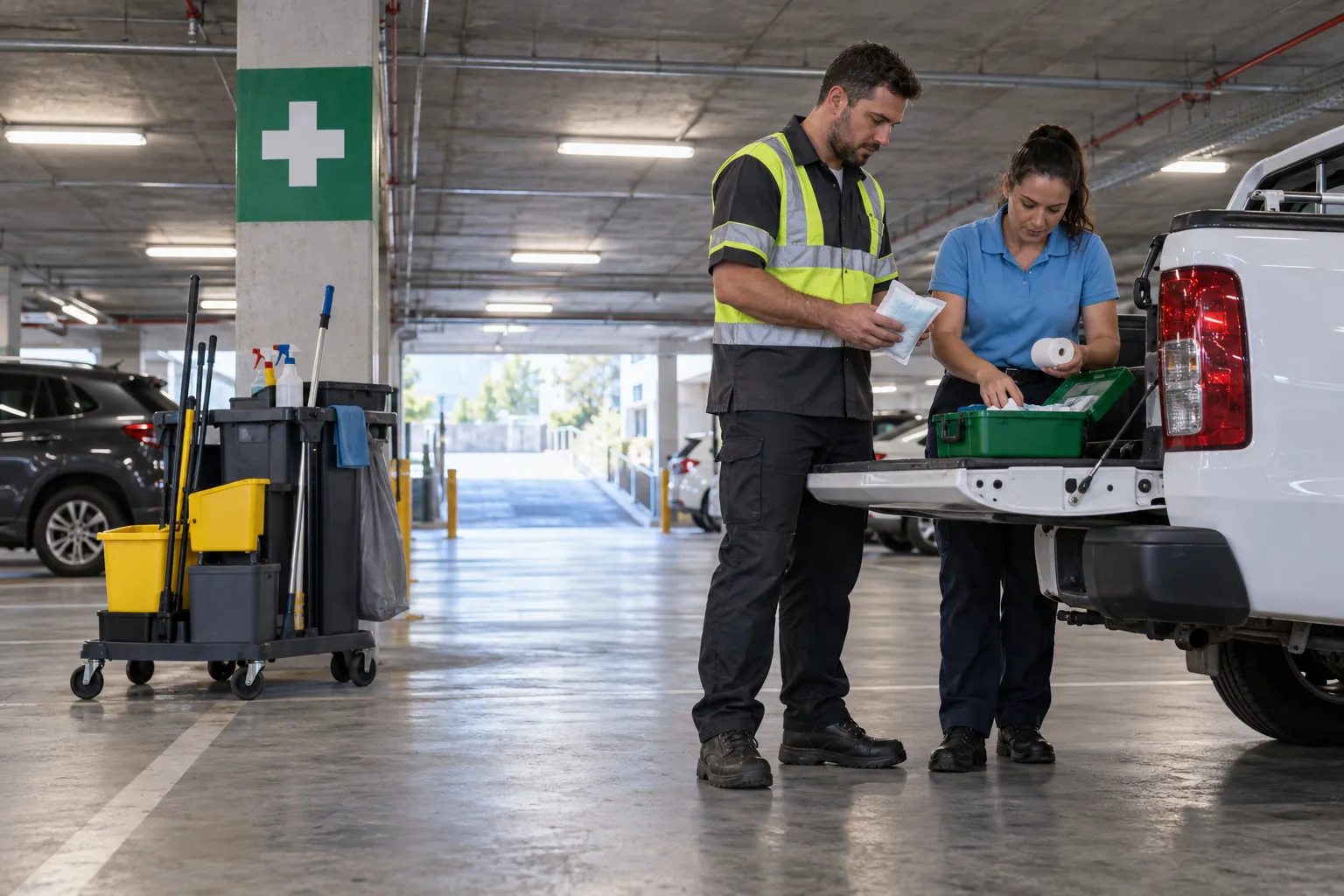
05
Who does what in a shared building
In a multi-tenant office tower, a shopping centre, a strata building with a caretaker, or any site with a cleaning or security contractor, several businesses have the same duty for the same people at the same time. Section 46 of Queensland's Work Health and Safety Act 2011, the same as in the Commonwealth's Work Health and Safety Act 2011, says each person with a duty in relation to the same matter "must, so far as is reasonably practicable, consult, cooperate and coordinate activities" with the others. The NSW code says businesses sharing a workplace may share first aiders, but must consult each other and "cooperate with each other in sharing first aid equipment and facilities".
In practice a building needs one written answer to a few questions:
- Whose kits are these? The lobby or end of trip kit may be the building owner's or the strata scheme's; floor kits each tenant's; the cleaners' store kit the cleaning contractor's.
- Who checks each one, and how often? Name a role, not only a person, so the duty survives a staff change.
- Can contractors reach a kit when they work? The NSW code says first aid equipment and first aiders "must be accessible to workers whenever they work including those working night shifts or overtime".
- Who restocks, and who pays? A contractor who uses a tenant's kit on a Sunday should know whom to tell.
- Who is trained? The NSW code recommends one first aider for every 50 workers in low risk workplaces and one for every 25 in high risk ones, with CPR refreshed annually and qualifications renewed every three years. As a minimum, it says, first aiders should hold a nationally recognised Statement of Attainment from a Registered Training Organisation for the nationally endorsed unit Provide First Aid, or a course providing equivalent skills.
Keep treatment out of the kit check. The NSW code says a record of first aid treatment should be kept by the first aider and that such records are subject to health records legislation. A kit check says what was in the box; it never names who was treated or for what.
Other first aid equipment has its own checks: see our guides to the AED maintenance checklist and emergency eyewash and shower equipment.
06
Where the record fails
Most first aid kit failures are not failures of buying. The kit was complete once. What fails is the record of whether anyone looked at it since.
The inventory card in the kit has three weaknesses. Only someone who opens the kit sees it, so a manager cannot tell from their desk which kits are overdue. A card signed in advance, or signed in one afternoon for every kit in the building, looks exactly like one signed after a real check. And the check after a use depends on a first aider remembering to tell someone at the end of a bad day. A spreadsheet in the facilities office is easy to read and just as easy to fill in without walking the building.
SiteClara is built for this gap. Each kit, or the wall beside it, carries an NFC tag or QR code; the person checking scans it on their phone, works through that kit's checklist and, when a photo is asked for, takes one. The check is recorded against that kit with who did it and when. A scheduled check shows as done or missed, so a quarterly check nobody did is visible the next morning, not at the annual review. Staff who find a kit short can report it from the same tag, and the report goes to whoever restocks it as a job that stays open until someone deals with it.
It has limits. SiteClara does not know what is in the kit: the person checking does, and the record is only as honest as that person. It does not order stock, track expiry dates item by item or replace the signed inventory list the NSW code asks for. It does not record first aid treatment, which belongs in the first aid record kept under health records law. It does not decide what kits, modules or first aiders you need, which is the PCBU's risk assessment. It is the working record that the kit was checked, by whom and when.
07
Questions people ask
What are the legal requirements for first aid kits in Australia?
Where the model WHS laws apply, regulation 42 requires a PCBU to ensure the provision of first aid equipment for the workplace and that each worker has access to it; in Queensland's Work Health and Safety Regulation 2011 each duty carries a maximum penalty of 60 penalty units. The regulation does not list contents. SafeWork NSW's Code of Practice: First aid in the workplace says all workers must be able to access a first aid kit, which "will require at least one first aid kit to be provided at their workplace", and sets out recommended contents in Appendix E.
What are 10 items in a first aid kit?
Ten items from Appendix E of SafeWork NSW's Code of Practice: First aid in the workplace, which lists what a kit for most workplaces should include: first aid instructions with a CPR flow chart, a resuscitation face mask or face shield, disposable nitrile gloves, sterile gauze pieces, saline, adhesive dressing strips, non-adherent wound pads, conforming cotton bandages, triangular bandages and an emergency rescue blanket. The full list runs to 29 items, and a risk assessment may add more.
What does a first aid kit checklist for 2026 include?
It covers the contents and the checks. SafeWork NSW's Code of Practice: First aid in the workplace says a nominated person should check each kit "after each use or, if the kit is not used, at least once every 12 months", that an inventory list in the kit should be "signed and dated after each check", and that items should be within their expiry dates with sterile products sealed. A checklist therefore lists each item and its quantity, then records expiry dates, sealed packs, the signature and the date.
08
Where to read the official guidance, and a short checklist
Read regulation 42 of the WHS Regulations for your jurisdiction and the Code of Practice: First aid in the workplace your state or territory has approved, such as SafeWork NSW's Code of Practice: First aid in the workplace. In Victoria, read WorkSafe Victoria's Compliance code: First aid in the workplace, which differs on medicines and on how often to check.
A short list to take away:
- Assess the work, hazards, size, location and people on site, including contractors and visitors, and record it.
- Stock each kit against your state's code, with the modules your hazards call for.
- Put kits where people can reach them on every shift, signed and marked on the floor plans.
- Name a person or role for each kit and write the check interval into the first aid procedure.
- Check after every use and on schedule, and sign and date the inventory.
- In a shared building, agree in writing whose kits are whose and who restocks them.
- Keep treatment records separate from kit checks, and confidential.
Sources
Every document this guide quotes or links to, in the order it first cites them.
- Work Health and Safety Regulations 2011 legislation.gov.au
- Work Health and Safety Regulation 2011 legislation.qld.gov.au
- Work Health and Safety Regulation 2017 legislation.nsw.gov.au
- Code of Practice: First aid in the workplace (January 2020) safework.nsw.gov.au
- Occupational Health and Safety Act 2004 legislation.vic.gov.au
- Compliance code: First aid in the workplace worksafe.vic.gov.au
- Work Health and Safety Act 2011 legislation.qld.gov.au
- Work Health and Safety Act 2011 legislation.gov.au
Related guides
 Premises and facilities managementAED maintenance checklist: keeping a workplace defibrillator ready in AustraliaWhat Australian WHS codes and ANZCOR say about workplace defibrillators, what an AED check covers, how often to do it, and who looks after it in a shared building.
 Premises and facilities managementEmergency shower and eyewash stations: when you need one, and how to know it will workWhen an Australian workplace needs an emergency shower or eyewash station, what WHS law, the codes and AS 4775 say, where to put one and how to check it works.
 Premises and facilities managementWorkplace inspection checklist: what WHS law asks, what to walk, and what to do nextWorkplace inspections under Australian WHS law: the duties behind them, what the checklist covers, how often, recording findings, and HSRs' right to inspect.
 Premises and facilities managementWork incident reports: what Australian WHS law asks, and what a good report holdsWhat a work incident report should hold under Australian WHS law, when an incident is notifiable, the register of injuries, and how to follow a report through.