Premises and facilities management
Facility management report: what to include, and what makes it believable
A facility management report is the regular account, usually monthly, that a facility team or facility services provider gives the building's owner or client of what was done, what was not, what is at risk and what it cost, across health and safety, fire code compliance, maintenance, cleaning, security, energy and budget.

It is where a building, or a facility services contract, is judged. The owner or client reads it to decide whether the building is safe, compliant and looked after; the facility team or service provider writes it to show that it is. Too often it is forty pages of charts that answer neither question. This guide covers what a facility management report in Canada should include, how the provincial fire and workplace safety rules shape it, and what makes the numbers in it believable.
01
What a facility management report is for
A facility management report is the regular account a facility team, or a company providing facility services, gives of the buildings and services it runs: what was done, what was not, what is at risk and what it cost. It goes to the owner, the client or the property manager, and is usually reviewed at a monthly meeting.
Reporting is part of the job description. The federal government's National Occupational Classification, under NOC 70012, Facility operation and maintenance managers, lists among the main duties to "prepare or oversee the preparation of reports and statistics related to areas of responsibility", alongside the budgets, the safety inspection and preventive maintenance programs, and the service contracts. The facility manager's duties are, in effect, the headings of the report.
There is no statutory format. The content is set by the contract or the internal service agreement: the scope of work, the service levels and the key performance indicators the two sides agreed. Where an organization runs a facility management system to ISO 41001:2018, Facility management – Management systems – Requirements with guidance for use, the report is one of the ways the organization monitors, reviews and improves performance, as the standard requires. ISO says the standard applies when an organization "needs to demonstrate effective and efficient delivery of FM that supports the objectives of the demand organization". IFMA's definition of facility management, taken from the ISO standard, is "an organizational function which integrates people, place and process within the built environment with the purpose of improving the quality of life of people and the productivity of the core business".
Behind the report sit legal duties that belong to the owner, the employer and the supervisor, whoever carries out the work. In Canada most of them are provincial: the provincial fire code, adopted from or modelled on the National Fire Code of Canada 2025, a model code published by the National Research Council; the provincial occupational health and safety act and its regulations; and, for federally regulated workplaces such as banks, airports and interprovincial transport, federal law. This guide uses Ontario as the main example, with British Columbia where it differs. Check the equivalent in your own province or territory, and use the French-language sources in Quebec.
02
What to include in a facility management report
A useful report covers the same headings every month, so that changes stand out:
- Summary: one page, in plain words, of what went well, what did not, and the decisions the owner or client needs to make or the things they need to know.
- Health and safety: injuries, near misses and incidents, anything reported to the ministry or to WorkSafeBC, the joint health and safety committee's inspection findings, and the actions taken.
- Fire and life safety: the status of each inspection and test the fire code requires, such as the fire alarm system, emergency lighting, portable extinguishers, sprinklers and standpipes, fire doors and the fire safety plan, with anything overdue, failed or awaiting repair shown clearly.
- Other regulated equipment: elevators, boilers and pressure vessels, backflow preventers and generators, with inspection dates and any orders outstanding.
- Preventive maintenance: work orders scheduled, completed, missed and why, across mechanical, electrical and HVAC systems, the roof and the building envelope. The preventive maintenance checklist is the baseline the report measures against.
- Reactive maintenance: service requests logged, by priority and building, completed within the response and completion times, and still open, with the oldest explained.
- Janitorial, security and grounds: janitorial services, security patrols, waste, pest control, landscaping and snow and ice control, with inspection scores or the contract's own measures.
- Key performance indicators: the KPIs in the contract, against target, with the trend over several months.
- Finance: operating costs against budget, repairs outside the fixed price, and quotes awaiting approval.
- Energy and water: consumption against the same month last year, and progress on any retrofit or efficiency work.
- Risks and recommendations: failing equipment, repeat faults, items near the end of their service life, and the capital repairs or replacements recommended, with the likely disruption to occupants.
- Actions: what was agreed at the last meeting, and whether it has been done.
Keep what the contract asks for and cut the rest. Every page nobody reads makes it harder to find the page that matters. Detailed data, such as the full list of work orders, can go in an appendix for anyone who wants it.
03
Reporting fire code and workplace safety compliance properly
The compliance section is the one an owner relies on, and the one most often written loosely. "Fire safety: compliant" tells the reader nothing. A good compliance section is a table, one row per requirement and per building, showing what the check is and how often it is due, when it was last done, by whom and with what result, when it is next due, any deficiencies from the last inspection and whether they are corrected, and where the record is kept.
In Ontario the fire code sets out what those records must be. Division B, Subsection 1.1.2 of the Ontario Fire Code, O. Reg. 213/07 says that where the code requires tests and corrective measures or operational procedures, "records shall be made noting what was done and the date and time it was done", and that they "shall be retained at the building premises for examination by the Chief Fire Official". Electronic records that can be made readily available on request are deemed to comply. Each record must be kept for at least two years after it is prepared, so that at least the most recent and the immediately preceding record of a given test or inspection are on hand, and the initial verification or test reports for fire protection systems installed after November 21, 2007 must be kept for the life of the system. Division B, Sentence 1.1.1.2.(3) says that a device that does not operate or appear to operate as intended when checked, inspected or tested "shall be repaired or replaced" if its failure would adversely affect fire or life safety.
So the monthly report summarizes those records rather than replacing them, says where the fire safety log book and inspection reports are kept, and carries each deficiency until the repair is recorded.
Workplace safety belongs in the same section. In Ontario, section 9 of the Occupational Health and Safety Act requires a designated member of the joint health and safety committee to "inspect the physical condition of the workplace at least once a month", or, where that is not practical, the whole workplace at least once a year with at least a part of it each month; section 8 says the same of a health and safety representative. The report should show that the inspection happened and what came of its findings. Section 25 requires the employer to ensure that "the equipment, materials and protective devices provided by the employer are maintained in good condition" and to "take every precaution reasonable in the circumstances for the protection of a worker". Notices given under sections 51 and 52, for a death or critical injury, or for an accident, explosion, fire or workplace violence that disables a person from their usual work or needs medical attention, belong on the report too, with what changed as a result.
In British Columbia, section 3.5 of the Occupational Health and Safety Regulation, Part 3 requires the employer to ensure "regular inspections are made of all workplaces, including buildings, structures, grounds, excavations, tools, equipment, machinery and work methods and practices, at intervals that will prevent the development of unsafe working conditions", and section 3.9 says unsafe or harmful conditions found in an inspection "must be remedied without delay".
04
Maintenance, KPIs, and the evidence behind them
For preventive maintenance, report work orders completed against the schedule, and separate the regulated tasks from the rest. For reactive maintenance, report the response time and the completion time separately, and show open requests by age. Downtime of critical equipment, such as heating in January or an elevator in a mid-rise, deserves its own line, because occupants experience the building through what does not work.
Key performance indicators work best when there are few of them, each measures something the owner cares about, and each can be checked. Common ones include:
- regulated inspections and tests completed on time, by building;
- preventive maintenance work orders completed on schedule;
- service requests attended and completed within the agreed times, by priority;
- repeat faults on the same equipment or location;
- janitorial and security inspection results against the scope of work;
- occupant satisfaction, from a short survey or feedback when requests close;
- injuries, near misses and inspection findings closed.
A KPI is only as good as the record behind it. If "99% of cleaning tasks completed" comes from sheets signed at the end of each shift, or "all security patrols completed" from a guard's notebook nobody reads, the owner is reading the provider's assurance, not evidence. Before a number goes into the report, whoever writes it should know where it came from and be able to show the underlying records if asked.
Trends matter more than single months. A report that shows the last six or twelve months for each KPI lets the reader see a slow slide that one month's figure hides.
Energy and water reporting has its own timetable in Ontario. Under O. Reg. 506/18, Reporting of Energy Consumption and Water Use, made under the Electricity Act, 1998, the owner of a prescribed property, other than a public agency, reports energy and water use through ENERGY STAR Portfolio Manager each year, no later than July 1 for the previous calendar year. A prescribed property is, among other criteria, a building with a gross floor area of at least 50,000 square feet in a property class listed in the ministry's guide. If the monthly report tracks the same figures, the annual submission is a check rather than a scramble.

05
Presenting the report and running the monthly review
Good facility management reports share a few habits:
- Lead with exceptions. Put what is overdue, failed, at risk or needs a decision on the first page. Green charts can come later.
- Use the same structure every month, so the reader knows where to look and can compare months.
- Report by building where there are several, because an average across a portfolio hides the one site that is struggling.
- Explain every miss. A missed task with a reason and a new date is credible; a missed task with no comment invites the question.
- Be timely. A report issued three weeks into the next month describes a building that no longer exists. Agree a date, and keep to it.
- Keep the actions list live. Each action has an owner and a date, and stays on the list until it is done.
The monthly meeting should work through the exceptions and the actions, not read the report aloud, and cover any order or notice received during the month, from a fire or ministry inspector or the insurer. The building compliance checklist is a useful cross-check that nothing regulated has dropped off the table.
Walk part of the building with the owner from time to time: the mechanical room, a busy washroom, the parkade after a storm. What the report says and what the building shows should match. When they do not, the report is the thing to fix.
06
Where the record fails, and what SiteClara does about it
The facility management report is usually assembled at the end of the month from whatever records exist: the computerized maintenance management system for work orders, contractors' inspection reports for the fire and life safety systems, and, for janitorial and security, paper sheets, patrol notebooks and the supervisor's memory. Those last records are the weakest, and they cover the services occupants notice most. The washroom sheet initialled in advance, the patrol walked with nothing to show, the leak mentioned to whoever was passing: a month of problems that nobody wrote down arrives in the report as a single line, "no issues".
SiteClara does not write the monthly report. It produces a record each day. A printed QR poster, with an NFC tag behind it if staff prefer to tap, sits at each location; janitorial, security and building staff scan or tap with their own phone, with no app to install, complete the scheduled checks due there or explain what stopped them, and report issues with a photo, which go onto the team's list of jobs until someone closes them.
Each day the supervisor reviews the totals and photos, adds a note, records who was notified and approves the daily report, which goes to nominated management or client contacts at 8 a.m. the next morning. It shows what was reported, what was completed, what is still open and how the scheduled checks went, for example 12 of 12 completed. Whoever writes the monthly report has a month of approved daily reports to draw on, rather than a month of memory.
07
Questions people ask
What are the different types of facility management reports?
The monthly report to the owner or client is set by the contract and has no statutory format, but some records and reports are required by law in their own right. In Ontario, Division B, Article 1.1.2.1 of the Ontario Fire Code, O. Reg. 213/07 requires that where the code calls for tests and corrective measures or operational procedures, "records shall be made noting what was done and the date and time it was done", kept at the building premises for the Chief Fire Official. Under sections 2, 3, 7 and 9 of O. Reg. 506/18, Reporting of Energy Consumption and Water Use, the owner of a prescribed property of at least 50,000 square feet, other than a public agency, reports energy and water use through ENERGY STAR Portfolio Manager each year, "no later than July 1 in the following year". The monthly report should summarize these, not replace them.
What are the 8 roles of facilities management?
There is no official list of eight roles, but the federal NOC 70012, Facility operation and maintenance managers gives facility operation managers eight main duties: plan, organize, direct, control and evaluate the facility's operations; oversee the leasing of space and the development of marketing strategies; direct administrative services such as cleaning, maintenance, parking, safety inspections, security and snow removal; run construction projects to modify the facility; oversee the installation, maintenance and repair of its machinery, equipment and electrical and mechanical systems; plan and manage the operations budget; "prepare or oversee the preparation of reports and statistics related to areas of responsibility"; and hire staff and oversee their training and supervision. IFMA's page on what facility management is groups the profession into 11 core competencies.
What are the four P's of facility management?
The definition of facility management that IFMA adopts, set out in IFMA's page on what facility management is, names three: it is "an organizational function which integrates people, place and process within the built environment". A fourth P is not part of that definition. A facility management report covers all three: the people who use and work in the building, the place itself, and the processes that keep it safe and running.
08
Further reading, and a list to take away
ISO 41001:2018 sets out requirements for a facility management system, including monitoring and reviewing performance, and IFMA explains what facility management covers and the competencies the profession expects. For the legal content, go to your own province: in Ontario, the Ontario Fire Code for fire safety records, the Occupational Health and Safety Act for inspections and incident notices, and O. Reg. 480/24 and O. Reg. 506/18; in British Columbia, Part 3 of the OHS Regulation. Your provincial or territorial fire authority can say which fire code edition applies.
Before the next facility management report goes out, check that:
- the first page shows what is overdue, failed, at risk or needs a decision;
- fire and life safety is a table by requirement and building, not a percentage;
- every deficiency from an inspection stays on the report until the repair is recorded;
- the JHSC or health and safety representative's monthly inspection is shown, with its findings closed or dated;
- service requests show response and completion times separately, and open requests by age;
- every KPI has a named source record that could be shown if asked;
- janitorial and security figures come from records made at the time, not end-of-shift sheets;
- trends cover at least six months, with seasonal comparisons against last year;
- every missed task has a reason and a new date;
- the actions list has owners and dates, and is reviewed at the monthly meeting.
Sources
Every document this guide quotes or links to, in the order it first cites them.
- NOC 70012, Facility operation and maintenance managers noc.esdc.gc.ca
- ISO 41001:2018, Facility management – Management systems – Requirements with guidance for use iso.org
- IFMA's definition of facility management ifma.org
- National Fire Code of Canada 2025 nrc.canada.ca
- Ontario Fire Code, O. Reg. 213/07 ontario.ca
- Occupational Health and Safety Act ontario.ca
- Occupational Health and Safety Regulation, Part 3 worksafebc.com
- O. Reg. 480/24, Washroom Facilities – Records of Cleaning ontario.ca
- O. Reg. 506/18, Reporting of Energy Consumption and Water Use ontario.ca
Related guides
 Premises and facilities managementFacility manager duties in Canada: what the role covers, and how to show it is doneWhat a facility manager does in Canada: the owner, employer and supervisor duties under provincial OHS and fire law, contractors, and the records that show it.
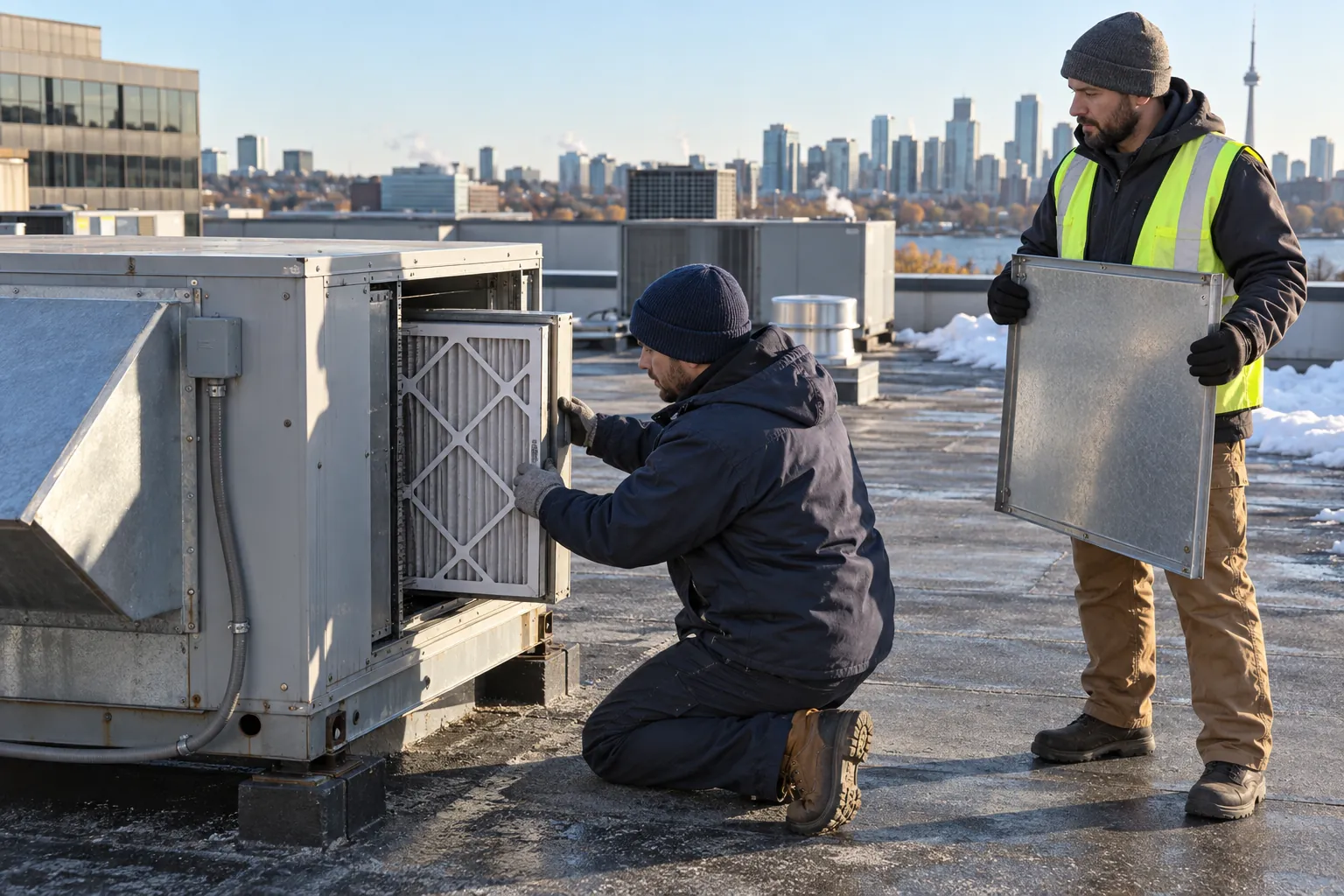 Premises and facilities managementPreventive maintenance checklist: what to include, how often, and how to show it was doneA preventive maintenance checklist for Canadian buildings: what the fire code and provincial law require, what to include, how often, and the records to keep.
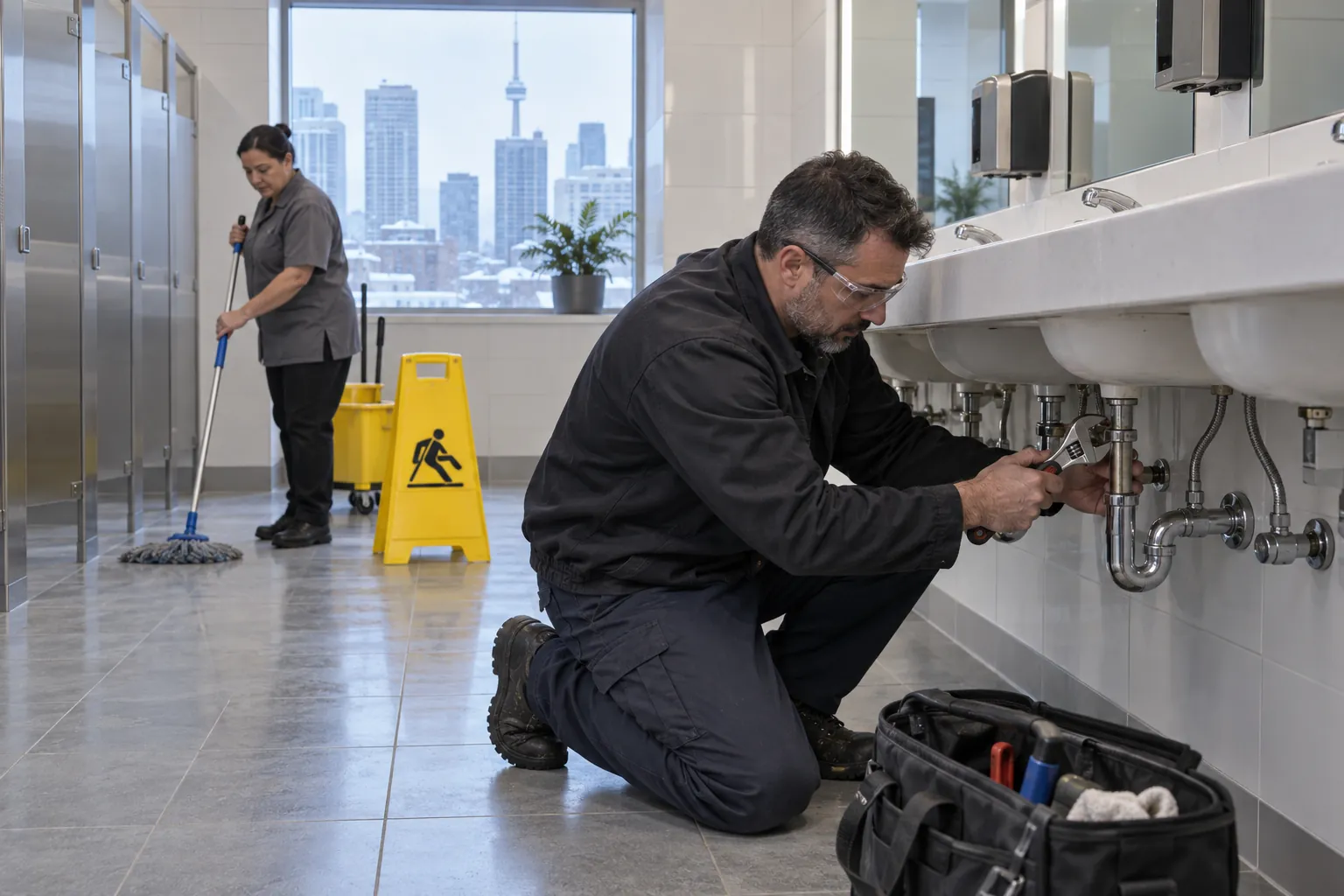 Premises and facilities managementReactive maintenance: how to run it well, and keep it in proportionHow to run reactive maintenance in a Canadian building: priorities and response times, the Ontario and BC rules, contractors, costs and closing the loop.
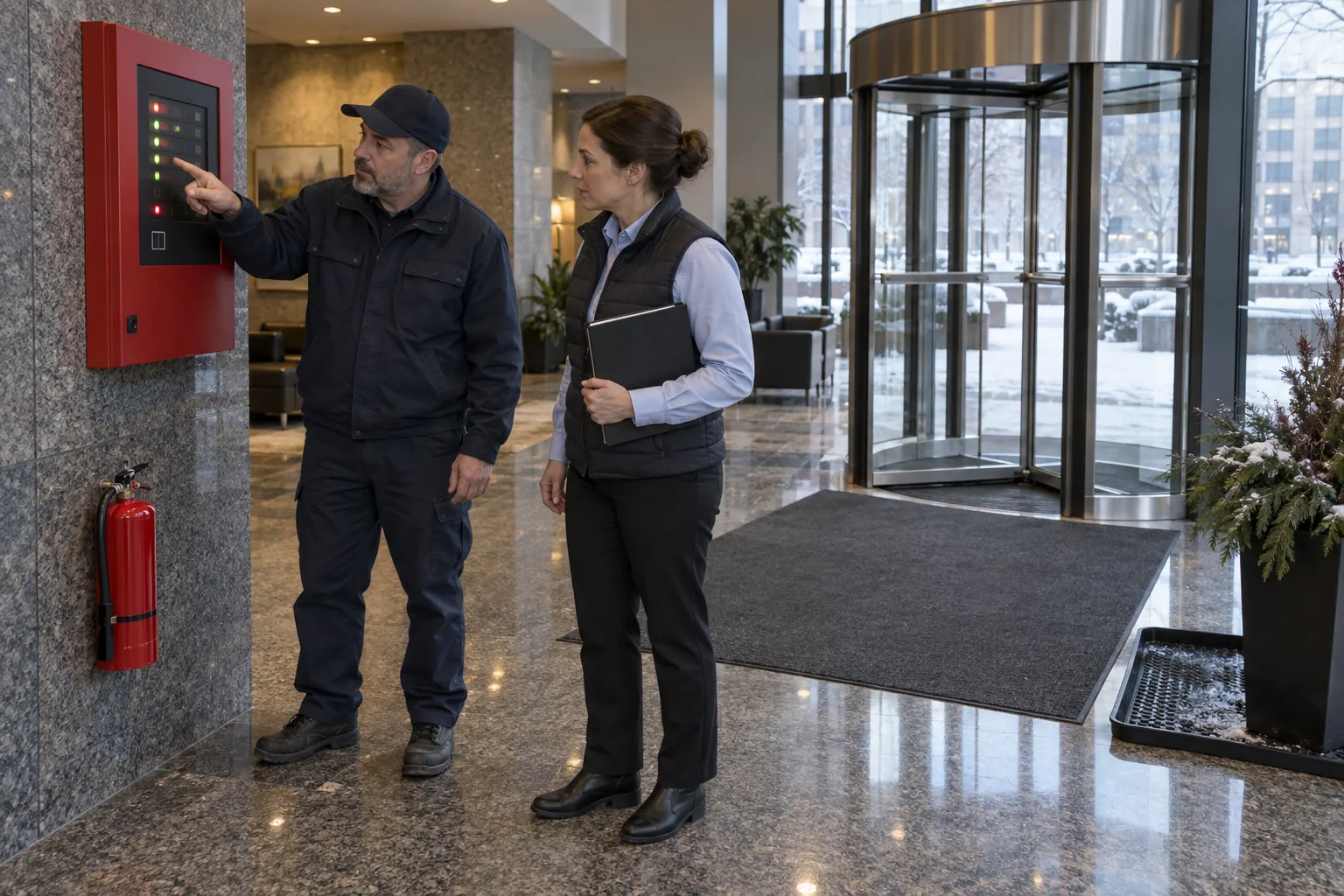 Premises and facilities managementBuilding compliance checklist: the legal picture for a Canadian buildingA building compliance checklist for Canadian commercial buildings: fire code, OHS, asbestos, elevators, boilers, accessibility and energy, who holds each duty.