Premises and facilities management
Reactive maintenance: how to run it well, and keep it in proportion
Reactive maintenance is the repair or replacement of equipment and building systems after they have broken down or failed, rather than on a schedule to stop them failing.
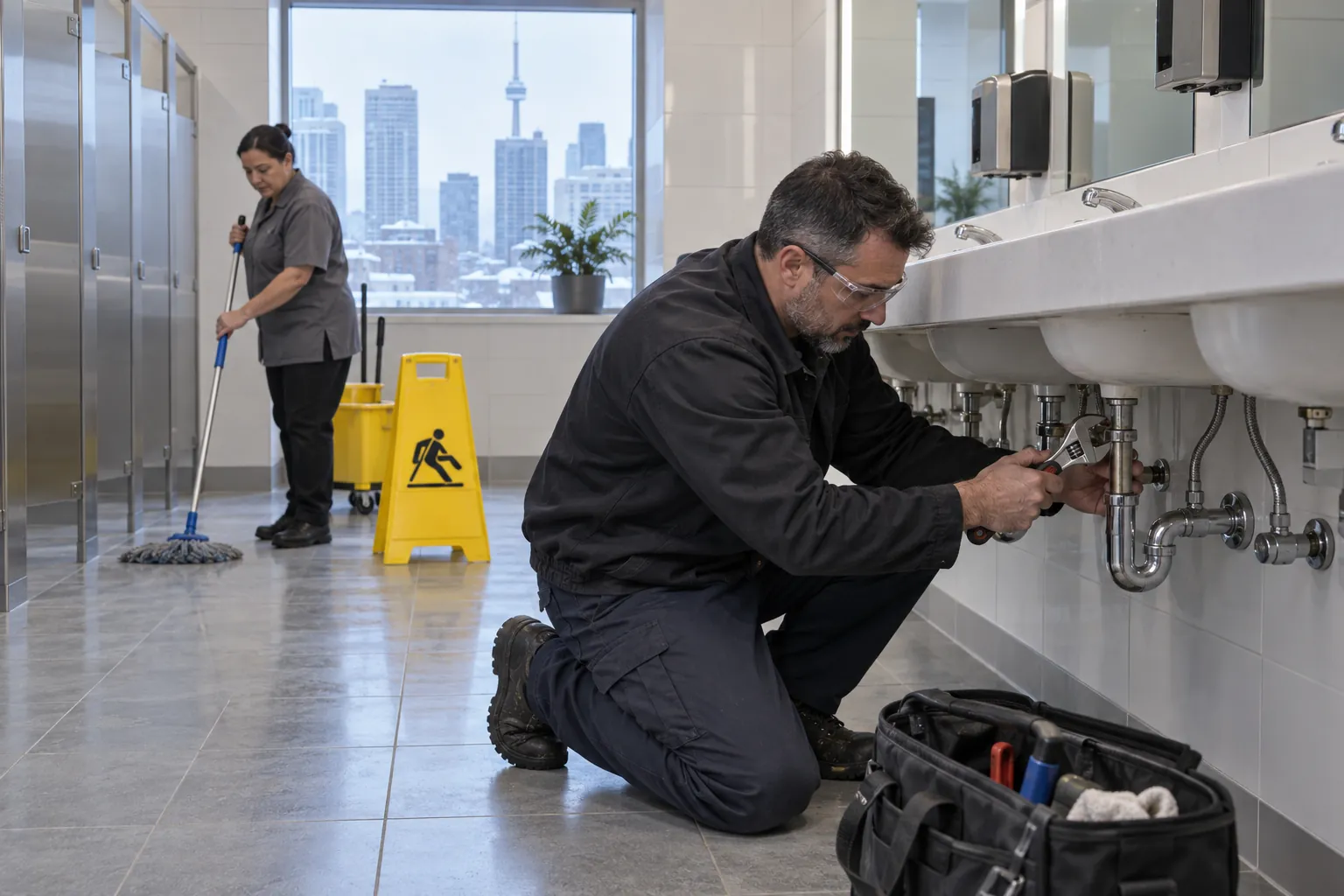
It is the leaking valve in the mechanical room, the entrance door that will not lock, the washroom with no hot water. Every building needs some, and too much of it is a sign that the planned work is not keeping up. This guide covers the Canadian rules behind it, how to prioritize and respond, how to control the cost, how to manage contractors safely, and how to close the loop with the person who reported the problem.
01
What reactive maintenance is, and the duty behind it
Reactive maintenance, also called corrective, breakdown or unplanned maintenance, is work carried out in response to a failure: a pipe that leaks, a rooftop unit that stops cooling, a door closer that breaks, a light that goes out. Its most urgent form is emergency maintenance, where the fault puts people, the building or its security at immediate risk.
It sits alongside preventive maintenance, work on a schedule to reduce the chance of failure; predictive or condition-based maintenance, triggered by monitoring that shows an asset is deteriorating; and run-to-failure, a deliberate choice to let a non-critical asset fail and then replace it. A light fixture in a storage closet can run to failure; a fire alarm panel cannot. Preventive and predictive work together are often called proactive maintenance, because they act before an equipment failure rather than after it.
No Canadian law sets how much reactive maintenance a building may have. The duty behind it comes from provincial occupational health and safety law for most workplaces, and from the Canada Labour Code, Part II, for federally regulated ones such as banks, airports and telecoms. Two provinces show its shape.
In Ontario, section 25(1)(b) of the Occupational Health and Safety Act requires an employer to ensure that "the equipment, materials and protective devices provided by the employer are maintained in good condition". Section 28(1) requires workers to report to their employer or supervisor "the absence of or defect in any equipment or protective device of which the worker is aware and which may endanger himself, herself or another worker", and "the existence of any hazard of which he or she knows".
In British Columbia, section 3.10 of the Occupational Health and Safety Regulation, Part 3 is the clearest statement of the reactive loop in Canadian law: anyone who sees "what appears to be an unsafe or harmful condition or act" must report it as soon as possible to a supervisor or the employer, and the person receiving the report "must investigate the reported unsafe condition or act and must ensure that any necessary corrective action is taken without delay." Section 4.3(3) of Part 4, General Conditions adds that equipment found unsafe "must be identified in a manner which will ensure it is not inadvertently returned to service until it is made safe for use."
Fire and life safety equipment has its own rule. Under Division B, Article 1.1.1.2.(3) of the Ontario Fire Code (O. Reg. 213/07), a device that "does not operate or appear to operate as intended" when checked, inspected or tested "shall be repaired or replaced" if its failure would adversely affect fire or life safety.
02
What reactive maintenance covers in practice
In an office tower, a school, a shopping centre or a condo, reactive work falls into familiar groups:
- Plumbing and drainage: leaks, blocked toilets and floor drains, dripping faucets, failed domestic hot water tanks, frozen pipes after a cold snap.
- Heating, ventilation and air conditioning: no heat, no cooling, noisy or failed fans, a make-up air unit that trips, faulty thermostats and controls.
- Electrical: lighting failures, tripped breakers, damaged receptacles, hand dryers that stop working.
- Doors, windows and locks: doors that will not close or latch, broken closers, cracked glazing, faulty card access, overhead parkade doors that stick.
- Building envelope and finishes: roof leaks, ice damage, water-stained ceiling tiles, lifting flooring, broken furniture and fixtures.
- Elevators: out-of-service cars and entrapments, which go straight to the elevator maintenance contractor.
- Fire and life safety systems: a fire door that does not close, an emergency light that fails its test, a trouble signal on the fire alarm panel.
Each of these follows the same path, whether the work is done by an in-house building operator or bought in from a contractor: the problem is reported and logged, given a priority and assigned; someone attends, makes it safe and fixes it; the fix is checked and the job closed; and the person who reported it is told. How problems reach you in the first place is covered in our guide to the maintenance request form. This guide is about what happens next.
03
Priorities and response times
Reactive work needs a priority scale that everyone applies the same way. Most contracts use four or five levels. The times below are examples only; yours belong in the contract, lease or management agreement.
- Priority 1, emergency: an immediate risk to health, safety, security or the building, such as a flood, no heat in January or a failed entrance lock. Attend and make safe within an hour or two, around the clock.
- Priority 2, urgent: a fault that stops part of the building being used or will get worse quickly. Attend the same day or within 24 hours.
- Priority 3, routine: an inconvenience rather than a risk. Attend within a few business days.
- Priority 4, planned: work that can wait to be grouped with other jobs or done at a quiet time.
Canadian law sets fixed response times in only a few places. Toronto Municipal Code Chapter 354, Apartment Buildings, which covers purpose-built rental buildings with three or more storeys and ten or more rental units, requires an owner or operator to respond to an urgent tenant service request within 24 hours and to one that is not urgent within 7 days (section 354-3.1C). An urgent request is one related to the discontinuance of fuel, electricity, gas, heat or hot or cold water, or a breach of building security, suite security or the building envelope: a sound starting point for your own Priority 1 list, in or out of Toronto.
Three habits make a priority scale work:
- Separate response from repair. Response is when someone arrives or makes safe; repair is when the fault is resolved. Measure both, or a contractor can meet every response target while jobs stay open for weeks.
- Judge the risk, not the complaint. A failed light is a nuisance in an office and a hazard on an exit stair.
- Plan for after hours. Say who answers an emergency at night and on weekends, who can authorize an emergency service call, and what the security guard or night custodian should do meanwhile.
A make-safe is not a repair. A leak isolated at the valve or an area coned off is the right first response, but the job stays open until the permanent fix is done. Faults on fire protection systems need more than a work order: in Ontario, Division B, Article 1.1.1.1 of the Fire Code requires a notification procedure when repairs are made to fire protection installations, including notifying the fire department and occupants where necessary for safety, and Article 6.3.1.3 requires notification if any part of a fire alarm system is shut down.
04
The balance with planned work, and the cost
Reactive maintenance is not a failure in itself. Some faults cannot be foreseen, and for non-critical assets run-to-failure can be the cheapest option. The problem is a building that is mostly reactive, where the maintenance budget goes on costly repairs and little is left for the planned work that would prevent them.
The disadvantages of reactive maintenance as a main strategy are well understood:
- Higher cost per job: emergency service call charges, overtime and after-hours rates, parts bought at short notice, and secondary damage, such as a ceiling ruined by a leak that a routine inspection would have caught.
- Unplanned downtime: an unexpected failure takes a washroom, a floor or a whole system out of use until the emergency repairs are done, and it rarely happens at a convenient time.
- Shorter equipment life: equipment run until it breaks usually wears out sooner than equipment that is serviced.
- Winter risk: in a Canadian climate, a heating or envelope failure left to the next business day can become frozen pipes and a flood.
- Compliance risk: safety systems that are only looked at when they fail are, by definition, not being maintained.
The apparent advantages, lower upfront cost and less planning, are real in the short term, which is why buildings drift into a reactive approach when budgets are cut. The savings usually come back later as larger bills.
There is no standard ratio of planned to reactive work. Track reactive jobs by asset and cause instead, and let the data show where the failures are: repeat faults on the same equipment point to something that needs replacing or adding to the preventive schedule, and a cluster in one area points to a root cause, such as a failing roof membrane. A computerized maintenance management system (CMMS) makes that analysis far easier.
The aim is not to eliminate reactive work but to choose it. Decide, asset by asset, whether planned work is worth its cost or whether running to failure is acceptable, and write that decision into the maintenance plan. Building certification looks at how existing buildings are run, too: according to BOMA BEST's history of the program, the certification, managed by BOMA Canada, "recognizes excellence in energy and environmental management and performance in commercial real estate."
05
Contractors, safe repairs, and closing the loop
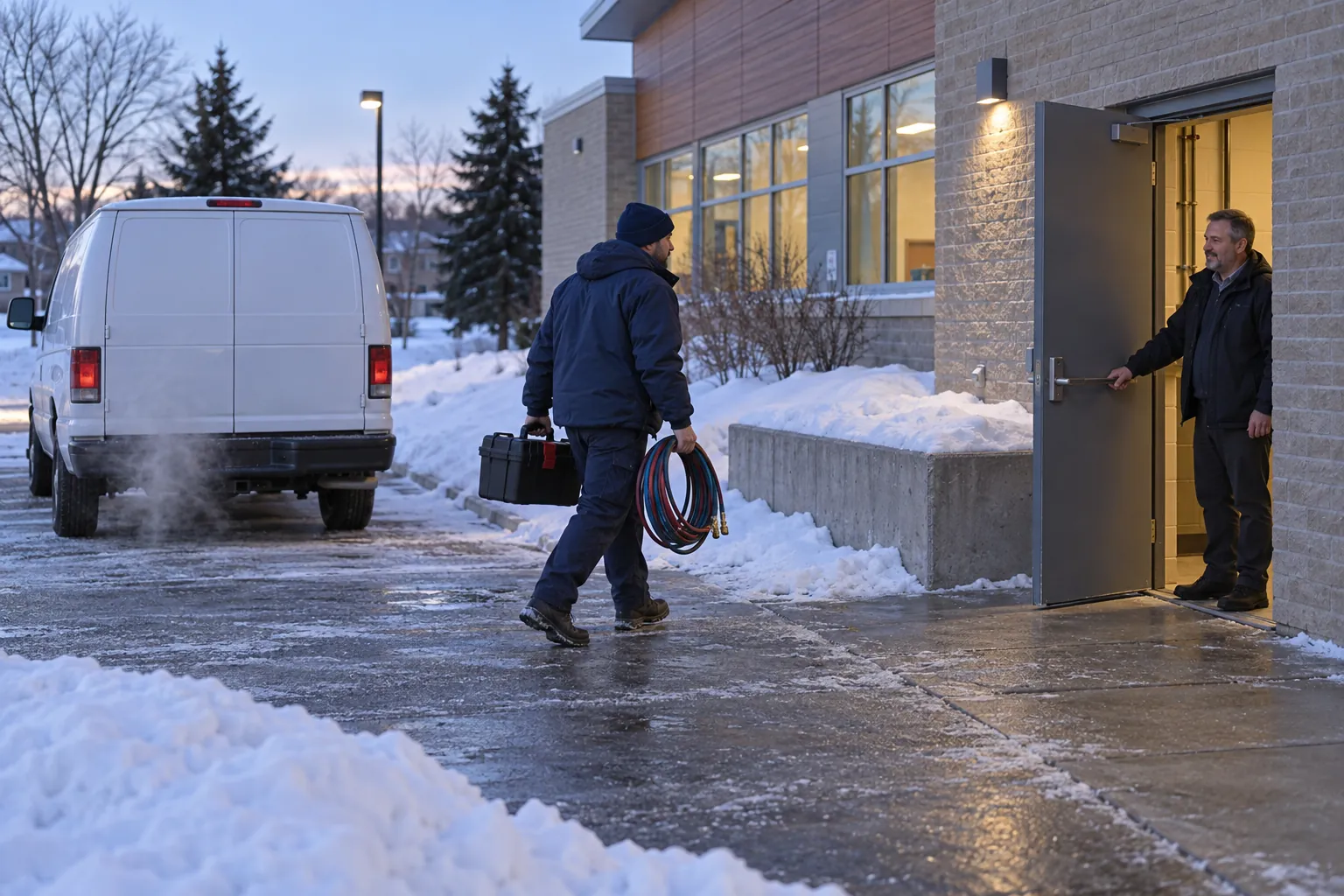
Most buildings use contractors for at least some reactive work. The arrangements that matter are:
- Approved contractors: a short list per trade, with insurance, workers' compensation clearance and licensing checked. In Ontario, the Technical Standards and Safety Authority's Be Fuels Wise: Hire Registered and Certified Professionals says fuel-fired appliances must be maintained by TSSA-registered contractors, and the Electrical Safety Authority's Property Owner and Manager Obligations says anyone hired to do electrical work must be a licensed electrical contractor, and that most electrical work needs a notification of work filed with the ESA, whatever the building type, before or within 48 hours of the start of the work.
- Authorization: who can instruct a contractor and up to what value, and what service call and after-hours rates were agreed before the first emergency.
- Asbestos before intrusive work: in Ontario, O. Reg. 278/05, Designated Substance – Asbestos on Construction Projects and in Buildings and Repair Operations requires an owner who knows or ought reasonably to know of asbestos-containing material in the building to keep a record of it on the premises and give written notice of the record to any employer it contracts for work that may involve or disturb the material (section 8(3)), and, before requesting tenders for or arranging repair work, to have a report prepared on whether the material to be disturbed contains asbestos (section 10).
- Lockout: in Ontario offices and other industrial establishments, sections 75 and 76 of the Industrial Establishments regulation (R.R.O. 1990, Reg. 851) allow repair only when dangerous motion has stopped and moving parts are blocked, and require control switches to be locked out where starting may endanger a worker. CCOHS explains the practice in Hazardous Energy Control Programs.
- Evidence of completion: a service report with what was found and done, photos where they help, and any further work recommended.
Closing the job has two halves, and the second is the one that gets forgotten:
- Check the fix. Someone on site, not only the technician who did the work, confirms the fault is resolved before the work order is closed. A job closed by the person who did it is a claim, not a check.
- Tell the person who reported it. A short message that the problem is fixed, or when it will be, is what turns a maintenance request into trust. People who never hear back stop reporting, and the next problem is found by a complaint instead.
Keep the record. Toronto's Chapter 354, section 354-4.1B(6), requires "logs of service and maintenance conducted on fuel burning appliances, heating systems, cooling systems, electrical systems, ventilation systems and plumbing systems", with the date and nature of the service and the name of the certified tradesperson where applicable, kept for at least 24 months (section 354-4.1C). The Ontario Fire Code, Division B, Article 1.1.2.1, requires a record of tests and corrective measures noting what was done and the date and time it was done, kept at the building for at least two years under Article 1.1.2.2. Elsewhere, keep reactive records long enough to answer an insurer or an inspector, and review response and repair times, repeat service calls and reopened jobs with each contractor every month.
06
Where the record fails, and what SiteClara does about it
Reactive maintenance records are usually good from the moment a work order is raised in the CMMS. They are weak before that point and after it. Before, because problems found by custodians, security guards and building staff on their rounds are passed on in the hallway or not at all, with no location and no time. After, because nobody goes back to check the fix or tell the person who reported it.
SiteClara covers the teams on the ground. A printed QR poster at each location, such as a washroom, a lobby, a stairwell, a parkade level or a garbage room, with an NFC tag behind it if you want staff to tap, lets staff scan or tap with their own phone, with no app to install, and report a problem there with a photo. The report already knows the building and the location, carries the time and the named person, and goes onto the team's list of jobs until someone closes it. The supervisor's queue groups open jobs by building and floor, and a supervisor can escalate a job once to the building manager, who can answer it.
Each day the supervisor approves a report that goes to nominated management or client contacts the next morning, showing what was reported, what was completed and what is still open.
07
Questions people ask
What are the four types of maintenance?
The US Department of Energy's O&M Best Practices Guide, Release 3.0, Chapter 5: Types of Maintenance Programs, written for its Federal Energy Management Program, compares four: reactive maintenance (breakdown or run-to-failure), preventive maintenance (time-based), predictive maintenance (condition-based) and reliability-centred maintenance, which combines predictive and preventive techniques with root cause failure analysis. Other sources group them differently, but these are the four programs the guide sets side by side.
What is the difference between reactive and proactive maintenance?
Reactive maintenance waits for the failure. The O&M Best Practices Guide, Chapter 5 calls it the "run it till it breaks" maintenance mode, repairing or replacing damaged equipment "only when obvious problems occur." Proactive maintenance acts before the failure: the same chapter describes preventive and predictive maintenance as repairing or replacing damaged equipment "before obvious problems occur," and heads reliability-centred maintenance "Pro-Active or Prevention Maintenance." It notes that damage a failure does to other equipment is "an increased cost we would not have experienced if our maintenance program was more proactive."
What are the disadvantages of reactive maintenance?
The O&M Best Practices Guide, Chapter 5 lists increased cost due to unplanned downtime, increased labour cost, especially if overtime is needed, the cost of repairing or replacing the equipment, possible secondary equipment or process damage, and inefficient use of staff resources. It adds that equipment run to failure has a shorter life, is likely to need more extensive repairs, will probably fail during off hours or close to the end of the normal workday, and needs a large inventory of repair parts. Its only listed advantages are low cost and less staff, which it calls a double-edged sword.
08
Further reading, and a list to take away
Read your province's occupational health and safety act and regulations (in Ontario the Occupational Health and Safety Act and Reg. 851; in British Columbia Parts 3 and 4 of the WorkSafeBC regulation; the Canada Labour Code, Part II, for federal workplaces), your provincial fire code, and, for Toronto rental buildings, Chapter 354. The Canadian Centre for Occupational Health and Safety's Hazard and Risk – Hazard Identification lists hazard reporting by employees and documents and records among the ways hazards come to light.
To keep reactive maintenance under control, check that:
- every problem is logged with a location and a priority, whoever reports it;
- priorities follow risk and criticality, with example faults for each level;
- after-hours emergencies have a named route and a person authorized to call in a contractor;
- contractors are approved, licensed for their trade, and shown the asbestos record before intrusive work;
- equipment under repair is locked out, and unsafe equipment is tagged out of service until it is fixed;
- fire alarm and sprinkler impairments trigger the notifications your fire code requires;
- repeat faults are reviewed and fed into the preventive maintenance schedule;
- the person who reported the problem is told when it is fixed.
Sources
Every document this guide quotes or links to, in the order it first cites them.
- Canada Labour Code laws-lois.justice.gc.ca
- Occupational Health and Safety Act ontario.ca
- Occupational Health and Safety Regulation, Part 3 worksafebc.com
- Part 4, General Conditions worksafebc.com
- Ontario Fire Code (O. Reg. 213/07) ontario.ca
- Toronto Municipal Code Chapter 354, Apartment Buildings toronto.ca
- BOMA BEST's history of the program bomabest.org
- Be Fuels Wise: Hire Registered and Certified Professionals tssa.org
- Property Owner and Manager Obligations esasafe.com
- O. Reg. 278/05, Designated Substance – Asbestos on Construction Projects and in Buildings and Repair Operations ontario.ca
- Industrial Establishments regulation (R.R.O. 1990, Reg. 851) ontario.ca
- Hazardous Energy Control Programs ccohs.ca
- O&M Best Practices Guide, Release 3.0, Chapter 5: Types of Maintenance Programs www1.eere.energy.gov
- Hazard and Risk – Hazard Identification ccohs.ca
Related guides
 Premises and facilities managementPreventive maintenance checklist: what to include, how often, and how to show it was doneA preventive maintenance checklist for Canadian buildings: what the fire code and provincial law require, what to include, how often, and the records to keep.
 Premises and facilities managementMaintenance request forms: what to capture, how fast to answer, and what to keepWhat a maintenance request form should capture, how requests are prioritized and closed, and what Ontario, Toronto and BC rules say about repairs and records.
 Premises and facilities managementBuilding maintenance checklist: what to check, how often, and who does itA building maintenance checklist for Canadian buildings: daily to annual tasks, the property standards bylaws and fire code behind them, and who does each.
 Premises and facilities managementFacility manager duties in Canada: what the role covers, and how to show it is doneWhat a facility manager does in Canada: the owner, employer and supervisor duties under provincial OHS and fire law, contractors, and the records that show it.