Premises and facilities management
Incident report template: what to record, and when the law says to report it
An incident report template is a standard form for recording a workplace incident while the facts are fresh: where and when it happened, who was involved, what happened in sequence, any injury and the first aid given, the conditions at the time, the witnesses, what was done on the spot and who was told.
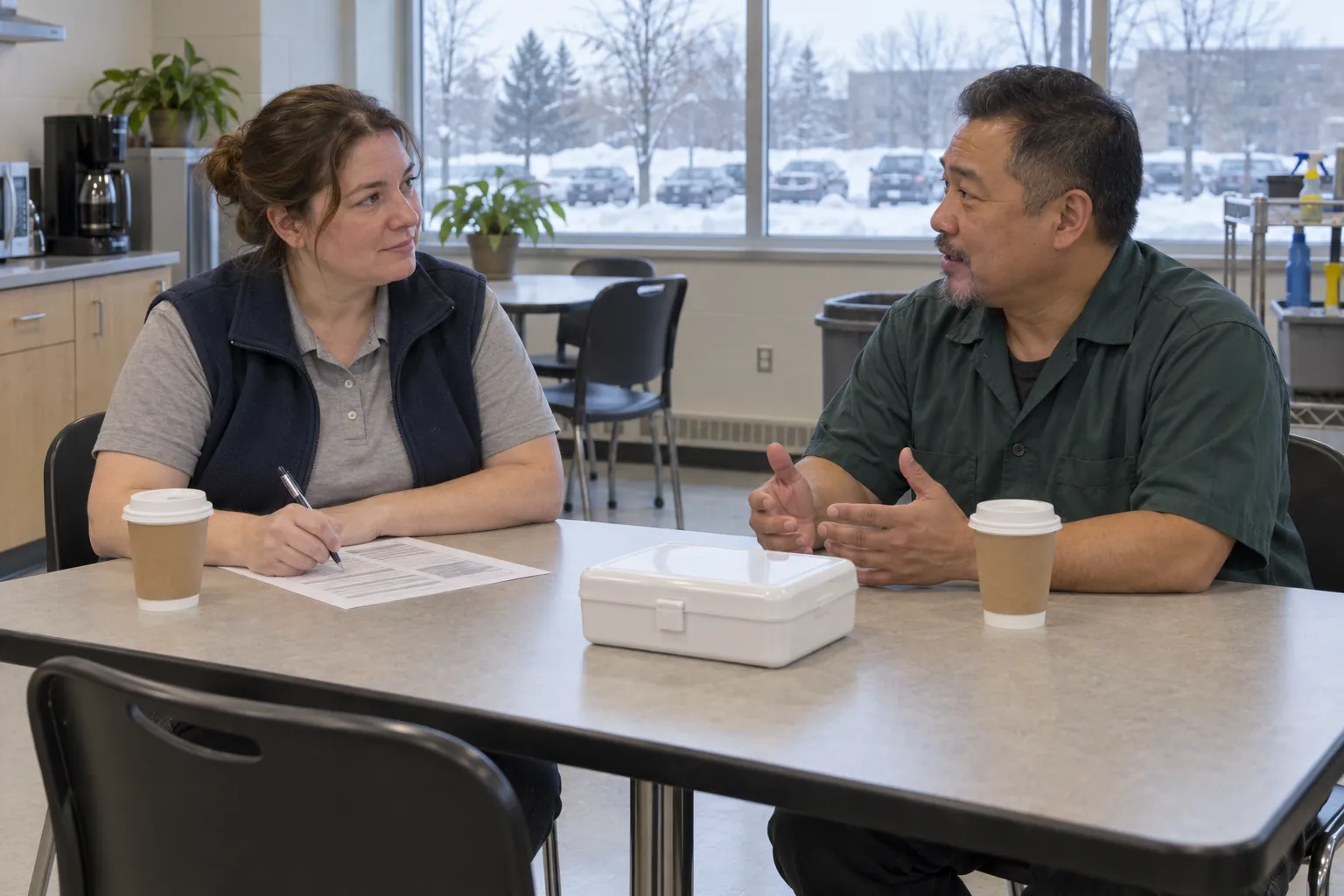
No single form is required across Canada, because most workplace health and safety law is provincial, and the province decides which incidents must be reported, to whom and how fast. This guide gives the fields a good template holds, how to write the report and take witness statements, the Ontario, British Columbia, Alberta and federal reporting rules, and why the record of the place before the incident matters as much as the report.
01
What an incident report is, and which law applies
The Canadian Centre for Occupational Health and Safety (CCOHS), in its OSH Answers page on incident investigation, defines an incident as "an occurrence arising out of or in the course of work that resulted in or could have resulted in injuries, illnesses, damage to health, fatalities, or material damage." Its first step is to "report the incident occurrence to a designated person within the organization" and give first aid and medical care as needed. The incident report is what turns that call into a record someone else can act on.
Three different documents often get called an incident report, and a good template keeps them apart:
- The internal incident report, filled in on the day by the worker, supervisor or first aider. This is the template most employers need, and the law rarely dictates its layout.
- The statutory notice or investigation report to the regulator, the joint health and safety committee (JHSC, or its equivalent, such as the federal work place committee) or the health and safety representative, required only for certain incidents, with contents set by the province or federal regulations.
- The employer's report of injury to the workers' compensation board, such as Form 7 to the WSIB in Ontario or to WorkSafeBC, required when an injury needs more than first aid or costs the worker time or pay.
Which rules apply depends on who employs the person hurt, not whose building it is. A janitorial contractor's custodian in a Toronto office tower is under Ontario's Occupational Health and Safety Act, while a federally regulated bank tenant's employees on the floor above are under the Canada Labour Code, Part II. The same slip can fall under two regimes, depending on whose worker fell.
02
The incident report template: the fields to include
For businesses of any size, a good incident report form is short enough to fill in on the day and complete enough that nobody has to reconstruct the event a week later. These are the fields worth including:
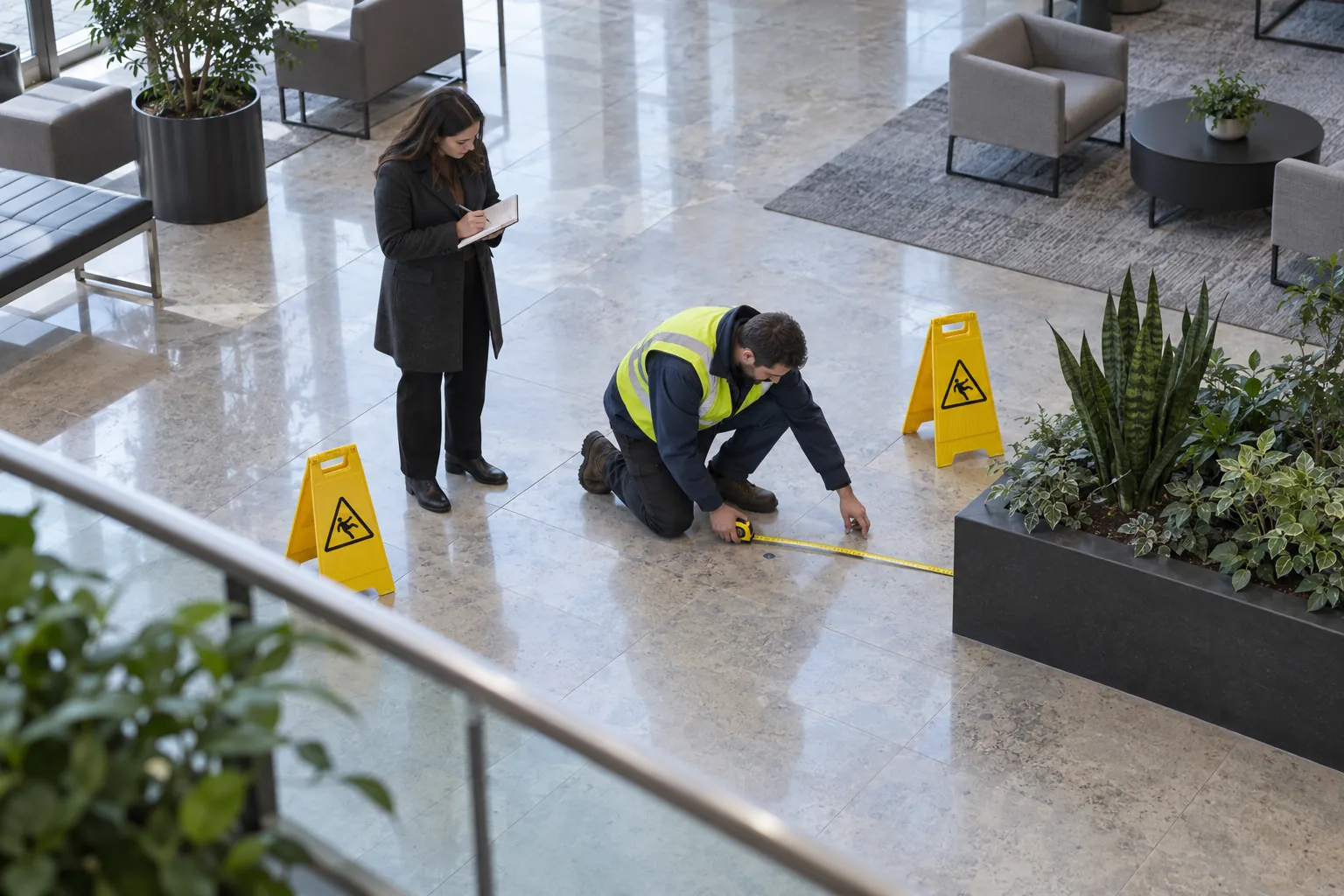
- Where: the building, floor and exact spot. "Lobby" is not enough; "main lobby, inside the east vestibule doors, on the second mat" is.
- When: the date and time it happened, and when it was reported, if later.
- Who was involved: name, job title and employer of each employee or other person involved, because in a building with contractors the employer decides which rules apply. Note a visitor, tenant or member of the public as such.
- Type of incident: injury, illness, property or equipment damage, near miss, fire, spill, or workplace violence.
- What happened: the sequence of events in plain words, from what the person was doing just before to what happened after.
- Injury and treatment: the part of the body, the kind of injury, the first aid given and by whom, and whether the person went for medical treatment, went home or returned to work.
- Conditions at the time: lighting, floor condition, weather at an entrance, noise, housekeeping, and anything that had changed from normal.
- Equipment and products: the ladder, machine, tool or chemical involved, with an identifying number where there is one.
- Witnesses: names and contact details of everyone who saw it or arrived just after.
- Photographs and video: the scene and the hazard before anything is moved, and a note of any camera that may have recorded it.
- Immediate action: the area coned off, the spill cleaned, the machine tagged out of service.
- Notifications: who was told, by whom and when, including the supervisor, the JHSC or representative, the regulator and the property manager.
- Reported by: the name of the person completing the form, their signature and the date.
Leave the analysis off the first page. The causes, the corrective action, its owner and its due date belong to the investigation and follow-up that a supervisor or investigation team completes afterwards. Asking an injured worker to diagnose their own fall produces short, defensive answers and a form nobody wants to fill in next time.
Keep a separate witness statement form too: the witness's name and contact details, where they were, what they saw and heard in their own words, their signature and the date. One page per witness keeps each account independent. Whether the incident report template is a printed pad, a Word document or an online form, the format matters less than that everyone knows where it is and a completed copy reaches whoever decides if the incident must be reported outside the company.
03
How to write an incident report
A useful incident report is factual, specific, detailed enough for someone who was not there, and written as soon as the injured person has been looked after:
- Facts first, opinions labelled. If the writer thinks the floor had just been mopped but did not see it, "I believe" is honest; stating it as fact is not.
- Times and measures, not impressions. "At about 7:40 a.m." beats "early in the morning", and "the wet floor sign was 3 metres away, by the elevator" beats "there was no sign".
- In sequence. CCOHS has investigators write down a step-by-step account of what happened; a clear sequence in the first report is where that starts.
- In the person's own words. A supervisor should not tidy the injured worker's account into something it is not.
- No blame. CCOHS says the purpose is "to find facts that can lead to corrective actions, not to find fault."
Physical evidence comes first because it changes fastest. CCOHS advises examining the site, preserving evidence and identifying all witnesses before anything else, and lists what to check, including the positions of injured workers, the equipment and products in use, housekeeping, weather, lighting, noise and time of day. Video surveillance footage should be accessed "before it is overwritten or otherwise lost."
CCOHS says witnesses "should be kept apart and interviewed as soon as possible after the incident", alone rather than in a group, because otherwise "individual perceptions may be lost in the normal process of accepting a consensus view". It recommends open questions and lists the general ones to ask each time, which make a sound witness incident report form on their own:
- Where were you at the time of the incident?
- What were you doing at the time?
- What did you see or hear?
- What were the work environment conditions (weather, light, noise, etc.) at the time?
- What was (were) the injured worker(s) doing at the time?
- Do you have any further information you would like to add?
- In your opinion, what caused the incident?
- How might similar incidents be prevented in the future?
A sample of the "What happened" field, written well: "At about 7:40 a.m. I was walking from the east vestibule doors to the elevators carrying a box of paper. My right foot slid on the second entrance mat, which was wet along its edge, and I fell on my left side. The wet floor sign was 3 metres away, by the elevator. The concierge on duty saw me fall and helped me up." It is in sequence and in the employee's own words, and it leaves the cause to the investigation.
For the corrective action, CCOHS asks for specific recommendations: rather than "eliminate blind corners", install mirrors "at the northwest corner of building X", then at blind corners throughout the worksite.
04
Which incidents must be reported, and how fast
The summaries below cover the three most populous provinces outside Quebec and federally regulated work; elsewhere, read your own province's or territory's rules. In British Columbia and Alberta, the scene of a serious reportable incident must not be disturbed except to help the injured, prevent further harm or protect endangered property, unless the regulator directs otherwise. Ontario's rule, for a death or critical injury, is similar but allows saving life or relieving suffering, maintaining an essential public utility or public transportation system, and preventing unnecessary damage to equipment or property.
Where the law prescribes a form or its contents, that report is the legal record. An internal template should collect every fact those forms ask for, so nothing has to be chased later, but it does not replace them.
05
The record of the place before the incident
Most incident report templates ask what happened. Fewer ask what state the place was in beforehand, and in buildings that is often what settles the cause. CCOHS points investigators to documents such as "inspection reports, company policies, maintenance reports, past incident reports" for what a witness cannot give. For the incidents facilities, janitorial and security teams see most, the useful documentation is close at hand:
- A slip in an entrance or washroom: when the floor was last cleaned or checked, whether a wet floor sign was out, and when the walkway was last cleared and salted.
- A trip on a stair or in a parkade: when the area was last inspected, and whether a loose nosing or failed light had already been reported and not fixed.
- A fall from a ladder: the ladder's last inspection, and whether it had been tagged out before.
- A falling ceiling tile or fitting: any earlier report of a leak, sag or loose fitting at the same spot.
Two things decide whether those records help. Each entry must show when it was made and by whom: a sheet on the back of the washroom door with every hour ticked in the same pen tells an investigator nothing. And a missed check must be visible as missed, with the reason; that is more useful to an honest investigation than a complete-looking sheet.
Add a field to the template: "Last inspection or cleaning of this location: date, time, by whom, and where the record is kept." In a building shared by an owner, a property manager, a janitorial contractor and tenants, agree in advance who keeps which record. Afterwards, the corrective action needs an owner and a due date, and is closed only when someone records that the mat was replaced or the handrail repaired. A JHSC reviewing incidents by location will see what one report never shows, such as three slips at one entrance in one winter.
06
Where the incident record fails, and what SiteClara does about it
Incident reporting rarely fails for want of a template. It fails because the form is in an office when the incident is in a parkade, because the report reaches the supervisor two days later, and because, when the investigator asks when the entrance was last checked, the answer is a ticked sheet that cannot show who walked past or when.
SiteClara records work and problems at the location. A printed QR poster, with an optional NFC tag behind it, sits at each place where checks are scheduled, such as a washroom, an entrance or a stairwell. Staff scan or tap on their own phone, with no app to install, and mark each check due there as done, or explain what stopped them. They can report a problem at the same spot, with a photo when one helps; the report carries the location, the time and the named person, and stays on the team's list of jobs until someone closes it.
The supervisor sees what is due, done and missed, adds a note and approves a daily report that goes to nominated management or client contacts the next morning. After an incident, that gives a dated record of when that washroom or entrance was last checked and by whom, any earlier report of a hazard there, and whether the fix was recorded as done.
07
Questions people ask
What are the 5 elements of a good incident report?
No Canadian law lists five. The five usually meant are who, what, when, where and how: the people involved, what happened, the date and time, the exact location, and the sequence and conditions that led to it. For the investigation, CCOHS's page on incident investigation groups causes into five categories: task, material, environment, personnel and management.
Can I download a free incident report format in Word?
You can build your own in Word for your internal report, using the fields above. For the statutory report in Ontario, the province's page on reporting workplace incidents and illnesses lets you download and complete its form, or prepare your own report or notice with the information O. Reg. 420/21 requires. The WSIB's guidance on reporting an injury or illness has employers report through its secure online services.
Do I have to report an injury that only needed first aid?
Usually not to the compensation board, but you must still record it. The WSIB's guidance on reporting an injury or illness needs no report when only first aid was given, the worker lost no time or pay and did no modified work for more than seven calendar days, but employers must keep accurate records of first aid treatment. Federally regulated employers enter first aid given in a first aid record (section 16.13) and record every minor injury given medical treatment, with its date, time, location and causes, under section 15.7 of the Canada Occupational Health and Safety Regulations.
08
Where to read more, and a list to take away
CCOHS explains the process, from securing the scene to follow-up, in its OSH Answers page on incident investigation. In Ontario, read reporting workplace incidents and illnesses and the WSIB's guidance on reporting an injury or illness; in British Columbia, Division 10 of the Workers Compensation Act, Part 2; in Alberta, section 33 of the Occupational Health and Safety Act; for federally regulated work, Part XV of the Canada Occupational Health and Safety Regulations. Elsewhere, go to your own regulator and compensation board.
Before you rely on your incident report template, check that:
- you know which law applies to each employer in the building, provincial or federal;
- the form records the exact location, the time, the people and their employer, and the sequence of events;
- it separates first aid from medical treatment, so the compensation board threshold is clear;
- witnesses give their own statements, apart and on the day;
- photographs are taken and camera footage saved before anything is moved or overwritten;
- someone decides the same day what must be reported, to whom and by when;
- the report points to the last inspection or cleaning record of the place;
- every corrective action has an owner and a due date, and is closed with evidence.
Sources
Every document this guide quotes or links to, in the order it first cites them.
- Incident investigation ccohs.ca
- Canada Labour Code, Part II laws-lois.justice.gc.ca
- Reporting workplace incidents and illnesses ontario.ca
- WSIB's guidance on reporting an injury or illness wsib.ca
- Workers Compensation Act, Part 2 bclaws.gov.bc.ca
- WorkSafeBC's page on how employers report a workplace injury or disease worksafebc.com
- Occupational Health and Safety Act search-ohs-laws.alberta.ca
- WCB-Alberta's page on reporting an injury, for employers wcb.ab.ca
- Canada Occupational Health and Safety Regulations laws-lois.justice.gc.ca
Related guides
 Premises and facilities managementNear miss reporting in Canada: what the law asks, and how to make it workWhat a near miss is, which Canadian laws make you report or investigate one (federal, Ontario, BC, Alberta), what a good report holds, and how to act on it.
 Premises and facilities managementSlips, trips and falls: how to prevent them in the buildings you look afterPreventing slips, trips and falls in Canadian buildings: Ontario, BC, Alberta and federal rules, wet floors, winter entrances, stairs and the records to keep.
 Premises and facilities managementWorkplace inspection checklist: how a JHSC inspection should workA workplace inspection checklist for Canadian JHSCs and representatives: Ontario, BC, Alberta and federal rules, what to walk, how often and what to record.
 Security patrolsSecurity report writing: what a guard's report needs, and how to make it stand upSecurity report writing for Canadian guards: the reports a shift produces, what an incident report must contain, and what Ontario, BC and Alberta law expects.