Premises and facilities management
Workplace inspection checklist: how a JHSC inspection should work
A workplace inspection checklist is the list of conditions and hazards an inspector works through on a walkthrough of the workplace: housekeeping, floors and exits, lighting, noise, fire safety, electrical, chemicals, materials handling, first aid and the work procedures in each area.
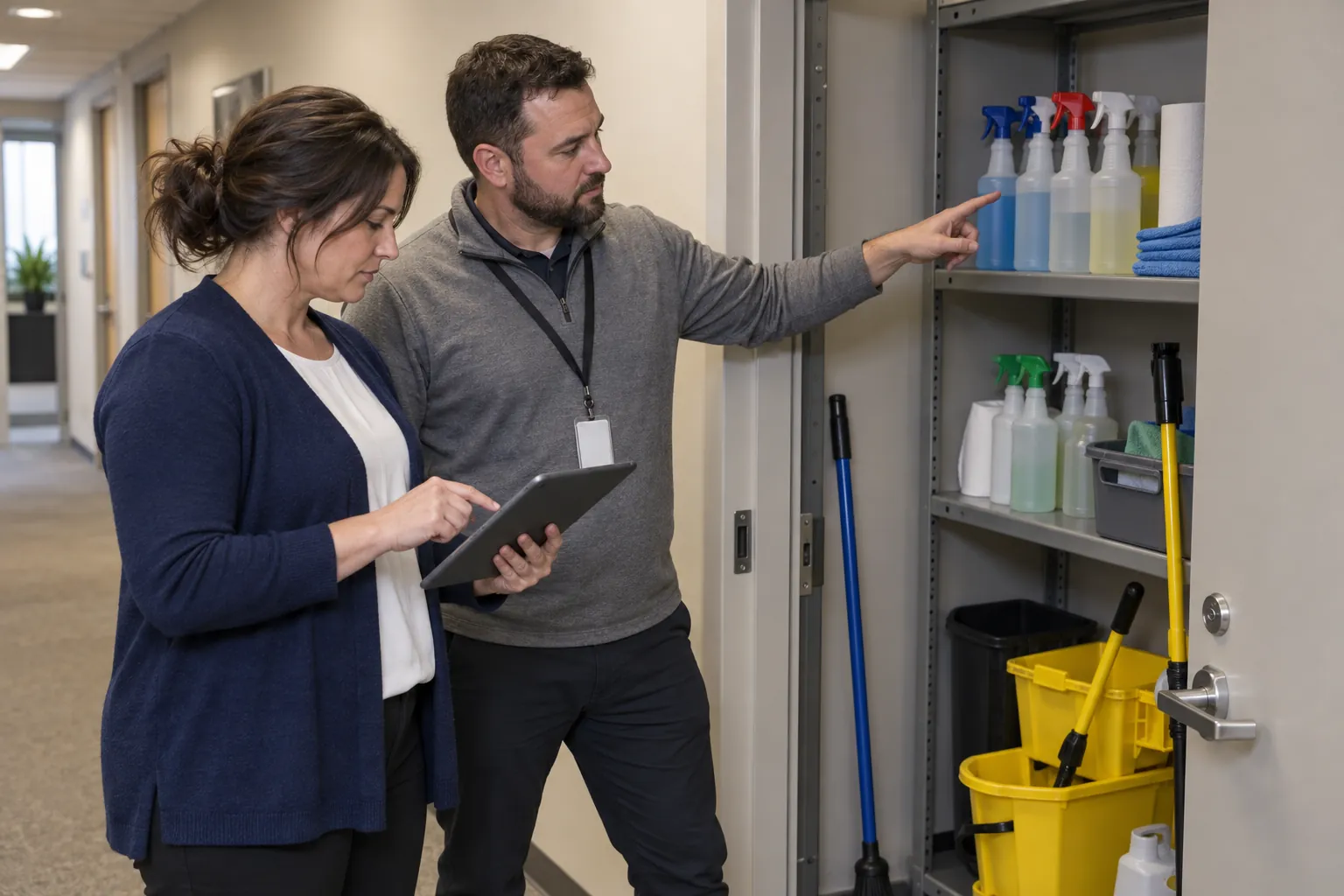
In Ontario and in federally regulated workplaces, the monthly inspection is not optional: Ontario's Occupational Health and Safety Act and the Canada Labour Code require the joint health and safety committee, or the health and safety representative, to inspect the workplace, or part of it, every month. British Columbia puts the inspection duty on the employer, with the committee taking part where feasible, and in Alberta the committee reviews the employer's work site inspection documentation. This guide covers what each regime says, a workplace inspection checklist that fits an ordinary office, school, retail or residential building, how often to inspect and who should do it, how to record findings so they get fixed, and what happens between the monthly inspections.
01
Workplace inspections: what the law in Canada requires
There is no single Canadian rule on workplace inspections. Occupational health and safety is mostly provincial and territorial law; the federal rules apply only to federally regulated work, such as banks, airports, telecommunications and interprovincial transport. The four regimes below differ in who carries the duty.
Ontario. Under section 9(2) of the Occupational Health and Safety Act, a joint health and safety committee (JHSC) is required "at a workplace at which twenty or more workers are regularly employed", among other cases. The worker members of the committee designate a member "to inspect the physical condition of the workplace" (section 9(23)), and that member should, "if possible", be a certified member (section 9(24)). The inspection duty itself is in section 9(26) and 9(27):
- the designated member "shall inspect the physical condition of the workplace at least once a month", unless a regulation or an inspector's order says otherwise;
- if that is not practical, the member "shall inspect the physical condition of the workplace at least once a year, inspecting at least a part of the workplace in each month";
- that rolling inspection follows "a schedule established by the committee" (section 9(28));
- the member "shall inform the committee of situations that may be a source of danger or hazard to workers", and the committee must consider them "within a reasonable period of time" (section 9(30)).
Where there is no committee but the number of workers "regularly exceeds five", section 8(1) requires a health and safety representative, selected by the workers from among those who do not exercise managerial functions. Sections 8(6) to 8(8) give the representative the same monthly inspection duty, with a rolling schedule "agreed upon by the constructor or employer and the health and safety representative". The Ministry's Guide for health and safety committees and representatives explains both in plain terms.
British Columbia. Here the duty starts with the employer. Section 3.5 of the Occupational Health and Safety Regulation, in WorkSafeBC's OHS Regulation, Part 3: Rights and Responsibilities, says: "Every employer must ensure that regular inspections are made of all workplaces, including buildings, structures, grounds, excavations, tools, equipment, machinery and work methods and practices, at intervals that will prevent the development of unsafe working conditions." Section 3.8 requires the joint committee or worker representative to take part "where feasible", and section 3.9 says unsafe or harmful conditions found "must be remedied without delay." Under the Workers Compensation Act, Part 2, a joint committee is required where 20 or more workers are regularly employed (section 31), a worker representative where there are more than 9 but fewer than 20 (section 45), and the committee's duties include "to ensure that accident investigations and regular inspections are carried out" (section 36(h)).
Alberta. The Occupational Health and Safety Act, Part 2 requires a joint health and safety committee where an employer regularly employs 20 or more workers (section 13(1)) and a health and safety representative for 5 to 19 (section 14(1)). The committee's listed duties include "review of the employer's work site inspection documentation" (section 13(6)(d)), which assumes the employer inspects and records it.
Federally regulated workplaces. Under section 135 of the Canada Labour Code, Part II (section 135), a work place health and safety committee is required where "twenty or more employees are normally employed", and it "shall inspect each month all or part of the work place, so that every part of the work place is inspected at least once each year". Section 136 of the Canada Labour Code gives a health and safety representative the same duty where fewer than twenty are employed.
Quebec, the other provinces and the territories have their own rules; check yours.
02
What a workplace inspection checklist covers
The Canadian Centre for Occupational Health and Safety (CCOHS), in its OSH Answers page on Effective Workplace Inspections, breaks a workplace into people, equipment, materials, the environment (noise, vibration, lighting, temperature and ventilation) and the process that ties them together, and says to "Look for deviations from accepted work practices", so the walk looks at work procedures as well as the building. Its Inspection Checklists – General Information page is blunt about templates: "The best checklist for your workplace is one that has been developed for your specific needs." For an ordinary office, school, retail or residential building, it usually covers:
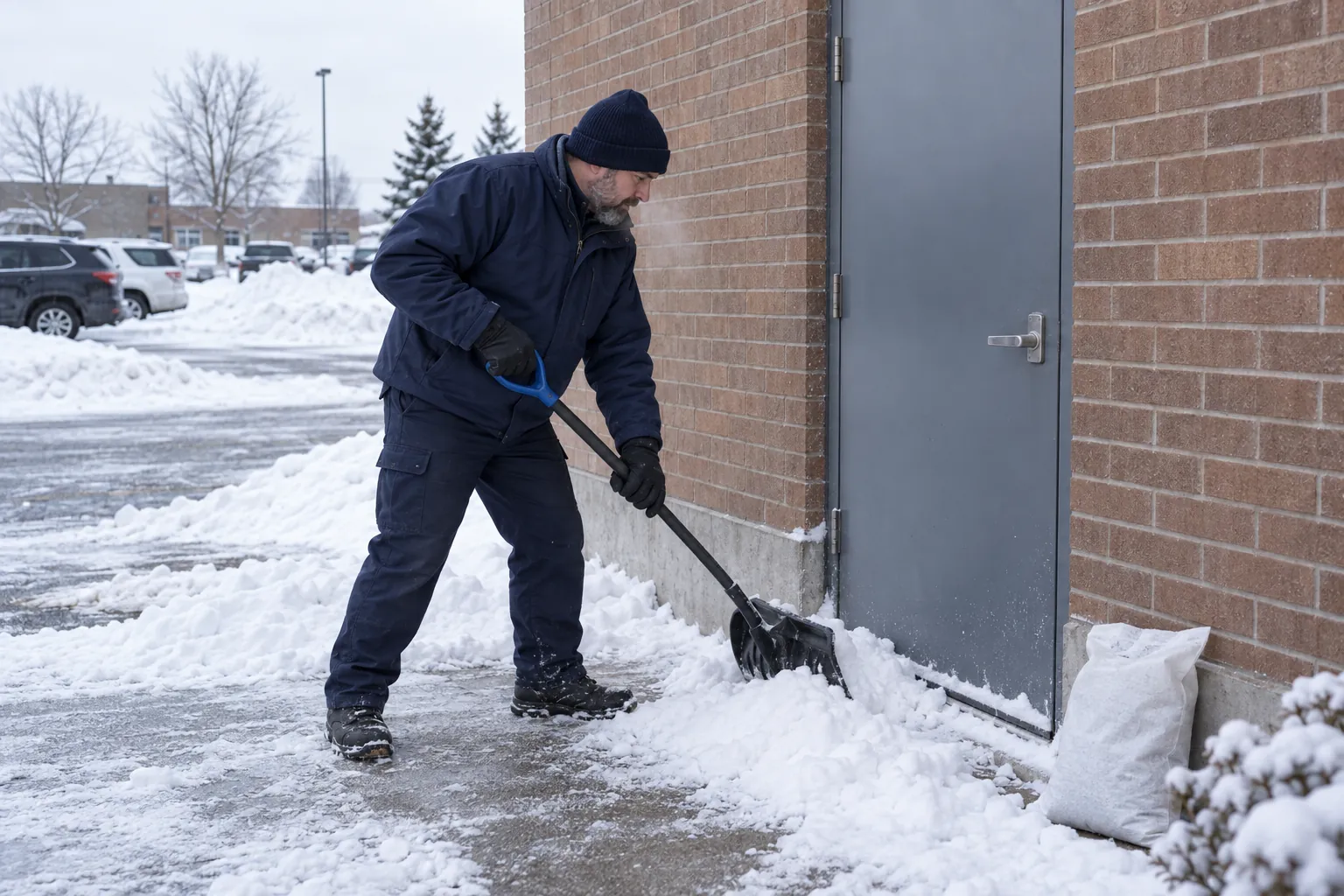
- Entrances and floors: mats flat and not saturated, meltwater and road salt dealt with, no worn carpet or loose tiles. In Ontario, section 11 of Regulation 851 (Industrial Establishments) says a floor or other surface used by any worker shall be kept free of "obstructions", "hazards" and "accumulations of refuse, snow or ice".
- Stairs, aisles and exits: clear and unblocked, handrails secure, exit doors opening freely, exit signs lit.
- Lighting: no dark stairwells, parkade corners or burnt-out lamps; emergency lighting in place and tested.
- Fire safety: extinguishers present and inspected, clear access to extinguishers, hoses and pull stations, fire doors closing and not wedged open, the fire safety plan and emergency procedures current.
- Electrical: damaged cords and plugs, daisy-chained power bars, electrical rooms locked and clear of storage.
- Chemicals: janitorial closets tidy, WHMIS labels on every container including decanted spray bottles, safety data sheets available, incompatible products stored apart.
- First aid: kits stocked to your province's first aid requirements, eyewash stations checked where the workplace has them, first aiders known.
- Violence and other psychosocial hazards: CCOHS lists psychosocial hazards among the areas a checklist covers. Check that reception desks, late-shift routes and lone-working areas still match the workplace violence assessment and the controls your jurisdiction requires.
- Parkades, loading docks and grounds: pedestrian routes, curbs and ramps, snow and ice control, lighting after dark.
- Postings: in Ontario, the Act and the names and work locations of committee members posted, or available in a readily accessible electronic format, as sections 25(2)(i) and 9(32) require.
CCOHS publishes sample checklists, including an Inspection Checklists – Sample Checklist for Offices and a Inspection Checklists – Sample Checklist for Manufacturing Facilities, the office one with questions such as "Are the floors slippery, oily or wet?" and "Are first-aid kits provided as per your jurisdiction's first-aid regulations?" Start from them and add what your own hazard assessments found, including any chemical, noise or manual handling hazard particular to your building. CCOHS also warns against letting the checklist do the looking: do not let the team become "so intent on noting the details listed in the checklist that it misses other hazardous conditions."
03
How often to inspect, and who should do it
For a JHSC in Ontario or a federal work place committee, the minimum is set by law: every month, or part of the workplace every month so that all of it is covered at least once a year. In British Columbia the test is intervals "that will prevent the development of unsafe working conditions", which in practice means more often where the risk is higher. Whatever applies, CCOHS says the schedule should state "when to inspect each area or item within the workplace, who carries out the inspection, what degree of detail to inspect each area or item".
A rolling schedule for a larger building might look like this:
- Every month: one or two floors, plus the entrances, the parkade and whatever has changed since the last walk.
- By season: entrances, mats, walkways and lighting more often through the winter, when snow, ice and early darkness change the hazards.
- Special inspections, after a change or an incident: a renovation, a new tenant, new equipment, an injury or a near miss. British Columbia requires a special inspection "when required by malfunction or accident" (section 3.7).
Who inspects is partly decided by law. In Ontario the worker members designate the inspecting member, a certified member, one who has completed certification training, if possible, and section 9(25) says they need not designate "the same member to perform all inspections". Rotating the inspector helps: fresh eyes see the cable everyone else steps over. Section 9(12) requires at least one certified member representing the employer and one representing workers on the committee, unless a regulation says otherwise.
CCOHS suggests including people who know the regulations, the hazards and the work. If the area's supervisor does not walk with the team, CCOHS says to "consult the supervisor before leaving the area". Fire alarms, sprinklers, elevators and boilers have their own inspections by qualified people; the committee's walk notes what is visible and does not replace them.
04
Recording findings so they get fixed
An inspection is only as good as what happens to its findings. CCOHS suggests a report with a short introduction (area, date, inspectors), then numbered observations, each with:
- The exact location, not "third floor" but "east stairwell, landing between 3 and 4".
- What was found, described plainly. CCOHS says to "Take a photograph if you are unable to clearly describe or sketch a particular situation."
- A priority: CCOHS suggests A for a major hazard needing immediate action, B for a serious one needing short-term action and C for a minor one needing long-term action. Anything that could hurt someone now is made safe during the walk, not written down and left.
- A recommended corrective action.
- A named person responsible and a due date.
- Follow-up: the status at the next inspection, and when it was closed.
In Ontario the inspecting member reports hazards to the committee, and the committee can make written recommendations to the employer under section 9(18). Section 9(20) then requires the employer to "respond in writing within twenty-one days", and section 9(21) says the response must contain "a timetable for implementing the recommendations" it agrees with and reasons for any it does not. The committee must keep minutes "and make the same available for examination and review by an inspector" (section 9(22)). A finding that never reaches the minutes is where programs quietly fail.
CCOHS calls regular inspections "an important part of the overall occupational health and safety program", and their value is in prevention. Before each walk, read the last report and its open items, so the inspection checks whether earlier fixes held. Every few months, look for repeats: the same blocked exit every month points to a storage problem, not a careless worker.

05
Between inspections: hazards, routine checks and shared buildings
A monthly walk sees a building on one day. Hazards appear in between: the leak after a storm, the exit door propped open for a delivery. The law expects those to be reported as they happen. In Ontario, section 28(1)(d) of the Act requires a worker to report "the existence of any hazard of which he or she knows" to the employer or supervisor. In British Columbia, section 3.10 of the OHS Regulation says a person who observes "what appears to be an unsafe or harmful condition or act" must report it "as soon as possible to a supervisor or to the employer".
The committee inspection also does not replace the employer's own routine checks. The employer's general duty in Ontario, under section 25(2)(h), is to "take every precaution reasonable in the circumstances for the protection of a worker", which in practice means routine checks of what changes quickly: winter entrances, washrooms, exit routes and the parkade. In Alberta, the committee reviews "the employer's work site inspection documentation", which only works if those checks are written down.
In a multi-tenant tower or a condominium, the property manager, tenants and janitorial and security contractors each have their own workers and duties. A tenant's JHSC may find a broken stair nosing in a common area it does not control. Agree in advance:
- who receives a hazard found in a common area, and how, for example through the building's maintenance request form;
- which contractor checks which areas, and how often;
- how a near miss reported by one employer's worker reaches the others who share the space, through shared near-miss reporting.
06
Where the record fails, and what SiteClara does about it
Inspection programs rarely fail for lack of a checklist. They fail in the record. The monthly inspection happens, but the report sits in a shared drive and the open items are not chased until the next walk finds them again. The daily checks that should sit between inspections are initialled in advance on a sheet on the back of a door. The hazards noticed by the custodian, the security guard and the building superintendent are mentioned in passing and never reach the committee.
SiteClara records work and reports at the location. A printed QR poster, with an optional NFC tag behind it, sits at each place where checks are scheduled, such as an entrance vestibule, an exit stairwell, a washroom or a janitorial closet. Staff scan or tap on their own phone, with no app to install, and mark the scheduled check done, or explain what stopped them, in their own words. The record carries the location, the time and the named person automatically, with a photograph when the check asks for one. From the same tag, anyone who is allowed to can report a problem, such as a burnt-out exit sign or a blocked fire door, and it goes onto the team's list of jobs until someone closes it.
The supervisor sees the day's checks and the open jobs, adds a note, and approves a daily report that goes to nominated management or client contacts the next morning, showing what was checked, what was reported, what was fixed and what is still open. For a committee preparing its monthly walk, that is a dated list of what was found and fixed since the last one.
07
Questions people ask
What should be included in a workplace safety inspection checklist?
Whatever your workplace actually has. The Canadian Centre for Occupational Health and Safety's Inspection Checklists – General Information lists 22 areas to consider, among them buildings, electrical, fire protection equipment, hazardous products, materials handling, personal protective equipment, walkways and roadways, controls, hygiene and first aid facilities, psychosocial hazards and the effects of climate, and notes that its examples "do not list all possible items." It advises that "It is always good practice to identify hazards and do a risk assessment to help find and prioritize the hazards in your workplace", and that "Whatever the format of the checklist, provide space for the inspectors' signatures and the date."
What are the workplace inspection requirements in Ontario?
A monthly inspection by a designated worker member of the joint health and safety committee, or by the health and safety representative. The Ministry's Guide for health and safety committees and representatives says the workplace "must be inspected at least once a month, unless a different schedule of inspections is ordered by a Ministry of Labour, Immigration, Training and Skills Development inspector or is prescribed in a regulation under the OHSA", or where that is not practical, the whole workplace at least once a year and part of it each month. The worker members choose the inspecting member, a certified member if possible, and the employer must "provide a JHSC with information and assistance the committee requires for the purposes of inspecting the workplace".
What are the different types of workplace inspections?
Besides the planned committee inspection, CCOHS's Effective Workplace Inspections describes ongoing inspections that "Supervisors and workers should conduct" as part of their jobs, pre-operation checks "performed by workers at the beginning of their shift" before using a machine, vehicle or equipment, and periodic inspections, which are "regular, planned inspections of the critical components of equipment or systems that have a high potential for causing serious injury or illness, or are necessary for emergency response." British Columbia's OHS Regulation, Part 3: Rights and Responsibilities adds special inspections "when required by malfunction or accident" (section 3.7).
08
Where to read more, and a list to take away
Start with your own jurisdiction: sections 8 and 9 of Ontario's Act with the Ministry's guide; Part 3 of British Columbia's OHS Regulation and Part 2 of its Workers Compensation Act; Part 2 of Alberta's Act; or sections 135 and 136 of the Canada Labour Code. CCOHS's Effective Workplace Inspections page and sample checklists are the plain-language starting point anywhere in Canada.
Before your next workplace inspection, check that:
- you know which law applies, and whether it requires a committee, a representative or both;
- the inspection schedule is written down and covers every part of the workplace at least once a year;
- the checklist fits the building, including entrances in winter, parkades and janitorial closets;
- every finding has an exact location, a priority, an owner and a due date;
- written recommendations get a written response, in Ontario within 21 days;
- hazards found between inspections are reported, recorded and reach the committee;
- in a shared building, everyone knows who fixes what in the common areas.
Sources
Every document this guide quotes or links to, in the order it first cites them.
- Occupational Health and Safety Act ontario.ca
- Guide for health and safety committees and representatives ontario.ca
- WorkSafeBC's OHS Regulation, Part 3: Rights and Responsibilities worksafebc.com
- Workers Compensation Act, Part 2 bclaws.gov.bc.ca
- Occupational Health and Safety Act, Part 2 search-ohs-laws.alberta.ca
- Canada Labour Code, Part II (section 135) laws-lois.justice.gc.ca
- Section 136 of the Canada Labour Code laws-lois.justice.gc.ca
- Effective Workplace Inspections ccohs.ca
- Inspection Checklists – General Information ccohs.ca
- Regulation 851 (Industrial Establishments) ontario.ca
- Inspection Checklists – Sample Checklist for Offices ccohs.ca
- Inspection Checklists – Sample Checklist for Manufacturing Facilities ccohs.ca
- Multi-workplace joint health and safety committee guidance ontario.ca
Related guides
 Premises and facilities managementNear miss reporting in Canada: what the law asks, and how to make it workWhat a near miss is, which Canadian laws make you report or investigate one (federal, Ontario, BC, Alberta), what a good report holds, and how to act on it.
 Premises and facilities managementSlips, trips and falls: how to prevent them in the buildings you look afterPreventing slips, trips and falls in Canadian buildings: Ontario, BC, Alberta and federal rules, wet floors, winter entrances, stairs and the records to keep.
 Premises and facilities managementMaintenance request forms: what to capture, how fast to answer, and what to keepWhat a maintenance request form should capture, how requests are prioritized and closed, and what Ontario, Toronto and BC rules say about repairs and records.
 Fire and water checksWorkplace fire safety checklist: what to check, how often, and who does it in CanadaA workplace fire safety checklist for Canadian buildings: the daily, monthly and annual checks the fire code sets, who does each one, and what the record shows.