Premises and facilities management
Slips, trips and falls: how to prevent them in the buildings you look after
Slips, trips and falls come from a sudden loss of traction or balance, and most falls happen on the same level rather than from a height: a freshly mopped corridor, a curled entrance mat, meltwater in a winter vestibule, a dark stairwell, a cable across a walkway.
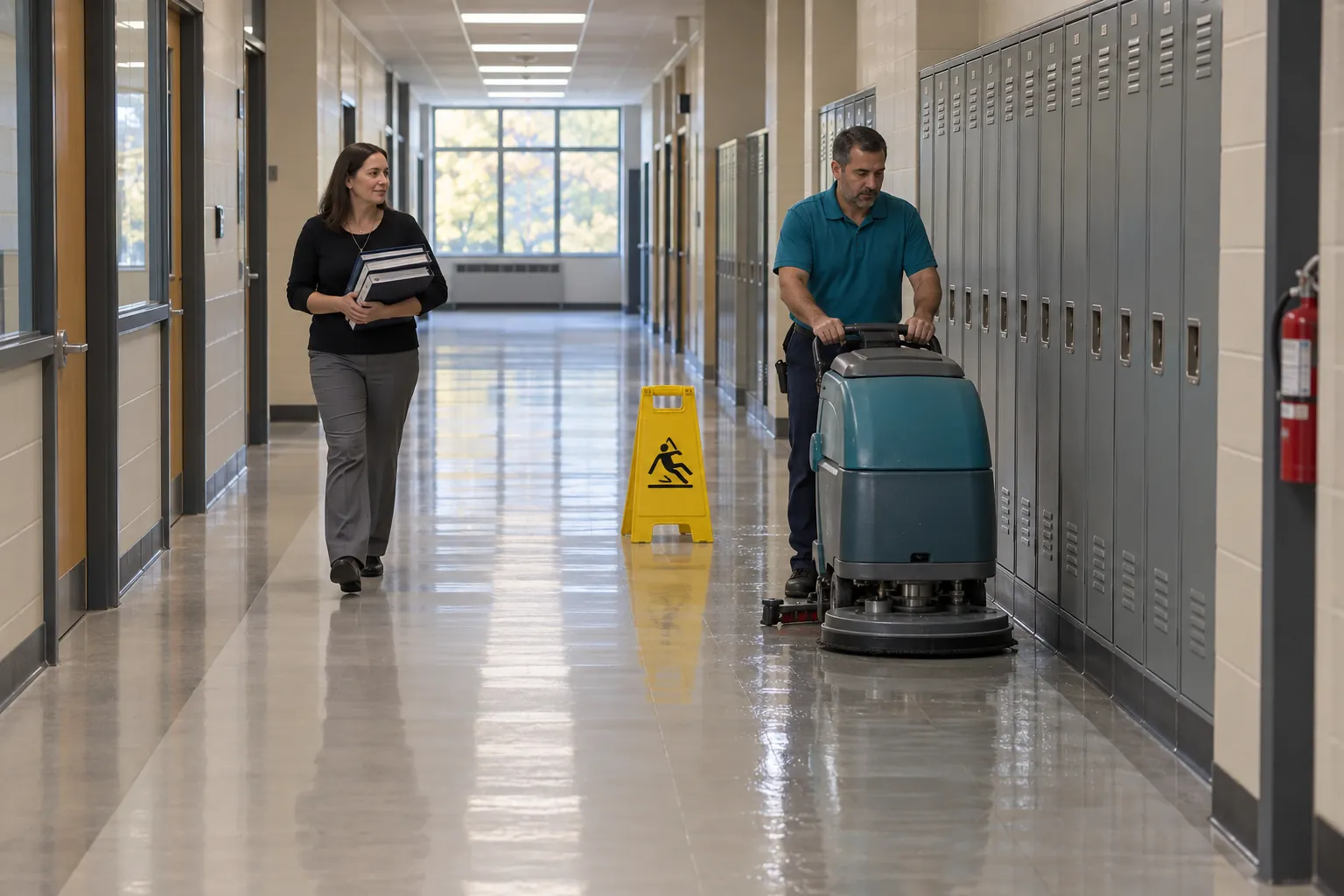
In Canada the duty to control them sits mostly in provincial law, with a separate federal regime for federally regulated work, and a building's occupier also owes visitors a duty of care. This guide covers what the Ontario, British Columbia, Alberta and federal rules say, where falls happen in practice, how janitorial, maintenance and property teams share the work, what to do about snow and ice, and what a useful record looks like.
01
Slips, trips and falls: what the law in Canada expects
The Canadian Centre for Occupational Health and Safety (CCOHS) explains the difference plainly in its OSH Answers page on the prevention of slips, trips and falls. A slip happens when there is too little friction between footwear and the walking surface, typically on "wet or oily surfaces", "occasional spills", "weather hazards" and "loose, unanchored rugs or mats". A trip happens when a foot strikes an object, with causes such as "poor lighting", "clutter in your way", "wrinkled carpeting", "uncovered cables" and "uneven (steps, thresholds) walking surfaces". CCOHS notes that the majority of falls happen on the same level, from slips and trips, rather than from a height.
There is no single Canadian slips, trips and falls law. Workplace health and safety is mostly provincial and territorial; the federal rules apply only to federally regulated work such as banks, airports, telecommunications and interprovincial transport. Each regime has its own words for the same duty:
- Ontario. Section 11 of Regulation 851 (Industrial Establishments) says a floor or other surface used by any worker shall "be kept free of, (i) obstructions, (ii) hazards, and (iii) accumulations of refuse, snow or ice" and "not have any finish or protective material used on it that is likely to make the surface slippery." Section 21 requires artificial lighting where natural lighting is inadequate, with "shadows and glare ... reduced to a minimum." The regulation applies to industrial establishments, which the Occupational Health and Safety Act defines as "an office building, factory, arena, shop or office", so almost every commercial building is one.
- British Columbia. Section 4.39 of the Occupational Health and Safety Regulation, in WorkSafeBC's OHS Regulation, Part 4: General Conditions, says: "Floors, platforms, ramps, stairs and walkways available for use by workers must be maintained in a state of good repair and kept free of slipping and tripping hazards." Section 4.40 deals with liquid that accumulates on a floor from a work process, and section 4.41 says "Refuse, spills and waste material must not be allowed to accumulate so as to constitute a hazard."
- Alberta. Section 185 of the Occupational Health and Safety Code, Part 12: General Safety Precautions says: "An employer must ensure that a work site is kept clean and free from materials or equipment that could cause workers to slip or trip." Section 186(1) requires lighting "sufficient to enable work to be done safely."
- Federally regulated workplaces. Section 2.14 of the Canada Occupational Health and Safety Regulations requires every exterior stairway, walkway, ramp and passageway that employees may use to be "kept free of accumulations of ice and snow or other slipping or tripping hazards", and every travelled surface to be "slip resistant" and "kept free of splinters, holes, loose boards and tiles and similar defects."
Behind the specific rules sits the general duty. In Ontario, section 25(2)(h) of the Occupational Health and Safety Act requires an employer to "take every precaution reasonable in the circumstances for the protection of a worker", and section 28(1)(d) requires a worker to report "the existence of any hazard of which he or she knows".
Workers are not the only people who fall. Members of the public, tenants, students and visitors do too, and their claims are governed by occupiers' liability law, which is also provincial. In Ontario, section 3 of the Occupiers' Liability Act says an occupier "owes a duty to take such care as in all the circumstances of the case is reasonable to see that persons entering on the premises ... are reasonably safe while on the premises", whether the danger comes from the condition of the premises or from an activity carried on there. Other provinces have their own rules, so check the ones that apply to your building.
02
Where slips, trips and falls happen in a building
In the offices, schools, condos, retail units and health-care buildings that janitorial, maintenance and security teams look after, the same places come up again and again. Walk the building with this list and a floor plan to find the fall hazards:
- Entrances and vestibules: meltwater, slush and road salt carried in from October to April, entrance mats that are saturated, curled at the edges or too short for the traffic, and the first few metres of hard floor beyond the mat.
- Washrooms: water around sinks and urinals, overflowing fixtures, and floors mopped while the washroom is still in use.
- Corridors after cleaning: a wet-mopped floor with no sign out, a floor stripped and refinished during the day, or a finish that does not suit the traffic. Ontario's Regulation 851 names that last point directly.
- Stairs and stairwells: worn or damaged nosings, poor lighting, missing or loose handrails, and boxes or chairs stored on landings.
- Lunchrooms, kitchens and cafeterias: spilled drinks and food, grease near cooking areas, and water from dishwashers and ice machines.
- Loading docks, garbage rooms and service corridors: pallets, packaging, leaking bins, hoses and carts left where people walk, each one a tripping hazard.
- Parkades and exterior walkways: ice, snow, drainage that refreezes overnight, potholes, uneven paving stones and dark corners where lights have failed.
Record where each hazard is, not only what it is: "the step outside the north service entrance", not "ice at the back door". A location that keeps appearing is telling you something about drainage, matting, lighting or the cleaning schedule.
03
Housekeeping and floor care: the janitorial side of prevention
CCOHS describes housekeeping as "the first and the most important (fundamental) level of preventing falls". Its list is short and practical: "cleaning all spills immediately", "marking spills and wet areas", "mopping or sweeping debris from floors", "removing obstacles from walkways and always keeping walkways free of clutter", "securing (tacking, taping, etc.) mats, rugs and carpets that do not lay flat", "covering cables that cross walkways", "keeping working areas and walkways well lit" and "replacing used light bulbs and faulty switches".
For a janitorial contractor or an in-house custodial team, that turns into a handful of working rules that reduce the risk:
- Wet work is signed and sectioned. The wet floor sign goes out before the mop touches the floor, one side of a corridor is done at a time, and the sign comes away once the floor is dry, so people keep believing the signs.
- Spills have an owner. Everyone in the building knows how to report a spill, and to stay with it or block it off while waiting.
- The finish suits the floor and the traffic. Follow the manufacturer's instructions, rinse properly, and check whether a floor has become slippery after a change of product.
- Matting is part of the cleaning program. Entrance mats are long enough for the traffic, lie flat and are swapped or extracted when saturated.
- Equipment does not become the hazard. Machine cords are routed away from walkways, and carts and buckets are not left in corridors.
- Defects are reported, not worked around. A lifted tile, a torn carpet seam or a dead light goes to maintenance.
CCOHS adds that better flooring helps, such as mats and abrasive strips, but that "high-tech flooring requires good housekeeping as much as any other flooring." Footwear matters too, particularly for custodians, dock staff and anyone who works outdoors.
04
Snow, ice and winter entrances
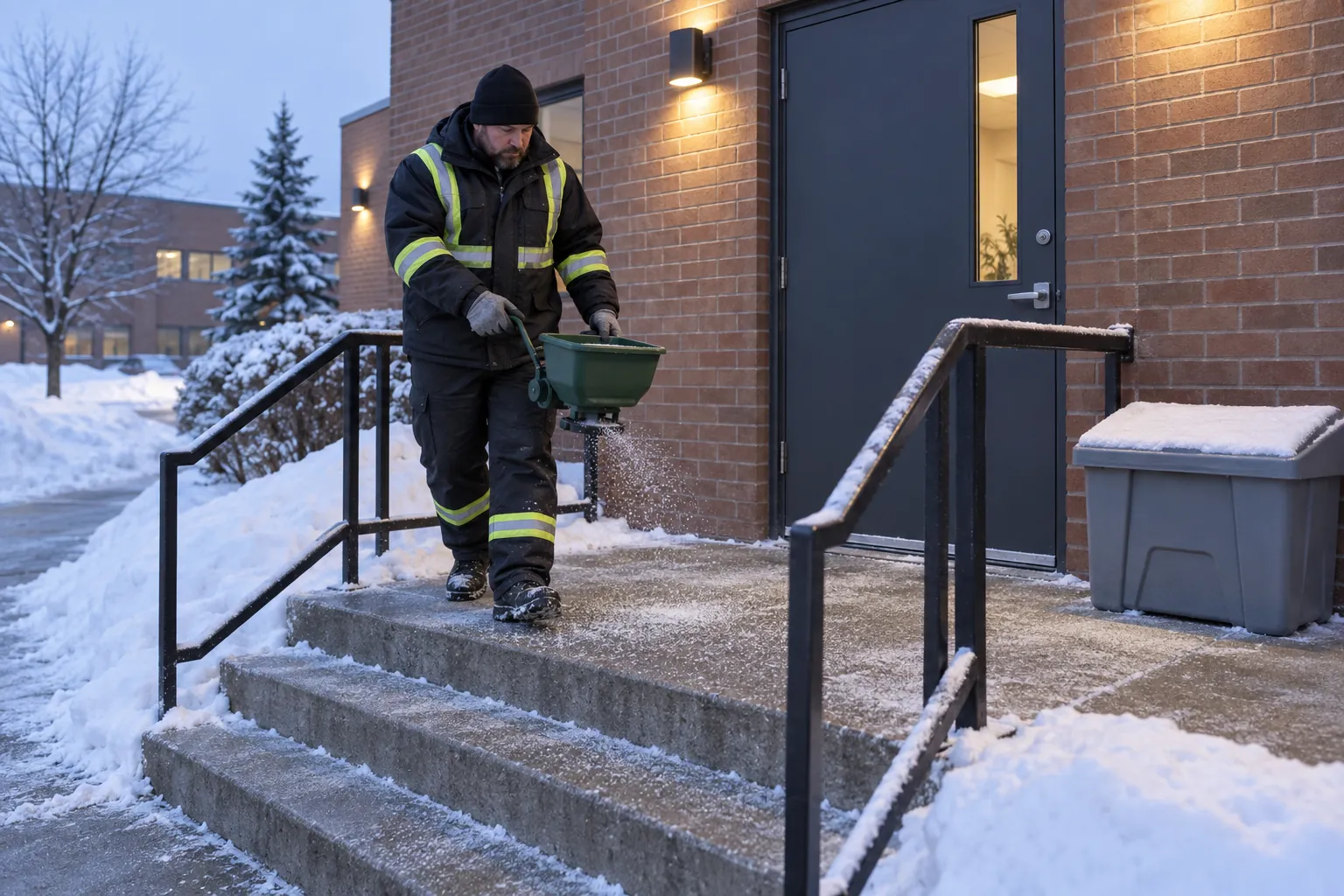
Winter is when most Canadian buildings see their worst slip hazards, and it is where the law is most specific. Ontario's Regulation 851 names "accumulations of refuse, snow or ice" on surfaces used by workers, and section 2.14(1) of the federal regulations names exterior stairways, walkways, ramps and passageways. Between the property manager, the snow and ice contractor, the janitorial crew and the security team, it is easy for everyone to assume someone else has the back door covered. Agree in writing:
- Which areas are whose: parking lots and roadways, sidewalks, exterior stairs and ramps, the first metre inside each entrance, the loading dock and emergency exits, including exit doors that are rarely used but must open onto a clear path.
- What triggers action: an amount of snowfall, a freezing rain warning, a temperature drop after a thaw, or a report from a tenant.
- What is used: salt, sand or other ice melt, where it is stored, and who tops up the bins at each door.
- Indoor follow-up: extra mats, more frequent mopping of vestibules, and wet floor signs out for the day.
- Who checks that the work was done, particularly early in the morning and after hours.
In Ontario, the record matters for a second reason. Since 2021, section 6.1 of the Occupiers' Liability Act has said that no action for personal injury caused by snow or ice may be brought against an occupier, or against an independent contractor employed to remove snow or ice, unless written notice of the claim, "including the date, time and location of the occurrence", is served within 60 days. An occupier who receives the notice must pass a copy to other occupiers and to the snow removal contractor for that period. The notice rule has exceptions, including where a judge finds a reasonable excuse and no prejudice to the defence. It does not decide who is liable, but it does mean the question will usually be about a particular place, date and time, and whoever keeps a dated record of what was done at that place is far better placed to answer it.
That is why so many property managers keep a snow removal log for each site, recording when areas were plowed, shovelled and salted, the conditions and who did the work.
05
Inspections, reporting and what good evidence looks like
Most slip and trip hazards are found by people walking past them. Three routines do most of the work.
Routine checks at known risk points. Entrances, washrooms, stairwells and lunchrooms are checked at set times, more often in bad weather, by whoever owns the area: floor dry, mats flat, signs where needed, lights working, nothing in the walkway. No law sets the frequency, so write it down and base it on the traffic.
Workplace inspections. In Ontario, the joint health and safety committee members who represent workers designate one of their number to inspect the workplace (section 9(23) of the Occupational Health and Safety Act), and section 9(26) requires that member to "inspect the physical condition of the workplace at least once a month", unless the regulations or an inspector's order say otherwise. Where that is not practical, section 9(27) allows the whole workplace to be inspected at least once a year, with part of it inspected each month. Other provinces have their own committee and representative inspection duties. Floors, stairs, lighting and housekeeping belong on every inspection; see the guide to the JHSC workplace inspection.
Stairways, specifically. CCOHS's page on stairways and fall prevention recommends lighting "at the minimum 50 lux level" and says "Spills, wet spots, or any debris should be immediately cleaned up." Check that handrails are secure, nosings are intact and landings are not used as storage.
Reporting and follow-up. Every reported hazard, fall, injury or near miss should become a job with an owner, a location and a time, open until someone confirms the fix; the guide to near miss reporting covers the report itself. A leaking roof drain mopped every morning for three weeks is being worked around, not managed. Send repairs through the building's maintenance request form.
Whatever the routine, good evidence answers the same questions:
- where exactly the check or the hazard was, by named location;
- when it happened, and when it was put right;
- who did the check or made the report, by name;
- what was found and what was done, with a photograph when the condition matters, such as ice on a step or a torn mat;
- whether a check was missed, and why, recorded at the time;
- who was told, if the hazard belonged to someone else, such as a landlord, a tenant or the snow contractor.
06
Where the record fails, and what SiteClara does about it
Slip and trip prevention rarely fails for lack of a policy. It fails in the gaps between people. The sheet on the back of the washroom door is initialled for the whole shift at once. The vestibule is "checked hourly" on paper while the mat has been saturated since the storm began. The loose stair nosing is mentioned to whoever was passing and never reaches maintenance. And when a notice of claim arrives, nobody can say what was done at that door, on that morning, and by whom.
SiteClara records work and reports at the location. A printed QR poster, with an optional NFC tag behind it, sits at each place where checks are scheduled, such as an entrance vestibule, a washroom, a stairwell or a loading dock. Staff scan or tap on their own phone, with no app to install, and mark the scheduled check done, or explain what stopped them, in their own words. The record carries the location, the time and the named person automatically, with a photograph when the check asks for one. From the same tag, anyone who is allowed to can report a problem, such as a curled mat or a dead stairwell light, and it goes onto the team's list of jobs until someone closes it.
The supervisor sees the day's checks and the open jobs, adds a note, and approves a daily report that goes to nominated management or client contacts the next morning, showing what was checked, what was reported, what was fixed and what is still open. For slips, trips and falls, that turns "the entrance is checked hourly" into a dated list of checks at a named door, and turns "I told someone about the stair" into a job with a time and a name.
07
Questions people ask
What's the difference between slips, trips and falls?
CCOHS's OSH Answers page on the prevention of slips, trips and falls says slips "happen where there is too little friction or traction between the footwear and the walking surface", and trips "happen when your foot collides (strikes, hits) an object causing you to lose balance and, eventually fall." A fall is where either one ends, and the same page says that 67% of falls happen on the same level from slips and trips, with the remaining 30% falls from a height.
What are the main causes of slips, trips and falls?
The same CCOHS page on the prevention of slips, trips and falls lists the causes of slips as wet or oily surfaces, occasional spills, weather hazards, loose or unanchored rugs and mats, and flooring without the same degree of traction throughout. It lists the causes of trips as an obstructed view, poor lighting, clutter in the way, wrinkled carpeting, uncovered cables, bottom drawers left open and uneven walking surfaces.
What are the key control measures for preventing slips and falls?
CCOHS, in its OSH Answers on the prevention of slips, trips and falls, says "good housekeeping, quality of walking surfaces (flooring), selection of proper footwear, and appropriate pace of walking are critical for preventing fall incidents." Housekeeping comes first: clean spills at once, sign wet areas, keep walkways clear and well lit, and secure mats that do not lie flat.
Is there a Canadian equivalent of the OSHA standard for slips, trips and falls?
OSHA is the United States regulator, and its standards do not apply in Canada. Most Canadian workplaces follow their province's or territory's occupational health and safety law, and federally regulated workplaces follow section 2.14 of the Canada Occupational Health and Safety Regulations, which says every exterior stairway, walkway, ramp and passageway employees may use "shall be kept free of accumulations of ice and snow or other slipping or tripping hazards" and every travelled surface shall be "slip resistant".
08
Where to read more, and a list to take away
For free resources, start with CCOHS's OSH Answers on the prevention of slips, trips and falls, then read the rules for your own jurisdiction: in Ontario, Regulation 851 (Industrial Establishments) and the Occupiers' Liability Act; in British Columbia, Part 4 of the OHS Regulation; in Alberta, Part 12 of the OHS Code; for federally regulated work, the Canada Occupational Health and Safety Regulations. Elsewhere, go to your own province's or territory's regulator; in Quebec, that is the CNESST.
Before you rely on your slip, trip and fall prevention, check that:
- you know which law applies to each employer in the building, provincial or federal, and which occupiers' liability rules apply to visitors;
- every high-risk location, such as entrances, washrooms, stairwells, lunchrooms and docks, is on a list with an owner and a written check frequency;
- wet floor signs go out before mopping and come back once the floor is dry;
- entrance mats are the right length, lie flat and are changed when saturated;
- the snow and ice contract says which areas are whose, what triggers action and who checks it was done;
- every reported hazard becomes a job with an owner and a date, closed with evidence;
- missed checks are recorded with the reason at the time, not explained later;
- the joint health and safety committee or representative sees the falls, near misses and repeat locations at every meeting.
Sources
Every document this guide quotes or links to, in the order it first cites them.
- Prevention of slips, trips and falls ccohs.ca
- Regulation 851 (Industrial Establishments) ontario.ca
- Occupational Health and Safety Act ontario.ca
- WorkSafeBC's OHS Regulation, Part 4: General Conditions worksafebc.com
- Occupational Health and Safety Code, Part 12: General Safety Precautions search-ohs-laws.alberta.ca
- Canada Occupational Health and Safety Regulations laws-lois.justice.gc.ca
- Occupiers' Liability Act ontario.ca
- Stairways and fall prevention ccohs.ca
Related guides
 Premises and facilities managementNear miss reporting in Canada: what the law asks, and how to make it workWhat a near miss is, which Canadian laws make you report or investigate one (federal, Ontario, BC, Alberta), what a good report holds, and how to act on it.
 Premises and facilities managementSnow removal log: what to record, when, and why it mattersWhat a snow removal log should record, when to make entries, who keeps it, and how Ontario's 60-day notice rule for snow and ice claims makes the log count.
 Premises and facilities managementWorkplace inspection checklist: how a JHSC inspection should workA workplace inspection checklist for Canadian JHSCs and representatives: Ontario, BC, Alberta and federal rules, what to walk, how often and what to record.
 Premises and facilities managementMaintenance request forms: what to capture, how fast to answer, and what to keepWhat a maintenance request form should capture, how requests are prioritized and closed, and what Ontario, Toronto and BC rules say about repairs and records.