Premises and facilities management
Near miss reporting in Canada: what the law asks, and how to make it work
A near miss is an unplanned event at work that could have injured someone or damaged something but did not: the fall that did not happen, the ceiling tile that landed on an empty desk, the cleaning cart that rolled down a ramp with nobody at the bottom.
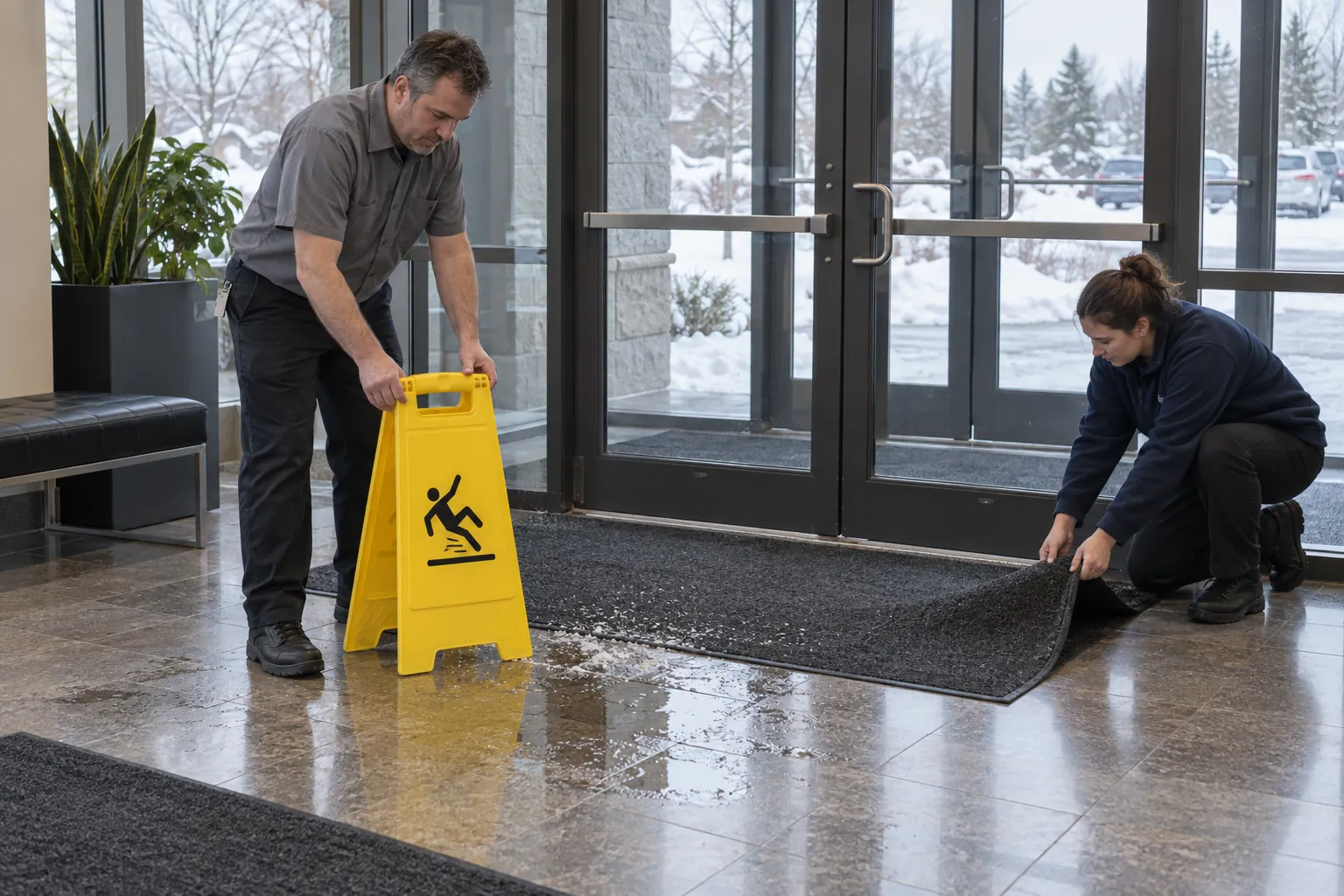
It costs nothing, which is why it is so often forgotten. In Canada some near misses must be investigated by law, depending on your province and whether your workplace is federally regulated. This guide covers what counts as a near miss, what the federal, Ontario, British Columbia and Alberta rules require, what a useful report holds, and how to make sure the hazard is actually fixed.
01
What a near miss is, and where the duty comes from
The Canadian Centre for Occupational Health and Safety (CCOHS) defines an incident, in its OSH Answers page on incident investigation, as "an occurrence arising out of or in the course of work that resulted in or could have resulted in injuries, illnesses, damage to health, fatalities, or material damage." It adds that "'near miss' or 'dangerous occurrence' are also terms for an event that could have caused harm but did not." A near miss, in other words, is an incident in every sense except the outcome.
That matters because there is no single Canadian near miss law. Workplace health and safety is mostly provincial. Each province and territory has its own act and regulations, and the federal rules apply only to federally regulated work such as banks, airports, telecommunications and interprovincial transport. So the first question for any building is which regime applies: a facilities team in a Toronto office tower works under Ontario law, while the same tower's federally regulated bank tenant runs its own employees under the Canada Labour Code, Part II.
What the regimes share is a general duty. In Ontario, section 25(2)(h) of the Occupational Health and Safety Act requires an employer to "take every precaution reasonable in the circumstances for the protection of a worker", and section 28(1)(d) requires a worker to report "any hazard or contravention of the Act or regulations to the employer or supervisor", as set out in the province's Guide to the Occupational Health and Safety Act. A near miss is the plainest possible evidence of a hazard. Once someone has seen it, the employer knows about it, and a reasonable precaution is expected to follow.
02
What counts as a near miss in a building
In the buildings that facilities, janitorial and security teams look after, near misses are ordinary and frequent. The ones worth reporting are those where a small change in timing or position would have meant an injury or damaged equipment. Typical examples:
- Slips and trips: a custodian slides on a freshly mopped floor with no wet floor sign out, a visitor catches a foot on a lifted mat at the entrance, meltwater and salt pool inside a vestibule in January.
- Falling objects: a ceiling tile, light diffuser or unsecured box drops into an area people use, or a pallet load shifts in a loading dock.
- Ladders and height: a stepladder shifts on a polished floor while someone changes a lamp, or a guard rail on a mezzanine turns out to be loose.
- Chemicals: two cleaning products mixed in the wrong bottle, an unlabelled spray container, a splash that missed someone's eyes.
- Electrical: a scorched receptacle, a floor machine cord with damaged insulation, a panel door left open in a public corridor.
- Vehicles and parking: a snowplow reversing close to someone on foot, a delivery truck backing towards a dock with nobody guiding it, a pedestrian crossing an underground garage ramp at speed.
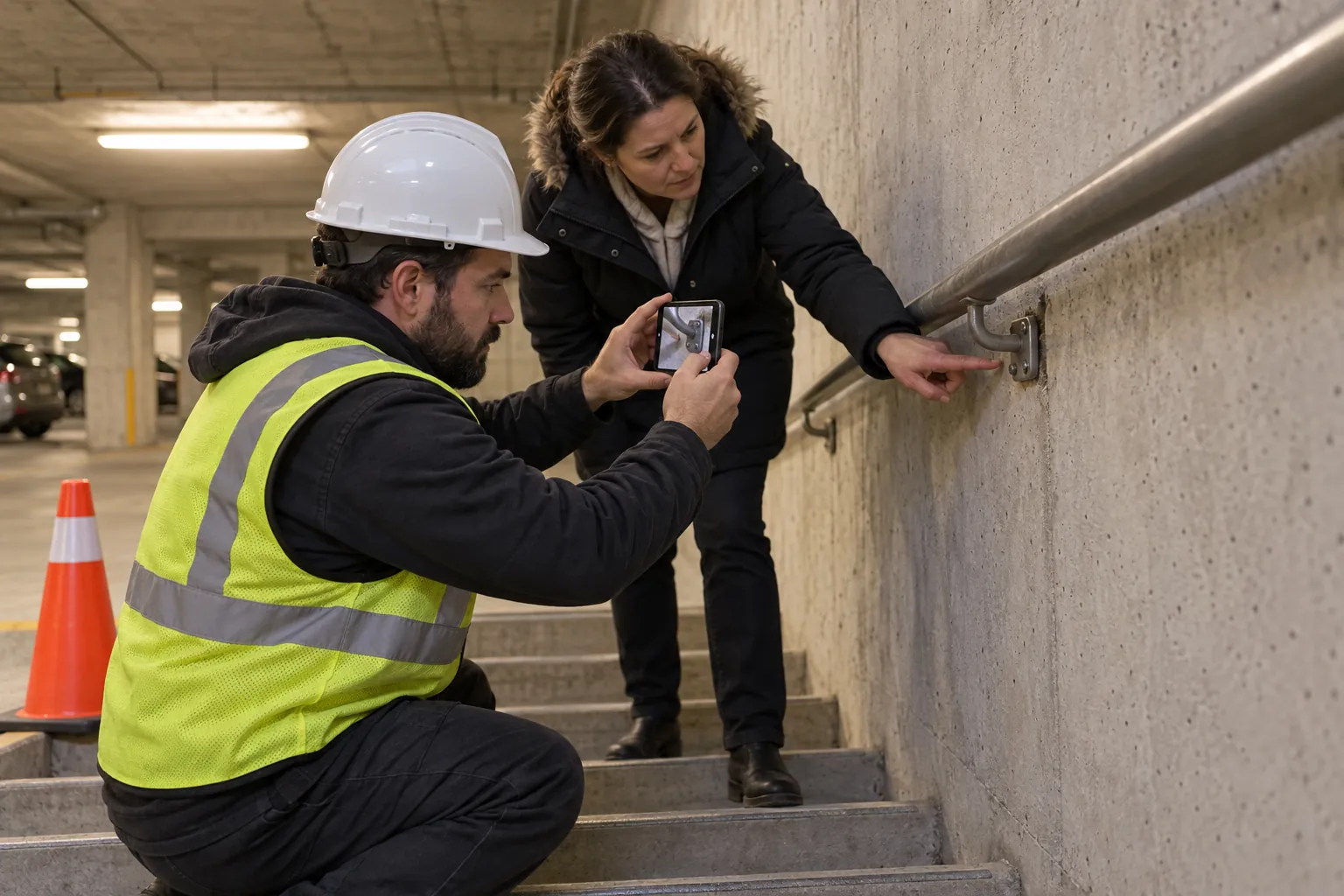
A near miss is different from an unsafe condition noticed on an inspection, although the two lead to the same place. The loose stair nosing found on a walk-through is a hazard; the loose stair nosing that tipped someone forward is a near miss. Both should be reported, and both should be fixed.
Near misses involving people who are not workers, such as tenants, students, shoppers or visitors, matter too. Alberta's guidance on reporting potentially serious incidents says that a potentially serious incident "is not limited to workers", and counts one involving someone else if it resulted from work activities at the work site or could have happened to a worker.
03
What the law requires, jurisdiction by jurisdiction
The rules below are those that name near misses or incidents without injury. Read your own act and regulations, because details change and every province also has reporting rules for injuries, critical injuries and deaths that sit alongside these.
Other provinces and territories have their own wording. Where a statute requires a specific investigation report, that report, on the form or in the manner the regulator sets, is the legal record. Anything else you keep, from a notebook to an app, is the working record that helps you find and fix the hazard.
04
What a good near miss report holds
A near miss report is short. If it takes ten minutes to fill in, people will stop filling it in. The best forms ask for the facts while they are fresh and leave the analysis for the investigation. A useful near miss form records:
- Where: the building, floor and exact location, specific enough that someone else can walk to it. "Parkade" is not enough; "P2, the ramp up from the east exit" is.
- When: the date and time it happened, and when it was reported, if later.
- What happened: a plain description of the event, and what could have happened.
- Who was involved or saw it: by name where they agree, or by role. Section 70 of BC's act requires the employer to record the names, addresses and telephone numbers of witnesses made available for an investigation.
- A photograph of the hazard, taken before anything is moved, if it is safe to do so. CCOHS advises including "all relevant details, including photographs and diagrams" in an investigation report.
- Immediate action: what was done on the spot, such as a cone put out, an area taped off or a machine taken out of service.
- Who it was reported to, and when.
The investigation then adds the parts the reporter should not be asked to supply: the causes, the unsafe conditions, acts or procedures that contributed, the corrective action decided, who owns it, the date it is due and the date it was done. BC's sections 71 and 72 and Alberta's section 33(6) both centre the report on causes and corrective action, which is a good model even where the law does not require it.
Keep the report blame-free in tone. CCOHS puts the main reason for investigating first: "to find out the cause of incidents and to prevent similar incidents in the future". Look for the unsafe condition, the missing procedure or the rushed task, not the person who happened to be standing there. A blame-free culture is also what encourages people to keep reporting near misses: training on what to report raises awareness, but one reprimand for an honest report can undo it.
05
From report to fix: who does what
A near miss program lives or dies on what happens after the report. Most workers will report once. Whether they report a second time depends on whether anything changed after the first. A working process looks like this:
- Make the area safe. Whoever finds it puts out a sign, cones or tape, or stops the task, then reports it. This is the one step that cannot wait.
- Report the same shift. To the supervisor, in the way the site has agreed. Federal rules say "without delay"; that is a good standard for everyone.
- Decide the level of response. The supervisor judges whether the event had potential for serious injury. If it did, and you are in BC, Alberta or a federal workplace, the investigation duties above apply. If not, it still needs a fix.
- Raise the fix as a job. The stair nosing, the dock light or the loose rail becomes a maintenance request with an owner and a due date. A near miss that stays on a report form and never becomes a work order has not been dealt with.
- Close it with evidence. A photograph of the repaired nosing, or a note of the changed procedure, with the date and who did it.
- Tell people. Let the reporter know what was done. Bring the month's near misses to the joint health and safety committee or health and safety representative, who can spot patterns a single report never shows.
Supervisors in janitorial and security contracts often sit in the middle. The hazard is in the client's building, the worker is theirs, and the fix is the property manager's. The contract should say that the provider's supervisor passes near misses about the building to the site's facilities contact the same day, and that the property manager tells the provider when the fix is done. Otherwise every party assumes someone else has it.
Watch for the near miss that repeats. Three reports of slipping at the same entrance in one winter are not three separate events; they are one hazard that the matting, snow clearing or salting plan has not controlled. Looking at the reports by location, month by month, is often more useful than any single investigation, and it is how near misses reduce the risk of accidents rather than only recording them.
06
Where near miss reporting fails, and what SiteClara does about it
Near miss programs rarely fail for want of a form. They fail because reporting is slow, because the report is detached from the place, and because nobody can see whether the fix happened. The usual pattern: a custodian mentions the wobbly handrail to whoever is passing, it goes into a notebook or a group chat, and a month later nobody can say who was told, where exactly it was, or whether it was repaired. The next committee meeting sees a total, not a list of hazards with owners.
SiteClara records work and reports at the location. A printed QR poster, with an optional NFC tag behind it, sits at each place where checks are scheduled, such as a washroom, an entrance, a loading dock or a stairwell. Staff scan or tap on their own phone, with no app to install, and can report a problem there, with a photo when one helps. The report carries the location, the time and the named person automatically, and goes onto the team's list of jobs until someone closes it. The same tag is where the scheduled checks at that location are marked done, or explained when something stopped them.
The supervisor sees the open jobs and the day's checks, adds a note and approves a daily report that goes to nominated management or client contacts the next morning, showing what was reported, what was completed and what is still open. For a near miss, that turns "I told someone" into a dated report at a known location, and turns "it was fixed" into a closed job with a time and a name.
07
Questions people ask
What is considered a near miss?
An event at work that could have caused harm but did not. CCOHS, in its OSH Answers page on incident investigation, notes that those who distinguish an incident from an accident use incident for "an unexpected event that did not cause injury or damage at that time but had the potential". Alberta's guidance on reporting potentially serious incidents suggests a practical test: look at the actual circumstances, the hazards and controls in place, and the "slightly different circumstances (timing, distance, body position, etc.) that may have resulted in a serious injury".
What is the difference between a near miss and an accident?
The outcome. CCOHS's page on incident investigation defines an accident as "an unplanned event that interrupts the completion of an activity, and that may (or may not) include injury or property damage", while a near miss did not cause harm but could have. CCOHS's own definition of an incident covers both, and it notes the argument that the word accident implies the event was related to fate or chance, when "many events were predictable and could have been prevented if appropriate actions were taken". It adds that the same investigation steps apply to near misses "as a way to prevent another incident".
What is another word for a near miss?
Canadian guidance and law use several. CCOHS's page on incident investigation says "near miss" or "dangerous occurrence" are both used, the Canada Labour Code, Part II speaks of "hazardous occurrences", and Alberta calls an incident that was likely to cause serious injury or illness a "potentially serious incident", as its guidance on reporting potentially serious incidents explains.
08
Where to read more, and a list to take away
CCOHS explains how to run an investigation, who should take part and what the report should include in its OSH Answers page on incident investigation. For federally regulated work, read Part XV of the Canada Occupational Health and Safety Regulations. In British Columbia, Division 10 of the Workers Compensation Act, Part 2 sets the investigation timetable. In Alberta, read section 33 of the Occupational Health and Safety Act and the province's guidance on potentially serious incidents. In Ontario, start with reporting workplace incidents and illnesses and the Guide to the Occupational Health and Safety Act. Elsewhere, go to your province's or territory's own regulator.
Before you rely on your near miss reporting, check that:
- you know which law applies to each employer in the building, provincial or federal;
- workers know what a near miss is, with examples from your own building;
- reporting takes a couple of minutes and can be done at the place it happened;
- every report records the exact location, the time and who reported it;
- a supervisor decides the same day whether it had potential for serious injury, and whether an investigation is legally required;
- every hazard becomes a job with an owner and a due date, closed with evidence;
- shared areas have an agreed owner between landlord, contractors and tenants;
- the reporter hears what was done;
- the joint health and safety committee or representative sees the near misses, by location, at every meeting.
Sources
Every document this guide quotes or links to, in the order it first cites them.
- Incident investigation ccohs.ca
- Canada Labour Code, Part II laws-lois.justice.gc.ca
- Guide to the Occupational Health and Safety Act ontario.ca
- Reporting potentially serious incidents alberta.ca
- Canada Occupational Health and Safety Regulations laws-lois.justice.gc.ca
- Workers Compensation Act, Part 2 bclaws.gov.bc.ca
- Occupational Health and Safety Act search-ohs-laws.alberta.ca
- Reporting workplace incidents and illnesses ontario.ca
Related guides
 Premises and facilities managementWorkplace inspection checklist: how a JHSC inspection should workA workplace inspection checklist for Canadian JHSCs and representatives: Ontario, BC, Alberta and federal rules, what to walk, how often and what to record.
 Premises and facilities managementSlips, trips and falls: how to prevent them in the buildings you look afterPreventing slips, trips and falls in Canadian buildings: Ontario, BC, Alberta and federal rules, wet floors, winter entrances, stairs and the records to keep.
 Premises and facilities managementMaintenance request forms: what to capture, how fast to answer, and what to keepWhat a maintenance request form should capture, how requests are prioritized and closed, and what Ontario, Toronto and BC rules say about repairs and records.
 Premises and facilities managementBuilding compliance checklist: the legal picture for a Canadian buildingA building compliance checklist for Canadian commercial buildings: fire code, OHS, asbestos, elevators, boilers, accessibility and energy, who holds each duty.