Security patrols
Security guard notes: how to keep a notebook that stands up
Security guard notes are a guard's own timed record of the shift, written in a notebook as things happen, of what the guard saw, heard and did.

They are the one record written at the time by the person who saw events, and every report, pass-down log and statement that follows is built from them. When a matter reaches a supervisor, an insurer, the police or a court, the notes are often the first thing asked for. This guide covers what Canadian training and provincial security law say about notes, what to record on a shift, the rules for writing entries that hold up, and how the notebook fits with the site's other records.
01
What a security guard's notebook is, and what the law says about it
A security guard's notebook is the guard's own running record of the shift: a small bound book, or a company device, in which the guard writes what they saw, heard and did, in time order, as it happens. Canadian sites call it the notebook, the duty book, the officer's notes or simply security guard notes. Unlike the shared logs at the desk, it belongs to one guard and goes with them around the site.
Private security is licensed by the provinces and territories, so the rules come from where the guard works. In Ontario, the Private Security and Investigative Services Act, 2005 (PSISA) licenses security guards and the businesses that employ them. It makes compliance with the code of conduct set by regulation a condition of every licence. A notebook entry that is invented, altered afterwards or written to cover a patrol that never happened is a question of conduct, not only of paperwork.
No Ontario statute prescribes a notebook format, but note-taking is part of the mandatory basic training. The ministry's Training Syllabus for Security Guards sets a minimum of 40 hours of in-class time (33.5 hours where Emergency Level First Aid certification is not included), and its Section 4: Report Writing requires trainers to cover "how to record relevant factual data and circumstances in a notebook" and "the importance of using a notebook and the rules and format for taking accurate notes". The same section lists the legal implications of reports, "necessary for audits or evidence in court", and the need to incorporate "who, what, where, when, why and how". Security guard training also covers force: Section 11: Use of Force Theory teaches the authority to use force under the Criminal Code and the National Use of Force Model, modified for security guards, so a note of any force used should record what the guard saw, what they did and why.
Other provinces put record-keeping duties on the security business rather than on the guard's notebook itself:
- British Columbia. Section 7 of the Security Services Regulation (B.C. Reg. 207/2008) requires a security business to keep records including each security worker's "dates and hours of work", client contracts and use-of-force reports, and to retain them "for at least 2 calendar years".
- Alberta. Section 12 of the Security Services and Investigators Regulation (Alta. Reg. 52/2010) requires a business licensee to keep records "stating the locations where each individual licensee employed by the business licensee was employed, including the locations where each individual licensee provided security services", and to keep them for at least two years, or until any investigation, complaint or proceeding they relate to has concluded. The same section requires investigators, though not guards, to keep "all notes and reports" for at least two years.
Those records are built from what guards write on shift. Quebec and the other provinces and territories set their own rules, so check the province first. In practice the employer's procedures and the site's post orders decide what kind of notebook is used, what goes in it, who owns it and how long it is kept.
02
What to write in a security guard's notebook
The post orders set out the guard's duties and responsibilities and the procedures to follow at the site, and they should say what needs to be recorded. A typical list for a shift on a Canadian office tower, condo, hospital, warehouse or construction site is:
- The start of the shift: the date, the site, the post, the time on duty, and the guard's name and licence number.
- The pass-down: what the outgoing guard handed over, such as open issues, keys and access cards out, contractors still on site, alarms in trouble or doors that will not secure.
- Patrols: the time each round started and finished, the route or area covered, and anything found: an unlatched exit door, a propped stairwell door, water on a parkade ramp, a light or camera not functioning properly, a snowbank blocking a fire exit.
- Alarms and access control systems: fire alarm and intrusion alarm activations, door-forced and door-held alerts from the access control system, the cause if known and what was done.
- People: trespassers, disturbances, persons refused entry, lost or found persons, with a description, their exact words where they matter, and what the guard said and did.
- Calls and instructions: contact with the supervisor, dispatch, the client or the police, with the time and the name of the person spoken to.
- Emergency services: in an emergency situation, the time they were called, the time they arrived, the names and badge numbers of the police officers or unit numbers of other responders, and any occurrence or file number given.
- Hazards and faults: what was found, where, when, and who it was reported to. A hazard noted but not passed on helps nobody.
- Incidents: the time and a short summary, with a reference to the separate incident report.
- Routine duties the post orders require, and supervisor visits.
- The end of the shift: what was passed to the relieving guard, the time off duty, and the guard's signature.
For a person, record what can be checked later: approximate age, height, build, clothing from head to foot, direction of travel. For a vehicle, record the colour, make, licence plate and province. Write exact words in quotation marks and say who said them.
The test: could someone who was not there read the entries and know what happened, in what order, and what is outstanding?
03
The rules for writing notes that hold up
Notebooks are read by people looking for gaps and changes. These long-standing best practices exist to make entries easy to follow and hard to alter, and the employer's procedures should set them out:
- Write at the time, or as soon as practicable after. Notes made during or immediately after an event carry weight; notes written at the end of the shift from memory carry much less. If an entry is written later, say so and record when it was written.
- Use a bound book with numbered pages that cannot be removed without it showing. Never tear out a page, even a spoiled one.
- Write in ink, legibly, and never use correction fluid or tape. Correct a mistake with a single line through it so it can still be read, and initial the correction.
- Date every page and put a time against every entry, using the 24-hour clock.
- Keep it in order. Do not leave blank lines or spaces to fill in later. Draw a line through unused space at the end of an entry or a shift.
- Record facts, not opinions. Write what was seen, heard and done. "Male, approx. 30, shouting and swearing at the concierge" is evidence; "aggressive drunk" is a conclusion. Where an opinion is needed, give the facts it rests on.
- Answer who, what, where, when, why and how, the six questions the Ontario syllabus sets for report writing.
- Sign off each shift with the time and signature, and have the supervisor sign and date it when they review it.
Many employers now issue a phone or tablet in place of a paper book. The same rules apply: the entry is made at the time, it records who made it, and a correction leaves the original visible.
04
The notebook as evidence: court, arrests and business records
Guards are witnesses. A trespass, a theft or an assault on a guarded site can lead to a charge, a civil claim or a tribunal hearing long after the shift, and the notebook is what the guard relies on and what the other side asks to see.
Criminal law is federal in Canada, and for criminal proceedings and federal matters the Canada Evidence Act sets several rules that bear directly on notes:
- Section 10 allows a witness to be cross-examined "as to previous statements that the witness made in writing", and the judge may require "the production of the writing" for inspection.
- Section 30 admits a record "made in the usual and ordinary course of business" as evidence of what it contains. Section 30(2) goes further: where such a record does not contain information "the occurrence or existence of which might reasonably be expected to be recorded in that record", the court may infer "that the matter did not occur or exist". A patrol, a call or an alarm missing from the book can count against the guard as well as for them.
- Sections 31.1 to 31.3 deal with electronic documents. The person relying on one must prove it "is that which it is purported to be", and the best evidence rule is met on proof of "the integrity of the electronic documents system" in which it was recorded or stored. For an electronic notebook, that means the system has to show who wrote each entry and when, and that it was not changed afterwards.
Civil matters under provincial law are governed by the province's own rules of evidence. The practical lesson is the same everywhere: complete, timely, unaltered notes are believed; gaps, rewrites and entries made up afterwards are not.
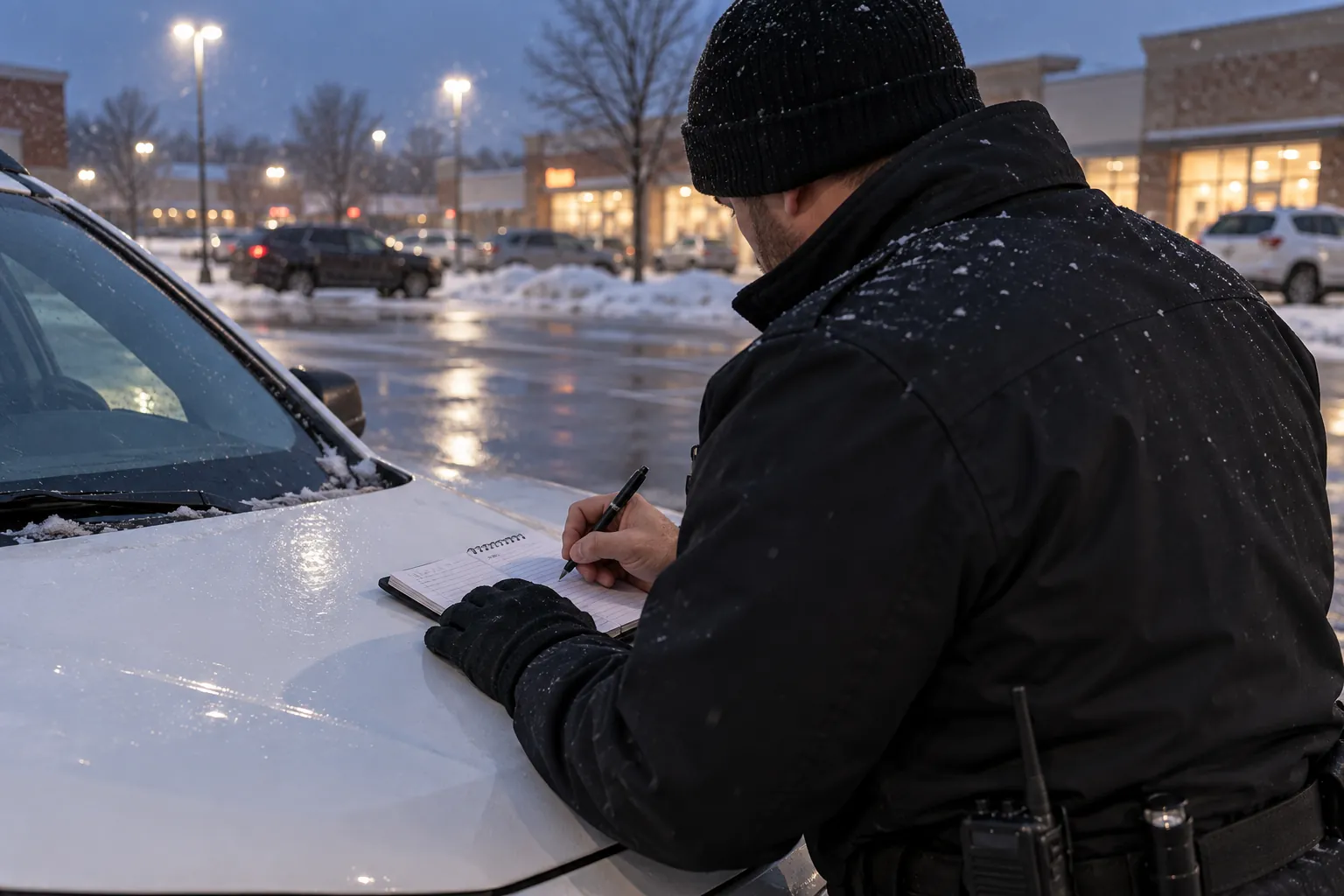
Arrests call for the most careful notes of all. Under section 494 of the Criminal Code, anyone may arrest without warrant a person they find committing an indictable offence, and the owner or person in lawful possession of property, or a person they authorize, may arrest someone found committing a criminal offence on or in relation to that property, either at the time or within a reasonable time after where it is not feasible for a peace officer to do it. Section 494(3) requires anyone other than a peace officer who makes an arrest to "forthwith deliver the person to a peace officer". A guard who arrests someone should record the grounds they saw, the time, what was said, any force used, when police were called and when the person was handed over, with the officer's badge number. Many employers do not allow guards to arrest at all; the post orders decide.
05
The notebook, the other records, and privacy
The notebook is the raw record. The site's other records are written from it or point to it:
- The daily activity report (DAR): a summary of the shift for the supervisor or the client, written from the notebook.
- The incident or occurrence report: a separate, detailed account of one event, such as an injury, a theft, a disturbance or a flood. The notebook entry gives the time and a summary and refers to the report.
- The pass-down log: what the next shift needs to know, kept at the post rather than in the guard's pocket.
- Patrol records: where a guard tour system or checkpoint scans are used, they show where the guard was and when; the notebook still says what they found.
Supervisors should read notebooks, not just collect them. A regular review, signed and dated in the book, checks that patrols happened as the post orders require, that hazards were passed on and fixed, that incidents in the notes have reports, and that entries follow the rules. Read across several weeks, notes also show patterns, such as the same door propped every night.
Notebooks are full of personal information: names, descriptions, licence plates, statements. The Office of the Privacy Commissioner of Canada's summary of PIPEDA explains that the federal law applies to private-sector organizations that handle personal information in the course of commercial activity, that Alberta, British Columbia and Quebec have their own private-sector privacy laws deemed substantially similar, and that personal information includes "any factual or subjective information, recorded or not, about an identifiable individual", including "opinions, evaluations, comments". In practice that means:
- record what the job needs, and no more;
- keep the notebook on the guard or locked away, never open on a lobby desk;
- keep them for as long as the employer's policy, the contract and any legal hold require, and no longer.
06
Where the notebook fails, and where SiteClara fits
The notebook is good at recording what the guard chose to write. It is weak at proving the routine. "02:00 patrol complete, all secure" reads the same whether the guard walked every level of the parkade or wrote it from the desk. A fault noted at 03:00 stays in the notebook unless someone passes it on. The client sees the notes only if they ask.
SiteClara records the routine part of the shift where it happens. A printed QR poster, with an optional NFC tag behind it, goes at each checkpoint: a stairwell exit, a loading dock door, a parkade level, a roof access, a mechanical room. The guard scans the code or taps the tag on their own phone, with no app to install, and marks the scheduled check done or records what stopped them. The time and the named guard are recorded at that moment. A hazard or fault found on the round can be reported there with a photo, and it goes onto the team's list of jobs until someone closes it.
The supervisor sees what was due, what was done and what was missed, and can record the reason a check was missed. At the end of the day the supervisor reviews the totals and photos, adds a note, records who was notified and approves the daily report, which goes to nominated management or client contacts at 08:00 the next morning: what was reported, what was completed, what is still open and how the scheduled checks went.
07
Questions people ask
What qualities does Ontario expect of a security guard?
Ontario sets them out as duties rather than a list of qualities. Section 2 of O. Reg. 363/07: Code of Conduct, made under PSISA, requires every licensed guard to "act with honesty and integrity", to "treat all persons equally, without discrimination", to "refrain from exercising unnecessary force", to "co-operate with police where it is required by law" and to respect privacy "by treating all information received while working as a private investigator or security guard as confidential", except where disclosure is required by the work or by law. It also forbids a guard to be unfit for duty through alcohol or drugs. Honest notes, kept confidential, are part of meeting that code.
What does basic security guard training cover in Ontario?
Twelve sections, set out in the ministry's Training Syllabus for Security Guards: the security industry, PSISA and the ministry code of conduct, basic security procedures, report writing, health and safety, emergency response preparation, the Canadian legal system, legal authorities, effective communications, sensitivity training, use of force theory and Emergency Level First Aid Certification. The minimum in-class time is 40 hours with first aid included, or 33.5 hours without it. Note-taking is taught in Section 4: Report Writing.
What is the Ontario security guard test like?
The province's Security guard and private investigator testing page says "Tests consist of 60 multiple-choice questions based on topics covered in the basic training courses", with 75 minutes to complete each test, taken online or at select DriveTest centres across Ontario. Report writing is one of those topics, so Section 4 of the syllabus shows what the test can ask about notes.
08
Further reading, and a list to take away
Each document cited above is on its owner's site: the Ontario syllabus and PSISA on ontario.ca, the BC and Alberta regulations on BC Laws and the Alberta King's Printer, the Canada Evidence Act and the Criminal Code on Justice Laws, and PIPEDA guidance from the Privacy Commissioner of Canada. Guards elsewhere should check their own province or territory's licensing authority.
Before the next notebook is issued on site, check that:
- the post orders say what goes in the notebook and what goes in separate reports and logs;
- every guard has a bound book with numbered pages, or a device that keeps every entry and every change;
- entries are made at the time, in order, with the date and a time against each;
- corrections are a single line and initials, never correction fluid or a torn page;
- incidents in the notes refer to a separate incident report;
- hazards and faults recorded are passed on to someone who will fix them;
- a supervisor reads, signs and dates the notebook regularly;
- completed books are returned, stored securely, and kept as long as the employer's policy and any provincial rule require.
Sources
Every document this guide quotes or links to, in the order it first cites them.
- Private Security and Investigative Services Act, 2005 ontario.ca
- Training Syllabus for Security Guards ontario.ca
- Section 4: Report Writing ontario.ca
- Section 11: Use of Force Theory ontario.ca
- Security Services Regulation (B.C. Reg. 207/2008) bclaws.gov.bc.ca
- Security Services and Investigators Regulation (Alta. Reg. 52/2010) kings-printer.alberta.ca
- Canada Evidence Act laws-lois.justice.gc.ca
- Criminal Code laws-lois.justice.gc.ca
- Office of the Privacy Commissioner of Canada's summary of PIPEDA priv.gc.ca
- O. Reg. 363/07: Code of Conduct ontario.ca
- Security guard and private investigator testing ontario.ca
Related guides
 Security patrolsSecurity report writing: what a guard's report needs, and how to make it stand upSecurity report writing for Canadian guards: the reports a shift produces, what an incident report must contain, and what Ontario, BC and Alberta law expects.
 Security patrolsSecurity post orders: what they should say, and how to keep them workingSecurity post orders in Canada: what they are, what to put in them, how Ontario's PSISA and fire and safety law shape them, and how to check guards follow them.
 Security patrolsGuard tour systems in Canada: how they work, what they prove, and how to choose oneHow guard tour systems record security patrols in Canada – wands, RFID, NFC, QR codes, GPS apps – what the data shows, and what to check before choosing one.
 Security patrolsSecurity guard duties and responsibilities: what the role involves in Canada, and how it is checkedSecurity guard duties in Canada: provincial licences, patrols, access control, incidents and the notebook, the limits of the role, and how the work is checked.