Security patrols
Security guard duties and responsibilities: what the role involves in Canada, and how it is checked
A security guard's duties and responsibilities are to protect a site, the people in it and the property on it by patrolling, controlling access, watching alarms and surveillance cameras, responding to incidents and emergencies, and recording what happened on each shift.

The job is easy to describe and hard to see. This guide sets out the duties and responsibilities of a security guard in Canada, the provincial licence behind the role, how the work changes from site to site, what a guard may not do, and how a client or supervisor can tell the duties are really being carried out.
01
What a security guard is, and the provincial licence behind the role
A security guard protects premises, property and people against theft, vandalism, trespass and fire, controls who comes in, and responds to incidents and emergencies until police, fire or paramedics arrive. Many guards work for security companies that supply guards to clients under contract; others are employees of the organization whose building they protect, such as a hospital, a university, a retailer or a property management company.
There is no national security guard licence in Canada. Private security is regulated by each province and territory, so the rules that apply depend on where the guard works. Outside Ontario, and in the national standard, the same job is often called a security officer. The federal government's National Occupational Classification profile for security guards and related security service occupations (NOC 64410) describes the work in general terms: guards "guard and implement security measures to protect property against theft, vandalism and fire; to control access to establishments; to maintain order and enforce regulations at public events and within establishments".
Ontario. The Private Security and Investigative Services Act, 2005 (PSISA) defines a security guard as "a person who performs work, for remuneration, that consists primarily of guarding or patrolling for the purpose of protecting persons or property", with bouncers, bodyguards and loss prevention work given as examples. Section 6 says no one may act as a security guard without the appropriate licence, and the guard must work for a licensed security business, a registered employer or an employer that is not required to register. An organization that employs its own in-house guards, rather than selling guard services to the public, must register as an employer under section 5. To get a licence, Ontario's page on security guard and private investigator licences for individuals says an applicant must be 18 or older, be legally entitled to work in Canada, hold a valid criminal record and judicial matters check, and complete the mandatory basic training and test. Security guard basic training must be at least 40 hours, including emergency first aid and CPR. A licence expires two birthdays after it is issued, and a guard must carry a digital or printed copy and be ready to show it on request.
British Columbia. Under section 2 of the Security Services Act, an individual "must not engage in any kind of security work" without a valid security worker licence for that kind of work, unless exempted by regulation or the registrar decides the work is incidental to the person's primary work. The Act's definition of a security guard service includes a person who "provides or supervises a guard patrol or watch of property" or "performs services to prevent the loss of property". Section 8 requires a licensed security worker, while working, to carry the licence and produce it on request.
Quebec. Guarding (gardiennage) is one of the private security activities that requires an agent permit from the Bureau de la sécurité privée under the Loi sur la sécurité privée. The Bureau's page on the permis d'agent régulier sets the minimum age at 18 and the guarding training at "au moins 70 heures de cours", including workplace first aid recognized by the CNESST.
The other provinces and territories set their own rules, with their own training and renewal requirements, so check the one where the site is before assuming anything. Beside the provincial rules sits a voluntary national standard, CAN/CGSB-133.1-2017, Security officers and security officer supervisors (reaffirmed 2022), which sets minimum requirements for selecting and training uniformed security personnel and which a client's contract can require.
02
The core duties of a security guard
The security guard job description varies by site, but the main duties and responsibilities, all aimed at preventing loss and harm and dealing with threats early, are much the same across Canada:
- Maintaining a visible presence. A guard who can be seen at the front desk, in the parking garage and on the floors is the simplest deterrent there is.
- Patrolling buildings and grounds on set routes and at set times, and at irregular times too, checking doors, windows, gates, emergency exits, stairwells, loading docks and alarm panels.
- Access control: checking identification and access cards, signing in visitors and contractors, issuing and recovering keys, fobs and passes, escorting people where the site requires it, and refusing entry to people who should not be there.
- Monitoring security systems: CCTV and other surveillance cameras, intrusion alarms, access control panels and, where the site has one, the fire alarm annunciator.
- Responding to alarms and incidents: investigating alarm activations, dealing with trespassers, disputes and suspicious behaviour, and calling police when the situation needs them.
- Responding to emergencies: fire alarms and evacuations under the building's fire safety plan, medical emergencies and first aid, floods, power failures and elevator entrapments, and meeting emergency services on arrival.
- Keeping the notebook and writing reports: the guard's notebook, the daily activity report, incident and occurrence reports, key logs and visitor logs.
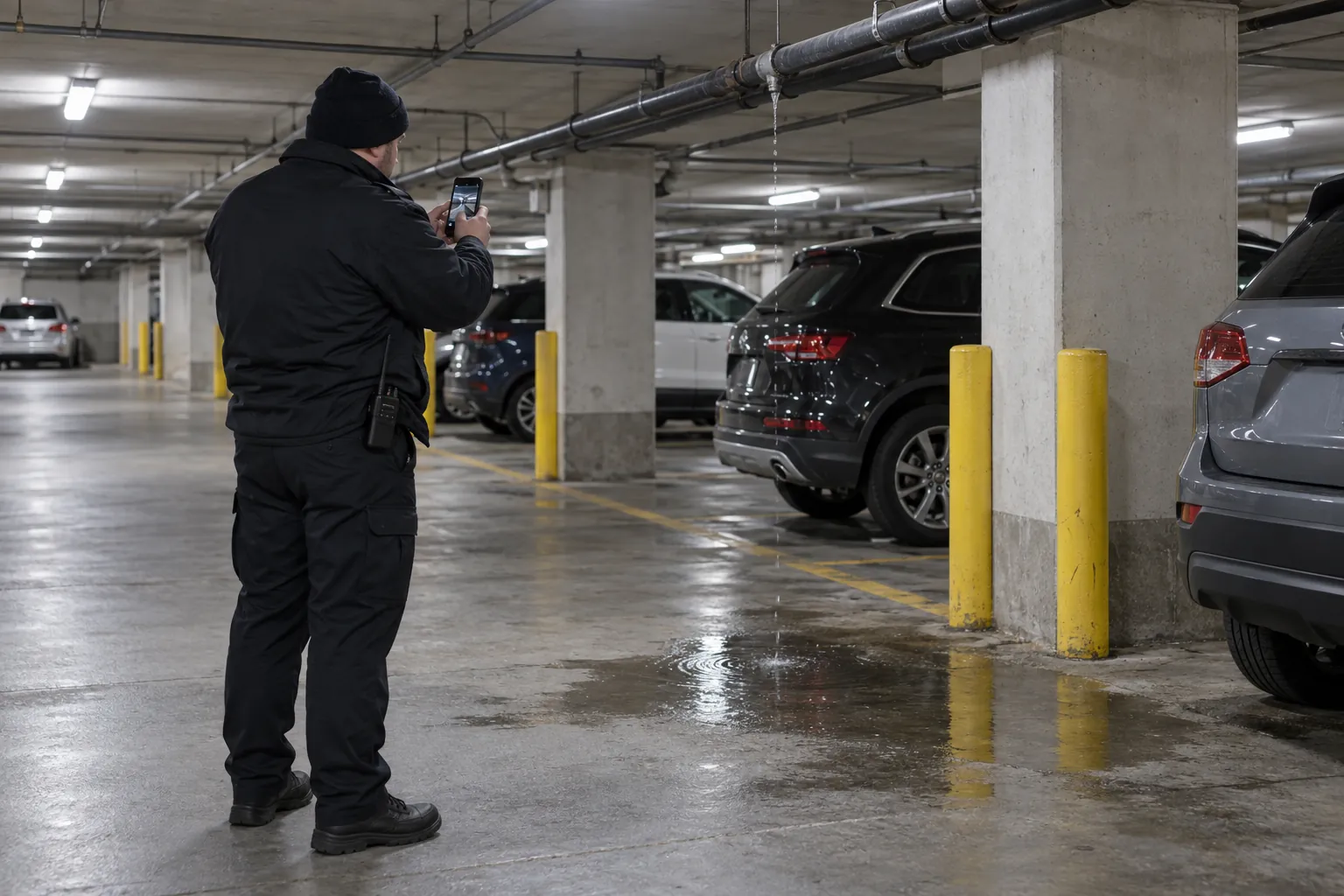
- Reporting hazards and deficiencies: broken locks, burnt-out lighting, leaks, icy walkways, blocked exits and anything unsafe, to whoever fixes them.
- Customer service: as the first point of contact for many visitors and tenants, staying calm and courteous under pressure.
- Shift change: briefing the incoming guard on open incidents, keys out, contractors on site and anything that needs watching.
Ontario's training syllabus for security guards mirrors that list. Its twelve sections include basic security procedures (observation, access control, crowd and vehicle control, shift handover), report writing, health and safety, emergency response preparation, legal authorities, effective communications, sensitivity training, use of force theory and emergency first aid. Its report writing section teaches guards to "record relevant factual data and circumstances in a notebook" and to write reports that answer who, what, where, when, why and how.
Every item comes back to one aim: a safe site, and a record that shows what was done to keep it that way.
03
How the responsibilities change from site to site
Guards have different responsibilities in different settings, and the site's post orders are where those differences are written down. Some common settings in Canada:
- Office towers and multi-tenant buildings: a concierge or lobby post as much as a guarding one – visitors, access cards, deliveries, elevators and the parkade – with lock-up patrols in the evening, and supporting the fire safety plan's supervisory staff during alarms and drills.
- Condominiums and residential buildings: a front desk or concierge post for residents and their guests, packages, move-ins, amenity room bookings and after-hours patrols of garages, garbage rooms and common elements, working alongside the property manager and the building superintendent.
- Retail and shopping centres: loss prevention, a visible presence in the mall, supporting store staff with difficult customers and securing the centre at close. In Ontario, work to prevent the loss of property through theft or sabotage is one of the exceptions to the rule that a guard wears a uniform.
- Construction sites and vacant buildings: perimeter patrols, gate control, checking equipment and materials, and deterring trespass and theft, often through the night and in winter weather.
- Hospitals, universities, colleges and public buildings: open sites with many entrances, where the job leans towards de-escalation, welfare and helping people rather than keeping them out.
- Licensed venues and events: crowd management, age checks, bag checks as a condition of entry, and working alongside event staff; the federal NOC profile notes that responsible beverage service certification is mandatory for security staff in establishments serving alcohol in Alberta, Saskatchewan, Manitoba, Ontario and Prince Edward Island.
Extra duties may include fire watch while a fire alarm or sprinkler system is out of service, snow and ice checks on entrances, key holding and alarm response, or mobile patrol of several sites. Whatever they are, they belong in writing.
04
What a security guard cannot do
Part of understanding the role is knowing its limits. A provincial licence is permission to work as a guard; it does not give the holder police powers.
- Arrest powers are a citizen's. Section 494 of the Criminal Code lets anyone arrest without warrant a person they find committing an indictable offence, and lets the owner or person in lawful possession of property, or a person they authorize, arrest someone they find committing a criminal offence on or in relation to that property, either at the time or, where they believe on reasonable grounds that it is not feasible for a peace officer to make the arrest, within a reasonable time after the offence. Anyone other than a peace officer who arrests a person "shall forthwith deliver the person to a peace officer". Section 494(4) makes such a person "authorized by law" for the purposes of section 25, the Code's protection for people who use only as much force as is necessary when acting under legal authority.
- Trespass is provincial. In Ontario, the Trespass to Property Act lets the occupier or "a person authorized by the occupier" direct someone to leave and, where there are reasonable and probable grounds, arrest a person on the premises in contravention of the Act, who must then be handed to a police officer promptly. A guard acts as the occupier's agent and should know what authority the client has actually given.
- No searches without consent. A bag check at an event or a building entrance is usually a condition of entry that a person can refuse, and refusing entry is the remedy.
- No holding out as police. Section 39 of Ontario's PSISA forbids a licensee to falsely hold themselves out as providing services or performing duties connected with police, and section 40 bars a security guard from using the terms detective, private detective, law enforcement, police or officer. It follows from section 40 that Ontario guards are "security guards" and not "security officers". British Columbia's Security Services Act bans "detective", "law enforcement", "peace officer" and "police", and bars licensees from carrying a firearm except as permitted for armoured car work.
- Uniforms follow the rules. Ontario's O. Reg. 362/07, Uniforms requires the employer's name or crest and the word SECURITY on the chest, an identification tag with the guard's name or licence number, no rank chevrons, no black or navy blue collared shirt and no police-style forage cap.
- Conduct and privacy. Ontario's O. Reg. 363/07, Code of Conduct requires every licensed guard to act with honesty and integrity, treat all persons equally, refrain from unnecessary force and from uncivil language, and treat information received at work as confidential except where disclosure is required. Visitor logs, CCTV and incident reports also fall under the privacy law that applies to the organization.
A guard who is unsure should ask the supervisor before acting, not after. When an incident goes beyond the role, the guard's duty is to observe, record in the notebook and call police.
05
How duties are set and checked
A guard's duties on any site should come from three documents: the contract, which sets the service and the hours; the security risk assessment, which says what the guarding is for; and the post orders, which tell the guard exactly what to do at that post, when and how, from patrol routes and access rules to alarm response and who to call.
The security supervisor, or the provider's site or account manager, then checks the work and its compliance with the post orders. The usual methods are:
- Site visits, announced and unannounced, including overnight, to check the guard is alert, in a compliant uniform, carrying the licence and following the post orders.
- Notebook and report reviews: reading the notebook, the daily activity reports and incident reports for completeness, and for patterns that suggest the site's risks have changed.
- Patrol evidence: a guard tour system record showing each checkpoint was visited, when and by whom.
- Client feedback and KPIs: complaints, alarm response times, incidents dealt with, and patrols completed against those scheduled.
- Licence and training records: licence expiry dates, site orientation, first aid and CPR, and any site-specific training such as fire safety plan duties.
- Lone worker check-ins, where a guard works alone. The Canadian Centre for Occupational Health and Safety's guidance on working alone advises employers to "establish a check-in procedure" and keep regular contact, and some provinces have specific working alone rules.
Judgment, communication and calm make guarding effective, and the best way to show them is an honest record of each shift, written at the time rather than at the end of it.
06
Where the evidence of duties fails, and where SiteClara fits
Most of what a good guard does leaves no trace. A patrol that finds nothing is written up as "all secure", and a client who never sees a problem may start to wonder what the guarding is for. The notebook filled in at 6 a.m. for the whole night, the burnt-out parkade light noted in the daily activity report but never passed on, and the check nobody can show was done are where confidence in a security contract wears away.
SiteClara gives the routine duties a record. A printed QR poster, with an optional NFC tag behind it, sits at each checkpoint on the patrol: a gate, an emergency exit, a loading dock, a parkade level, a mechanical room door. The guard scans the code or taps the tag on their own phone, with no app to install, and marks the scheduled check done, or says what stopped them, such as a locked room. The time and the named guard are recorded as it happens, with a photo when the check asks for one. A hazard or incident found on the round is reported there and goes onto the team's list of jobs until someone closes it.
The security supervisor sees what is due, done and missed, and records the reason a check was missed. A job that needs the building's property manager can be escalated to them to answer. At the end of the day the supervisor reviews the totals and photos, adds a note and approves the daily report, which goes to nominated management or client contacts at 8 a.m. the next morning, showing what was reported, what is still open and how the scheduled checks went.
07
Questions people ask
What are the main duties of a security guard?
Protecting property and people, controlling access and responding to incidents. The federal NOC 64410 profile for security guards and related security service occupations lists the main duties as controlling access to establishments, operating security control-room equipment and patrolling assigned areas "to guard against theft, vandalism and fire", enforcing regulations to maintain order and resolve conflicts, making sure safety and emergency procedures are followed, and issuing passes, directing visitors and checking age identification.
What is a security guard not allowed to do?
A guard has no police powers. Their arrest powers are the ones section 494 of the Criminal Code gives anyone, or the owner of property and a person they authorize, and a guard who arrests someone "shall forthwith deliver the person to a peace officer". Provincial law adds its own limits: in Ontario, for example, a guard may not falsely hold themselves out as police or use the word officer in their title. A guard also has no general power to search: a bag check is a condition of entry that a person can refuse.
What are the 5 qualities of a security guard?
No official list of five exists, but provincial training shows what is expected. Ontario's training syllabus for security guards covers observation and basic security procedures, report writing, health and safety, emergency response, legal authorities, effective communications, sensitivity training, use of force theory and emergency first aid, so the skills a professional guard needs are sharp observation, clear writing, calm communication, sound judgment within the law and the ability to act in an emergency.
08
Further reading, and a list to take away
Start with the province or territory where the site is: in Ontario, the PSISA and its regulations on e-Laws and the government's licensing and training pages; in British Columbia, the Security Services Act; in Quebec, the Bureau de la sécurité privée, in French. Nationally, the NOC 64410 profile, CAN/CGSB-133.1-2017, section 494 of the Criminal Code and CCOHS on working alone.
Before a guard starts on a new site, check that:
- they hold a valid licence for the province the site is in, and it is in date;
- their uniform meets the province's rules;
- they have read the site's post orders and know where to find them on shift;
- they know the patrol routes, the checkpoints and the times;
- they know the fire safety plan, the emergency procedures and who to call for each kind of incident;
- they know how to keep the notebook, record patrols, hazards and incidents, and who reads the records;
- they understand what they may and may not do, including arrest, trespass and bag checks;
- if they work alone, the check-in procedure is set and tested;
- their supervisor has a plan for site visits and record reviews.
Sources
Every document this guide quotes or links to, in the order it first cites them.
- National Occupational Classification profile for security guards and related security service occupations (NOC 64410) noc.esdc.gc.ca
- Private Security and Investigative Services Act, 2005 ontario.ca
- Security guard and private investigator licences for individuals ontario.ca
- Security guard basic training ontario.ca
- Security Services Act bclaws.gov.bc.ca
- Permis d'agent régulier bspquebec.ca
- CAN/CGSB-133.1-2017, Security officers and security officer supervisors publications.gc.ca
- Training syllabus for security guards ontario.ca
- Report writing section ontario.ca
- Criminal Code laws-lois.justice.gc.ca
- Trespass to Property Act ontario.ca
- O. Reg. 362/07, Uniforms ontario.ca
- O. Reg. 363/07, Code of Conduct ontario.ca
- Working alone ccohs.ca
Related guides
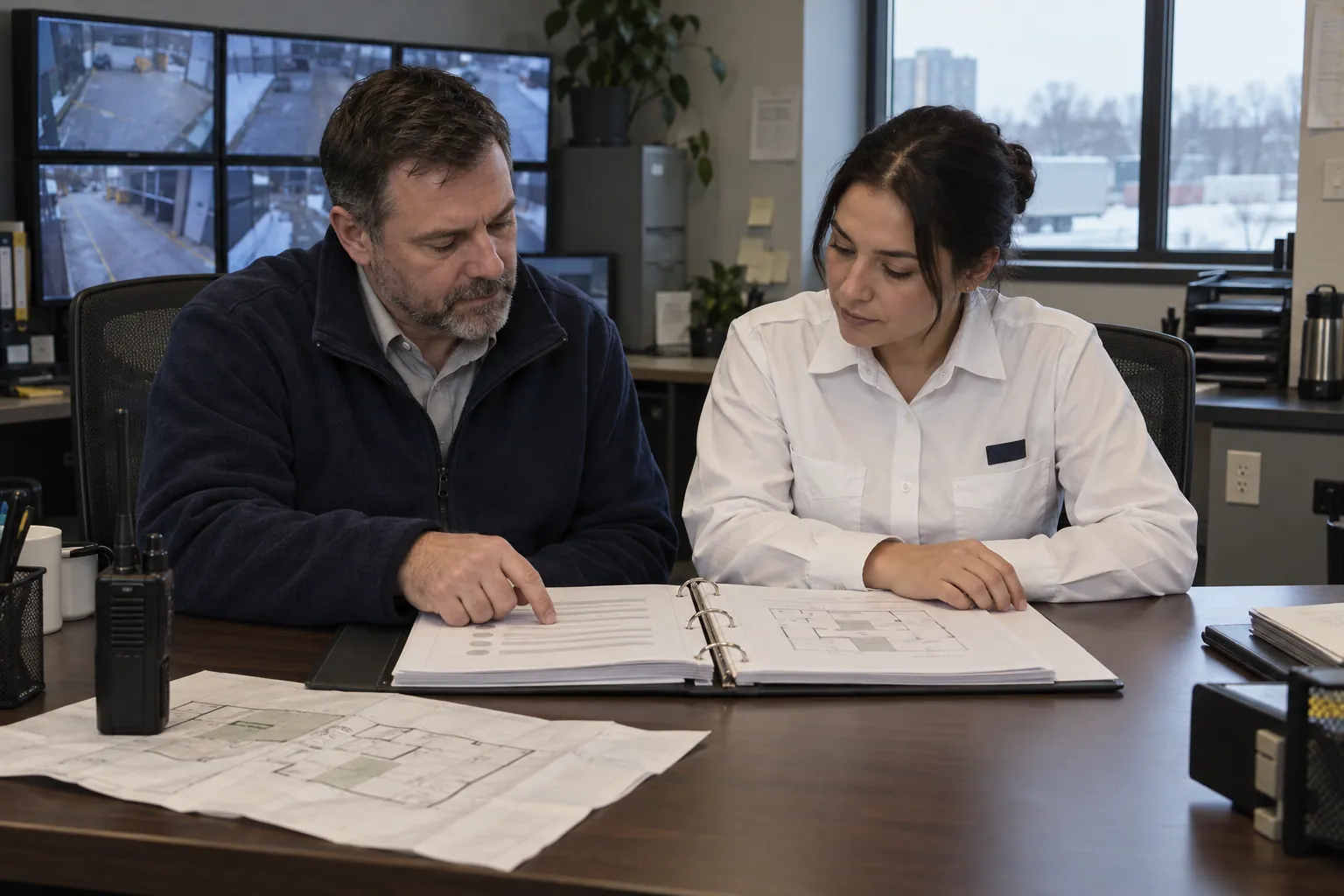 Security patrolsSecurity post orders: what they should say, and how to keep them workingSecurity post orders in Canada: what they are, what to put in them, how Ontario's PSISA and fire and safety law shape them, and how to check guards follow them.
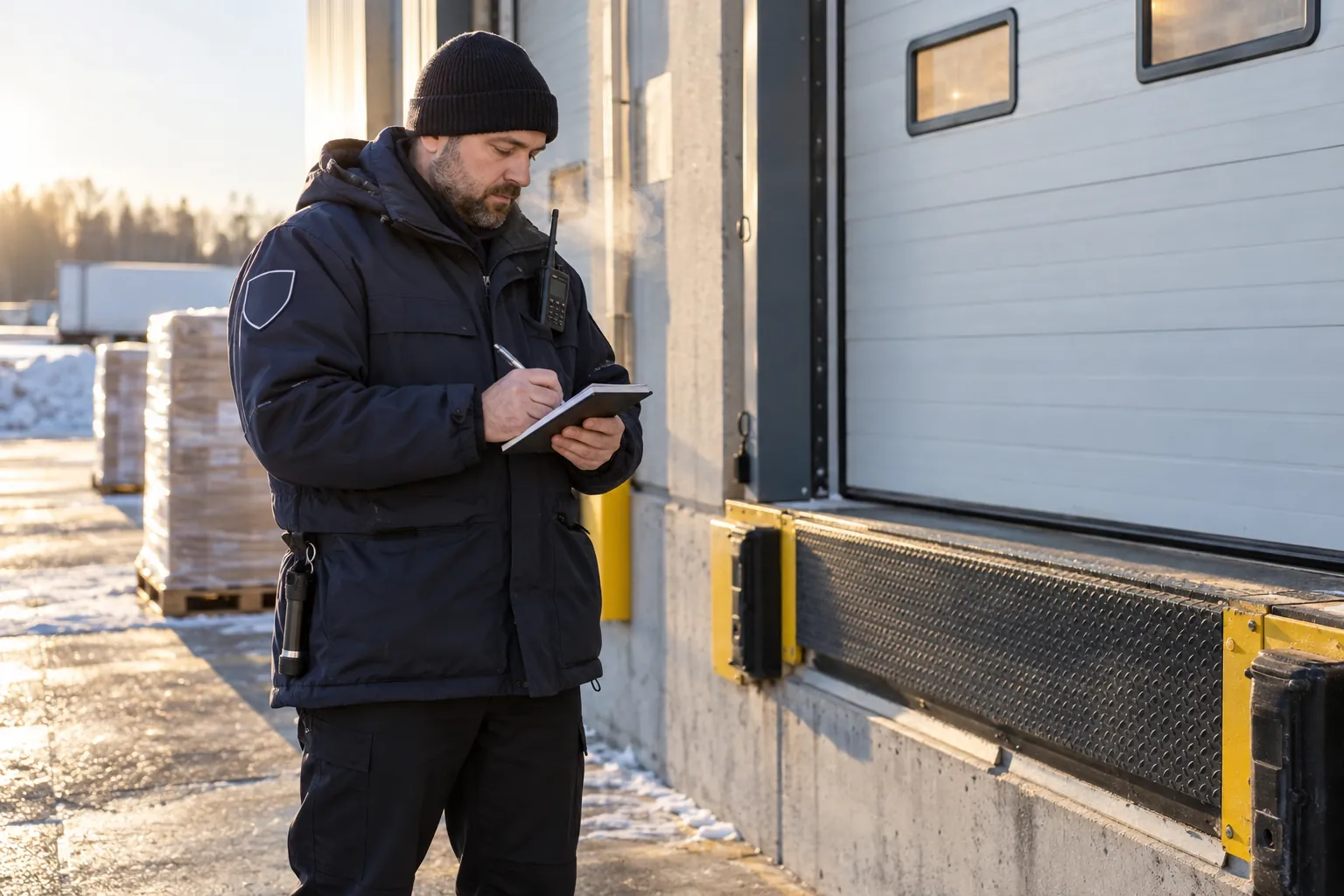 Security patrolsSecurity guard notes: how to keep a notebook that stands upSecurity guard notes in Canada: what goes in the notebook, the rules for writing it, what provincial security law and the Canada Evidence Act mean for it.
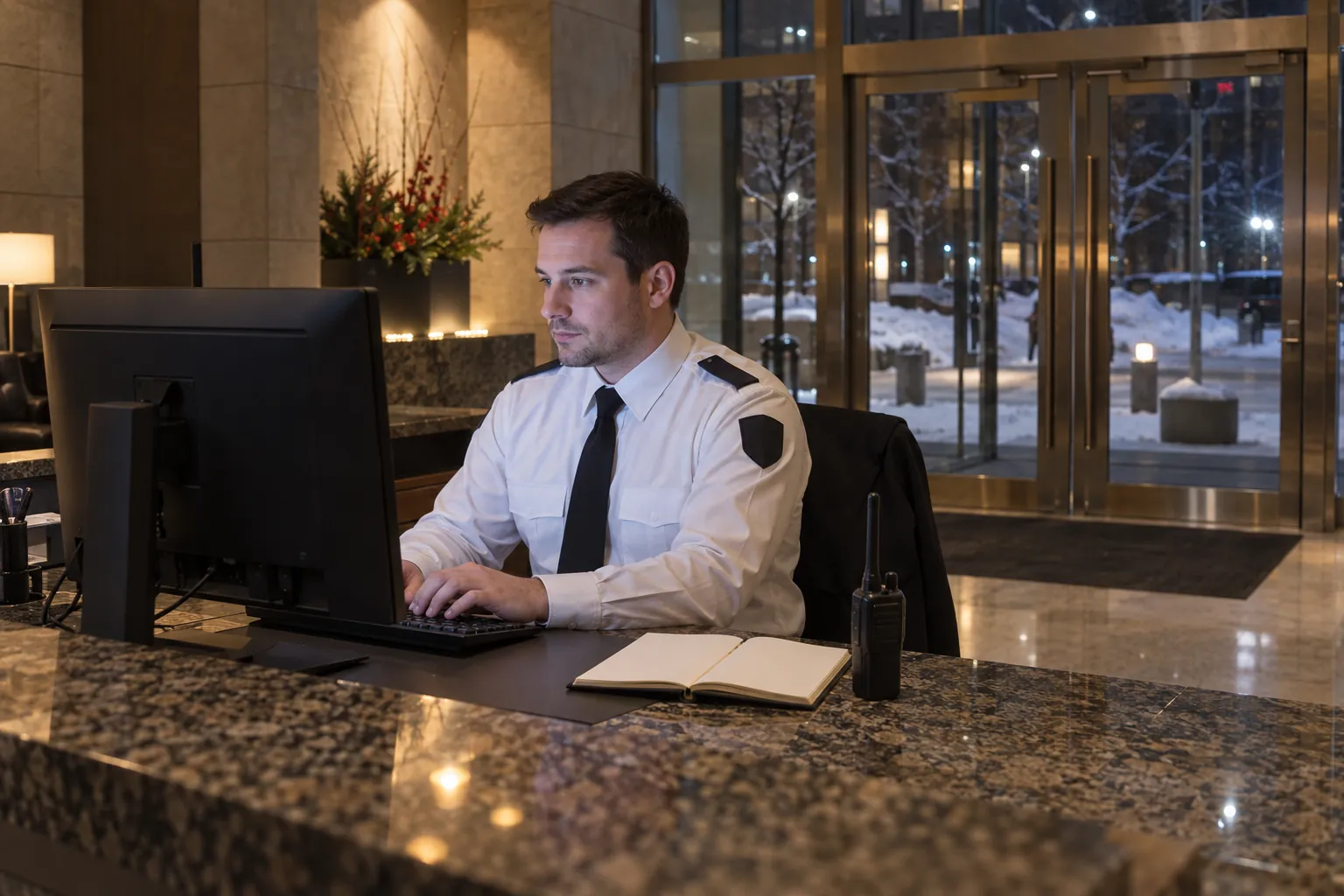 Security patrolsSecurity report writing: what a guard's report needs, and how to make it stand upSecurity report writing for Canadian guards: the reports a shift produces, what an incident report must contain, and what Ontario, BC and Alberta law expects.
 Security patrolsGuard tour systems in Canada: how they work, what they prove, and how to choose oneHow guard tour systems record security patrols in Canada – wands, RFID, NFC, QR codes, GPS apps – what the data shows, and what to check before choosing one.