Security patrols
Security post orders: what they should say, and how to keep them working
Post orders are the written, site-specific instructions a security guard follows at one post: the daily duties, patrols, rules, emergency procedures and who to call.
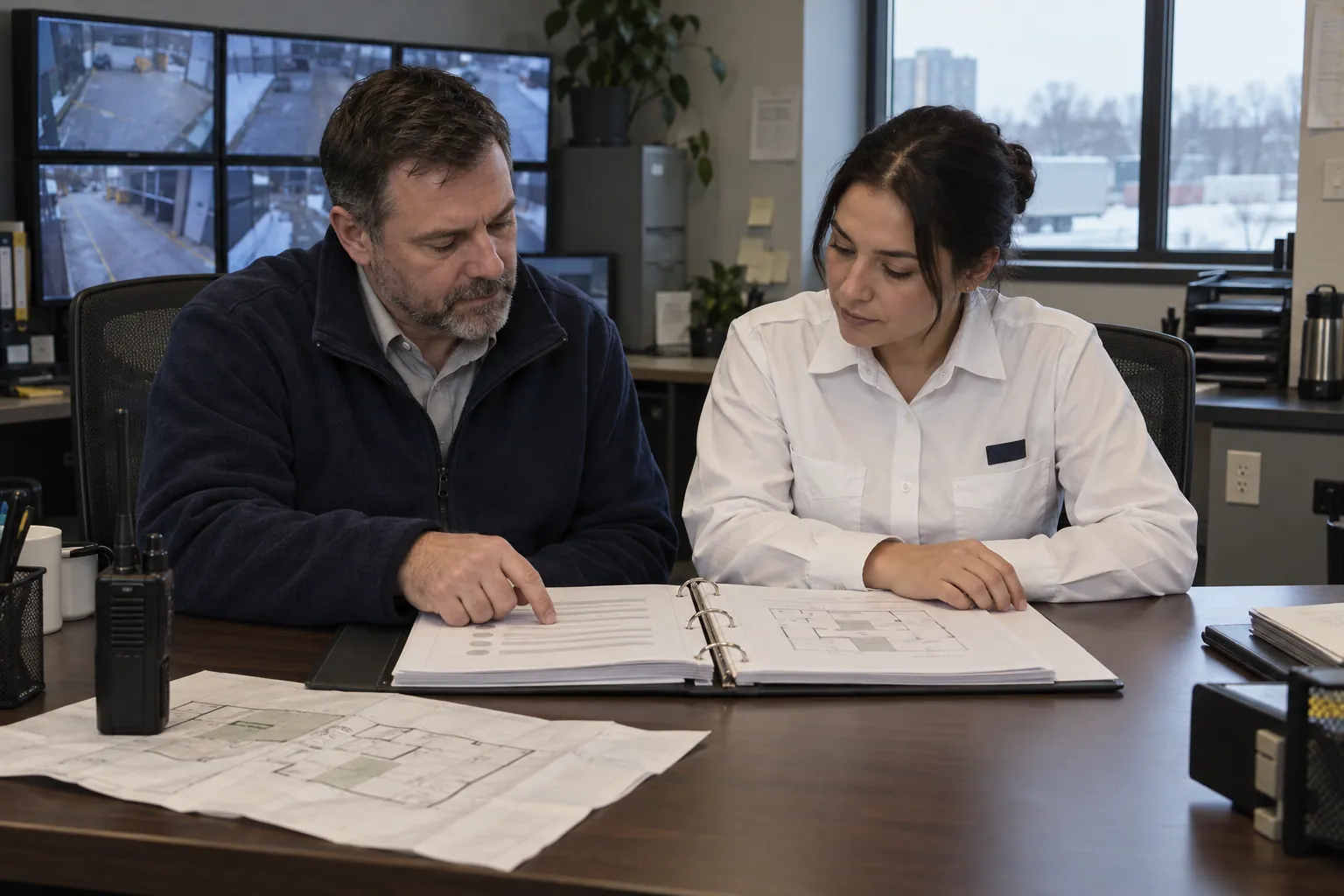
Good post orders mean a licensed guard who has never worked the site can take over the post and do the job properly. This guide covers what post orders are in Canada, what they should contain, the provincial law that shapes them, how they are agreed and reviewed, and how a supervisor or client can tell they are being followed.
01
What post orders are, and where they come from
In Canadian security, post orders (sometimes site orders, standing orders or site instructions) are the written instructions for a particular post: a lobby desk, a loading dock gate, a parkade booth, a mobile patrol route, a hospital emergency department. They turn the security contract and the site's risk assessment into the working detail a guard needs on shift. A site with several posts usually has general orders that apply to everyone and a separate set of orders for each post.
No Canadian statute uses the words "post orders", and no law sets out their contents. They exist because of what the law does require of the people and companies involved. In Ontario, the Private Security and Investigative Services Act, 2005 (PSISA) defines a security guard, in section 2, as a person who performs work, for remuneration, "that consists primarily of guarding or patrolling for the purpose of protecting persons or property", and section 6 prohibits anyone from acting as a guard without a licence. An organization that employs its own guards rather than selling guard services to the public must register as an employer under section 5. The Act licenses the person and the business; the post orders are how the business tells a licensed guard what that site needs.
Beside the licensing law sits ordinary workplace law. Ontario's Occupational Health and Safety Act requires an employer, in clause 25 (2) (a), to "provide information, instruction and supervision to a worker to protect the health or safety of the worker". For a guard alone on a site at 3 a.m., the post orders are a large part of that information and instruction. Every other province has an equivalent general duty in its own occupational health and safety law, and federally regulated workplaces such as airports and banks fall under the Canada Labour Code instead.
There is also a voluntary national standard. CAN/CGSB-133.1-2017, Security officers and security officer supervisors, reaffirmed in 2022, "sets out minimum requirements to be used when selecting uniformed security officers and supervisors" and includes pre-assignment training programs for both. Government and institutional contracts can name it, and a contract that does usually expects site-specific instructions as well.
Put simply, post orders:
- define the post: where the guard's responsibility starts and ends, and the hours it is staffed;
- decide the response in advance, so an alarm, a medical call or a trespasser gets the agreed procedure rather than improvisation;
- keep the service consistent across shifts, relief guards and new hires;
- protect the guard, who can show they followed the instructions the client approved;
- give the client something to hold the contract to, because the work expected is written down.
02
What security post orders should include
Every site is different, but complete post orders usually cover:
- The site: the address, a short description, occupancy and hours, and floor plans marked with entrances, exits, stairwells, the fire alarm annunciator, sprinkler and gas shut-offs, the elevator machine room, first aid kits, AEDs and the assembly point.
- Contacts: the client's property manager or facility manager, the building operator or superintendent, the security company's dispatch and field supervisor, keyholders, contractors on call and the after-hours escalation list, in order.
- The post and its hours: each post, when it is staffed, break coverage, and exactly what the guard does there.
- Patrols: the routes, the checkpoints, the times or frequency, and what to check at each point, from exit doors and roof hatches to parkade levels and mechanical rooms.
- Access control: tenant and staff access cards, visitor and contractor sign-in, deliveries and couriers, move-ins in a condominium, vehicles and parkade access, and who may be let in after hours and how to verify them.
- Key and fob control: the keys and fobs held, the key log, and who may sign them out.
- Security systems: CCTV, intrusion alarm, access control and the fire alarm panel, with the action for each kind of signal.
- Emergency procedures: the guard's role under the building's fire safety plan, medical emergencies, bomb threats and suspicious packages, floods, power failures, elevator entrapments, severe weather and lockdown where the site has a plan.
- Workplace violence and harassment: how to summon help, how to report an incident, and the de-escalation expected, taken from the employer's program.
- Working alone: the check-in schedule and what happens when a check-in is missed.
- Reporting: the security guard's notebook, the daily activity report, incident and occurrence reports, what must be reported, to whom and how quickly.
- Conduct and uniform: carrying the licence, uniform standards, phone use, breaks and the code of conduct.
- Privacy: how visitor logs, CCTV and incident reports are handled and who may see them.
- Version and sign-off: the date, version number, client approval and a sheet for each guard to sign.
A post orders template is a useful start, but orders copied from another site are the commonest fault a supervisor or auditor finds. The layout, the risks, the people and the phone numbers must be this site's own.
03
The provincial law the post orders have to carry
Post orders are the place where several legal duties meet the guard at the post. The examples below are Ontario's, with one from British Columbia; check the equivalent rules in the province or territory where the site is.
The fire safety plan. Under the Ontario Fire Code, O. Reg. 213/07, Division B, Article 2.8.2.1, a building's fire safety plan must "provide for the appointment and organization of supervisory staff to carry out fire safety duties" and for their training, and must set out the emergency procedures, including sounding the alarm, notifying the fire department and evacuating occupants. In many office towers and condominiums the guard on the desk is part of that supervisory staff. The post orders should repeat the guard's own fire safety duties in the same words as the plan, and the plan must be reviewed at least every 12 months, so the orders should be checked against it whenever it changes.
Workplace violence. Section 32.0.2 of Ontario's Occupational Health and Safety Act requires the employer's workplace violence program to "include measures and procedures for summoning immediate assistance when workplace violence occurs or is likely to occur" and for workers to report incidents. Guards meet aggression more often than most workers, so this belongs in the post orders in practical terms: the panic button, the radio call, the phone number, and when to withdraw and call police.
Working alone. Several provinces have specific rules. In British Columbia, section 4.21 of the Occupational Health and Safety Regulation, Part 4 says the employer "must develop and implement a written procedure for checking the well-being of a worker assigned to work alone or in isolation", with a designated person making contact at predetermined intervals and recording the results, and a check at the end of the shift. Where no such rule applies, the Canadian Centre for Occupational Health and Safety's guidance on working alone still advises that "a check-in procedure be in place".
Conduct. Ontario's O. Reg. 363/07, Code of Conduct requires every licensed guard to "act with honesty and integrity", to "refrain from exercising unnecessary force" and to treat all information received while working as confidential, except where disclosure is required as part of the work or by law. Post orders should never instruct a guard to do something the code or the law forbids, such as searching someone without consent or other lawful authority.
Privacy and CCTV. For private-sector sites, the Office of the Privacy Commissioner of Canada's Guidelines for Overt Video Surveillance in the Private Sector say access to recordings "should be granted only to a limited number of authorized individuals" and that operators need "appropriate and ongoing training". If the guard monitors cameras, the post orders should say who may view footage and how a request for it is handled. Some provinces have their own private-sector privacy law, and public bodies have theirs.
04
Writing post orders guards actually use
The test is simple: could a trained, licensed guard who has never been to the site follow the post orders and do the job properly after reading them? A binder of generic policy on the lobby desk fails that test. Orders that are easy to follow reduce confusion at shift change, when a relief guard takes over and in an emergency.
- Be specific. "Patrol the building regularly" tells the guard nothing. "Patrol route B, checkpoints 1 to 9, at 22:00, 01:00 and 04:00, checking every ground-floor exit door is closed and latched and the P2 sump room is dry" does.
- Say what to do, in order. For each alarm, incident and emergency, list the steps and who to call, and when to call 911 first.
- Put the urgent pages first. A guard dealing with a fire alarm at 3 a.m. needs the procedure on one page, not in chapter nine.
- Use the floor plans. Mark routes, checkpoints, exits and shut-offs on them.
- Keep the contacts current. An out-of-date escalation list wastes the minutes that matter.
- Separate the permanent from the temporary. A contractor on site for a week, an exit door out of service or a fire watch while the sprinkler system is shut down goes in a dated temporary order, not an edit to the whole document.
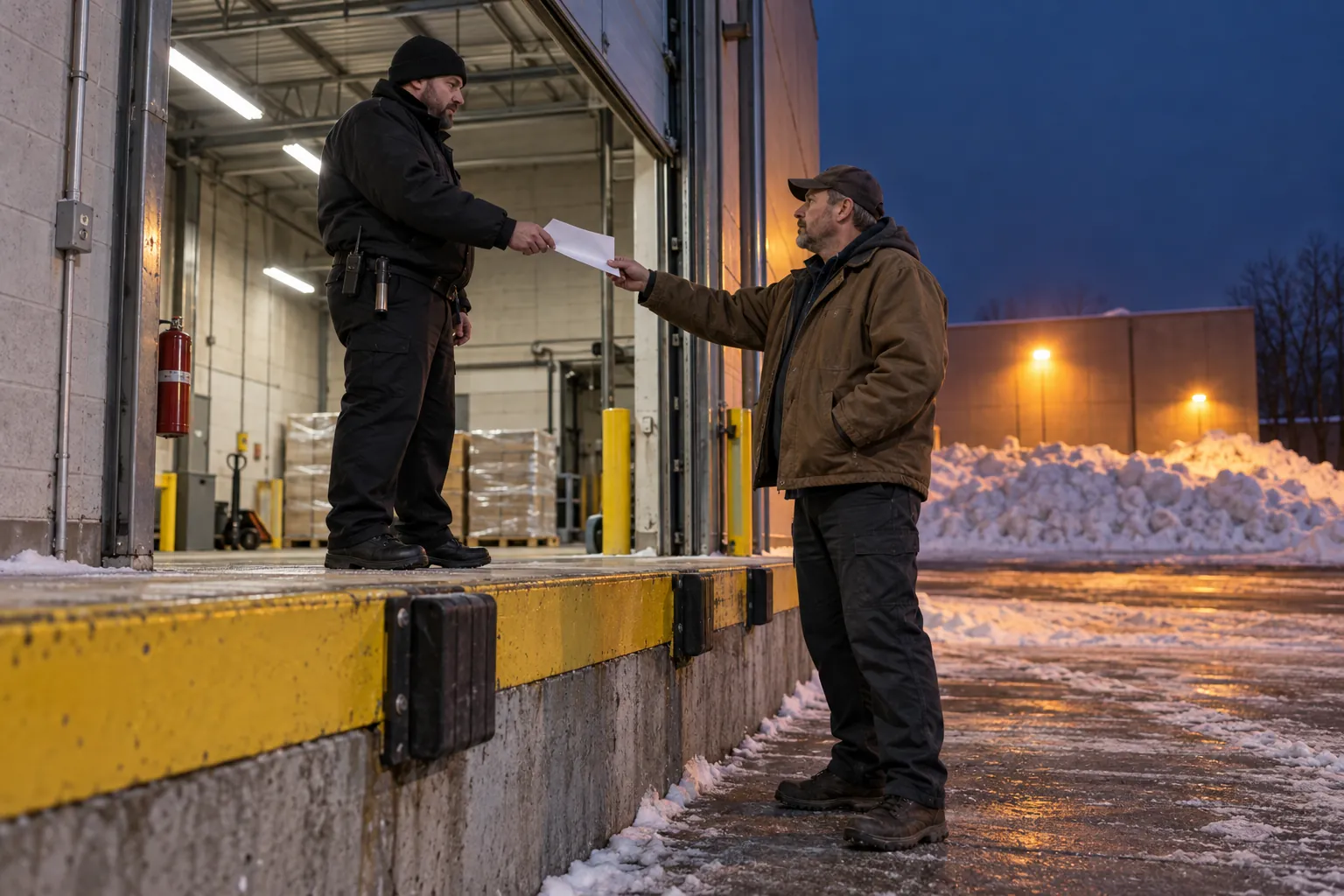
- Write for the whole team. Plain language, short sentences, and in a bilingual workplace, both official languages where guards need them.
05
Agreeing, signing and reviewing post orders
Post orders are the security company's document, written by its operations or account manager, but they describe the client's building and requirements, so the client's property manager or facility manager should approve them. The usual cycle is:
- Draft at start-up, after a site survey and the security risk assessment, and against the building's fire safety plan.
- Agree with the client, and record who approved which version and when.
- Orient every guard at the site before their first shift, including relief and mobile guards, walk the patrol route with them, and have them sign to confirm they have read and understood the orders.
- Keep a copy at the post where the guard can reach it at any time, on paper or on a device, with the current version clearly marked.
- Review and re-sign when something changes.
No law sets an expiry date for post orders. Review them whenever the site, its risks or the client's needs change: after an incident, a change of tenants or layout, a new access control or CCTV system, a revised fire safety plan, or a change of client contacts. Many providers also set a fixed review at least once a year. Each time the orders change, every guard on the site should sign for the new version, and the old one should be withdrawn from the post.
06
Where post orders fail in practice, and where SiteClara fits
The post orders say route B, nine checkpoints, three times a night. The notebook says "patrol completed, all secure". Nobody reading that line can tell which checkpoints were visited, when, or whether the far exit door on P3 was checked at all. The orders are clear; the evidence that they were followed is not. The same is true of the daily activity report written at 6 a.m. for the whole night, and of the burnt-out stairwell light noted in the notebook but never passed to the building operator.
SiteClara turns the patrol in the post orders into a record. A printed QR poster, with an optional NFC tag behind it, goes at each checkpoint the orders name: an exit door, a loading dock, a parkade level, a roof hatch, a mechanical room. The guard scans the code or taps the tag on their own phone, with no app to install, sees the checks due at that point and marks them done, or says what stopped them, such as a locked room. The time and the named guard are recorded as it happens, with a photo when the check asks for one. A hazard or fault found on the round is reported there and goes onto the team's list of jobs until someone closes it.
The security supervisor sees what was due, done and missed, and records the reason a check was missed. A job that needs the building's manager can be escalated to them to answer. At the end of the day the supervisor reviews it, adds a note and approves the daily report, which goes to nominated management or client contacts at 8 a.m. the next morning, showing how the scheduled checks went, what was reported and what is still open.
07
Questions people ask
What are post orders in security?
They are the written, site-specific instructions for a security post: the duties, patrol routes, access rules, emergency procedures and contacts for that site. No Canadian statute defines them. In Ontario, the Private Security and Investigative Services Act, 2005 licenses the guard, whose work "consists primarily of guarding or patrolling for the purpose of protecting persons or property", and the Occupational Health and Safety Act requires the employer, in clause 25 (2) (a), to "provide information, instruction and supervision to a worker to protect the health or safety of the worker". Post orders are how the security company gives that instruction for one site.
Is there an official post orders template or example?
No Canadian law or national standard prescribes one. The national standard CAN/CGSB-133.1-2017, Security officers and security officer supervisors sets minimum requirements for selecting uniformed security officers and supervisors, with pre-assignment training programs for both, not the contents of a site's orders. A company's own template or an example from another site is only a starting point; the list of what post orders should include, above, and the checklist at the end of this guide show what the finished orders for this site need to cover.
08
Further reading, and a list to take away
Start with the province or territory where the site is. In Ontario that means the PSISA and its regulations on e-Laws, the government's training syllabus for security guards (its basic security procedures section covers access control and updating the next person on shift), the Occupational Health and Safety Act and the Fire Code. In British Columbia, WorkSafeBC's regulation on working alone. Nationally, CAN/CGSB-133.1-2017, CCOHS on working alone, and the Privacy Commissioner's guidance on video surveillance. For the wider role, see security guard duties.
Before a guard's next shift on the site, check that the post orders:
- are written for this site and this post, not copied from another;
- set out the post's hours, patrol routes, checkpoints and times;
- give the steps and the people to call for each alarm, incident and emergency;
- match the building's current fire safety plan;
- include the workplace violence procedure and, where the guard works alone, the check-in schedule;
- have a current contact and escalation list;
- say who may see CCTV footage, visitor logs and reports;
- are approved by the client, with the version and date recorded;
- have been read and signed by every guard who works the post;
- are kept at the post where the guard can reach them;
- have a date for their next review.
Sources
Every document this guide quotes or links to, in the order it first cites them.
- Private Security and Investigative Services Act, 2005 ontario.ca
- Occupational Health and Safety Act ontario.ca
- CAN/CGSB-133.1-2017, Security officers and security officer supervisors publications.gc.ca
- O. Reg. 213/07 ontario.ca
- Occupational Health and Safety Regulation, Part 4 worksafebc.com
- Canadian Centre for Occupational Health and Safety's guidance on working alone ccohs.ca
- O. Reg. 363/07, Code of Conduct ontario.ca
- Guidelines for Overt Video Surveillance in the Private Sector priv.gc.ca
- Training syllabus for security guards ontario.ca
- Basic security procedures section ontario.ca
Related guides
 Security patrolsSecurity guard duties and responsibilities: what the role involves in Canada, and how it is checkedSecurity guard duties in Canada: provincial licences, patrols, access control, incidents and the notebook, the limits of the role, and how the work is checked.
 Security patrolsSecurity guard notes: how to keep a notebook that stands upSecurity guard notes in Canada: what goes in the notebook, the rules for writing it, what provincial security law and the Canada Evidence Act mean for it.
 Security patrolsGuard tour systems in Canada: how they work, what they prove, and how to choose oneHow guard tour systems record security patrols in Canada – wands, RFID, NFC, QR codes, GPS apps – what the data shows, and what to check before choosing one.
 Security patrolsSecurity report writing: what a guard's report needs, and how to make it stand upSecurity report writing for Canadian guards: the reports a shift produces, what an incident report must contain, and what Ontario, BC and Alberta law expects.